BMC Remedy CMDB: Features, Benefits, and Alternatives

BMC Remedy CMDB has been around for over two decades. However, BMC is now shifting toward its cloud-based Helix platform. As a result, you may start to question your current setup. Does the on-premise Remedy still fit your needs, or should you explore other options?
In this post, you will see what BMC Remedy CMDB does well and where it falls short. Next, you will learn how Virima CMDB fills those gaps with continuous automated discovery, broader ITSM integrations, and ViVID service maps that give you current, discovery-sourced operational visibility. The result is less manual CMDB upkeep and more accurate data when it counts.
Is BMC Remedy CMDB still the right choice for IT teams in 2026?
BMC Remedy CMDB has evolved into BMC Helix CMDB under a cloud migration. Teams switching most often cite complexity, high licensing costs, and limited discovery automation as the primary triggers. Virima CMDB is a SaaS alternative with automated discovery, ViVID service mapping, and seven ITSM integrations. Deployed without on-premise infrastructure.
From BMC Remedy CMDB to BMC Helix CMDB: A modern evolution
BMC Remedy CMDB has gone through a major shift, evolving into BMC Helix CMDB. The move reflects BMC’s broader transition from legacy on-premise ITSM to a cloud-native platform.

Key drivers of the transition
- Modernization: BMC rebuilt the interface to replace the dated Remedy experience with something more intuitive.
- Cloud-native architecture: Helix CMDB runs natively in the cloud, offering better scalability and easier access for distributed teams.
- AI and automation: BMC added machine learning for auto-classification, predictive insights, and faster incident routing.
What stays the same
The core Remedy CMDB functionality hasn’t changed. Helix CMDB still handles:
- Asset discovery: Automated identification of hardware, software, and network devices.
- Configuration management: Centralized tracking of configuration items (CIs), their attributes, and relationships.
- Change management: Tracking changes to IT infrastructure with impact context.
- Incident management: Providing asset and relationship data to speed up incident resolution.
Features of BMC Remedy CMDB
- Asset discovery: Remedy includes discovery capabilities that identify servers, applications, and network devices across your environment.
- Relationship mapping: See dependencies between CIs to support impact analysis and root cause troubleshooting.
- ITSM suite integration: Remedy CMDB ties into BMC’s broader ITSM suite, connecting incident, change, and problem management workflows.
- Customization: Offers data model flexibility to tailor CI types and attributes to your environment.
Use cases for BMC Remedy CMDB
- Incident management: Trace incidents to affected CIs and their upstream and downstream dependencies.
- Change management: Assess change risk by analyzing what depends on the CI being modified.
- Asset lifecycle management: Track IT assets from procurement through decommissioning.
- Service catalog management: Keep your service catalog aligned with actual infrastructure.
Limitations of BMC Remedy CMDB (based on user reviews)
- Complexity: Implementing and maintaining Remedy requires dedicated expertise. User reviews on G2 consistently cite steep learning curves and heavy customization overhead.
- Scalability concerns: On-premise deployment can strain as your environment grows, especially across hybrid and multi-cloud infrastructure.
- Cost: Licensing, maintenance, and the professional services needed for customization add up quickly, especially for mid-market organizations.
- Limited automation: While Remedy offers some automation, users report gaps in automated CMDB maintenance, reconciliation, and discovery refresh workflows.
When BMC Helix CMDB is still the right call: For organizations already running the full BMC Helix suite. ITSM, Discovery, and CMDB together. Staying within the ecosystem avoids integration overhead and leverages existing administrator expertise and support contracts. If your team is deeply invested in BMC tooling and your renewal economics work, a full platform switch carries transition risk that a same-vendor CMDB migration to Helix does not.
What to look for when evaluating a CMDB alternative
Before comparing specific tools, define what actually matters for your environment:
- Discovery depth and frequency: Does the tool discover across on-prem, cloud, and hybrid environments? Can it run continuously, or only on scheduled scans?
- Service mapping and impact visualization: Can you see application dependencies and trace the blast radius of a change or incident?
- ITSM integration: Does it connect to your existing ITSM platform without heavy customization?
- CMDB maintenance automation: How much manual effort is needed to keep CI data accurate over time?
- Compliance and certification: Does the vendor hold SOC 2 Type II or other trust credentials?
- Total cost of ownership: Factor in licensing, implementation, ongoing administration, and integration costs.
Virima CMDB: A practical alternative to BMC Remedy
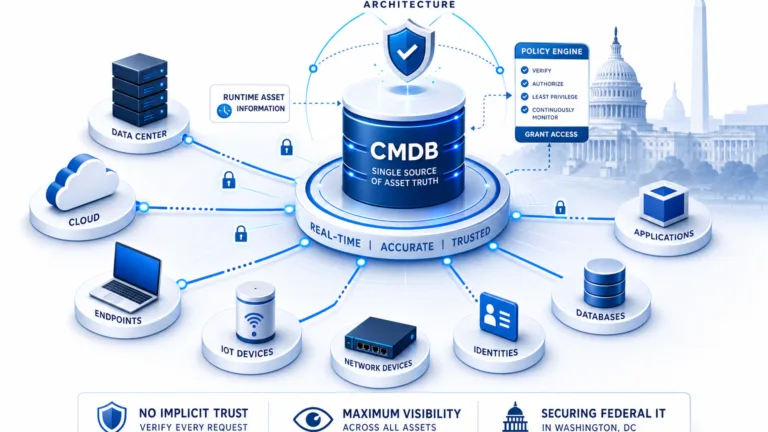
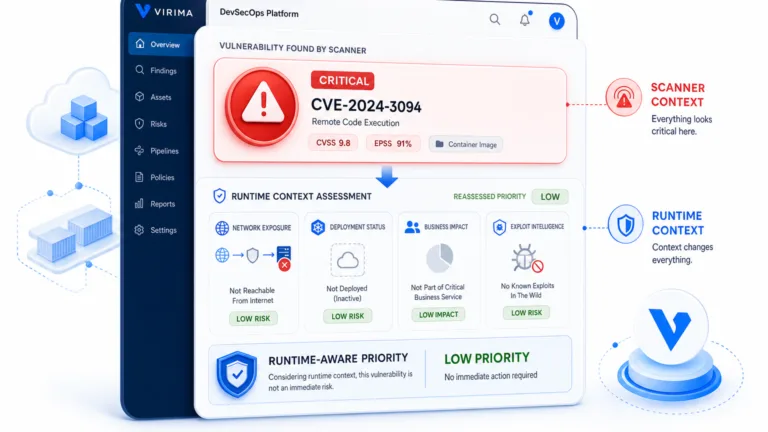
If BMC Remedy’s complexity and cost are giving your team pause, Virima takes a different approach. Virima delivers Trusted Runtime Truth for Agentic IT. Live, explainable, policy-aware operational context across assets, services, dependencies, ownership, change history, vulnerabilities, and blast radius. It is SaaS-delivered, built to keep your CMDB accurate through automated discovery and business rules, and designed for teams that need current, governed data without a dedicated CMDB engineering staff.
Here is what that looks like in practice.
Discovery that covers your full environment
Virima’s IT discovery uses agentless IP-based scanning to identify physical and virtual assets across data centers, edge, and cloud environments. For Windows, macOS, and Linux endpoints that roam off-network, the optional Discovery Agent provides persistent configuration monitoring and software usage metering.
Cloud infrastructure is covered through API integrations with AWS and Azure, pulling cloud assets directly into the CMDB without separate tooling.
Does BMC Remedy CMDB include discovery, or is it a separate license?
BMC Helix CMDB (formerly Remedy) requires a separate BMC Helix Discovery license to populate the CMDB with asset data. Virima includes agentless and agent-based discovery in the platform. Covering on-premises, cloud (AWS and Azure), and hybrid environments. With no additional discovery license required.
ViVID: Service maps that show what’s happening right now
Virima Visual Impact Display (ViVID) does more than draw static dependency maps. It overlays open incidents, pending changes, event alerts, and known vulnerabilities directly on your service maps. When a network switch fails at 2 AM, your on-call team sees which services sit downstream and what incidents are already open, all without digging through multiple tools.
Want to see what live service visibility looks like across your environment? Explore Virima’s Trusted Runtime Truth platform and see how it changes incident and change workflows.
That is a real difference from BMC Remedy’s basic relationship mapping. ViVID turns your service maps into an operational heads-up display for change management, incident response, and vulnerability prioritization.
Automated CMDB maintenance
Virima’s continuous discovery keeps CI data current automatically. Business rules control which discovered assets and configuration changes flow into the CMDB, so your team isn’t manually reviewing every update. When a CI changes and your CMDB doesn’t reflect it, the next change request is flying blind. Virima’s approach closes that gap.
Seven ITSM integrations, not just one
Virima integrates with ServiceNow, Jira Service Management, Ivanti, HaloITSM, Xurrent, and Hornbill. The ServiceNow integration is codeless, with 100+ blueprints for mapping Virima data to ServiceNow CMDB tables and bi-directional sync to keep both systems current.
What ITSM platforms does Virima CMDB integrate with?
Virima integrates with seven ITSM platforms: ServiceNow, Jira Service Management, Ivanti, HaloITSM, Xurrent, and Hornbill. The ServiceNow integration is codeless, with over 100 pre-built blueprints for bi-directional sync between Virima and ServiceNow CMDB tables. No custom development required.
If you’re a ServiceNow ITSM customer evaluating alternatives to ServiceNow Discovery, Virima guarantees at least 50% savings over ServiceNow Discovery pricing. You keep your ITSM investment while getting discovery, service mapping, and ViVID included.
CMDB governance rules that keep your data clean
Discovered data is only as useful as what you allow into your CMDB. Virima’s business rules engine lets you define exactly which discovered assets and configuration changes flow into the CMDB. Filtering noise, enforcing naming conventions, and flagging anomalies before they create drift. The result is a CMDB that stays accurate without a dedicated team manually reviewing every update.
Built-in compliance and vulnerability context
Virima is SOC 2 Type II certified and holds PinkVERIFYITIL 4 certification across six processes: SACM, change, incident, problem, request, and knowledge management. NIST National Vulnerability Database (NVD) integration is included at no extra cost, cross-referencing your discovered assets against known vulnerabilities without requiring a separate security tool subscription.
How to migrate from BMC Remedy to Virima
Switching CMDBs doesn’t have to be a rip-and-replace project. A phased approach reduces risk:
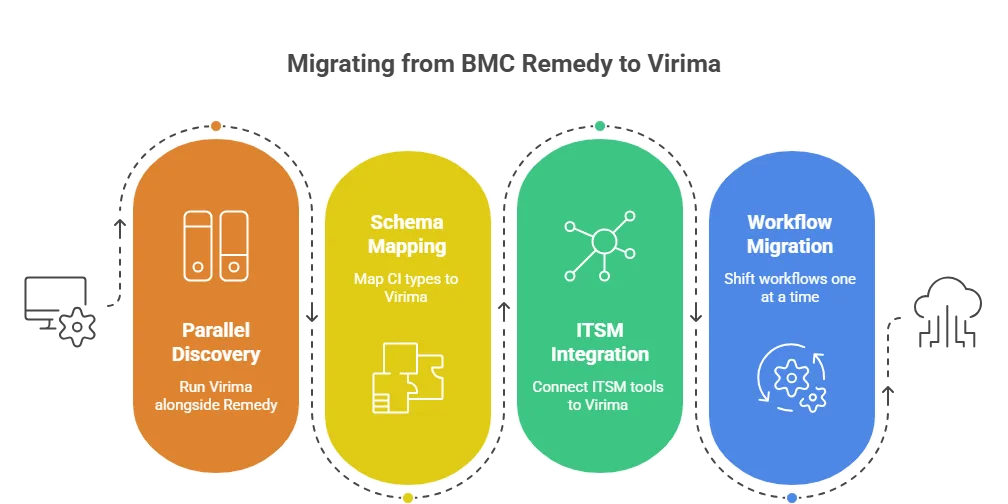
- Run Virima discovery in parallel alongside your existing Remedy CMDB. Compare what Virima finds against what Remedy holds to identify data gaps.
- Map your CI types and relationships to Virima’s CMDB schema. Virima includes 120+ pre-defined asset blueprints with no limit on creating custom blueprints, so most CI types map without starting from scratch.
- Get your ITSM integration working first. If you’re on ServiceNow, Jira, or Ivanti, connect that before decommissioning Remedy.
- Shift CMDB-dependent workflows one at a time: change management, incident triage, reporting. Validate accuracy at each stage.
Virima is SaaS-delivered and designed for rapid deployment, with no on-premises infrastructure to stand up. That is a sharp contrast to the typical Remedy implementation timeline, which often involves months of professional services.
BMC Remedy vs. Virima CMDB: Where Virima stands apart
| Capability | BMC Remedy / Helix CMDB | Virima CMDB |
|---|---|---|
| Deployment model | On-premise (Helix for cloud) | Cloud-native SaaS (AWS-hosted) |
| Discovery | Requires separate BMC Helix Discovery license | Agentless + agent-based, included in platform |
| Service mapping | Basic CI relationship visualization | ViVID with incident, change, alert, and vulnerability overlays |
| ITSM integrations | BMC ITSM suite (primary); limited native integrations outside BMC ecosystem | 7 platforms: ServiceNow, Jira Service Management, Ivanti, HaloITSM, Xurrent, Hornbill |
| CMDB maintenance | Manual processes common; reconciliation requires dedicated effort | Automated via scheduled discovery and configurable business rules |
| Vulnerability context | Separate tooling required | NIST NVD integration included at no extra cost |
| Compliance certifications | Varies by deployment; no PinkVERIFY | SOC 2 Type II; PinkVERIFY ITIL 4 (6 processes) |
| Implementation timeline | Typically 6+ months with professional services | Rapid SaaS deployment; no on-premise infrastructure required |
| Pricing model | Enterprise licensing + professional services; quote-based | SaaS subscription; transparent TCO |
Ready to benchmark Virima against your current BMC Remedy environment? Schedule a demo, and we’ll walk through your specific use case.
Your CMDB shouldn’t need a dedicated team just to stay accurate
BMC Remedy CMDB served many IT teams well for years. However, things have changed. Today, you deal with hybrid and cloud environments every day. Because of this, high maintenance, complex licensing, and on-premise limits can slow you down.
So, when you evaluate alternatives, you should look beyond features. Instead, focus on what helps you work faster and smarter. You need a CMDB that keeps your CI data accurate with less manual effort. It should also connect to your existing ITSM tools and give your team current, actionable visibility when it matters most.
Ready to see the difference? Schedule a demo with Virima to compare it against your current BMC Remedy environment.
FAQ on BMC Remedy CMDB
What are the most common reasons IT teams switch away from BMC Remedy CMDB?
User reviews on G2 and Gartner Peer Insights consistently cite three triggers: implementation complexity (steep learning curves, heavy reliance on professional services), high total cost of ownership (licensing plus customization overhead), and limited automated CMDB maintenance. As environments shift to hybrid and multi-cloud, the on-premise architecture of Remedy becomes a constraint rather than a foundation.
How do I keep a CMDB accurate without a dedicated team?
Automated discovery combined with business rules is the most reliable method. When discovery runs on a defined schedule and business rules control which changes propagate to the CMDB, CI data stays current without manual review cycles. The alternative. Relying on change tickets and manual updates. Consistently results in CMDB drift, which undermines every downstream process that depends on it.
What should I evaluate before switching from BMC Remedy to another CMDB?
Prioritize five areas: discovery coverage across your current environment (on-prem, cloud, hybrid), how much manual effort is required to keep CI data accurate after initial population, ITSM integration depth with your existing toolset, service mapping and impact visualization for change and incident workflows, and total cost of ownership including implementation, licensing, and ongoing administration.
How much does BMC Remedy CMDB cost?
BMC does not publish standard pricing for Remedy or Helix CMDB. Costs depend on deployment model, user count, and which modules you license. Industry reports and user reviews suggest enterprise licensing starts in the mid-five-figure range annually, with implementation and customization often adding two to three times that amount on top. For mid-market IT teams, this makes Remedy difficult to justify against alternatives with simpler SaaS pricing.