10 Best IT Asset Management (ITAM) Tools for 2026

IT asset management tools track every device,software license,and cloud subscription your organization owns. Often called IT asset management software (ITAM software),these tools follow each asset from purchase to retirement. As a result,your IT,finance,and security teams share one accurate record they can act on.
In 2026,the best IT asset management tools go further. They connect asset data to business services,show what breaks when something changes,and give AI agents and automation the accurate,current data they need to act with confidence.
The shortlist is long. The buying job is not. IT directors compare IT asset management tools on discovery depth, lifecycle records, CMDB relationships, and how cleanly inventory feeds the ITSM desk they already run. The ten platforms below still win for different jobs. The practices that follow also mark when unified discovery, CMDB, and service maps have to sit under that shortlist.
| When ITAM covers lifecycle and tickets but hybrid discovery, CMDB freshness, and service maps still lag, start with discovery-backed accuracy under the desk you keep. Explore Trusted Runtime Truth. |
Three paths for ITAM programs. Stay on your current ITAM when lifecycle tracking, desk-native assets, or agentless discovery already match the job. Pair current ITAM with discovery-sourced CMDB when assignment workflows are right but hybrid coverage, relationship maps, and multi-desk sync are not. Choose a unified discovery, CMDB, and ITAM platform when bi-directional ITSM sync, high-frequency discovery, and service context are the buying job. Virima does not replace ServiceNow, Lansweeper, Ivanti, or ITSM. Confirm desk coverage on the integrations hub.
Federal asset-visibility guidance, including CISA Binding Operational Directive 23-01, treats complete asset visibility as a prerequisite for vulnerability and operations programs. That is the same bar teams hit when ITAM stops at assignment records and leaves hybrid discovery unfinished.
Best IT Asset Management Tools in 2026: Ranked and Compared
The 10 best IT asset management tools for 2026 are:
- Virima ITAM,Best for unified ITAM,CMDB,and service mapping across hybrid IT environments
- ServiceNow ITAM ,Best for large enterprises with mature ITSM practices already on the ServiceNow platform
- Lansweeper ,Best for agentless network discovery across large,diverse IT estates
- ManageEngine AssetExplorer ,Best for budget-conscious mid-sized teams,especially within the ManageEngine ecosystem
- Asset Panda ,Best for mobile-first tracking of physical and IT assets in smaller organizations
- Ivanti Neurons for ITAM ,Best for endpoint-heavy,security-focused enterprises already using Ivanti ITSM
- Jira Service Management (Assets) ,Best for Atlassian-centric teams that need basic ITAM alongside ticketing
- SysAid ,Best for small and mid-sized teams that want a unified help desk and ITAM in one tool
- IT Glue ,Best for MSPs and IT service providers that need documentation-first asset management
- Reftab ,Best for small teams that need simple check-in/check-out tracking on a limited budget
Why Virima is on this shortlist for hybrid teams: It combines agent and agentless IT discovery,a discovery-sourced CMDB,ViVID™ service mapping,and bi-directional ITSM integrations in a single platform ,giving AI agents and IT teams the runtime truth they need,not just an asset list. See Virima ITAM →
Each of these IT asset management tools is reviewed below with current 2026 pricing,discovery capabilities,integration depth,and honest pros and cons.
IT asset managers,IT directors,and the compliance and security leaders they work with all face the same challenge. They need an accurate record of every IT asset,including laptops,servers,software licenses,and cloud subscriptions. And they need it across hybrid,cloud,and remote environments.
Spreadsheets simply cannot keep up. According to the Flexera 2026 State of the Cloud Report,73% of organizations now run hybrid cloud estates. These estates span SaaS,on-premises,and multi-cloud infrastructure. Without an ITAM platform,the gaps add up fast. You lose audit trails,license compliance,policy alerts,and any clear view of what you actually pay for. That is why dedicated IT asset management tools have become essential,not optional.
What’s changed for IT asset management tools in 2026
The core ITAM goals have not changed. You still need accurate inventory,lifecycle tracking,and software license compliance. What has changed is the environment around those goals. That environment now creates new demands,and this section breaks them down.
AI agents raise the stakes for asset data accuracy
AI agents now provision resources,route change requests,and respond to incidents on their own. To act with confidence,they need accurate data. Specifically,they need to know what exists,who owns each asset,and what breaks if they act. An ITAM platform that only tracks what you own cannot give them that context. Platforms that combine discovery with CMDB and service mapping can. In short,they supply the trusted runtime truth AI agents need,not just a hardware list.
For a deeper look at what agentic operations require,see our guide to building a CMDB for AI agents.
SaaS sprawl is now an ITAM problem
SaaS applications are assets too. You need to know who approved each tool,whether anyone still uses it,and when it renews. That job now belongs to ITAM,not a finance spreadsheet. The Flexera 2026 report notes that most organizations now spread applications across three or more cloud platforms. So when SaaS goes unmanaged,you get unused licenses,duplicate subscriptions,and growing compliance risk.
So when you evaluate ITAM tools in 2026,check a few things. Does the platform track SaaS license assignments? Does it flag idle seats? And does it show renewal dates next to your hardware and on-premises software?
Patch status belongs in the asset record
Knowing a device exists is no longer enough. Before they can judge risk,security and compliance teams need more. They need to know whether the device is patched,whether it carries a known vulnerability,and which services it supports. Some ITAM platforms pull in vulnerability data NIST National Vulnerability Database (NVD) for Windows Server CIs. As a result,security teams can prioritize fixes by business impact,not just by CVE score.
What is IT asset management software?
IT asset management software (ITAM software) is a platform that tracks every device,software application,and cloud subscription your organization owns. It follows each one from the day you acquire it to the day you retire it. In turn,it gives your IT,finance,and security teams one accurate record they can act on. To see how this works in one platform,explore Virima’s ITAM and CMDB capabilities.
IT asset management software answers the practical questions that come up every day: Who owns this device and where is it deployed? Is this software license still active,or are we paying for a seat no one uses? Is this asset within its warranty period and compliant with security policy? What will be affected if we decommission this server? The best ITAM platforms in 2026 answer all four questions from a single,discovery-sourced record.
The best ITAM platforms serve IT Asset Managers (license waste,lifecycle costs),IT and compliance leaders (audit-readiness,cloud spend,policy),and Security Engineers (vulnerability context,dependency mapping) without requiring separate tools.
Scoring criteria: how we evaluated each IT asset management tool
Can your ITAM tool tell you not just which assets exist,but how they connect to business services,which services are affected if something changes,who owns each asset,and whether everything is policy-compliant right now? For MSPs specifically,ITAM is just one layer of a broader managed services software stack that includes RMM,PSA,and ITSM platforms working in concert.
1. Discovery and inventory depth (25%)
How thoroughly does the tool find and catalog assets across on-premises,cloud,virtual,and remote environments? Discovery quality is weighted highest because inaccurate asset data makes every downstream process unreliable.
2. Lifecycle management (20%)
Does the tool track assets from procurement through deployment,maintenance,and disposal? Can it manage warranties,contracts,and end-of-life schedules?
3. Integration and ecosystem (20%)
How well does the tool integrate with ITSM platforms (ServiceNow,Jira,Ivanti) and cloud providers (AWS,Azure)? Is the integration bi-directional? One-way integrations create drift and erode data trust.
4. Reporting,compliance,and security (20%)
Does the tool provide audit-ready reporting,license compliance tracking,role-based dashboards,and vulnerability intelligence tied to specific assets?
5. Pricing and total cost of ownership (15%)
What does the tool actually cost when you factor in licensing,implementation,training,and ongoing maintenance? Headline pricing rarely reflects what organizations end up paying.
IT asset management tools at a glance: comparison table
| Tool | Best For | Discovery | CMDB | ITSM Integration | Automation / AI readiness* | Pricing (2026) | Ideal Org Size |
|---|---|---|---|---|---|---|---|
| Virima | Unified ITAM,CMDB,and service mapping for hybrid IT | Agent + agentless; AWS,Azure | Yes | ServiceNow,Ivanti,Halo,Xurrent,Jira,TeamDynamix (bi-directional) | Foundation ready | From ~$15K/yr | Mid-market to enterprise |
| ServiceNow ITAM | Large enterprises with mature ITSM on ServiceNow | Agent + agentless,cloud connectors | Yes | Native (same platform) | Partial | $100-$200+/fulfiller/mo + ITOM add-on | Large enterprise (500+ IT) |
| Lansweeper | Agentless network discovery | Agentless; IP range,AD | No | API connectors only | No | From $239/mo | SMB to mid-market |
| ManageEngine | Budget-conscious mid-size teams | Agent + agentless,SNMP | Partial | Native ManageEngine suite | No | From $955/yr (on-prem) | SMB to mid-market |
| Asset Panda | Mobile-first physical + IT tracking | Manual (barcode/CSV) | No | Jira,Zendesk (18+ connectors) | No | Tiered by asset count | SMB (50-200 employees) |
| Ivanti Neurons | Endpoint-heavy,security-focused enterprises | Agent + agentless,UEM | Partial | Native Ivanti ITSM (bundled) | Partial | Custom (bundled with ITSM) | Mid-market to enterprise |
| Jira Service Mgmt | Atlassian-centric teams with basic ITAM needs | Limited (manual/import) | Partial | Native Jira ecosystem | No | From ~$51/agent/mo (Premium) | SMB to mid-market |
| SysAid | Unified help desk + ITAM | Built-in + Lansweeper add-on | No | Native SysAid ITSM | No | Custom (3 tiers) | SMB to mid-market |
| IT Glue | MSPs and documentation-first IT teams | Via PSA integrations | No | ConnectWise,Autotask,Kaseya | No | From ~$29/user/mo | MSPs |
| Reftab | Simple check-in/check-out tracking | Manual (barcode,QR,NFC) | No | Limited (API available) | No | From $0 (25 assets free) | Small teams,education |
Beyond asset tracking: the operational visibility gap
Most IT asset management tools in the table above cover the basics in some form. That means asset discovery,lifecycle tracking,and software license management. In 2026,those basics are simply the price of entry. The real difference shows up in what comes next.
AI agents now run IT tasks on their own. They provision resources,apply patches,and route incidents. To do this safely,they need accurate,current data. They must know what exists,how assets connect to services,who owns each record,and what breaks if they act. Platforms that combine discovery-sourced data,service dependency mapping,and policy-aware governance can supply that truth. ITAM tools that only track inventory cannot.
Basic asset tracking is a solved problem. The real question is what comes next. You want operational visibility,the kind that turns raw asset data into decisions your teams and your AI workflows can trust. The tools in this guide differ a lot in how far they go beyond simple tracking.
Do Enterprise IT Teams Need Both ITAM and CMDB Tools?
Most IT teams start with ITAM and treat CMDB as a separate project. In practice,the two solve different problems ,and enterprise IT operations need both.
ITAM tracks what you own. It answers procurement questions: which devices are deployed,which software licenses are active,which assets are approaching end of life. ITAM gives finance and compliance teams the inventory record they need for audits,budgets,and renewals.
A CMDB maps how those assets connect to the business services that depend on them. It answers operational questions: what breaks if this server goes down,which services are affected by this patch,who owns the downstream impact of this change. Without a CMDB,your ITAM data tells you what exists but not what it does.
In 2026,the distinction matters more than ever. AI agents now execute change requests,respond to incidents,and provision resources without a human in every loop. For them to act safely,they need both layers ,the asset record from ITAM and the dependency context from a CMDB. An ITAM tool alone gives them a list. A combined ITAM and CMDB platform gives them trusted runtime truth.
The tools that close this gap are the ones that combine discovery-sourced asset data with live service dependency mapping in a single platform. Virima does this natively. ServiceNow ITAM does it within its own ecosystem. Most other tools on this list handle one layer or the other,not both. See the comparison table above for a quick read on which platforms include a CMDB alongside their ITAM module.
For a side-by-side breakdown of what each layer does and when you need both,read our IT asset management tools vs CMDB comparison.
10 best IT asset management tools in 2026
1. Virima ITAM
Rating: 4.7/5 (Capterra,GetApp,Software Advice) | Best for: Mid-market to enterprise teams managing hybrid IT that need CMDB depth alongside ITAM ,without a ServiceNow-scale budget
Full disclosure: this is Virima’s blog. We’ve written this entry to the same standard as the rest of the list ,specific capabilities,honest tradeoffs,and real pricing.
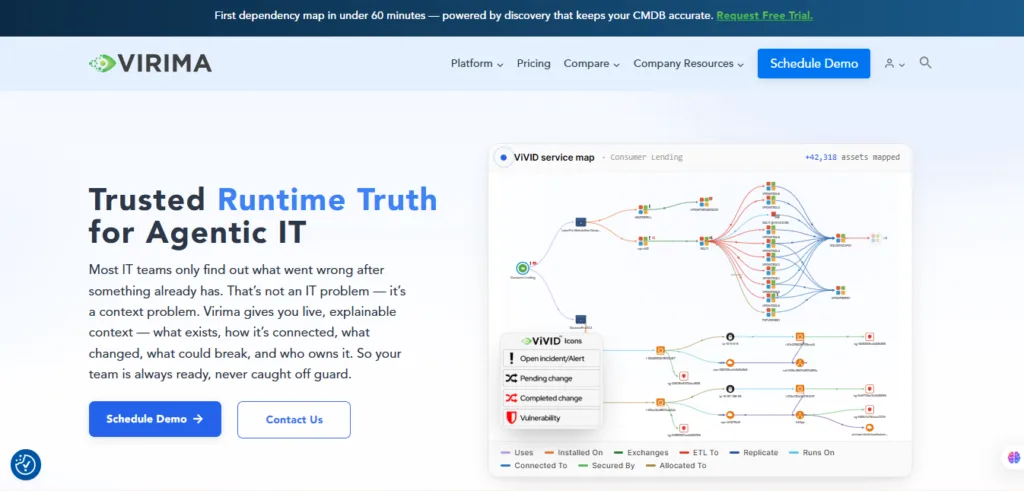
Virima combines IT asset management,CMDB,and ViVID™ service mapping in a single platform. Where most ITAM tools stop at tracking what you own,Virima adds the layer most teams eventually need: knowing how each asset connects to business services,what breaks when something changes,and which vulnerabilities matter by service impact rather than CVE score alone.
Discovery runs agentlessly or via optional agents across on-premises infrastructure,AWS,and Azure. Every CI is bi-directionally synced with whichever ITSM platform your team runs ,ServiceNow,Ivanti,Halo,Xurrent,Jira Service Management,or TeamDynamix ,keeping your CMDB current without manual reconciliation.
What Virima does:
- Discover: Find assets across on-premises,cloud (AWS and Azure),and remote environments using agentless scanning,optional agents,and cloud integrations ,through high-frequency discovery cycles designed for hybrid environments
- Visualize: Map how systems and endpoints connect to business services through service mapping with ViVID™ maps,which overlay ITSM incidents,event management alerts,and Windows Server NVD vulnerability data onto service maps built from your service definitions
- Manage: Track asset status from procurement to retirement with custom status tags,user and location linking,and contract associations
- Optimize: Monitor actual software usage,reclaim idle licenses,and generate audit-ready compliance reports
- Govern: Data certification and attestation workflows keep asset ownership,lifecycle status,and business criticality accurate and policy-compliant over time
- Integrate: Bi-directional sync with ServiceNow,Ivanti,Halo,Xurrent,Jira Service Management,and TeamDynamix
- Secure: NVD integration for Windows Server CIs identifies known vulnerabilities so security teams can prioritize remediation by business impact rather than CVE score alone
ITAM tools that support agentless discovery and native ServiceNow integration include Virima,Lansweeper,and ServiceNow’s own ITOM module. Virima uses both agentless scanning and optional agents to discover assets across on-premises,AWS,and Azure environments,then syncs bi-directionally with ServiceNow CMDB ,keeping configuration records accurate at a significantly lower total cost of ownership than ServiceNow’s own ITOM Discovery licenses. Lansweeper offers agentless discovery but connects to ServiceNow via API connector.
Customer reviews:
“We are a mid-size company without in-house skills to build/manage a complex CMDB. We consulted with Gartner,with end users and had demos from half a dozen players. Frankly,buying Virima felt risky. Their presence is not huge. Their prices are very reasonable. What was the catch? None.” ,Capterra Verified Review
“Our business relationship with Virima is second to none. When we had to meet a crazy launch deadline,the implementation team committed to 30+ days of 12-16 hour a day,7 days a week work with us. They have been one of the few vendors where it really does feel like we’re in a partnership.” ,Capterra Verified Review
Pros:
- Unified platform: discovery,CMDB,ITAM,and service mapping in one place
- ViVID™ service maps overlaid with ITSM incidents and Windows Server NVD vulnerability data for immediate operational context
- Bi-directional ITSM integrations (ServiceNow,Ivanti,Halo,Xurrent,Jira,TeamDynamix)
- Over 120 pre-defined and configurable asset blueprints
- Data certification and attestation workflows for ongoing data accuracy
- Dedicated Customer Success Manager for every account
- Competitive pricing that scales with assets managed
Cons:
- Smaller market presence compared to ServiceNow or BMC
- UI design is catching up to the depth of functionality
- Feature requests are handled individually,though the team is responsive
- Not the right fit for organizations that only need barcode-based physical asset tracking ,that’s a narrower tool’s job
- Service map setup requires you to define service compositions first (manually or via import); Virima builds the map from those definitions; it does not auto-infer service membership
2026 Pricing:
Subscription-based options designed for growing mid-market IT teams through enterprise organizations. Explore Business Pro for right-sized, predictable discovery and ITAM capabilities, or contact Virima for Enterprise tiers. Transparent, customizable bundles with no surprise add-on modules.
2. ServiceNow ITAM
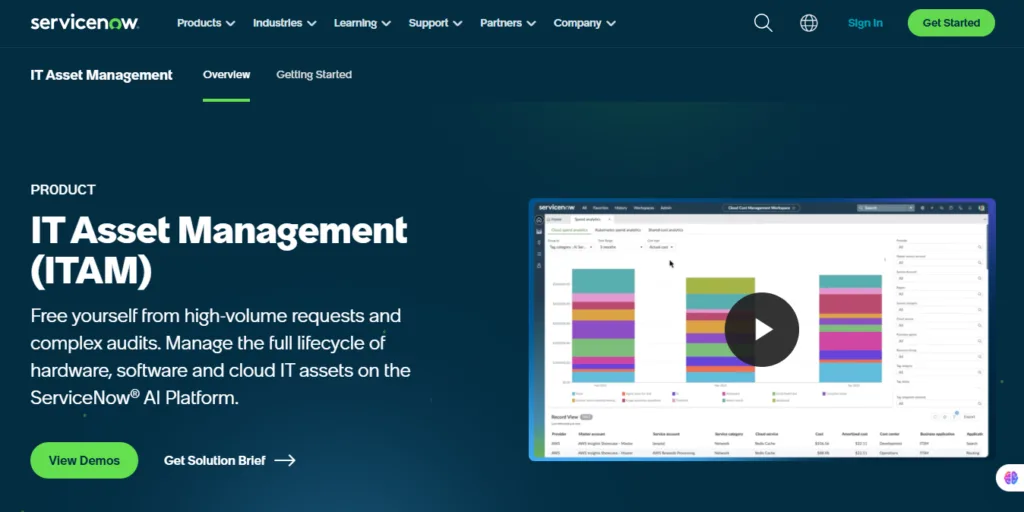
Rating: 4.4/5 (G2,Gartner Peer Insights) | Best for: Large enterprises with mature ITSM practices and in-house ServiceNow expertise
ServiceNow IT Asset Management is part of the larger ServiceNow platform. It manages IT assets across their full lifecycle. Because it sits alongside ITSM,you get asset management and service management in one place. It also includes built-in discovery,normalization,and workflow automation.
Key features:
- Integrated asset management tied to incident,change,and problem management workflows
- Discovery and normalization for accurate,deduplicated asset data
- Software license management with usage tracking and compliance reporting
- Hardware asset lifecycle from procurement to disposal
- AI-powered capabilities through Now Assist (Enterprise tier)
Pros:
- Deep integration with the ServiceNow ITSM ecosystem
- Powerful workflow automation and customization
- Strong audit trail and compliance reporting
- Large partner ecosystem for implementation support
Cons:
- Implementation is complex,time-consuming,and often requires costly consulting
- ITAM module requires separate licensing on top of base ITSM
- ITOM Discovery is an additional paid module
- Total cost of ownership can reach six figures annually for mid-sized deployments
- Data accuracy requires sustained administrative effort to maintain
2026 pricing:
ITSM Professional: ~$100-$140/fulfiller/month; Enterprise: $150-$200+. ITAM and ITOM modules priced separately. Total cost of ownership can reach six figures annually for a mid-sized deployment,before implementation and consulting.
Pro Tip: Pair Virima’s discovery and ITAM with your ServiceNow CMDB to get accurate,current asset data flowing into ServiceNow workflows at a significantly lower total cost of ownership than ServiceNow’s own ITOM/ITAM modules.
3. Lansweeper
Rating: 4.4/5 (G2),4.5/5 (Capterra) | Best for: Mid-to-large IT teams that need agentless network discovery at an accessible price
Lansweeper is a cyber asset intelligence platform built on agentless discovery. It scans your whole network and surfaces hardware,software,and connected assets. Best of all,it does this without installing agents on every device.
Key features:
- Agentless discovery across IP ranges,Active Directory,and cloud
- Centralized inventory of hardware,software,and connected devices
- Software license tracking with compliance alerts
- Missing patch detection (deployment integration required)
- Built-in and custom reporting via SQL queries
Pros:
- Strong,reliable agentless discovery across diverse environments
- Covers hardware,software,patches,and licensing in one tool
- Free tier available (up to 100 assets)
- Scales from small offices to large enterprise deployments
Cons:
- Limited customization and workflow flexibility compared to enterprise tools
- Advanced reporting may require scripting or external tooling
- No native ITSM integration; relies on API connectors
- Starter and Pro tiers cap at 2,000 assets
2026 pricing:
Starter: from $239/month (up to 2,000 assets). Pro: 2,000-9,000 assets,scaled pricing. Enterprise: 10,000+ assets,custom. Free version: up to 100 assets.
4. ManageEngine AssetExplorer
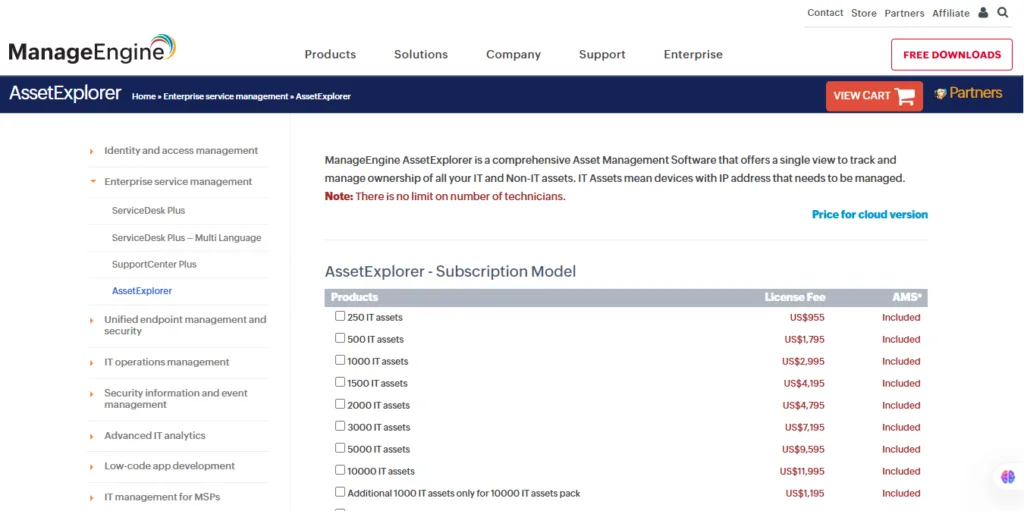
Rating: 4.3/5 (Gartner),4.4/5 (G2) | Best for: Budget-conscious mid-sized teams,especially those already using ManageEngine products
ManageEngine AssetExplorer is a dedicated ITAM tool. It offers discovery,license monitoring,lifecycle tracking,and mobile access. And it does so at a competitive price.
Key features:
- Discovery and inventory via agent and agentless scanning
- Software license management with compliance alerts
- Purchase order and vendor management
- IT asset lifecycle tracking (warranties,configurations,ownership)
- Mobile app for on-the-go asset audits
- Native integration with the ManageEngine ecosystem
Pros:
- Strong value for money for small and mid-sized teams
- Quick to deploy with straightforward setup
- Solid license compliance and tracking capabilities
Cons:
- No built-in patch management; requires separate tools
- Best value within the ManageEngine ecosystem; limited outside it
- Free version capped at 25 nodes
2026 pricing:
Cloud: from $115/month ($1,245/year) for 250 assets. On-premises: from $955/year for 250 assets. Free version for up to 25 nodes.
5. Asset Panda
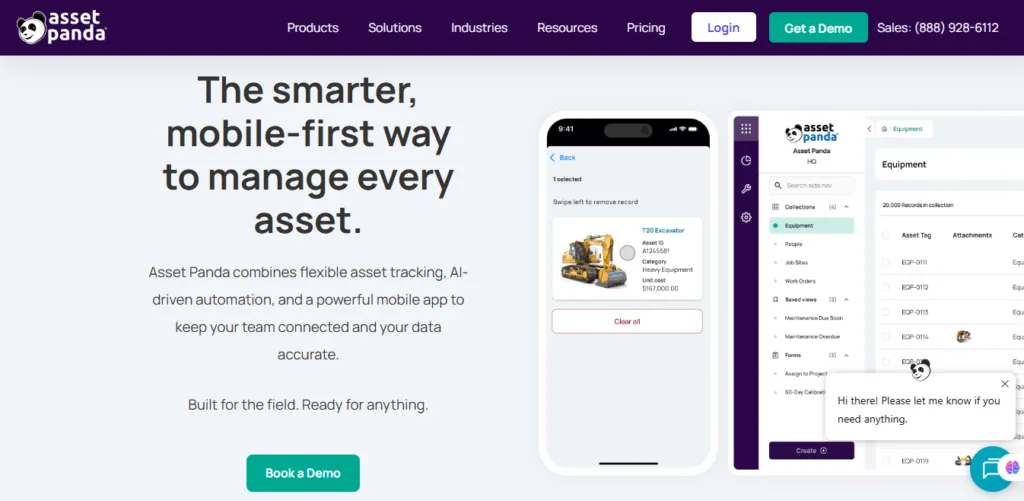
Rating: 4.6/5 (G2),4.6/5 (Capterra) | Best for: Small-to-mid-sized organizations (50-200 employees) seeking mobile-first asset tracking
Asset Panda is a cloud-based asset management platform with a clean interface and strong mobile functionality. It works equally well for IT and non-IT assets.
Key features:
- Barcode and QR code scanning via native iOS/Android apps
- Custom workflows and configurable fields for lifecycle processes
- Contract,license,and warranty tracking from a unified view
- 18+ third-party integrations (Jira,Zendesk,DocuSign,and more)
- Multilingual support for distributed teams
Pros:
- Excellent mobile experience for field teams
- Highly customizable to fit diverse industries
- Unlimited users on all plans
Cons:
- No discovery; all asset data entry is manual
- No remote access or device control capabilities
- Limited automation for advanced ITAM environments
2026 pricing:
Tiered by asset count. Mid-tier plans covering approximately 2,000 assets often cost a few thousand dollars annually. Unlimited users included on all plans.
6. Ivanti Neurons for ITAM
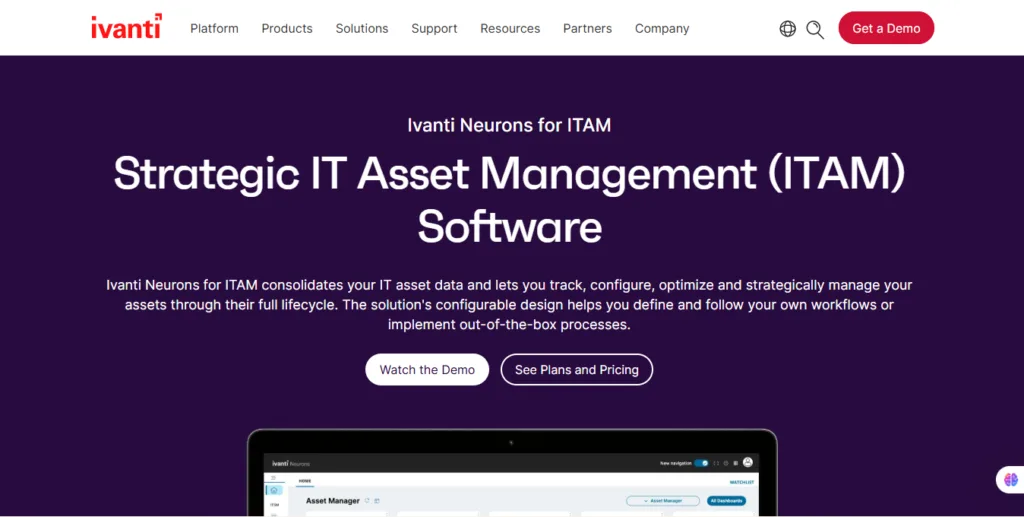
Rating: 4.3/5 (Gartner Peer Insights),4.2/5 (G2) | Best for: Endpoint-heavy,security-focused enterprises already using Ivanti ITSM
Ivanti Neurons for ITAM unifies lifecycle management with endpoint intelligence and automation. It integrates tightly with Ivanti Neurons for Discovery,Ivanti Endpoint Manager,and Ivanti ITSM.
Key features:
- Centralized asset repository from request through disposal
- Integration with Ivanti Neurons for Discovery and Endpoint Manager
- Software license management with compliance tracking
- AI-powered insights for proactive remediation
- UEM (Unified Endpoint Management) convergence
Pros:
- Strong discovery and normalization when paired with the Ivanti ecosystem
- Comprehensive lifecycle management from procurement to retirement
- Unifies ITAM with endpoint security management
Cons:
- Initial setup and configuration require significant time and expertise
- Best value only when using the broader Ivanti ITSM platform
- Custom pricing makes budget planning difficult
2026 pricing:
ITAM capabilities are bundled with Ivanti ITSM subscription plans. Contact Ivanti for custom quotes.
7. Jira Service Management (Assets)
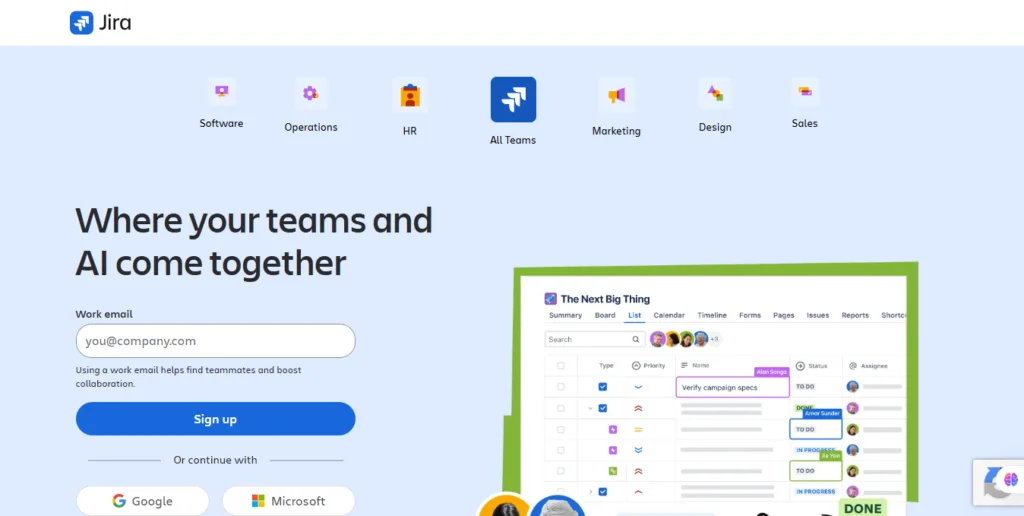
Rating: 4.2/5 (G2) | Best for: Atlassian-centric teams that need basic ITAM alongside ticketing
Jira Service Management includes a CMDB/ITAM module called Jira Assets (formerly Insight). Its strength is native Jira integration. Its weakness is that Atlassian built it as a ticketing tool first.
Key features:
- Custom object schemas for flexible asset categorization
- Asset-to-ticket linking for incident and change context
- Basic network discovery via IP scanning
- Automation rules for asset lifecycle workflows
- Native integration across the Atlassian ecosystem
Pros:
- Natural fit if you’re already using Jira for ticketing
- No separate CMDB/ITAM module charge on Premium tier
- Flexible schema design accommodates diverse asset types
Cons:
- No built-in discovery; relies on manual imports or third-party tools
- Asset management feels bolted on rather than purpose-built
- Full ITAM capabilities require Premium or Enterprise tier
2026 pricing:
Free (up to 3 agents),Standard (~$20/agent/month),Premium (~$51/agent/month,includes Assets/CMDB).
Better together: Virima integrates directly with Jira Service Management through bi-directional sync,feeding enriched discovery and service mapping data into Jira Assets automatically.
8. SysAid
Rating: 4.5/5 (G2,Gartner Peer Insights,Capterra) | Best for: Mid-sized IT teams that want a unified help desk and ITAM in one tool
SysAid combines IT service management and asset management in a single platform,with discovery capabilities enhanced through a Lansweeper partnership.
Key features:
- Built-in asset discovery and inventory management
- Advanced discovery powered by Lansweeper integration (separate license required)
- Unified help desk with asset-to-ticket linking
- Patch management and remote control capabilities
- AI-powered features for ticket categorization and routing
Pros:
- Consolidated ITSM and ITAM in one platform
- User-friendly interface with quick setup
- Strong automation for ticket workflows and asset classification
Cons:
- Advanced Lansweeper discovery requires a separate license
- Reporting may not satisfy teams with advanced analytics requirements
- Mobile experience could be stronger
2026 pricing:
Three subscription tiers: Help Desk,ITSM,Enterprise. Pricing not publicly disclosed; contact SysAid for quotes.
9. IT Glue
Rating: 4.6/5 (G2) | Best for: MSPs and documentation-first IT service providers
IT Glue is an IT documentation platform from Kaseya that helps MSPs centralize knowledge. It is not a traditional ITAM tool but pairs well with dedicated ITAM or CMDB platforms for MSP environments.
Key features:
- Structured IT documentation with standardized templates
- Secure password and credential management
- PSA integrations (ConnectWise,Autotask,Kaseya)
- Network documentation with visual topology maps
Pros:
- Excellent for MSPs managing multi-client environments
- Strong documentation logic keeps teams organized
- Built-in password vault for secure credential management
Cons:
- No lifecycle management,procurement tracking,or depreciation
- Limited integrations outside the Kaseya/ConnectWise/Autotask ecosystem
- Requires pairing with a dedicated ITAM or CMDB tool for full asset management
2026 pricing:
Starts at approximately $29/user/month.
10. Reftab
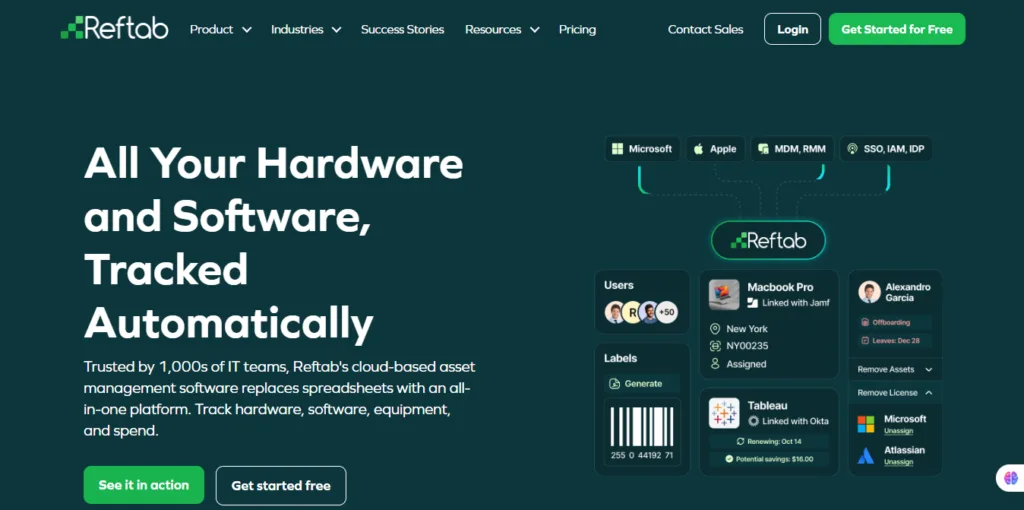
Rating: 4.7/5 (Capterra) | Best for: Small teams,education,and organizations needing simple check-in/check-out tracking
Reftab is a lightweight asset tracking tool for organizations that need simple check-in/check-out functionality. Popular in education,libraries,and small IT departments.
Key features:
- Barcode,QR code,and NFC scanning for check-in/check-out
- Custom fields and categories for flexible asset classification
- Reservation and lending management
- Email notifications for overdue assets
- Free tier for up to 25 assets
Pros:
- Simple to set up and use
- Free plan is genuinely useful for very small teams
- Clean interface with minimal training required
Cons:
- No discovery or network scanning
- Not designed for enterprise ITAM,software licensing,or compliance tracking
- Reporting is basic compared to dedicated ITAM tools
2026 pricing:
Free tier for up to 25 assets. Paid plans scale based on asset count.
Honorable mention: IBM Maximo
Best for: Large enterprises in asset-intensive industries (manufacturing,utilities,transportation) needing EAM capabilities beyond IT.
Virima ITAM pairs lifecycle records with discovery-sourced CMDB context for hybrid estates.
IBM Maximo Application Suite is an enterprise asset management (EAM) platform. It reaches well beyond IT into operational technology,IoT,facilities,and industrial equipment. As a result,it fits organizations that manage converged IT and OT environments at scale.
Honest limit: Virima ITAM is not a full software asset management rights engine and does not replace ServiceNow ITSM or Lansweeper-class agentless scanning as the only tool in every estate. Teams that need deep publisher true-up logic or a pure network scanner often keep those systems and place discovery-sourced CMDB and service mapping with ViVID™ maps underneath.
- AI-powered predictive maintenance and asset health monitoring
- IoT integration for condition-based asset management
- Strong in regulated industries (energy,transportation,healthcare)
- Complex implementation requiring IBM consulting or certified partners
- Enterprise pricing (custom quotes only)
Honorable mention: Microsoft SCCM (Endpoint Configuration Manager)
Best for: Windows-heavy enterprises that already standardize on Microsoft endpoint management and need patching,OS deployment,and policy control more than a full ITAM + CMDB stack.
Microsoft Endpoint Configuration Manager (formerly SCCM) is built for managing Windows devices at scale. If your estate is mostly Windows and you need tight control over patching,image deployment,and compliance policies,MECM is often already in the stack.
Where it helps
- Centralized Windows management: One console for updates,configurations,and security policies across Windows endpoints.
- Automated patching and software distribution: Scheduled pushes without desk-side visits,with software usage signals on managed devices.
- OS deployment: Image creation,customization,and large-scale Windows rollouts.
- Policy and compliance enforcement: Applies security baselines to managed devices.
- Active Directory integration: Fits existing AD-centric operations.
Where it stops short of ITAM
- Not a full IT asset management platform: Strong on managed Windows endpoints; weak as the system of record for mixed OS,network gear,cloud resources,and service dependency context.
- On-premises gravity: Classic MECM deployments lean on on-prem infrastructure; cloud-first programs often pair or shift toward Intune.
- Setup cost: Licensing,infrastructure,and skilled admins add up at enterprise scale.
Treat MECM as device and patch control for Windows fleets. Teams with hybrid multi-cloud estates,non-Windows servers,or service-level blast-radius questions still need discovery-backed ITAM and CMDB coverage beside it.
Honorable mention: Flexera FlexNet Suite
Best for: Organizations whose primary pain is software license compliance and SaaS/software spend optimization,not full hardware + dependency ITAM.
Flexera FlexNet Suite is purpose-built software asset management (SAM). If entitlement accuracy,license position,and reclaiming unused software spend sit above other ITAM jobs,Flexera is built for that lane.
Where it helps
- Software discovery: Surfaces installations across physical,virtual,and cloud environments.
- License compliance tracking: Compares usage to purchased entitlements and flags compliance risk.
- License position dashboards: Shows where spend and risk concentrate.
- Adjacent system feeds: Connects procurement,HR,and configuration sources so entitlement data is not trapped in one silo.
- Implementation support: Professional services for complex SAM rollouts.
Where it stops short of full ITAM
- SAM-first,not estate-wide ITAM: Hardware lifecycle,network discovery,and service mapping usually need companion tools.
- Integration lift: Clean license position depends on reliable feeds from multiple systems.
- Cost and skill: Enterprise SAM programs carry real licensing cost; advanced recognition and normalization need trained operators.
Choose Flexera when software license risk is the board-level driver. If you also need discovery-sourced hardware inventory,CMDB relationships,and change impact context in one operational layer,plan Flexera as part of a broader toolset rather than the only system of record.
How to choose IT asset management tools in 2026
Step 1: Define your environment and scale
How many assets are you managing? Are they on-premises,cloud,hybrid,or distributed across remote workers? A team managing 200 laptops has different needs than one managing 20,000 assets across AWS,Azure,and three data centers. If your estate is growing,our benchmarks for IT asset management platform scalability give you a clear scorecard to hold any shortlisted vendor to.
Step 2: Map your integration requirements
Your ITAM tool should not live in a silo. Confirm the tool offers bi-directional integration with your ITSM platform ,not just a one-way data push. Virima syncs bi-directionally with ServiceNow,Ivanti,Halo,Xurrent,Jira,and TeamDynamix.
Step 3: Evaluate discovery depth
If your team is still entering assets manually,you’re already behind. Look for tools with discovery options that match your environment: agentless scanning for broad visibility,optional agents for deep endpoint data,and cloud API connectors for AWS and Azure.
For hybrid and multi-cloud environments,ITAM tools need discovery across on-premises infrastructure,cloud platforms (AWS,Azure),and remote endpoints. Virima combines agentless and agent-based discovery with cloud connectors,pulling assets from all three into a single unified view. ServiceNow ITAM and Ivanti Neurons also offer strong multi-cloud capabilities,but at significantly higher cost and implementation complexity.
Step 4: Assess lifecycle and compliance needs
Does your organization face compliance rules like GDPR,HIPAA,ISO 27001,or SOC 2? If so,you need an ITAM tool that tracks the full asset lifecycle. It should also give you audit-ready reporting. That means procurement records,ownership history,configuration changes,and disposal documents in one place.
Step 5: Calculate total cost of ownership
Factor in implementation time,consulting costs,training,ongoing maintenance,integration development,and annual uplift clauses. A tool that costs less upfront but requires a full-time administrator may cost more over time.
ITAM software costs vary widely. Entry-level platforms like Reftab offer free plans for small teams. Mid-market tools like Lansweeper start at $239/month and ManageEngine AssetExplorer at $955/year. Virima offers right-sized subscription plans starting with Business Pro for growing IT organizations, scaling up to custom Enterprise tiers. ServiceNow ITAM and Ivanti use custom enterprise pricing that typically reaches $100-$200+ per user per month before implementation.
Step 6: Request demos with your real data
Test any shortlisted IT asset management tools against your actual environment. Ask vendors to demonstrate discovery,reporting,and integration using scenarios specific to your organization ,not canned demos.
Schedule a demo to see Virima with your actual environment →
Why Virima deserves a spot on your shortlist
Every one of these IT asset management tools has real strengths,and the best choice depends on your environment,budget,and priorities. That said,Virima occupies a distinct position in the ITAM market.
Virima gives you discovery-sourced,trusted runtime truth,refreshed on demand as confidence degrades. You get a live view of what you run,how each asset maps to a service,where the risk sits,and what the downstream impact is when something changes. This goes beyond discovery,CMDB,and lifecycle management. It delivers the operational visibility that mid-market and enterprise teams need in 2026,including the context layer that lets AI agents act on accurate data.
What makes it different:
- ViVID™ service maps show how assets connect to dependent services,with ITSM incidents,vulnerability data,and change events overlaid on the same map. Service definitions are provided once; maps refresh with each discovery cycle.
- Bi-directional sync with ServiceNow,Ivanti,Halo,Xurrent,Jira,and TeamDynamix means your ITSM platform always has accurate,current asset context.
- Data certification and attestation workflows keep asset ownership,lifecycle status,and business criticality accurate beyond what discovery alone can capture.
- NVD integration for Windows Server CIs connects asset data to known vulnerabilities,helping security teams prioritize remediation by business impact.
- Dedicated Customer Success Manager for all accounts ,not just enterprise-tier customers.
See Virima in action ,schedule a personalized demo →
Compare your ITAM shortlist against discovery coverage, CMDB freshness, and ViVID™ maps under the ITSM desk you already run. Leave with a clearer picture of where inventory ends and discovery-sourced truth has to start.
Keep the ITAM tool that fits. Add discovery when the ceiling is operational
IT asset management tools remain the right buy for many lifecycle, desk-native, and discovery-first programs. Virima does not replace ServiceNow, Lansweeper, Ivanti, Jira Assets, or ITSM. It supplies Trusted Runtime Truth when hybrid discovery, relationship-rich CMDB, and multi-desk sync are the job inventory-only or desk-only stacks were never designed to finish alone.
Disclaimer: Vendor features, packaging, and list pricing change over time. Confirm current documentation and commercial terms for each tool. Virima capabilities, packaging, and integrations also change. Timelines and outcomes vary by estate, discovery scope, credentials, and CMDB configuration. Table cells and pricing notes are directional shortlist aids, not scored ratings or quotes.
Frequently Asked Questions
What is IT asset management (ITAM) software?
ITAM software tracks hardware, software licenses, and cloud subscriptions across request, procurement, deployment, maintenance, and retirement. It answers what you own, who owns it, and where it sits in the lifecycle. Stronger platforms also feed discovery and CMDB context so the record stays usable for incident, change, and audit work.
What is the difference between ITAM and a CMDB?
ITAM tracks ownership and lifecycle. A CMDB models relationships between configuration items and services. ITAM answers inventory questions. A CMDB answers operational impact questions. Many enterprises run both, either in one platform or as ITAM plus a discovery-sourced CMDB under ITSM.
Does Virima replace ServiceNow ITAM or Lansweeper?
No. ServiceNow ITAM remains valid on mature ServiceNow workflows. Lansweeper remains strong for agentless network discovery. Virima supplies multi-method discovery, multi-source inventory, CMDB context, and ViVID™ maps on high-frequency scheduled cycles, then syncs into ITSM systems of engagement. Many programs keep desk-native or scanner tools and place discovery-sourced truth underneath.
Which ITAM tool is best for hybrid and multi-cloud environments?
Look for agent plus agentless coverage, cloud connectors for AWS and Azure, relationship-rich CMDB, and ITSM sync that does not create a second source of truth. ServiceNow ITAM fits mature ServiceNow estates. Lansweeper fits network-first discovery. Unified discovery and CMDB platforms fit teams that need hybrid inventory and service maps without standardizing every workflow on one mega-suite first.
Is open-source ITAM software good enough for enterprise use?
Open source ITAM is enough when checkout workflows, self-host effort, and light CMDB needs match the job. It usually falls short when hybrid cloud discovery, bi-directional desk sync, and audit-ready freshness must run on a standing cadence without a full-time platform team. Many enterprises keep open source for a niche workflow and add commercial discovery underneath.