IT Asset Management Tools vs CMDB: Do You Need Both?

The confusion is understandable — but costly
Ask ten IT teams how they use their CMDB and their ITAM tool. You’ll get ten different answers. Some treat the CMDB as a glorified spreadsheet for hardware (which it technically is, just an expensive one). Others have loaded every asset record into it. Then they wonder why it runs slow and breaks under maintenance.
A few teams have collapsed both into a single platform. Most have quietly accepted that neither works very well.
This isn’t a sign of incompetence. ITAM and CMDB genuinely overlap. Both track assets. Both care about accuracy. Both feed downstream processes. But they’re built to answer different questions. Treat them as interchangeable, and you create gaps. Those gaps surface at the worst possible moments — during an audit, mid-incident, or right before a high-risk change.
Both tools exist to answer the same five questions about your environment. What exists. How it’s connected. What changed. What could break. Who owns it. But neither answers all five on its own.
Poor CMDB outcomes usually track back to scope creep and stale data, not missing software. Teams load the wrong attributes, skip relationship maintenance, then lose trust when change and incident workflows need answers fast.
ITAM vs CMDB at a glance
| Dimension | IT asset management tools | CMDB |
|---|---|---|
| Primary question | What do you own? | How does it all connect? |
| Data model | Flat asset records with attributes | Relational graph of CIs and dependencies |
| Core users | Asset managers, finance, procurement, compliance | IT operations, change managers, incident responders |
| Strongest in | License compliance, contracts, lifecycle, financial reporting | Change impact, incident response, service mapping, blast radius |
| Update cadence needed | Periodic (procurement events, true-ups) | High-frequency (aligned to infrastructure change rate) |
| Failure mode | Audit exposure, license overspend, missed renewals | Failed changes, slow MTTR, dependency blind spots |
Both data sets need to stay accurate. Neither replaces the other. The interesting question is how they stay in sync when procurement systems, cloud APIs, and ops tools all change the estate on different clocks.
The core difference in one sentence
ITAM tracks what you own. A CMDB maps how it works.
Everything else follows from that line.
IT asset management tools focus on the lifecycle of an asset. They cover everything from procurement through disposal. That includes cost, contract, ownership, license entitlement, and compliance. A CMDB focuses on configuration items (CIs) and the relationships between them. It maps how services depend on infrastructure. It shows what breaks when something changes. It clarifies the blast radius of an incident.
Both need accurate data. Both need to stay current. But they serve fundamentally different purposes. The teams using each are usually asking very different questions.
For the discipline-level view of CMDB asset management versus ITAM (SACM and CI language), see CMDB asset management vs ITAM: key differences explained. This article stays on the tools decision, the scorecard, and how discovery keeps both views aligned.
What IT asset management tools do well
Good ITAM tooling keeps you in control of the financial and contractual side of your IT estate. These are the parts that surface in finance reviews, vendor audits, and procurement cycles.
ITAM tracks hardware lifecycle from purchase order through deployment, refresh, and disposal. So you know what you have and what it cost. It manages software entitlements against installations. That’s what stands between you and an awkward true-up call when a vendor audits you. It tracks contracts and warranties — the renewal you forgot about until support rejected the ticket. It also handles depreciation schedules, chargeback models, and the chain-of-custody records that disposal compliance requires.
The questions ITAM answers are operational and financial. How many licenses do you own? When does this server’s support contract expire? What did you spend on endpoint hardware last quarter?
The data model is fairly flat. Asset records carry attributes, not a web of relationships. The audience is asset managers, procurement, finance, and compliance officers. They mostly want clean tabular data they can reconcile.
What a CMDB does well
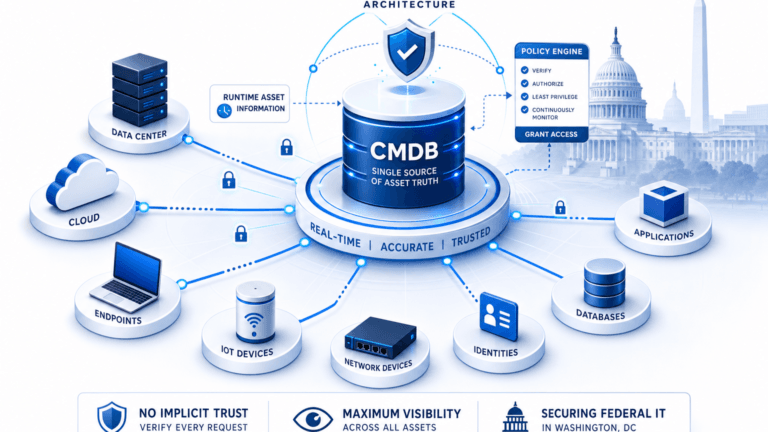
A CMDB centers on configuration items and the relationships between them. Where ITAM asks “what do you own,” a CMDB asks “how does everything connect, and what depends on what?” That sounds abstract. Until you’re mid-incident at 2 a.m. and need the answer in the next ninety seconds.
CMDBs map dependencies between servers, applications, network devices, and services. They tie infrastructure components to the business services those components support. So you can evaluate a change request against actual blast radius rather than a hopeful guess. This is where service mapping earns its keep — by translating raw CI relationships into a service-level view operations teams can actually use.
A good CMDB feeds change management with impact analysis. It feeds incident management with affected-service context. It feeds problem management with the historical record of what touched what.
The questions a CMDB answers are operational and contextual. If this database server goes down, which applications are affected? What’s the downstream impact of patching this middleware? Who owns the service that depends on this CI?
The audience is IT operations, change managers, service desk teams, and incident responders. The data model is relational by design. CIs connect through typed relationships that reflect how the environment actually works — not how someone documented it three years ago.
Why using IT asset management tools as a CMDB (or vice versa) breaks down
When teams use a CMDB as ITAM: data overload
Some teams push every asset attribute into CMDB records. Purchase dates. Depreciation schedules. License counts. Contract terms. The result is a CMDB that runs slow, costs more to maintain, and gets harder to query for operational purposes. The better pattern is to keep finance data in ITAM but reconcile depreciation against discovered state so book value tracks reality.
CMDBs work best for relationship traversal and operational context. They aren’t built for financial reporting or license reconciliation. Stuffing procurement data into CI attributes doesn’t give you ITAM. It gives you a CMDB that’s harder to trust and slower to use.
The governance models differ too. ITAM data usually belongs to finance and procurement. CMDB data belongs to IT operations and change management. Merge them into one record, and you create ownership confusion plus data quality problems that compound over time.
When teams use ITAM as a CMDB: missing the relationships
The reverse problem shows up just as often. Teams with mature ITAM practices sometimes assume their asset inventory is close enough to a CMDB. It isn’t.
An ITAM tool can tell you a server exists, who owns it, and when the warranty expires (the easy questions). It can’t tell you which application services run on it. It can’t tell you what databases it connects to. And it can’t tell you which business processes go down if it fails. Without that relationship layer, change impact analysis becomes guesswork. Incident response falls back on tribal knowledge instead of discovery-sourced ground truth.
The pattern shows up constantly in practitioner forums. A common refrain on r/sysadmin and r/ITIL — paraphrased across many threads — is that asset inventories look like a CMDB until the first major incident. Then teams discover their “CMDB” can’t answer “what depends on this?” because it was never built to.
When AI agents or automation tools need to act on your environment, this gap turns dangerous. An agent that knows an asset exists but can’t see its dependencies can’t make a governed decision about whether it’s safe to touch.
Real-world scenarios where you need both
Some specific situations turn the absence of either capability into real operational risk. Here’s where the gap actually bites.
Audit preparation. A software audit needs license entitlement data (ITAM) and deployment context (CMDB) reconciled. ITAM tells you what you’re entitled to. The CMDB tells you where software is actually installed and on which CIs. Without both, you’re either over-reporting or under-reporting. Either outcome is expensive. Software vendor audits get expensive fast when entitlement data and install data disagree. Reconciliation gaps are the usual driver of over-reporting, under-reporting, and painful true-ups.
Incident response. When a critical service goes down, you need to know what broke (CMDB relationships) and who owns the affected assets (ITAM ownership records). Incident responders switching between two disconnected tools resolve incidents more slowly. They make more mistakes. Sometimes they fall back on memory, which is worse.
Change approval. A well-run change advisory board needs blast radius visibility before approving any change. That requires CMDB relationship data. But it also needs to know whether affected assets are in warranty, under support, or near end of life — all ITAM data. Change approvals made without both views carry hidden risk. Unplanned outages often follow changes that skipped real impact analysis. CMDB relationship data exists to close that gap before CAB approval, not after the incident.
Hybrid IT environments. Modern environments span on-premises infrastructure, cloud workloads, and SaaS apps. Without automated discovery feeding both tools, ITAM and CMDB data diverge fast. Cloud assets spin up and down outside procurement workflows. SaaS licenses get provisioned outside IT (sometimes outside anyone’s awareness, until the invoice arrives). Without a shared discovery layer, both tools go stale on their own.
The decision scorecard
| Use case | ITAM alone | CMDB alone | Both, connected by discovery |
|---|---|---|---|
| Software audit defense | ★★★★ | ★ | ★★★★★ |
| Change impact analysis | ★ | ★★★★ | ★★★★★ |
| Incident response speed | ★★ | ★★★★ | ★★★★★ |
| License optimization | ★★★★ | ★★ | ★★★★★ |
| Hardware lifecycle planning | ★★★★ | ★★ | ★★★★ |
| Service dependency awareness | ★ | ★★★★ | ★★★★★ |
| Audit-readiness across the estate | ★★★ | ★★★ | ★★★★★ |
How to score your environment in 15 minutes. For each row, rate your current stack 1-5 (1 = cannot answer with trusted data in a normal workday; 5 = answer is discovery-backed and owned). Write the score next to the row, not in a separate spreadsheet you will ignore.
If three or more rows need “Both, connected by discovery” at 4+, treat dual-view plus shared discovery as a near-term operating requirement, not a nice-to-have. If audit defense and license optimization score high but change impact and dependency awareness score low, invest in relationship and service mapping next. If blast radius looks strong but ownership, warranty, and entitlement are weak, fix ITAM fields and RACI before you expand CI scope.
Use this dual-view readiness checklist before you buy or consolidate tools:
- Named owners for finance attributes versus ops/CI attributes
- Software true-up source of record agreed with procurement
- CAB impact fields that require dependency context, not free text only
- Incident “affected service” field populated from CMDB, not memory
- Cloud and SaaS assets entering inventory outside PO workflows
- Scheduled multi-source discovery covering agent and agentless paths
- Attribute-level reconciliation when two sources disagree
- Audit calendar that pulls entitlement and install/deploy context together
Choose ITAM-only if your goal is financial governance of a fairly static estate. You need minimal change activity and low service dependency risk.
Choose CMDB-only if you run a high-change-rate operations function and have a separate financial system handling assets. You’ll still feel the gap during audits and procurement decisions.
You need both, connected by automated discovery, if you run real change management, software compliance programs, or any AI-driven IT workflow. Discovery is what keeps the two from drifting apart.
Automated discovery: the missing link
Here’s the problem most ITAM vs CMDB comparisons skip. Both tools start stale and stay stale unless something keeps feeding them accurate data.
Manual updates don’t scale. Spreadsheet imports introduce errors. Agent-based discovery misses agentless devices. Point-in-time scans miss ephemeral workloads. Teams end up arguing about whether the data is right instead of actually using it. EMA and other analyst research consistently finds that CMDB data quality degrades within weeks without recurring discovery.
Recurring automated discovery keeps both ITAM and CMDB records accurate without depending on human discipline. When discovery runs on a scheduled basis across multi-source, multi-protocol scans, both ITAM and CMDB can refresh from the same feed. Most tools tell you what was last entered. Discovery-sourced records reflect the latest completed scan cycle.
What makes that record trustworthy enough to act on comes down to four things. Source traceability — every CI traces back to its discovery source, protocol, and timestamp. Reconciliation — when sources disagree, the most authoritative value wins at the attribute level. Freshness — records reflect what’s running now, not last quarter’s snapshot. Impact mapping — every asset connects to the services and people it affects.
This isn’t just a data quality improvement. It’s a prerequisite for using either tool confidently in operational workflows. Discovery-sourced ground truth means a CI record you can act on. So when it says a server runs a specific OS version with specific open ports, you can trust that — whether you’re approving a change, responding to an incident, or briefing an AI agent on what it’s about to touch.
Virima’s automated multi-source IT discovery feeds both ITAM and CMDB records through scheduled, high-frequency discovery cycles.
When ITAM and CMDB must answer the same five questions from one defensible record, start with how Trusted Runtime Truth frames discovery-sourced ground truth for teams and agentic workflows.
How Virima unifies ITAM and CMDB
Full disclosure: this is the gap Virima was built around, so we have a perspective on what unification actually requires.
Virima rests on a simple premise. Trusted runtime truth for agentic IT requires three things most stacks treat as separate problems. Discover with authority. Understand in context. Govern every action. Asset lifecycle data and operational relationship data aren’t different stacks. They’re different views of the same authoritative record.
The Virima CMDB is populated automatically from discovery. CI relationships get mapped and maintained without manual intervention. That’s understand in context. The Virima IT asset management capabilities sit alongside that CMDB data. Asset managers get lifecycle, financial, and contract context tied directly to the same records operations teams rely on. The discovery layer reconciles authoritative data from multiple sources at the attribute level, with full source traceability. That’s discover with authority. And explainability, approval gates, and auditability live inside the platform. So every action — human or agent — has a defensible record. That’s govern every action.
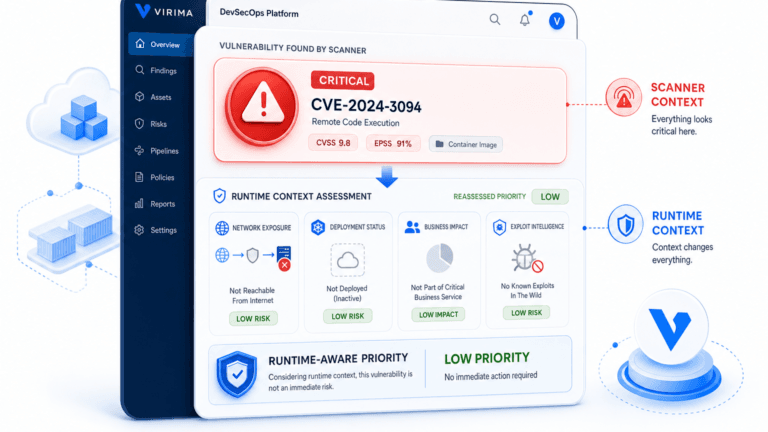
Virima’s ViVID Visual Impact Display makes that operational context visual. Service maps overlay open incidents, recent changes, and pending changes on affected CIs. Where enabled, Windows Server vulnerability signals from NIST NVD can weight risk by asset and service criticality alongside your dedicated scanners. So your team sees what’s true and what’s about to break in the same view.
The process producing that truth is independently verified. Virima holds SOC 2 Type 2 and ISO/IEC 27001:2022 certifications. That matters when the records you act on inform change approvals, audit responses, and AI-driven decisions.
You’re not running two disconnected tools that need periodic reconciliation. You work from a single source of discovery-sourced ground truth that serves both functions. It feeds your existing ITSM, ITOM, and SecOps tools without forcing a rip-and-replace. Virima integrates with ServiceNow, Jira Service Management, HaloITSM, Ivanti, Hornbill, and Xurrent.
If you’re trying to decide whether to consolidate or integrate, that’s the line that matters. Virima doesn’t ask you to abandon your existing platforms. It acts as the trusted runtime truth your existing platforms can plug into. Records stay accurate. So every downstream tool — including AI agents making automated decisions — works from live, explainable context with a defensible audit trail.
How does Virima compare to ServiceNow, BMC, and Ivanti for ITAM and CMDB?
Virima delivers automated multi-protocol discovery, service mapping, and CMDB reconciliation in a core platform subscription. ServiceNow and BMC offer broader enterprise suites but at significantly higher cost and implementation complexity. Ivanti provides strong asset optimization but relies on partner connectors for service dependency context.
For a deeper look at how CMDB tools compare, see our in-depth review of CMDB software in 2026. It covers the leading platforms and what to look for.
Can one platform handle both IT asset management and CMDB reconciliation?
Unified platforms like Virima handle both ITAM and CMDB reconciliation through a single automated discovery layer. Virima captures hardware lifecycle, software entitlements, and configuration item (CI) dependency maps concurrently, eliminating data drift between financial asset inventories and operational CMDBs without dual-tool maintenance overhead.