Oracle Database CMDB Discovery Guide: MySQL, Relationships & ViVID

Application performance drops without warning. Users report slowness. Dashboards show healthy servers and stable network traffic. Yet logs reveal repeated database timeouts — and suddenly the lack of reliable database discovery becomes obvious.
At that moment, the real issue is not performance. It is visibility.
Which database is failing? Which host runs it? Who owns it? And which business services depend on it? In many IT environments, the answer is unclear.
Although every critical application depends on a database, database discovery is often incomplete or inconsistent. As a result, databases remain the hidden dependency layer inside otherwise well-maintained CMDBs and service maps.
This gap creates operational blind spots. And when incidents occur, those blind spots extend mean time to resolution, increase change risk, and weaken governance.
Fortunately, with the release of Virima v6.1, enterprises can now strengthen database visibility alongside broader discovery of servers, networking, storage, and cloud services.
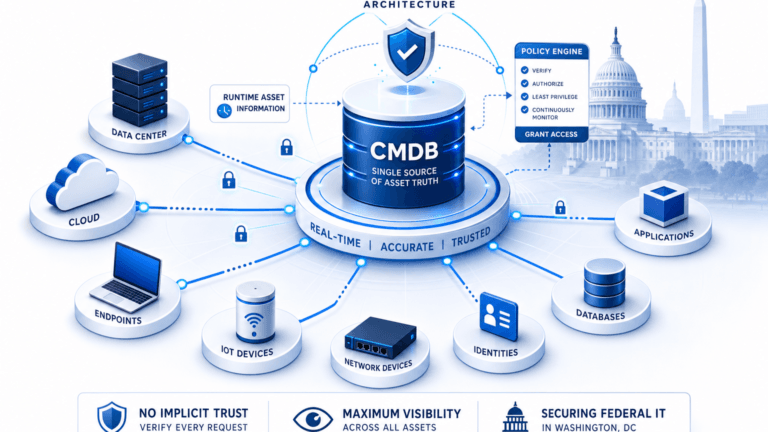
They all feed richer application dependency mapping and tighter CMDB relationships for better IT operations and security.
TL;DR: What Virima 6.1 changes about database visibility
- Oracle database CMDB discovery is now comprehensive via Deep Host Scan, alongside MySQL discovery through agent-based scans.
- Databases are automatically modeled in the CMDB with accurate “Runs On” relationships to host servers.
- Service maps now include the full dependency chain: Business Service → Application → Database → Infrastructure.
- Change impact analysis becomes more precise because database dependency mapping is visible before maintenance.
- Oracle license audits and MySQL sprawl are easier to manage with structured reporting.
- Broader v6.1 enhancements — including expanded infrastructure discovery, stronger security controls, and improved ITSM synchronization — further strengthen CMDB relationships and operational governance.
In short, database discovery in Virima 6.1 closes one of the most common blind spots in enterprise IT environments and enables safer change, faster incident response, and stronger compliance posture.
Looking for quick answers on what Virima captures and which CI types are created? See the Virima Database Discovery FAQ →
Why databases become CMDB blind spots
Databases are rarely missing by accident. Instead, structural and tooling gaps create the problem.
First, databases operate behind the application layer. Network scans detect servers and open ports. However, they often fail to identify internal database engines or custom instances that do not expose standard interfaces.
Second, many discovery tools prioritize infrastructure. They perform traditional IT asset discovery for servers and network gear well, but stop short of deep middleware inspection that reveals database systems.
Third, database platforms are often managed by specialized teams. Manual CMDB updates from DBAs lag behind real deployments, especially in agile, hybrid, and cloud environments.
Finally, database instances can span environments. From on-prem to cloud, from production to dev/test, creating sprawl that escapes detection without purpose-built discovery.
The result:
- Incomplete service maps
- Weak CMDB relationships
- Reactive incident response
- Poor license and capacity insight
- Security gaps due to unknown instances
Traditional approaches leave the data layer partially modeled or entirely invisible.
Why database dependencies drive outages
Databases are the connective tissue of modern IT
Every business service depends on data.
Web platforms store customer transactions in MySQL. Enterprise applications rely on Oracle for critical operational data. Analytics and reporting pull from multiple database tiers across hybrid environments.
Therefore, databases sit at the center of application dependency mapping. They support authentication, transactions, analytics, and orchestration. Remove them, and services fail.
Yet many organizations lack reliable database service mapping across their environment.
What breaks when database visibility is missing
Incident response delays
When an alert fires, teams review service maps. However, if the map shows only application servers and load balancers, the database layer remains invisible.
Teams troubleshoot blindly. Database saturation or failure goes undetected until manual investigation. As a result, mean time to resolution (MTTR) increases significantly.
Inaccurate change impact analysis
Imagine an Oracle patch scheduled on a Linux server.
If database discovery is incomplete, the CMDB shows only the host. It does not reflect which databases or applications depend on it. Change approvals proceed with partial context, leading to unexpected outages and stakeholder frustration.
License and capacity risk
Without structured database discovery, leadership cannot confidently answer:
- How many Oracle or MySQL instances are running?
- Which hosts have multiple databases?
- Which instances are production versus dev/test?
For Oracle database discovery in particular, this creates audit exposure and licensing risk. Gartner research consistently identifies Oracle license compliance as among the highest-risk audit categories in enterprise IT, with untracked database instances representing the most common source of unexpected licensing exposure. Untracked MySQL instances add sprawl and governance gaps.
Security exposure
If databases are not visible in the database CMDB, security teams cannot enforce patch compliance, encryption policies, or vulnerability scans on unknown assets. This enlarges the attack surface and increases risk.
Why traditional discovery misses databases
Most legacy discovery tools rely on network probing. However, databases do not always respond predictably. They may:
- Run on non-standard ports
- Block external queries
- Operate as background services
Therefore, shallow scans miss them.
Accurate database discovery requires either:
- Deep host inspection that examines processes, services, and installed components, or
- Agent-based discovery that runs local checks and reports back database metadata.
Virima 6.1 addresses these gaps with purpose-built detection methods for both Oracle and MySQL, and then models those findings inside the CMDB with automatic relationships.
Oracle database CMDB discovery: Deep Host Scan and “Runs On” relationships
How Oracle discovery works in Virima 6.1
Virima 6.1 uses Deep Host Scan to perform Oracle database CMDB discovery across Windows and Linux systems, identifying instances and automatically modeling them as configuration items.
Instead of scanning from the outside, Deep Host Scan inspects:
- Running processes
- Installed services
- Oracle binaries and directories
- Instance metadata
Because inspection occurs at the host level, Oracle instances are identified even when they are not externally accessible.
This ensures database discovery is accurate, comprehensive, and not dependent on network exposure.
What gets discovered
The discovery process creates:
Oracle Database CI
- Database name or SID
- Version and edition (where detectable)
- Installation path
- Service status
Host Server CI
- The Windows or Linux server hosting Oracle
Then Virima automatically creates a “Runs On” relationship linking:
Oracle Database CI → Host Server CI
This models real dependency, enabling bi-directional queries such as:
- “What databases run on this server?”
- “Which server hosts this database?”
Accurate relationships form the backbone of service maps and change analysis.
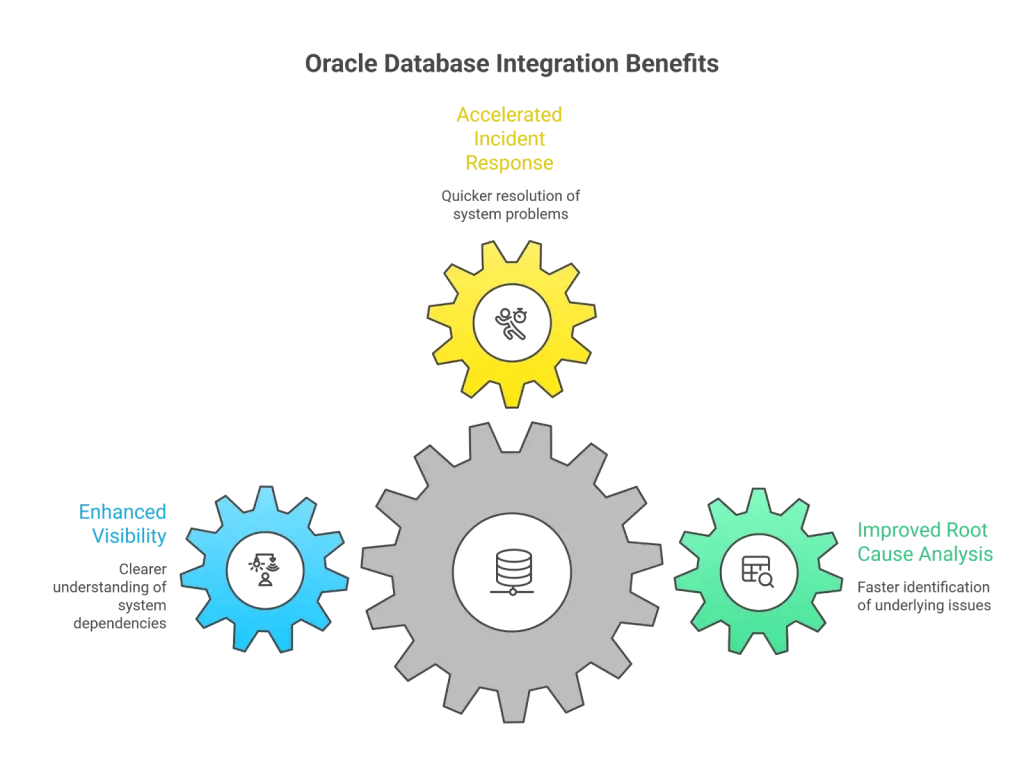
Operational value of Oracle discovery
Improved service mapping
With Oracle databases discovered and linked, service maps now show the full stack: Business Service to Application to Oracle Database to Server to Network to Storage
This is where ViVID, Virima Visual Impact Display, becomes directly useful. ViVID overlays live operational data onto the service map: open incidents, pending changes, recent changes, and vulnerabilities pulled from integrated ITSM platforms, displayed in context against the specific CI they affect.
When an Oracle database is correctly modeled and linked to its host, ViVID can show which incidents are open against that database, which changes are in flight on its server, and which business services sit upstream, all in a single view without switching tools.
Accurate change impact analysis
Before discovery, server change requests lack database context. After discovery, change tools or Virima’s impact analysis features show:
- Which Oracle databases are affected
- Which applications depend on those databases
- Which business services could be impacted
This leads to safer, more predictable changes.
License and compliance management
Oracle environments demand precision.
Database discovery provides authoritative inventory for all Oracle instances through Virima’s IT Asset Management layer, where each discovered Oracle CI is tracked as an individual asset record with version, edition, host location, and ownership attributes. IT and finance teams can generate structured reports directly from this asset data showing:
- Oracle versions and editions
- Host locations
- Ownership and usage patterns
This strengthens audit readiness, reduces compliance risk, and supports capacity planning.
MySQL discovery via agent-based scans
How MySQL Discovery works
For MySQL discovery, Virima 6.1 uses agent-based scanning on Windows and Linux hosts.
A lightweight agent runs locally, detects MySQL installations and running instances, and reports metadata back to the discovery application.
Tested on MySQL versions from legacy (5.0) to modern (8.0), this method ensures consistent visibility.
What gets discovered
MySQL Database CI
- Version
- Installation directory
- Service status
- Listening port
Host Server CI
As with Oracle, Virima automatically models a “Runs On” relationship between the MySQL Database CI and its host.
This ensures that MySQL instances are present in the CMDB and tied into service maps.
Operational value of MySQL Discovery
Web and SaaS visibility
MySQL is ubiquitous in LAMP/LEMP stacks powering web applications, content systems, internal SaaS platforms, and microservices.
With MySQL discovery in place, service maps now show the complete dependency chain, enabling faster incident response and clearer root cause identification.
Dev/test governance
MySQL instances often proliferate in development and test environments. Without discovery, these instances go untracked.
With Virima’s IT Asset Management layer, each discovered MySQL instance is tracked as an individual asset record, making it straightforward to identify: Sprawl across dev, test, and production environments Instances running unsupported or unpatched versions Candidates for consolidation or decommission
Governance does not require a separate audit exercise, it becomes a standing report from the same discovery data that feeds your service maps and change workflows.
How to operationalize database discovery
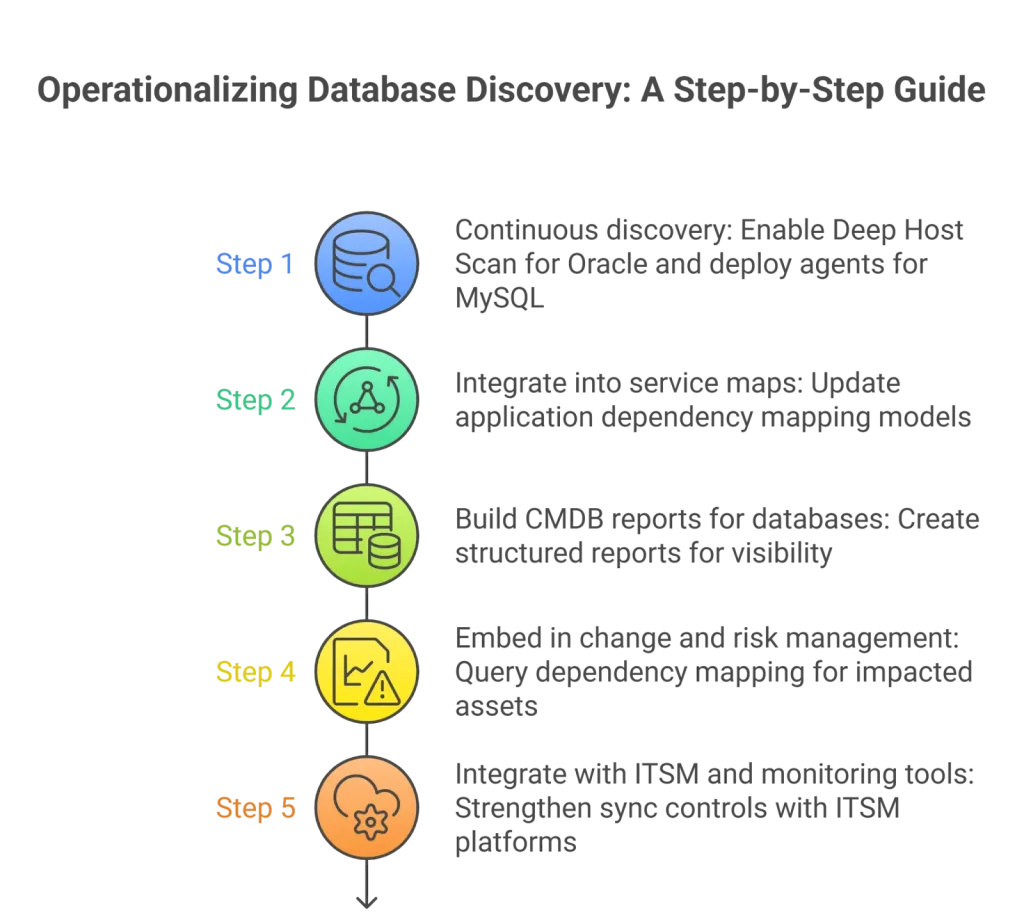
Step 1: Continuous discovery
- Enable Deep Host Scan for Oracle discovery
- Deploy agents for MySQL discovery
Schedule recurring scans and ensure new hosts are automatically included in scope.
Step 2: Integrate into service maps
Update application dependency mapping models to include database CIs:
Business Service → Application → Database → Host → Network/Storage
Validate relationships with DBAs and application owners.
Step 3: Build CMDB reports for databases
Create structured reports showing:
- All Oracle and MySQL instances
- Host servers and versions
- Ownership and status
Use these reports for:
- Executive visibility
- Audit preparation
- Patch and upgrade planning
Step 4: Embed in change and risk management
Before changes:
- Query database dependency mapping for impacted assets
- Include this context in approval workflows
After changes:
- Validate database services
- Confirm downstream service health
Use CMDB insights to flag:
- Databases supporting multiple critical applications
- Unsupported versions
- Single points of failure
Step 5: Integrate with ITSM and monitoring tools
Virima v6.1 strengthens sync controls with ITSM platforms such as ServiceNow and Ivanti, enabling:
- Accurate CMDB population
- Reverse sync where needed
- Better change, incident, and problem workflows
Integrate polling from your existing monitoring tools to configuration management database cmdb correlate alerts with database CIs for richer context.
Real-world scenarios: Database discovery in action
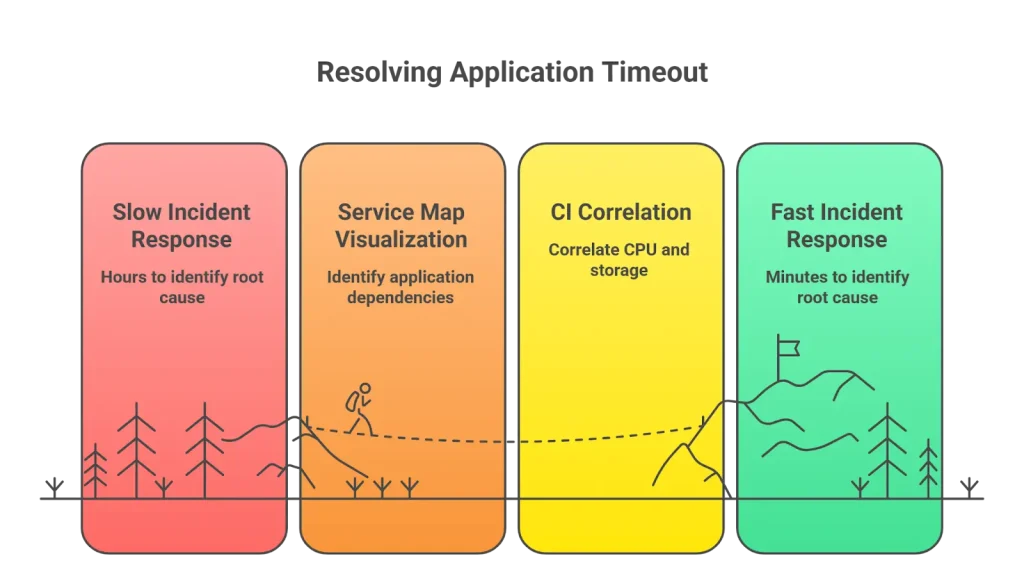
Scenario 1: Incident response for application timeout
Before discovery, teams chase logs and contact DBAs. With Virima 6.1, service maps show:
Application to Oracle Database to Server XYZ to Storage Array ABC
With ViVID active, incident responders see the open incident flagged directly on the Oracle Database CI, correlated storage latency on the upstream server, and all collects data affected downstream services in context, on the map. The root cause is visible in minutes because the data layer is no longer invisible.
Scenario 2: Planned maintenance on database host
Before discovery, a patch on a Linux server causes unexpected downtime for three applications.
With database discovery, change planners operating systems identify Oracle and MySQL instances running on the host. Impact analysis reveals dependent applications and services, enabling coordination and communication of planned downtime.
Scenario 3: License audit preparation
Before discovery, manual spreadsheets attempt to track Oracle instances. With Virima 6.1, teams generate CMDB reports showing installed versions, editions, and host locations — strengthening audit readiness and minimizing disruption.
Close the database visibility gap
Databases power every application and most outages. Yet historically, they remain underrepresented in CMDBs and service maps.
With Virima 6.1, enterprises gain:
- Robust database discovery for Oracle and MySQL
- Automatic CMDB relationships linking databases to hosts
- Broader discovery coverage across infrastructure, storage, networking, and cloud
- Better service mapping, incident response, change impact analysis, and license governance
- Strengthened security and integration with ITSM ecosystems
Database discovery is not optional. Without it, databases fail silently and when they do, the investigation starts from asset management itam scratch because the service management itsm CMDB has no record of what was running, where, or what depended on it.
If your CMDB is missing database visibility, schedule a Virima demo to see how Oracle and MySQL discovery work in your environment — and where your blind spots are.
Already using Virima? Verify that Deep Host Scan is enabled and deploy agent-based discovery to start uncovering databases across your estate today.
Frequently Asked Questions about database discovery in Virima 6.1
1. What is database discovery and why does it matter?
Database discovery is the automated identification and modeling of database instances within a CMDB, including their relationships to host servers and dependent applications. It matters because databases are critical service dependencies, yet they are often invisible in traditional discovery models.
2. How does database discovery improve incident response?
When database discovery is enabled, service maps include the data layer. This allows incident responders to immediately see whether an outage is tied to a specific Oracle or MySQL instance, its host server, or related infrastructure. As a result, root automate discovery cause analysis becomes faster and more precise.
3. How is Oracle database discovery performed in Virima 6.1?
Oracle database discovery uses Deep Host Scan. The scan incident management inspects running services, processes, and installed components on Windows or Linux servers. It detects Oracle instances even if they are not externally exposed and automatically creates CMDB relationships to the host server.
4. How does MySQL discovery work?
MySQL discovery uses agent-based discovery. A lightweight agent network devices installed on the server identifies MySQL instances and reports metadata such as version, installation path, and service status. The system then models the instance inside the CMDB with a “Runs On” relationship.
5. What are CMDB relationships in the context of databases?
CMDB relationships define how configuration items connect. For databases, the most critical relationship is “Runs On,” which links a database CI to its host server CI. These data sources relationships support accurate database dependency mapping and impact analysis.
6. How does database discovery support change management?
Before server patching or maintenance, teams can query the CMDB to identify which databases run on the host and which applications depend on them. This improves pre-change impact analysis and reduces unexpected downtime.
7. Can database discovery help with Oracle license audits?
Yes. Structured Oracle database discovery data flow provides authoritative reporting on versions, editions, and host locations. This strengthens audit readiness and reduces compliance risk.
8. How does database discovery improve application dependency mapping?
Application dependency mapping becomes complete only when databases are included. Database discovery ensures that service maps extend beyond application servers into the data layer, creating full-stack visibility.
9. Is agent-based discovery safe for production environments?
Modern agent-based discovery tools are lightweight and configurable. They are designed to operate safely in production without affecting database performance while ensuring consistent visibility.
10. How does database discovery fit into the broader Virima v6.1 release?
Database discovery is part of a broader visibility enhancement in v6.1, which includes expanded infrastructure discovery (networking, storage, cloud), stronger security controls, and improved ITSM synchronization. Together, these enhancements strengthen operational governance and CMDB accuracy across the enterprise.