Which IT Asset Management Software Is Best for Small, Mid-Size, and Enterprise Teams?

A 50-person IT team can run its laptop checkout off a free register for years and never feel the gap. Grow that same team to 500 employees and 2,000 devices, and the cracks show up at the worst time. A software audit can’t prove who owns what, or a change window gets delayed because nobody can confirm what a server actually touches. The jobs get harder well before the headcount looks “enterprise,” and buying the wrong tier either way costs real time. Choosing the best IT asset management software by company size starts with a decision matrix, not a ranked list. Fleet pace, discovery need, and audit cadence decide the right tier — company headcount alone will mislead you.
This page focuses on matching tiers to jobs across company sizes. For a broader tool-by-tool shortlist, use the live best IT asset management tools roundup. For lean-team buying notes aimed at smaller fleets, see asset management software for small business.
Selection criteria by company and fleet size
Company headcount is a rough proxy. The jobs below — not employee count — decide the tier. NIST defines IT asset management as managing the IT asset portfolio across the lifecycle. NIST’s SP 1800-5 practice guide shows why an authoritative inventory underpins security and operations use cases.
Score each shortlist against these jobs:
- Entry model: Can the team keep the register current without a backlog every week?
- Discovery need: Must new devices appear from scheduled scans or cloud connectors, or is manual entry still honest?
- Service desk handoff: Does incident and change work need CI-quality records, or only ownership tags?
- License and audit evidence: Do publishers or internal reviews need install and ownership proof on a calendar?
- Relationship depth: Do you need dependency maps after services are defined, or custody fields only?
- Governance: Who approves discovered items into the CMDB, and who owns each field after import?
When two tiers both look plausible, pick the higher tier on discovery and governance. Downgrading later costs more than starting one step up.
How do you choose ITAM software by company size?
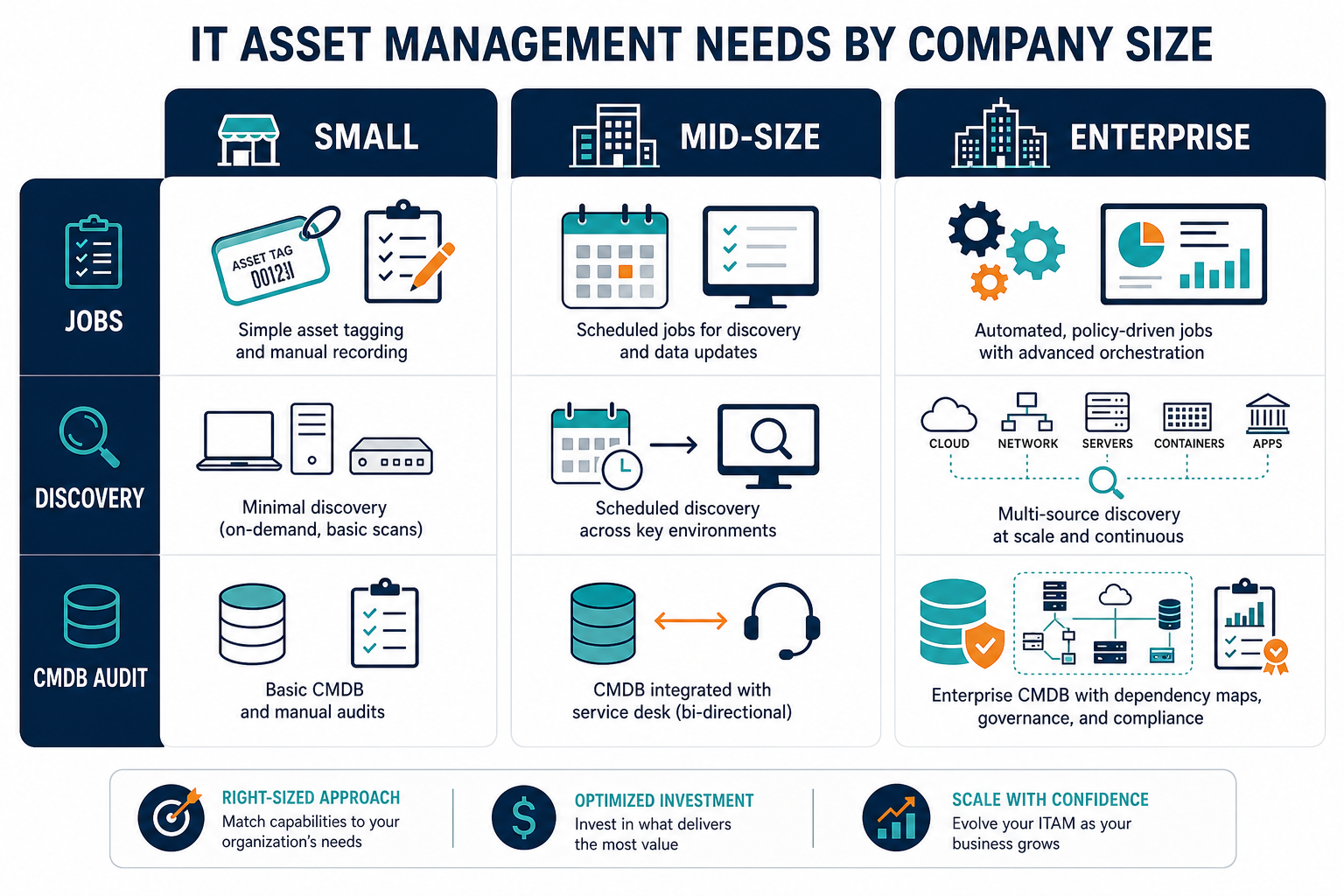
Match the tool to jobs, not headcount alone. Small teams often stay on free registers while fleets stay manual. Mid-size teams add scheduled discovery and desk links. Enterprise teams need CMDB governance, multi-source truth, and audit-ready evidence packs.
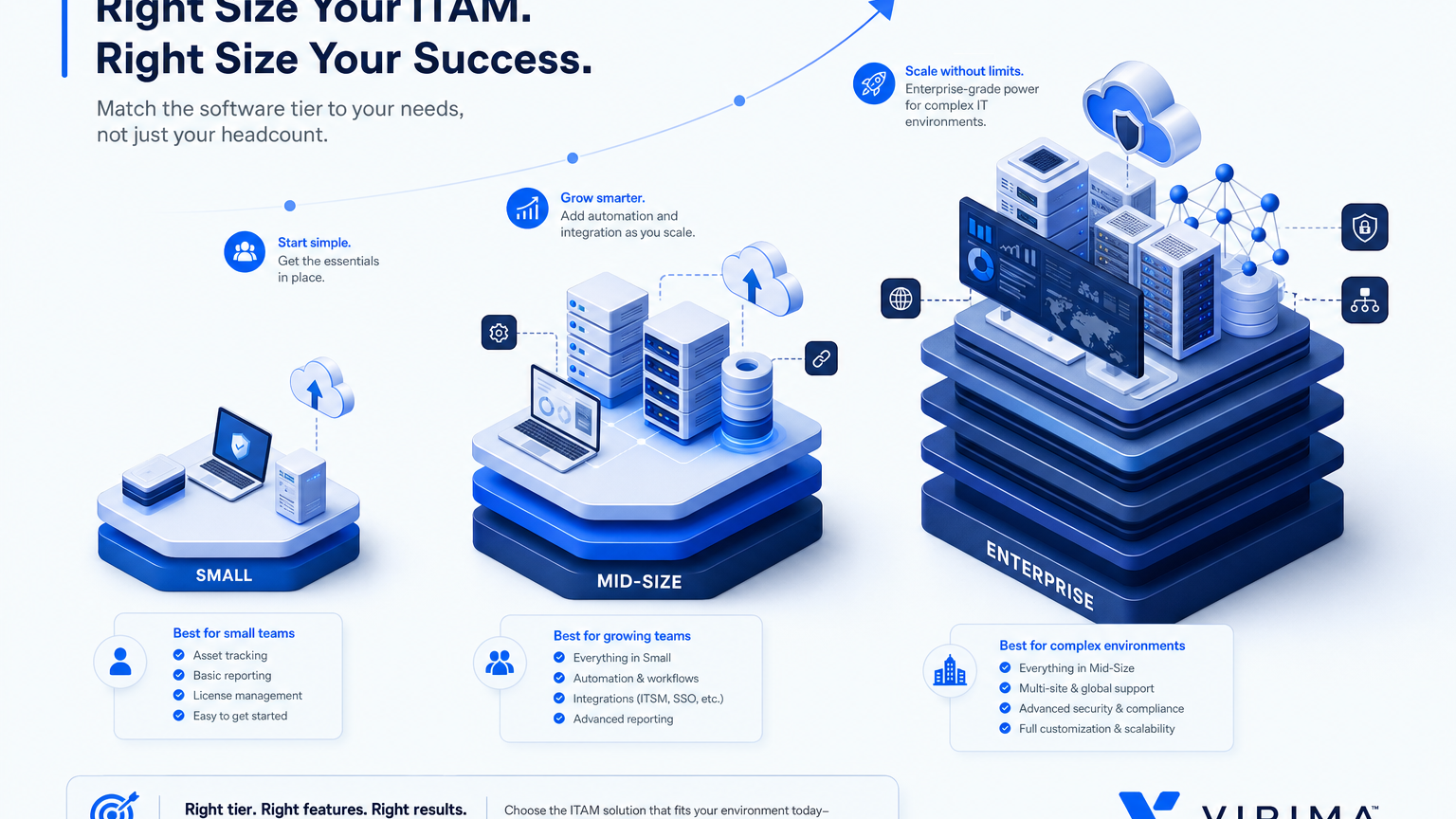
Small teams (needs, profile, example picks)
Profile: Few sites, limited cloud sprawl, one or two people who still touch every laptop assignment. Audits ask for ownership and purchase history more than live configuration maps.
Needs: Asset tags, checkout, status, simple reporting, export to CSV, optional barcode labels. Hosting can be self-managed open source or a free-tier commercial register if seat limits still fit.
Example picks (category, plain text): Snipe-IT, GLPI, and similar open-source or free-tier registers work while every change still passes through a human handoff. Spreadsheets remain acceptable only for pilots, not as the long-term source of truth under concurrent edits.
A 2026 Reftab survey of more than 300 IT decision-makers, most at small and mid-market organizations, found only 38.6% had an active system for tracking software assets at all. Of those that did, 47.5% still relied on spreadsheets rather than a dedicated tool (Reftab, State of Software Tracking 2026). That gap is exactly why a free register plus a spreadsheet passes as a stopgap at this size, but only as a stopgap.
When small stops being small: New hires and contractors outpace the register, remote gear never returns for tagging, or the first software true-up fails because install evidence is missing. At that point keep the free tool for custody labels if it still helps, and add discovery-sourced inventory for technical truth.
Mid-size teams (250 to 2,500 assets)
Profile: Multiple offices or heavy remote work, mixed endpoints and servers, a real service desk, and recurring license or security questions. Headcount often sits in the tens to low hundreds of employees, but asset count and change rate matter more.
Needs: Scheduled multi-source discovery, durable join keys (serial or cloud instance ID rather than hostname alone), a path from discovered items into governed records, and a clean handoff into the existing help desk. ITAM fields for ownership and purchase still matter because scans do not invent finance data. Virima’s ITAM layer holds that commercial context alongside discovery-sourced technical records.
Example picks (category): Discovery-led ITAM and CMDB platforms, or desk-adjacent inventory modules paired with a stronger discovery authority. Avoid register-only tools that force weekly spreadsheet rebuilds across sites.
The stakes are concrete, not theoretical. One documented case found 47 different publisher name variants for a single vendor across one estate, which silently fragmented license counts until normalization caught it (Virima, software normalization case study). Durable join keys and discovery-fed records catch that kind of drift before a renewal cycle, not a once-a-quarter spreadsheet reconciliation.
Where Virima fits in this band: Teams that want discovery, ITAM, and CMDB depth in one product path, including a right-sized full-platform option on Business Pro, without pretending a custody spreadsheet is enterprise configuration authority.
Enterprise IT (2,500+ assets and multi-domain estates)
Profile: Hybrid cloud, many owners, formal change boards, external audits, and ITSM platforms that expect CI quality. Asset counts often exceed a few thousand under active control, with software and cloud growing faster than hardware.
Needs: Multi-source discovery into a governed CMDB, clear field ownership, service definitions before dependency maps, integration to systems of engagement, and evidence that last-verified context is trustworthy. Governance often outweighs feature parity when two vendors look similar on slides. Virima’s CMDB is fed by multi-source discovery and reconciled against ownership and change history before anything counts as authoritative.
The audit stakes are real and rising. Flexera’s 2026 State of ITAM report found 48% of organizations were audited for software compliance in the past year, and 44% spent over $1 million on software audits across the past three years (Flexera, State of ITAM 2026). Unowned devices make that worse: one Virima-documented case found 12% of devices had no assigned owner at audit time (Virima, unowned IT assets and audit risk).
Example picks (category): Enterprise discovery and CMDB stacks, platform CMDB modules fed by authoritative discovery, and ITAM layers that reconcile commercial records to technical CIs. Full ITSM suites win when you are buying workflow breadth; best-of-breed discovery and CMDB win when the desk already exists and estate truth is the gap.
Virima integrates directly with ServiceNow, Jira Service Management, Ivanti, Halo, Xurrent, Hornbill, and TeamDynamix to enrich their records with discovery-sourced ground truth. It serves enterprises that need those runtime records, ITAM, and service mapping after services are defined, while those platforms stay systems of engagement. Connect through the integrations hub once, with partner names in plain text.
What do enterprise teams need from ITAM for audits?
Enterprises need authoritative inventory with durable identity, ownership, license evidence, and CMDB relationships that match change history. Auditors trust last-verified sources and clear field owners more than a static spreadsheet rebuilt the week before review.
Discovery-led vs. register-only requirements
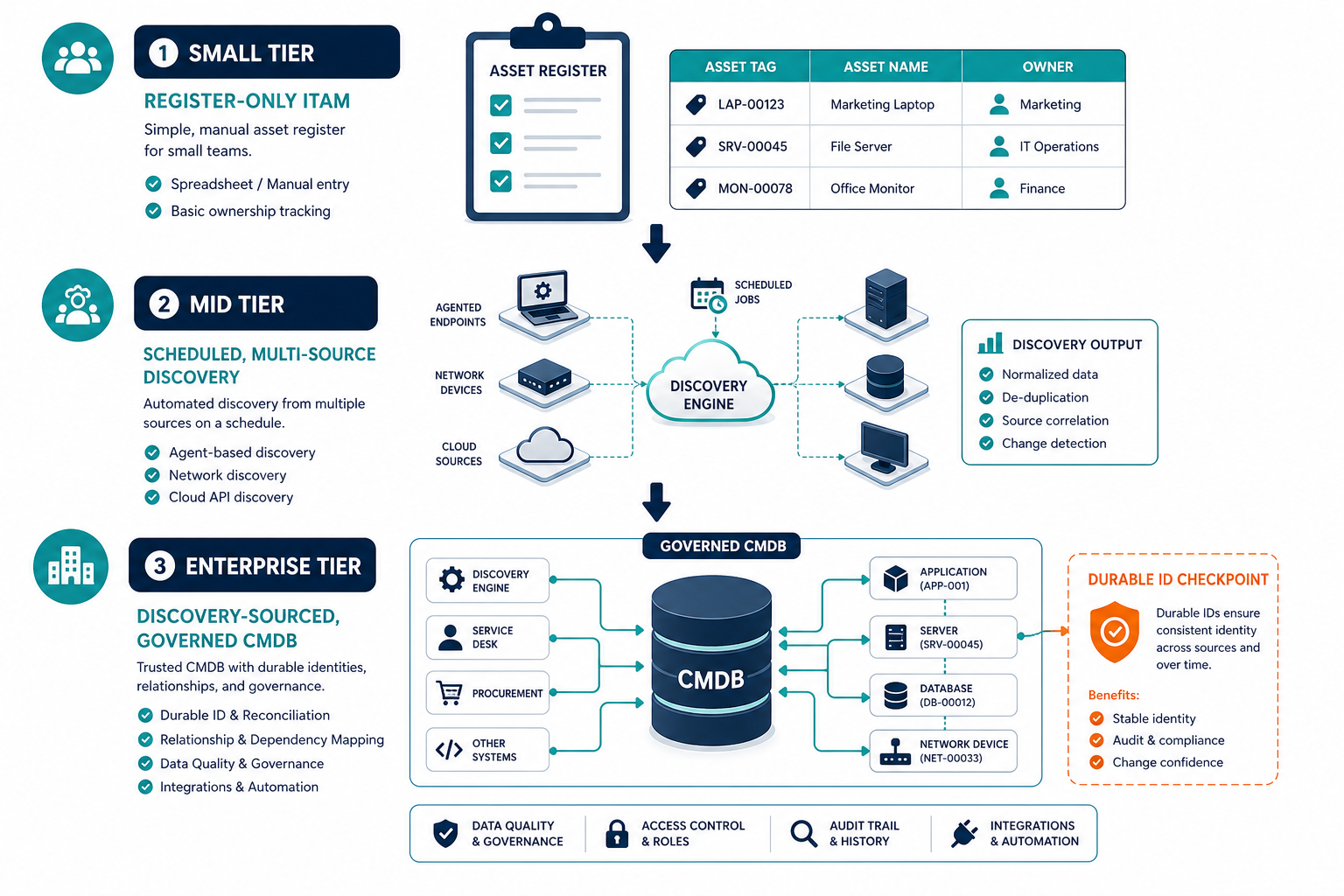
Register-only tools store what people type: tags, assignees, purchase notes, locations. They excel at custody. They fail when the network and cloud change faster than forms.
Discovery-led platforms run scheduled discovery cycles, stage candidates for review, and promote approved items into CMDB or inventory records with source tags. They still need human ITAM fields for cost and contract data a scan cannot invent. The same Reftab report puts a number on that gap: among teams that did track software, 47.5% relied on spreadsheets, and only 9.8% used a dedicated tool — the register-only pattern this section is built to flag.
In practice, choose register-only while three conditions hold: the team can keep every row current, audits accept ownership history without live config proof, and change work does not depend on dependency context. Choose discovery-led when any of those break for a full quarter.
Hostname is not a durable join key across rebuilds and cloud moves. Serial numbers and cloud instance IDs are. Whatever tier you buy, design identity before the first bulk import.
Where Virima fits
Virima is the discovery-fed ITAM and CMDB path for mid-size and enterprise teams that outgrew free registers but do not want estate truth locked inside a full suite purchase. Scheduled discovery feeds candidates. Approved items become configuration items with source and last-verified context. ITAM holds assignment and commercial fields. After your team defines business services, ViVID™ service maps provide blast-radius context for change risk evaluation.
Small teams can stay on free tools until the upgrade triggers fire, then migrate with export and pilot import rather than a weekend flip. See how Trusted Runtime Truth frames live, discovery-sourced estate records before you book time with the team.
Matching ITAM to your company size and need discovery-fed CMDB records your change process can trust? Walk a sample estate and see how Virima stages discovered items into governed CIs.
Size the jobs before you size the logo
Best IT asset management software by company size comes down to matching jobs, not logos. Small teams often win with free registers while fleets stay manual. Mid-size teams need discovery and desk-quality records. Enterprises need CMDB governance and audit-ready evidence.
Ready to test which tier your current list actually supports? Schedule a demo and bring one site export plus one network segment as the pilot scope.
Frequently Asked Questions
Which ITAM tool is best for 100 devices?
At roughly one hundred devices, a free or open-source register such as Snipe-IT is often enough if every change is still entered by hand. Move toward discovery-led ITAM when remote gear, cloud instances, or license checks outrun weekly updates.
Which has the best discovery for mid-size IT?
Mid-size IT needs scheduled multi-source discovery that stages candidates for review, durable identity keys, and a path into CMDB or inventory records the service desk can trust. Prefer platforms that separate discovered candidates from approved configuration items.
What do enterprise teams need for audits?
Enterprises need authoritative inventory, ownership, license evidence, and CMDB relationships tied to last-verified sources. Field ownership and change history matter as much as the raw asset count on the report.
Is company headcount enough to pick a tier?
No. Fleet pace, multi-site reach, cloud growth, license pressure, and audit cadence decide faster than employee count. Use headcount as a starting label, then score the jobs list in the selection criteria section.
Does Virima work for a company that hasn’t outgrown its free asset register yet?
Yes — teams can stay on a free register for custody while piloting Virima’s discovery against one network segment, so identity and CI fields are already correct before a full migration is needed.