47 Publisher Name Variants for the Same Vendor: How Software Normalization Broke Our License Counts

| Software publisher normalization in ITAM maps all vendor name variants to a single canonical identifier across entitlement records and discovery scan data. When normalization fails, one vendor can appear under dozens of names, making accurate license reconciliation impossible. This article walks through a real case where 47 name variants for a single vendor caused a hidden 72-seat compliance gap — and what a six-week fix revealed. |
Software publisher normalization in IT asset management maps all name variants for a single software vendor to one canonical identifier. Registry strings like “Adobe Systems Incorporated” and invoice entries like “Adobe Inc.” resolve to the same record, applied consistently across entitlement records and discovery scan results. Without normalization, license reconciliation breaks down structurally. The same vendor appears under dozens of names, making it difficult to calculate an accurate effective license position (ELP) — the real-time count of entitlements owned versus installations active.
One enterprise software inventory export we analyzed showed 47 distinct publisher name entries for a single vendor. This is a software publisher normalization problem, and in ITAM, it is more common than most teams realize.
| What is software publisher normalization in ITAM? Software publisher normalization maps all variant name strings for a single software vendor to a single canonical identifier, then applies that identifier consistently across both entitlement records and discovery-sourced installation data. Without normalization, the same vendor appears under multiple names, making it impossible to calculate an accurate license position for any of their products. |
How 47 Became the Number
Software inventory data accumulates from multiple sources. Discovery scans pull publisher names from Windows registry entries, MSI metadata, and application strings. Different versions of the same application report themselves differently. Different packaging formats produce different name strings. Procurement enters publisher names manually into ITAM when processing purchase orders, and spelling conventions shift across team members and years.
Whether teams use agent-based or agentless discovery, the raw output is the same: publisher strings from whoever packaged the software, not from a controlled normalization layer. Without that layer, fragmentation is the default outcome.
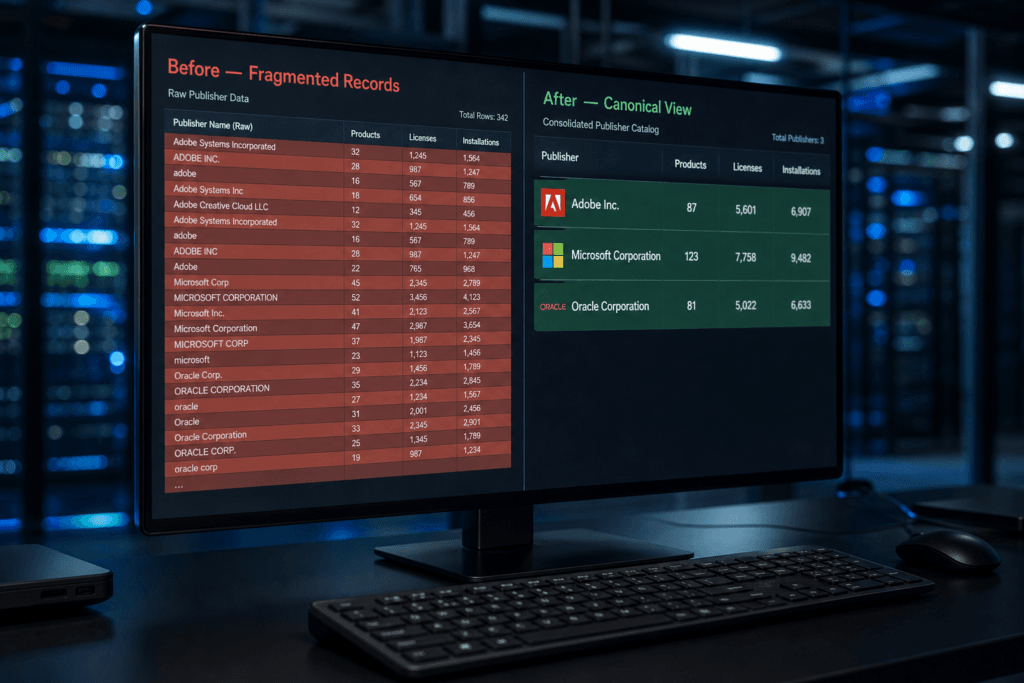
When we traced the 47 Adobe variants in our ITAM system, we found:
- 9 variants of “Adobe” as a standalone publisher name
- 7 variants of “Adobe Systems” with and without punctuation
- 6 variants of “Adobe Systems Incorporated” with different capitalization and abbreviation patterns
- 5 variants of “Adobe Inc.” created after the corporate name change in 2018
- 4 variants of “Adobe Systems Inc” with inconsistent comma and period placement
- 16 product-specific strings where the product name appeared in the publisher field rather than the normalized publisher name
Combined: 47 line items representing a single publisher’s product portfolio.
| Fragmented publisher records produce three compounding ITAM problems: overcounted entitlements, underreported installations, and blocked license reconciliation. Each error makes the others worse, leaving your effective license position unreliable across every reconciliation cycle. |
What the Fragmented View Was Hiding
The 47-line-item view of our Adobe estate gave us a fragmented picture of what we owned, what was installed, and what our license position actually was. Three specific problems came from that fragmentation.
The BSA | The Software Alliance Global Software Survey finds that software audit exposure is highest in organizations where asset inventory data comes from multiple uncoordinated sources. Publisher name fragmentation creates exactly that condition.
Overcounting Entitlements
When procurement entered each Adobe renewal under a different name format, the ITAM system created separate entitlement records for each. Our actual Creative Cloud entitlement was 890 seats, but it appeared as four separate records across inconsistently named publisher entries. Any query filtering by publisher name against a single variant returns a partial count.
Underreporting Installations
IT discovery scans reported installations against the publisher name string pulled from the registry. The same physical installation might report as “Adobe Inc.” on one machine and “Adobe Systems Incorporated” on another — the discrepancy depended on which application version the scanner found. That mismatch made aggregated installation counts by publisher unreliable. The same product appeared under multiple names.
Blocked License Reconciliation
To calculate an ELP, both datasets must share the same publisher identifier. With 47 variants, any reconciliation job matched only a fraction of installations to the corresponding entitlement record. The remaining records had no matching entry on either side. This created the impression of large over-licensed and under-licensed positions, but the root cause was a normalization problem, not a compliance problem.
The Normalization Project
We ran a 6-week software catalog normalization project. The scope covered our full software inventory: 8,400 distinct software titles from IT discovery scan results, matched against 2,300 entitlement records in ITAM.
The normalization methodology:
- Export all publisher name strings from discovery data and from ITAM entitlement records
- Cluster variants using fuzzy string matching, grouping strings with edit distance below a defined threshold
- Review each cluster manually and assign a canonical publisher name from an authoritative reference
- Map all variants to the canonical name in a publisher alias table
- Reprocess all ITAM entitlement and discovery records against the alias table
Results: From 3,200 Raw Entries to 847 Canonical Publishers
The result was 847 distinct publishers, down from what had appeared to be 3,200 when counting raw variants. Our 47 Adobe entries resolved to 1 canonical publisher record with 23 distinct product lines. For the first time, we had a clear picture of our entire Adobe software portfolio.
The Flexera 2024 State of ITAM Report found that organizations with unnormalized software catalogs average 3.8x more publisher variants than canonical publishers, with effective license position errors exceeding 35% on major enterprise titles. For teams building systematic normalization practices, Top Software License Management Tools in 2026 covers the automation options available.
What the Normalized Position Actually Showed
After normalization, we ran the license reconciliation again. The reconciliation revealed the true Adobe position:
- Creative Cloud: 890 seats licensed, 847 active installations, 43 seats over-licensed
- Acrobat Pro: 340 seats licensed, 412 active installations, 72 seats under-licensed
- Adobe Sign: 60 seats licensed, 21 active installations, 39 seats over-licensed
- Stock (individual): 12 seats licensed, 12 active installations, at parity
The pre-normalization view had shown three Creative Cloud line items with inconsistent seat counts, two Acrobat Pro records, and no Sign entries at all. The normalized view revealed a clear Acrobat Pro compliance gap. We purchased 72 seats immediately at renewal pricing to close the under-licensed position before the upcoming audit window.
Without normalization, we would have entered the Adobe renewal negotiation blind. The Acrobat Pro gap would have been a material liability at the next vendor audit.
Trusted Runtime Truth applies directly here. The same data source must drive both entitlement records and installation counts, with a consistent publisher identifier across both. When discovery data and ITAM entitlement data share a normalized catalog, license reconciliation becomes a query, not a cleanup project.
| Publisher name variants accumulate because software inventory data comes from multiple sources, each with its own naming conventions. Discovery scans read raw registry strings. Procurement enters names manually. Vendors change their own corporate names across renewal cycles. Without a publisher alias table enforced at data entry, variants grow with every scan, every purchase order, and every renewal. |
Why This Happens and How to Prevent It
Software publisher normalization fails for a structural reason: software inventory data comes from multiple systems, and none of them shares a publisher reference by default.
Three Sources, No Shared Reference
Discovery scans pull publisher names from OS registry entries — strings written by whoever packaged the software. Procurement enters publishers manually into ITAM, following their own spelling conventions. Vendors send electronic software delivery receipts using whatever name applied to that product version, which may have changed across contract cycles. No single source corrects the others. Variants accumulate one scan and one purchase order at a time.
Enforcing Normalization at Data Entry
Preventing accumulation requires a publisher alias table that all data inputs check against. Every new discovery result and purchase order must match the alias table before entering ITAM. New publisher names that fail to match an existing entry should trigger a review, not create a new record. The CMDB best practices that govern configuration item data quality apply the same principle: one authoritative record per entity, enforced at the point of data entry.
Our CMDB now enforces publisher name validation at ingestion. The system normalizes discovery results before they reach ITAM records. Purchase orders route through a matching step that blocks new variants when a canonical entry already exists.
The Jira Service Management tickets we opened during normalization took 6 weeks to work through. Maintaining the alias table going forward takes roughly 4 hours per month. The difference in license position accuracy is significant.
| Why do software vendors appear under multiple names in ITAM systems? Software publisher names accumulate as variants because they come from multiple inputs: OS registry strings written by software packagers, manual procurement entries with inconsistent conventions, and vendor invoices that may reflect name changes across contract cycles. Without a publisher alias table enforced at data entry, each source creates its own variant, which aggregates into dozens of entries for a single vendor. |
| How does unnormalized software data affect license compliance? Unnormalized software data makes license reconciliation unreliable because entitlement records and installation counts cannot join on a consistent key. Queries filtering by publisher name return partial counts. Automated reconciliation jobs match only the variants they recognize, leaving large shares of both entitlements and installations without a match. The resulting compliance report reflects data fragmentation, not actual compliance status. |
| What is a publisher alias table in software asset management? A publisher alias table maps all known name variants for a software vendor to a single canonical identifier. It functions as a normalization layer for all data inputs — discovery scan results, purchase orders, and software delivery receipts. When every data source maps to the same canonical publisher name, entitlement and installation data join accurately for license reconciliation. |
Normalization as an Ongoing Process
The 6-week normalization project fixed the historical backlog. Keeping it fixed required a process change: publisher name validation at data entry, enforced by a maintained alias table. Without that enforcement layer, the variants accumulate again — one registry string, one manual PO entry, one vendor invoice at a time. Software asset management normalization is a process discipline, not a one-time cleanup.
Before entering any major software renewal negotiation, ask one question: how many entries does your ITAM system show for this vendor? If the answer is more than one per product line, normalize before you negotiate. That cleanup is easier now than mid-cycle. How to Make the Best Out of Your IT Discovery Tool covers how discovery-sourced data anchors ITAM catalog accuracy.
Accurate license reconciliation starts with normalized publisher data. Explore how Virima’s discovery layer keeps your software catalog clean at the source.
FAQ: Software Normalization and ITAM Accuracy
How many publisher name variants is normal for a large enterprise ITAM system?
The Flexera 2024 State of ITAM Report found that organizations with unnormalized catalogs average 3.8 variants per canonical publisher. For an estate with 800 distinct software publishers, that implies approximately 3,000 raw publisher name strings in the ITAM system. In practice, most normalization projects reduce publisher counts by 60 to 75 percent from raw inventory counts. ServiceNow, Ivanti, Halo, Jira service management, Hornbill, Xurrent.
Can discovery tools help with software normalization?
Discovery tools that include a software recognition library normalize publisher names at the point of scan rather than passing raw registry strings to ITAM. Recognition library quality determines how much manual normalization is still required. Libraries updated regularly and that include corporate name change history significantly reduce manual cleanup.
How does software normalization affect vendor renewal negotiations?
Normalization gives procurement teams an accurate, auditable picture of total spend with a single vendor across all product lines. It is the prerequisite for meaningful volume discount negotiations, license consolidation conversations, and enterprise agreement restructuring. Teams arriving at renewal negotiations with fragmented publisher records often cannot answer basic questions about their total spend with that vendor.
What is the difference between software normalization and software recognition in ITAM?
Software recognition identifies what application is installed — matching an executable or file signature to a known product. Software normalization standardizes the publisher and product name strings so they match consistently across all data sources. Recognition tells you what software exists. Normalization ensures it appears under one consistent name in every entitlement and installation record.
How does software publisher normalization affect vendor audit readiness?
A vendor audit checks whether installation counts match entitlement records. If those records use different publisher name strings, the audit comparison fails before you can demonstrate compliance. Normalized publisher data gives your ITAM system a single, defensible ELP that aligns with what the auditor sees — cutting audit preparation time and removing gaps that stem from data fragmentation rather than actual under-licensing.
What role does the CMDB play in software publisher normalization?
The CMDB holds the authoritative record of what software sits on each configuration item (CI). When the CMDB enforces a normalized publisher catalog at data entry, every software record on a CI carries a canonical publisher identifier. That consistency flows through to ITAM license reconciliation automatically. Without CMDB-level enforcement, normalization becomes a periodic cleanup exercise rather than a structural property of the data.
Does Virima’s discovery normalize publisher names before writing to ITAM?
Yes. Virima’s IT discovery maps registry strings to canonical publisher names before surfacing results in the ITAM module. This stops variant accumulation at the point of scan rather than requiring a downstream cleanup project.
What is the first step to fix a software catalog that already has thousands of publisher variants?
Start with your highest-spend vendors — the top 20 by annual contract value — and run variant clustering for those publishers first. Resolving normalization for the top 20 typically covers 60 to 70 percent of license risk by dollar value, even though it covers only 2 to 5 percent of catalog entries by count. This gives procurement teams accurate position data for the renewals that matter most while the broader project continues.
Clean Publisher Data Before Your Next Renewal Negotiation
Software publisher normalization in ITAM is not a one-time project. It is an ongoing discipline that determines whether your license reconciliation is trustworthy. The 47-variant problem is preventable — but only if normalization is enforced at the point where data enters the system, not corrected in the weeks before a vendor audit.
Get live, explainable runtime truth across your entire software estate, without replacing your existing ITSM stack.
Virima’s discovery normalization keeps your ITAM publisher catalog clean at the source, so every renewal negotiation starts with an accurate position.