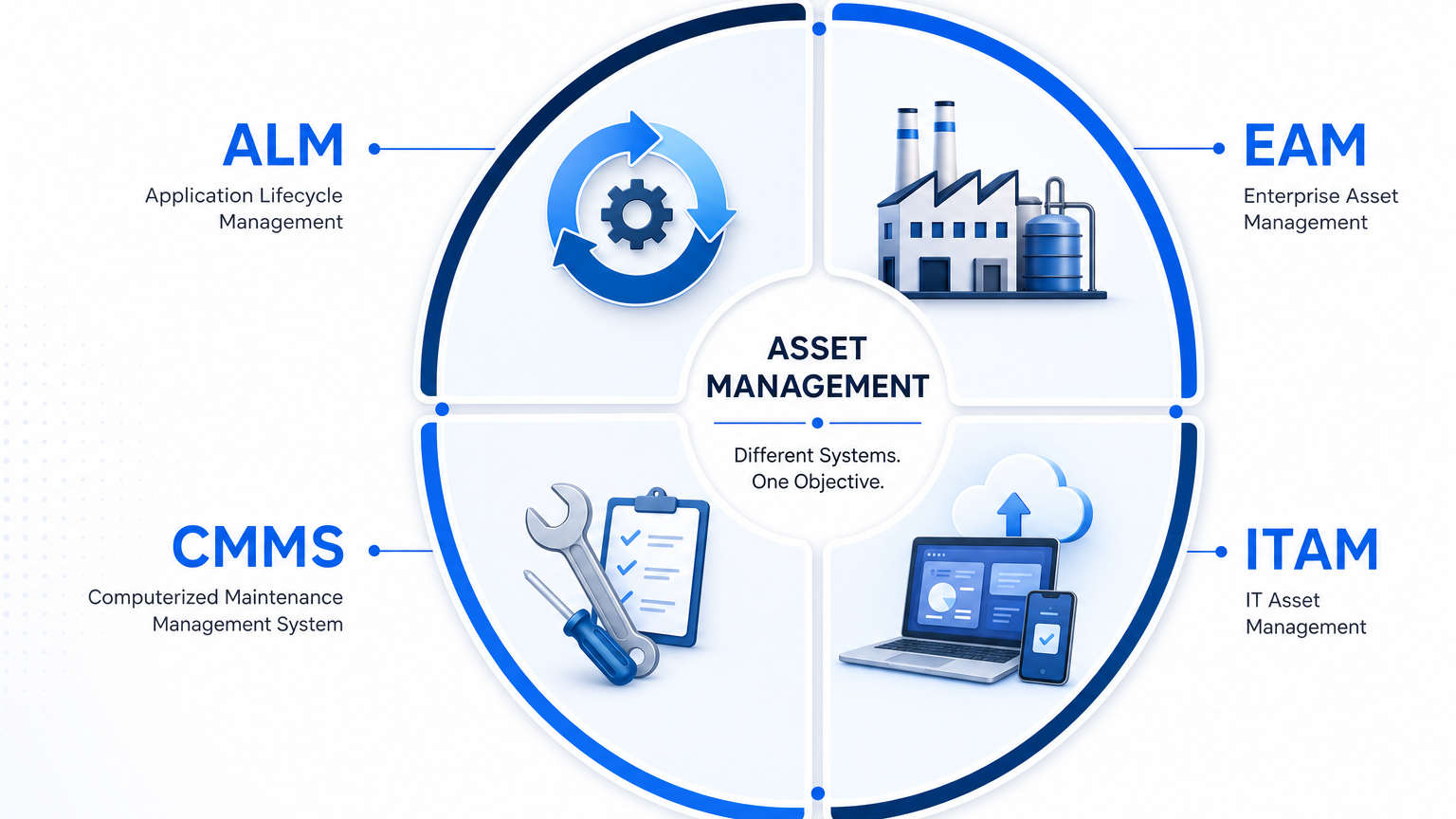
What Is the Difference Between ALM, EAM, CMMS, and ITAM?

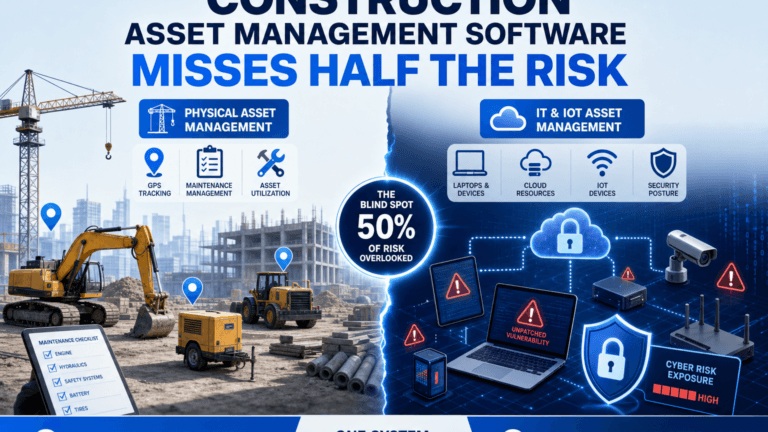
A facilities team requests a CMMS to manage pump and chiller work orders. An IT team requests a platform to track laptops, software licenses, and cloud instances. Procurement sees the word “asset” in both requests, folds them into one RFP, and six months later the organization owns a tool that cannot do either job well. That mismatch is exactly why IT and facilities leaders need the difference between ALM, EAM, CMMS, and ITAM settled before they shortlist vendors, not after the demo. ALM is the practice; CMMS, EAM, and ITAM are the systems that execute it for different asset types.
This page is the category map; for a vendor roundup inside the IT lifecycle software lane specifically, see the existing asset lifecycle management software list.
ALM vs EAM vs CMMS vs ITAM: one-paragraph definitions
Asset lifecycle management (ALM) is the practice of governing an asset from planning and acquisition through operation, maintenance, and disposal. Industry explainers treat ALM as the end-to-end discipline, not a single product SKU. IBM’s asset lifecycle management overview frames ALM as maximizing value and controlling risk across that full span. For how this plays out specifically on the IT side, see Virima’s guide to IT lifecycle management.
Enterprise asset management (EAM) is the software and process stack for capital-intensive physical assets: production lines, facilities equipment, fleets, and plant infrastructure. EAM typically covers work management, reliability, inventory of spare parts, and financial performance of those assets. IBM’s enterprise asset management overview positions EAM as the system of record for those industrial and facilities assets across their useful life.
Computerized maintenance management system (CMMS) is the work-order and maintenance execution layer. Technicians open jobs, pull parts, record labor, and close work against assets. IBM’s CMMS overview describes CMMS as the toolset for scheduling and documenting maintenance so equipment stays available. Many organizations run CMMS first, then grow into broader EAM.
IT asset management (ITAM) is the practice of accounting for IT hardware, software, cloud resources, and related contracts so finance, security, and operations share one controlled view. NIST’s glossary defines IT asset management as managing the IT asset portfolio across the lifecycle. NIST’s SP 1800-5 practice guide further shows how IT asset management supports security and operational use cases with an authoritative inventory. ITAM is also a narrower, more specific job than general inventory tracking; see the difference between ITAM and inventory management for that distinction. Enterprise asset management, by contrast, stays scoped to physical capital assets and rarely touches software licenses or cloud spend at all.
How much IT asset visibility do organizations actually have?
SaaS visibility rose from 50% to 66% of organizations between 2025 and 2026. Complete IT asset visibility across hardware, software, and cloud still sits at just 36%, according to Flexera’s 2026 State of ITAM Report.
Virima’s product lane is ITAM plus discovery and CMDB depth for that IT portfolio. It is not a plant CMMS or a full industrial EAM suite.
What is the difference between ALM, EAM, CMMS, and ITAM?
ALM is the full acquire-to-retire practice. CMMS software runs maintenance work orders on physical equipment. EAM extends plant and facilities assets with cost and performance controls. ITAM governs IT hardware, software, cloud resources, and licenses. Pick the system that matches asset type and the jobs your teams actually run.
4-column market map (scope, typical assets, example vendors, when to choose)
Use this table as a buying filter for the enterprise asset management vs ITAM split procurement teams blur most often. Vendor names are category examples only. Partner and competitor product names stay plain text.
| Category | Scope | Typical assets | When to choose |
|---|---|---|---|
| CMMS | Maintenance execution | HVAC units, pumps, production machines, facility equipment | You need work orders, PM schedules, and technician close-out first |
| EAM | Plant and capital asset performance | Same physical base plus cost, reliability, and investment views | You outgrew work-order-only CMMS and need lifecycle cost on industrial assets |
| ITAM | IT portfolio control | Laptops, servers, network gear, software seats, cloud instances | You need inventory, licenses, ownership, and compliance evidence for IT |
| ALM (practice) | End-to-end lifecycle policy | Any asset class under a shared lifecycle model | You are designing process across domains; software still splits by asset type |
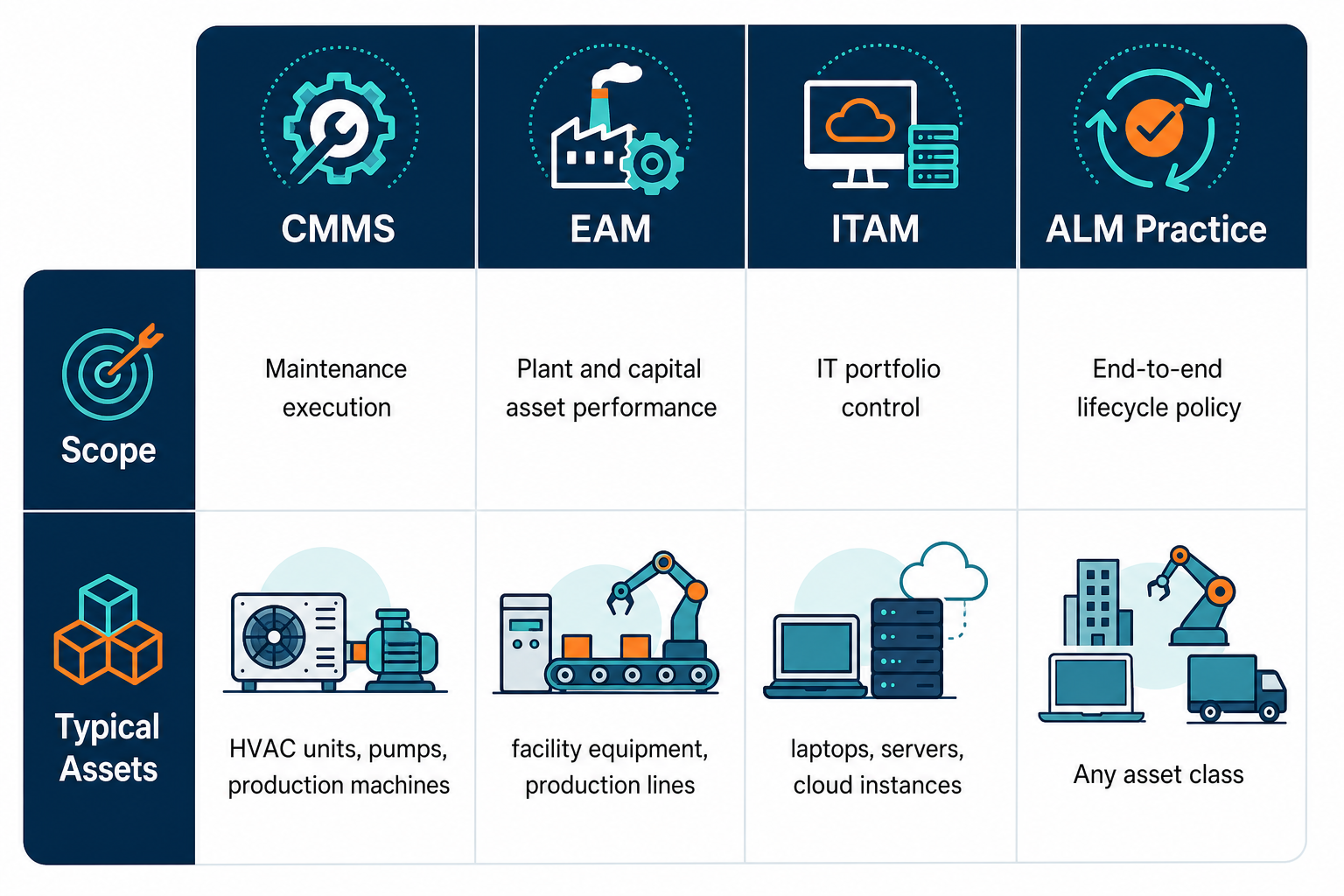
Example vendor families differ by column. Plant and facilities buyers often evaluate Maximo-class EAM or CMMS stacks. IT buyers evaluate ITAM and discovery platforms, service desk CMDB modules, and hybrid cloud inventory tools. Crossing those shortlists without renaming the job creates failed RFPs and unused licenses.
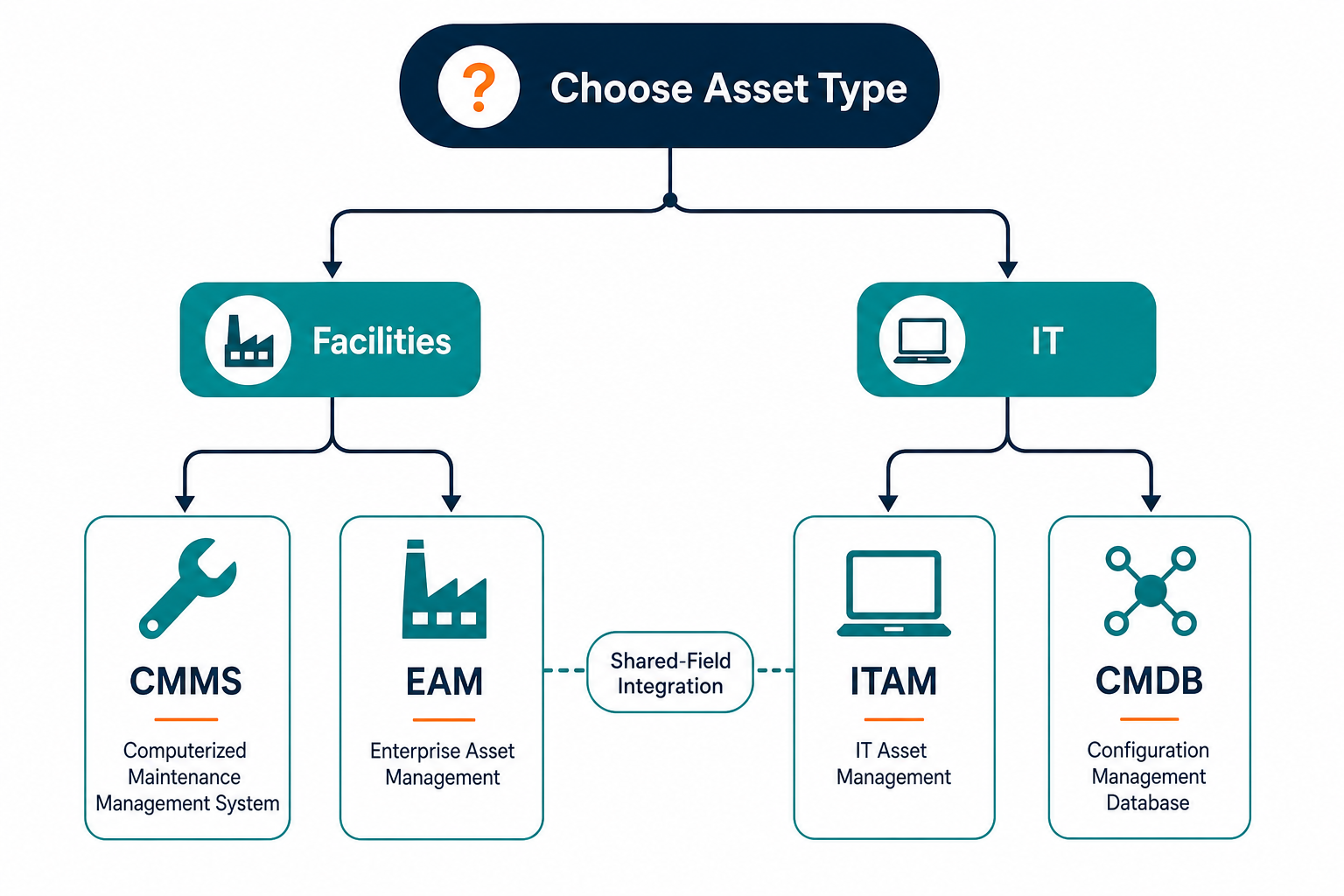
Decision tree: facilities vs IT vs mixed
Start with the asset that fails if the system is wrong — the CMMS vs IT asset management split is usually the fastest way to tell which track you’re on.
- Is the primary pain a broken pump, chiller, or production line? Choose CMMS, then EAM if you need capital and reliability analytics on that plant fleet.
- Is the primary pain unknown laptops, cloud sprawl, license true-ups, or stale CMDB records? Choose ITAM with discovery into a governed CMDB.
- Do facilities and IT share a badge reader, OT gateway, or building network? You still need two systems of record with a narrow integration for shared identity and location fields. Do not force one plant EAM to own software licenses, and do not force ITAM to own mechanical work orders.
- Is procurement asking for “one asset platform for everything”? Split the RFP by asset class and lifecycle jobs. ALM policy can be shared across domains while the operational systems usually cannot collapse into one product.
Mixed estates fail when hostname or badge ID is treated as the only join key across OT and IT. Durable keys such as serial numbers and cloud instance IDs matter on the IT side. Tag and location standards matter on the facilities side. Map those keys before any bulk import.
Do I need a CMMS for IT assets?
A CMMS is built for maintenance work on physical plant and facilities equipment. IT assets need ITAM for inventory, licenses, and ownership, plus discovery and CMDB depth when change and incident teams must trust configuration. Use CMMS beside ITAM when facilities and IT share a site, not as a substitute for ITAM.
Where IT and OT overlap
Operational technology (OT) and industrial IoT sit on the boundary. Controllers, sensors, and gateways are physical assets facilities or plant teams maintain, and they are also network-connected devices security and IT must inventory. That overlap is why both EAM and ITAM appear in the same architecture diagram.
A workable pattern keeps CMMS or EAM as the maintenance system of record for the mechanical and process asset. ITAM plus discovery then serves as the system of record for the network identity, firmware, software, and connectivity path. Shared fields might include location, criticality, and owner. Each system still owns the attributes only it can verify.
Virima can discover and track network-reachable IT and many connected devices that answer scans or agents, then hold them as configuration items when they fall under change control. It does not replace a plant CMMS for work-order culture on pumps and conveyors. For IoT or OT devices that never appear on IT segments, expect a facilities or OT inventory feed rather than assuming every sensor lands in ITAM automatically.
Where Virima fits (ITAM / IT ALM only)
Virima sits in the ITAM and IT lifecycle column. Scheduled multi-source discovery feeds candidates for review. Approved items become configuration items in the CMDB with source tags and last-verified context. ITAM covers assignment, financial fields, and license-oriented records a scan cannot invent.
After your team defines business services, ViVID™ builds dependency maps from those definitions plus discovery data for blast-radius context.
ITSM platforms such as ServiceNow, Jira Service Management, Ivanti, HaloITSM, Xurrent, Hornbill, and TeamDynamix remain systems of engagement for tickets and workflows. Connect them once through the integrations hub instead of per-platform pages. Product capability detail for the ITAM module lives on the IT asset management feature page.
If your shortlist is still full of plant EAM suites because the RFP said “enterprise assets,” rewrite the scope to IT hardware, software, cloud, and CMDB relationships. That is the lane where discovery-sourced runtime records matter for agentic and automated IT work. See how Trusted Runtime Truth frames live, explainable estate data before you book a walkthrough.
Need ITAM and CMDB depth for hardware, software, and cloud without buying a plant EAM suite? Walk a sample IT estate and see discovery-fed records your change process can trust.
Pick the category before the vendor
ALM is the shared lifecycle practice. CMMS software runs maintenance work on plant equipment. EAM extends plant and facilities performance management. ITAM governs the full IT portfolio under change and audit pressure.
Virima covers ITAM and the IT side of asset lifecycle with discovery and CMDB depth, not industrial work-order execution.
When the category is clear, vendor demos stop talking past each other. Bring one facilities failure mode and one IT failure mode to the next internal review, then shortlist only the systems that close those jobs.
Frequently Asked Questions
Is ALM software the same as EAM?
ALM is the lifecycle practice from acquire through retire — no vendor sells “ALM” as a single product. EAM is the enterprise software most teams buy to execute that practice for capital-intensive physical assets. If a vendor demo during an “ALM” evaluation only shows maintenance work orders and equipment costs, that’s an EAM product being positioned for the search term, not a distinct category — a useful tell when shortlisting.
Do I need a CMMS for IT assets?
No for pure IT inventory and license control. CMMS fits maintenance work on physical plant equipment. IT assets need ITAM, and often discovery plus CMDB, so configuration and ownership stay trustworthy for change and audit work.
Can ITAM handle IoT or OT devices?
ITAM can hold network-reachable connected devices that discovery or agents can verify, especially when they fall under IT change control. Mechanical and process assets still belong in CMMS or EAM for work orders. Shared location and criticality fields bridge the two without forcing one system to own both jobs.
Does Virima combine CMDB and ITAM in one platform, or are they separate modules?
Virima runs CMDB and ITAM as part of one platform rather than separate products. ITAM data — ownership, licenses, cost — and CMDB data — configuration items, relationships, last-verified source — live in the same estate view, so finance and operations work from one record instead of reconciling two systems.
Does Virima replace Maximo-class plant EAM?
No. Virima targets IT discovery, ITAM, and CMDB depth for hardware, software, and cloud. Plant maintenance and industrial EAM remain separate systems when those jobs are real, with optional shared fields for mixed sites.