Agentic AI Governance for IT Operations: Boards Own the Risk. Who Owns the Failure?

Agentic AI governance for IT operations now decides who answers when an autonomous agent changes production. IBM surveyed 3,221 executives across EMEA in September 2026 and found 98% have board-level responsibility for AI risk, yet no single role was named by more than 17% for adverse outcomes from AI agents. Eight in ten say an AI incident reached the board or C-suite in the past year. With 35% already running agentic AI in production and 75% expecting agents to hold some decision autonomy by 2027, the gap between board oversight and a named owner has become the central governance problem for CIOs and CTOs.
What Is Agentic AI Governance for IT Operations?
Agentic AI governance for IT operations is the system of decision rights, escalation paths, evidence, and containment that controls what autonomous agents can do to production services. The NIST AI Risk Management Framework frames governance through Govern, Map, Measure, and Manage functions that fit IT operations well because every agent action maps to a service, a change, and an owner. ISO/IEC 42001 adds the management system discipline for defining accountability and reviewing performance over time, while ITIL 4 supplies the service ownership and change enablement practices that make those decisions enforceable during delivery.
IBM asked executives what capabilities will matter as autonomy grows. Vendor liability frameworks led at 33%, followed by defined human escalation thresholds at 32%, monitoring and audit trails at 30%, and the ability to pause agent activity across the enterprise at 29%. A named owner for each agent and each service is the fifth requirement that makes the other four work, because thresholds, evidence, and pauses all depend on knowing who decides and who is accountable.
Where board oversight ends
| Situation | Outcome the review needs |
|---|---|
| The board names an AI risk owner | Risk responsibility is assigned at the top of the organization |
| An agent changes a production service | The review asks which service changed, what depended on it, and who owned it |
Board oversight assigns responsibility for risk. Operating accountability names the person who approves the specific change and answers for the specific service when that change causes harm.
What IBM Surveyed Executives Reported
IBM and Censuswide surveyed organizations with 1,000 or more employees in the United Kingdom, France, Germany, Italy, Spain, the Netherlands, Saudi Arabia, and the UAE from 14 to 24 September 2026. The IBM EMEA study describes EMEA findings, so every figure below carries that scope. See the full IBM report (PDF) for the complete data. Twenty-six percent govern through a dedicated committee, and 40% changed governance policy after an incident.
The pattern is consistent. Oversight is nearly universal, incidents reach the top quickly, and accountability for the specific agent failure stays diffuse. That diffusion is where IT operations must respond, because the next four breaks all surface inside the estate that IT already runs every day across services, changes, and ownership records. Explore Trusted Runtime Truth for the discovery-sourced context that supports those answers.
Why Agentic AI Governance Is Important for IT Teams
Thirty-five percent of surveyed organizations already run agents in production while 75% expect some decision autonomy by 2027, yet only 37% say governance scales with deployment. Fifty-six percent continue deploying within agreed risk limits while only 33% pause to wait for stronger controls. Deloitte found in January 2026 that 21% of 3,235 IT and business leaders across 24 countries report a mature governance model for agentic AI, which confirms that most teams are scaling agents before the operating model is ready. Gartner forecast in June 2025 that more than 40% of agentic AI projects could be canceled by the end of 2027 over cost, unclear value, or inadequate risk controls.
Clear ownership predicts higher governance maturity. McKinsey reported in March 2026 that organizations with clear ownership for responsible AI average a maturity score of 2.6 against 1.8 for those without an accountable function, based on about 500 organizations surveyed from December 2025 to January 2026. KPMG found in June 2026 that accountability for AI-driven business decisions is split across the C-suite in United States enterprises above 1 billion dollars in revenue, which shows the gap extends beyond EMEA. As AWS CEO Matt Garman told SiliconANGLE in December 2025, agents begin to behave like part of the team within months.
Four places accountability breaks when an agent acts
- Ownership break. No role is named by more than 17% when an agent fails. The question underneath is which service the agent touched and who owns that service at the moment of the change. The data prerequisite is covered in CMDB requirements for agentic AI, so this post does not repeat it. Result: The incident review names a board owner but cannot name the service owner.
- Escalation break. Defined human thresholds matter to 32% of executives, but a threshold needs to know how many services and teams a proposed change reaches before it runs. Impact data must come from blast radius analysis that traces downstream dependencies from the target system. Result: The agent proceeds without human review because nobody measured the reach of the change.
- Evidence break. Audit trails matter to 30% of executives, and reconstruction needs a record of what changed in the environment between two dates, with prior and new values. The governance layer for that evidence is described in CMDB governance for AI agents. Result: The team cannot prove what the environment looked like before the agent acted.
- Containment break. The ability to pause agent activity across the enterprise matters to 29% of executives, yet a pause needs scope. Operators must know what a pause would stop and which business services depend on the affected systems before they halt activity that production relies upon. Result: The pause is either too narrow to stop harm or too broad to keep services running.
As IBM Senior Vice President Ana Paula Assis said in the October 2026 release, governance must be built into how agents operate with clear boundaries, clear ownership when things go wrong, and controls that operate quickly enough to matter.
Vendor AI and Unmeasured Exposure Outside the Agent
Fifty-four percent of executives report gaps in governing vendor and partner AI, while only 21% monitor third-party AI on a scheduled basis and 13% require independent assurance. Controls stay contractual at 43% or limited to audit rights at 39%. Only 37% have a board-reviewed estimate of the financial exposure created by governance gaps. The risk sits outside the agent itself, in the systems a vendor-supplied agent can touch.
The infrastructure that a vendor-supplied agent touches can be discovered and mapped, which gives the contract something concrete to be checked against during reviews. The internals of the vendor model cannot be seen through infrastructure discovery, and that boundary should stay explicit in every vendor discussion. Coverage across IT discovery spans network-connected infrastructure and cloud accounts across AWS and Azure plus virtualization and Kubernetes, which defines the estate that IT can verify independently. Schedule a Demo at request-demo when vendor touchpoints need mapping to services and owners before the next contract review.
What the Gap Means by Role
For the board and the CIO
The board needs a direct answer to who answers for each agent and what evidence supports that assignment. CIOs should present ownership per agent and per service, escalation thresholds tied to impact data, and incident evidence compared against the service map.
For the CTO and platform teams
Platform teams need agent identity, scoped access, and dependency data wired into change and incident workflows. The map supplies the reach, dependency, and ownership inputs that policy controls and human approvers use to make defensible decisions.
For regulated environments
IBM reports 41% of European Union executives accelerating governance investment ahead of high-risk obligations under the EU AI Act that IBM places in December 2027. Confirm that date against the EU AI Act framework before publishing.
Agentic AI Governance Examples That Close the Gaps
The following scenarios are illustrative and pair each break with the question IT must answer.
Who owns it. A team traces an agent action to a billing service and finds the named service owner in map context. The question is which service changed. The data is the service-to-infrastructure map with ownership shown alongside the affected configuration items.
Escalation. An agent proposes a database change that touches twelve dependent services, so the change routes to a human approver under change management instead of executing autonomously. The question is how far the change reaches. The data is the downstream impact path before the change runs.
Evidence. A team reconstructs what changed between two dates after an overnight incident, comparing prior and new values for the affected systems. The question is what the environment looked like before and after the agent acted. The data is timestamped change history tied to services.
Containment. An operator scopes a pause to the payment processing cluster by checking which services depend on the affected systems, keeping order fulfillment running. The question is what a pause would touch. The data is ViVID service mapping that shows who is affected by each dependency.
For the full data foundation behind these answers, see what a CMDB must provide before agents act.
From Board Mandate to Operating Practice
| Board mandate | Operating practice |
|---|---|
| The board names an AI risk owner | IT names an owner for each agent and each service the agent can reach |
| The review asks questions after the incident | Impact is checked before the agent acts and evidence is compared after |
Five steps move the mandate into daily operations. First, inventory every agent with access to production, including vendor-supplied agents. Second, name an owner for each agent and each service, with ownership confirmed by people and shown in map context. Third, set escalation thresholds from impact data so broad changes require human approval. Fourth, rehearse a pause against the dependency map so operators know the scope before an incident. Fifth, compare incident evidence against the map after every event to close ownership and threshold gaps.
Where Virima Fits
Virima speaks to the four IBM gaps of ownership, escalation, evidence, and containment by supplying the discovery-sourced map behind each decision.
What the map shows
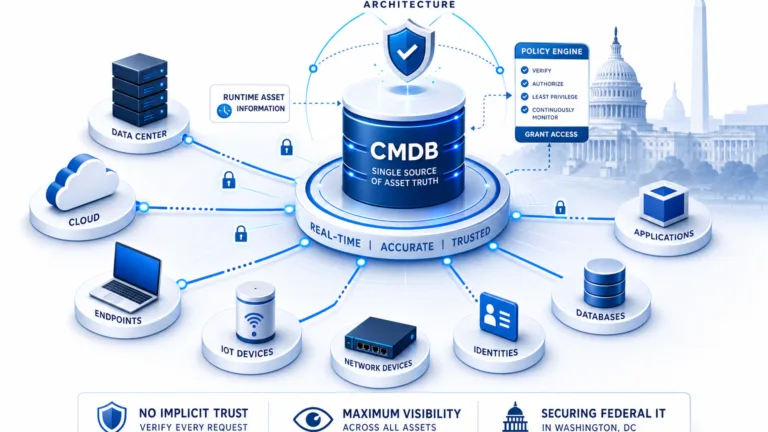
The discovery-sourced CMDB holds configuration items with relationships, while ViVID service maps show which business services and teams each change affects. Ownership appears in map context so responders can see who owns the affected service without searching separate systems.
How current it stays
High-frequency scheduled discovery keeps the map current as of the last scan, and CMDB Health Scoring signals freshness so teams know how much weight to place on the data during escalation and review.
Where it connects
Discovered configuration items and relationships sync into ITSM workflows so change, incident, and audit activity reference the same service context that operations uses.
Closing: Name the Owner Before the Agent Acts
Boards already own the risk. IT operations must now name the owner for every agent and every service, check impact before agents act, and keep evidence that proves what changed. That operating discipline turns board oversight into accountability that holds during review.
Frequently Asked Questions
What is agentic AI governance for IT operations?
It assigns decision rights for autonomous agents in production, covering owner, escalation threshold, evidence, and pause scope. Frameworks like NIST AI RMF shape the functions, while service data makes them enforceable.
Why is agentic AI governance important?
Production use is growing faster than oversight, with 35% running agents and only 37% saying governance scales. Without ownership and impact checks, routine agent actions can trigger enterprise-wide incidents.
Who is accountable when an AI agent fails?
The board holds risk responsibility, but operating accountability belongs to the named agent owner and service owner. IBM found no role above 17%, which means most organizations still lack that second assignment.
What are examples of agentic AI governance controls?
Agent inventory, per-service owners, impact-based escalation thresholds, timestamped change evidence, and rehearsed pause scope. Each control depends on knowing what the agent reaches and what depends on it.
How should IT govern vendor AI it does not control?
Map every system the vendor agent can touch, attach owners and dependencies, and tie contracts to that verified footprint. Model internals stay outside infrastructure visibility, so assurance must combine mapping with contractual controls.