Free Asset Inventory Software: When to Upgrade | Virima

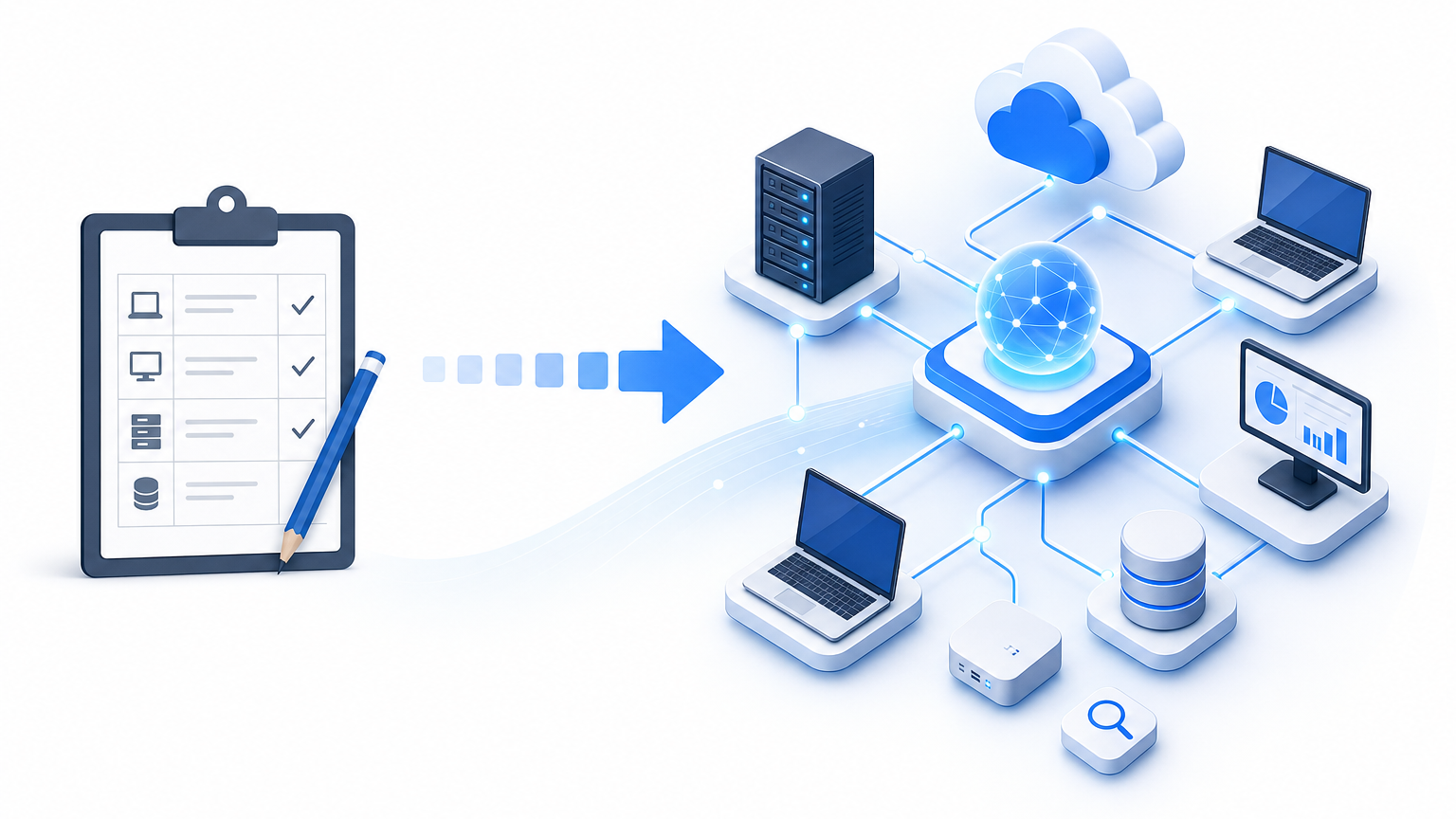
Your Snipe-IT register says the team owns 340 laptops. The network scan says 390, and nobody can explain the gap until an auditor asks what changed last quarter. That gap is exactly where free asset inventory software stops covering the job, and when to upgrade becomes the real question. Free and open-source tools such as Snipe-IT or a free-tier custody register work well for small fleets with manual entry. They stop being enough once you need automatic discovery, more than a few hundred assets under active change, license compliance evidence, or CMDB relationships that a change board will trust.
This page is the decision frame before any cutover plan. For product-level stay, pair, or leave on Snipe-IT, use the existing Snipe-IT features, limitations, and alternative guide. For the export and CI mapping steps after you decide, use the migrate from Snipe-IT to discovery CMDB cutover.
What free tools do well
Open-source and free inventory tools earn their place on a short list of jobs. Snipe-IT is built as a free, open-source IT asset management system with checkout, labels, status, and a web UI for people who assign hardware. The project is actively maintained on GitHub under snipe/snipe-it, and the product site documents self-hosting plus commercial hosted options when you want someone else to run the stack.
Manual registers also shine when the fleet is small, the network is simple, and every asset still passes through a human handoff. Asset tags, assigned users, purchase notes, and location fields stay accurate when someone updates them on every move. Free-tier commercial registers follow the same pattern: they are strong at custody and weak at proving what is on the network without a person typing it in.
Use free tools when three conditions hold at once. The team can keep the register current without a backlog. Audits ask for ownership and purchase history more than for live configuration. Change work does not yet depend on dependency maps or blast-radius context. When any of those conditions break, the free stack is still useful as custody, while technical truth needs another system.
7 limits of free inventory tools
Free and open-source asset inventory limits show up in predictable ways once the estate grows past manual pace. These limits are about jobs, not brand attacks.
- No scheduled multi-source discovery. Someone must create or edit each row. Devices that never get tagged never appear.
- Scale is a people problem. Hundreds of endpoints across sites turn every refresh into a project.
- License and install evidence is thin. Seat counts and install paths need discovery or connector data, not only a spreadsheet column.
- CMDB relationships are missing. Custody tools store assets; they do not hold CI classes, source tags, and service maps change boards expect. A CMDB does not discover assets on its own either — it depends on a companion discovery process, so a free register with no scheduled discovery leaves the CMDB layer with nothing current to reconcile against.
- Cloud and remote drift. Instances and off-network laptops change faster than weekly form entry.
- Duplicate identity. Hostname alone is a weak join key. Durable keys such as serial or cloud instance ID need a platform that can correlate them.
- Audit clock risk. Rebuild-the-list week before an audit is a process failure, not a feature gap in the free tool.
These limits sharpen under a real cadence requirement. CIS Controls v8 calls on organizations in Implementation Groups 2 and 3 to run an active discovery tool daily, or more frequently (CIS Controls, Control 1). A manual register updated on a weekly or monthly cycle cannot hit that cadence, no matter how disciplined the team is.
None of these limits mean free tools are wrong for custody. They mean the upgrade is about adding a discovery-sourced record of what exists, how it connects, and when it was last verified.
When is free asset inventory software no longer enough?
Free inventory is enough while fleets stay small and every change is entered by hand. Move to paid discovery ITAM or CMDB when you need scheduled discovery, license evidence, multi-site scale, or configuration relationships that incident and change work can trust.
Free options and practical caps
Use this table as a market map, not a ranked bake-off. Caps and tiers change; verify current terms on each vendor before you plan a purchase.
| Option | Model | What it owns well | Where it usually stops |
|---|---|---|---|
| Snipe-IT (self-host) | Open source, free software | Tags, checkout, status, custom fields, API | You operate hosting, upgrades, backups, and all discovery yourself |
| Snipe-IT (hosted) | Commercial hosting of the same product | Same custody model without self-host ops | Still a register unless you add discovery elsewhere |
| Free-tier commercial registers (e.g. AssetTiger-class tools) | Freemium SaaS | Small manual inventories and simple reporting | Free tiers typically throttle seats, features, or history; discovery is limited or absent |
| Spreadsheets | Manual | Pilot lists and one-time audits | No source of truth under concurrent edits |
GLPI is a common free alternative that adds agent-based discovery on top of its inventory module, which closes part of the gap in the table above. It still stores what it finds as a flat asset list rather than CI classes and relationships a change board can query, so the CMDB gap in row one still applies even with an agent running.
Open-source category context lives on Virima’s top open-source IT asset management software roundup. This page does not re-list every project. It asks when the free model stops matching the jobs you already have.
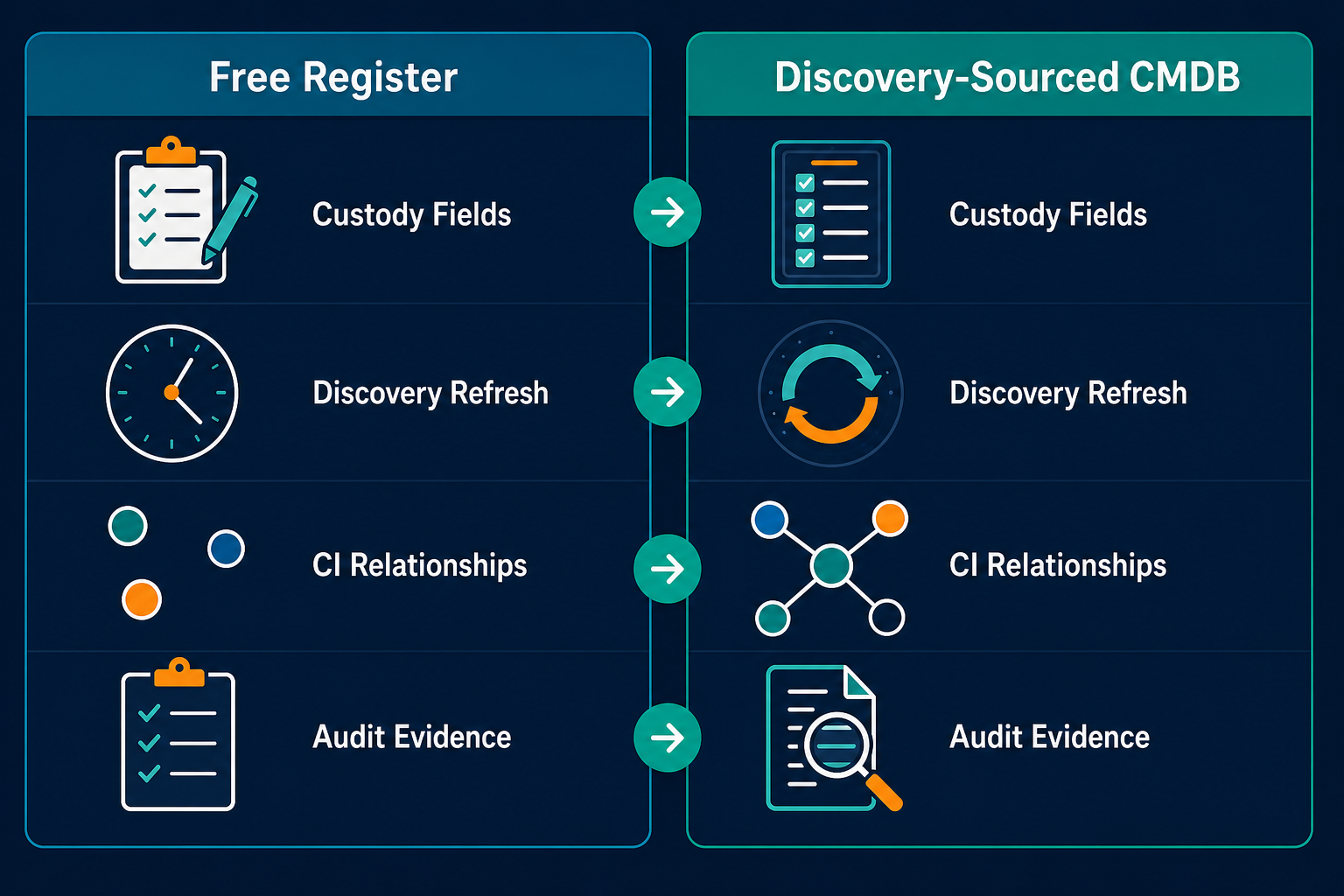
The hidden cost of manual upkeep
The license line on a free tool can be zero while the operating cost is not. Every unlogged laptop, renamed host, and shadow cloud instance becomes rework during incident response, refresh projects, and audit prep. Teams pay that cost in staff hours, delayed changes, and incomplete evidence packs. That drift is not a fringe risk: Gartner research, as reported by CIO Dive, projected that 75% of employees will acquire, modify, or create technology outside IT’s oversight by 2027, up from 41% in 2022, and a manual register has no mechanism to catch what IT never logged in the first place.
Manual upkeep also creates two competing lists. The register shows what people believe they assigned. The network shows what answers to a scan. Without a scheduled discovery cycle that stages candidates into a CMDB, those lists diverge until someone spends a week reconciling them under deadline pressure.
Durable identity makes the gap worse when ignored. Hostname is not a durable join key across rebuilds and cloud moves. Serial numbers and cloud instance IDs are. Free registers can store those fields, but they cannot keep them honest without discovery and correlation rules that flag duplicates and stale rows.
Upgrade trigger checklist
Knowing when to upgrade from Snipe-IT, or any free register, comes down to whether two or more of these triggers are true for a full quarter.
- Discovery need: You cannot name every device on the segments you own without a multi-day manual hunt.
- Fleet pace: New hires, contractors, or cloud projects add assets faster than the register is updated.
- License pressure: Software publishers or internal SAM need install and usage evidence, not only purchase rows.
- Change risk: You need dependency context before a change window, and spreadsheets cannot supply it.
- Audit cadence: You rebuild inventory from scratch before each external or internal review.
- ITSM handoff: The service desk needs CI-quality records, and the free tool stays a side database.
- Multi-source truth: Endpoints, network, and cloud must reconcile into one governed record with source and last-verified context.
If only custody jobs remain (labels, checkout, loaners), keep the free tool and pair it. If technical configuration must be trusted weekly, add a discovery-sourced CMDB path and decide field ownership per attribute.
What triggers an upgrade from free open-source asset inventory?
Upgrade when discovery, license evidence, multi-site pace, change dependency context, or audit rebuilds outrun manual entry. Keep free tools for custody labels when that workflow still works, and move technical configuration into a discovery-sourced CMDB with clear field ownership.
Step-by-step migration path (CSV import)
Once the checklist says move, treat migration as staged cutover, not a weekend flip.
- Freeze a backup of the free register and export assets, users, locations, licenses, and custom fields.
- Classify rows into CMDB candidates (servers, endpoints, network, cloud under change control) versus custody-only stock (accessories, consumables).
- Map durable keys (asset tag plus serial or instance ID) before any import template load.
- Pilot one site or category into the discovery-sourced CMDB using CSV or spreadsheet import.
- Run scheduled discovery beside the register. Review discovered items, then move approved records into the CMDB.
- Reconcile two lists: register-not-found and discovered-not-in-register. Archive, merge, or correct status on each class.
- Define a short service list so ViVID™ maps can build from human service definitions plus discovery data.
- Lock field ownership and the free tool’s end state: retire, keep for labels, or pair through API or CSV.
Virima supports that path as multi-source discovery into a governed CMDB, ITAM for assignment and financial fields a scan cannot invent, and service mapping after you define services. First narrative next step: see how Trusted Runtime Truth frames live, explainable estate records before you book time with the team.
Not sure you’re there yet? Run your estate against the Upgrade Trigger Checklist above first. If two or more triggers hold true, walk a sample estate with Virima and see how discovered items get staged into governed CIs.
Where Virima fits after free inventory
Virima is the paid discovery and CMDB layer for teams that still respect what free registers did well. Scheduled discovery cycles feed candidates for review. Approved items become configuration items with source tags and last-verified context inside the CMDB. ITAM holds ownership and purchase fields.
After service definitions exist, ViVID™ builds dependency maps for blast-radius work. ITSM platforms such as ServiceNow, Jira Service Management, Ivanti, HaloITSM, Xurrent, Hornbill, and TeamDynamix stay systems of engagement; connect through the integrations hub once, with partner names in plain text.
Keep Snipe-IT or another free register when barcode checkout still earns its keep. Give the CMDB technical fields discovery can verify. That split is how lean and mid-market teams avoid pretending a custody tool is a full configuration authority.
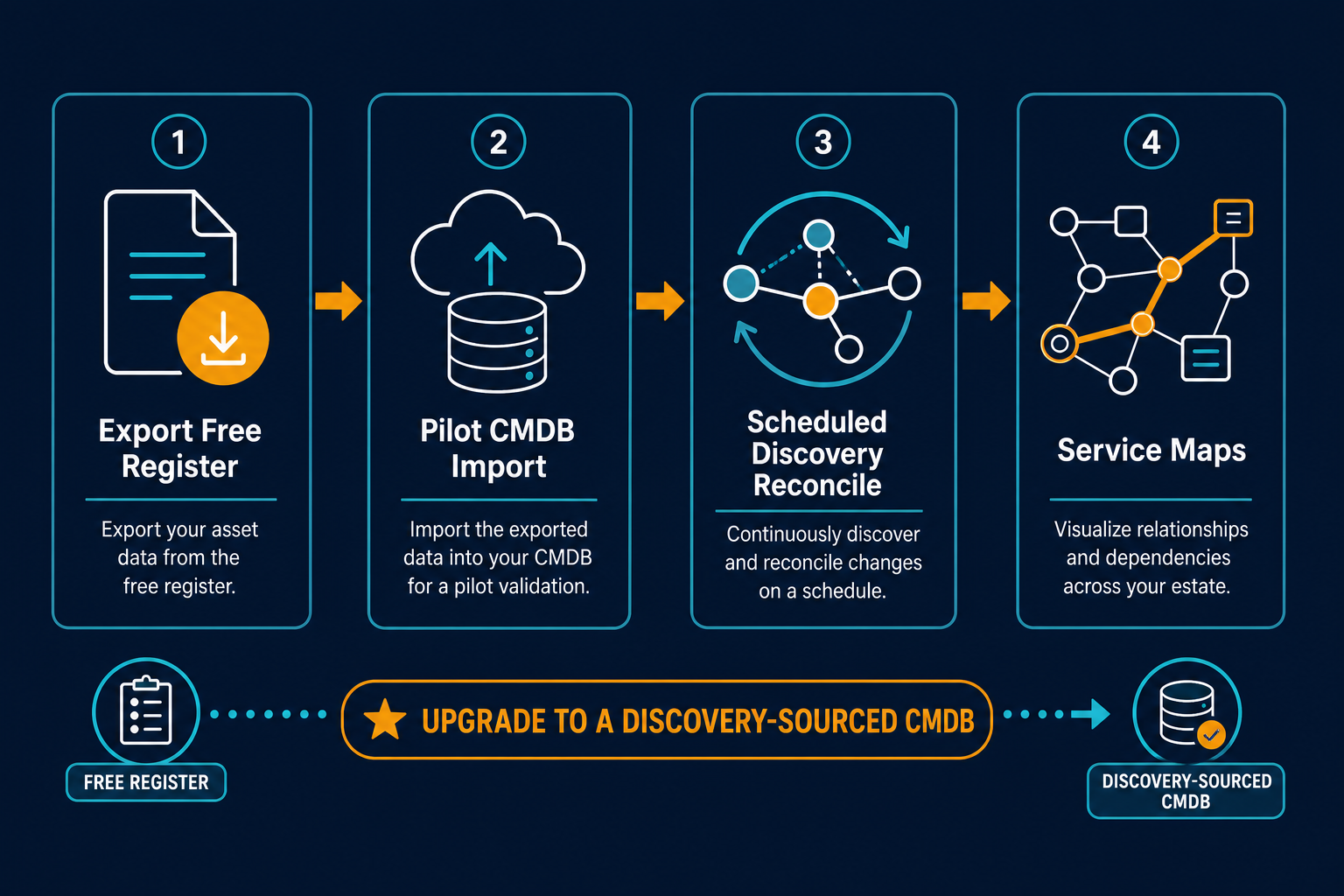
When free stops and discovery starts
Making this move unlocks something a free register can’t structurally deliver: one governed record that incident response, change approval, and audit prep can all draw from without separate reconciliation work. Once scheduled discovery feeds the CMDB, the question changes from “what do we think we own” to “what changed since the last verified scan” — a faster, cheaper question to answer under deadline pressure. That shift is the real payoff of the upgrade, not just closing the gap between two lists.
Start with the Upgrade Trigger Checklist above to see where you stand, then schedule a demo and bring one export plus one network segment as the pilot scope.
Frequently Asked Questions
Is Snipe-IT really free?
Snipe-IT the software is free and open source under its project license. You still pay for the server, backups, upgrades, and staff time to run it, or you pay a host if you choose commercial hosting of the same product.
How many assets does a free-tier inventory tool usually allow?
Free tiers vary by vendor and change over time. Treat published caps as marketing terms to verify on the vendor site before you plan growth. Plan the upgrade when manual entry or tier limits block discovery and audit jobs, not only when a seat counter turns red.
Can I import Snipe-IT data into a discovery CMDB?
Yes. Export assets and related objects, map durable keys, load a pilot through CSV or spreadsheet import, then run scheduled discovery beside the register and reconcile both mismatch lists before full cutover.
Should I keep a free register after adding discovery ITAM?
Keep it when labels and checkout accountability still matter weekly. Write one owner per field so the CMDB owns technical facts and the free tool owns custody, then exchange data through API or CSV.
What is the first paid capability most teams add?
Most teams add scheduled multi-source discovery into a governed CMDB so configuration stays verified between audits. License evidence and service maps usually follow once the CI population is trustworthy.
Does Virima replace Snipe-IT, or work alongside it?
It works alongside it. Virima adds scheduled discovery and a CMDB layer on top of what a free register already tracks. Keep Snipe-IT for checkout and labels, and let Virima own the technical facts — configuration items, relationships, and source attribution — that a free register was never built to discover.