Why Scaling Agentic Automation in IT Operations Always Fails Without Deep Foundation Visibility

Engineering leaders across enterprise organizations are assigning change and incident workflows to automated software agents in information technology service management (ITSM) systems. Software agents increasingly manage initial alert triage, ticket classification, routine maintenance tasks, and automated incident remediation scripts across complex environments. A critical operational gap emerges when an automated routine executes a localized task flawlessly while destabilizing dependent applications across adjacent environments.
Scaling autonomous infrastructure reliably requires rigorous impact analysis grounded in accurate service dependency maps, clear technical ownership, and complete visibility into active work orders. Unplanned service disruptions multiply rapidly when automated scripts modify infrastructure assets with unmapped dependencies, degrading mean time to resolution and stalling broader automation initiatives.
Industry forecasts underscore the urgency of building sound operational foundations before expanding autonomous execution scopes. According to research highlighted by CIO analysis of Gartner predictions, over forty percent of agentic artificial intelligence (AI) initiatives face project cancellation by 2027 due to escalating costs, unclear business value, or inadequate risk controls. Operations teams protect production environments by validating configuration dependencies before granting programmatic agents autonomous execution privileges.
Modern operations architectures require authoritative operational truth across physical servers, container clusters, and cloud networks. Discover how Virima Trusted Runtime Truth provides dependable baseline visibility to govern autonomous IT operations safely.
Where Agentic Automation Meets Change and Incident Work
Enterprise infrastructure organizations typically introduce software agents to lower-complexity operational routines that consume substantial manual engineering hours. Routine workflows handed to automated systems first include incoming alert triage, automated ticket categorization, repetitive configuration tasks, and standard remediation steps. Operational exposure concentrates heavily within change management and incident response workflows because these processes directly alter live production environments. A minor configuration adjustment applied to an individual database cluster can trigger widespread outages when upstream dependencies remain unrecorded.
Engineering teams often begin agentic automation by delegating alert enrichment and ticket dispatching to machine learning models. These initial implementations extract diagnostic data from log aggregators, match incoming symptoms against historical incident records, and assign tickets to appropriate engineering queues. As organizations gain operational confidence, leadership teams encourage expanding autonomous capabilities into active remediation and routine maintenance tasks. Automated agents receive authorization to restart unresponsive background services, adjust virtual container resources, rotate expiring security certificates, and apply minor configuration patches during off-peak hours.
The operational stakes escalate dramatically whenever autonomous scripts transition from passive monitoring to active state modifications across production infrastructure. While an incorrect ticket assignment merely delays administrative review, an automated change script executed against an unmapped dependency path can immediately compromise customer-facing digital services. When automated agents execute remediation playbooks during active service degradations, incomplete dependency visibility can compound existing operational instability.
Independent analysis published on ITSM.tools examining AI agent governance notes that automation adoption accelerates faster than corresponding governance models across enterprise engineering departments. Technical teams maintain service stability by ensuring automated execution policies incorporate comprehensive dependency evaluations before initiating production changes.
Why Instructions Leave Out Impact
Programmatic task instructions specify the exact technical parameters of the target component requiring modification. A deployment playbook explicitly defines the server hostname, target container port, and necessary script commands to complete an update. Operational impact encompasses every connected service that relies upon that target component to deliver critical business capabilities. Infrastructure dependencies span physical host servers, virtual hypervisors, internal application runtimes, relational databases, and dynamic cloud subscriptions.
An automated execution agent follows its programmatic mandate with absolute computational precision. When instructed to terminate an underperforming microservice instance or apply a database schema update, the agent evaluates success entirely through the completion of that specific directive. The instruction set rarely contains contextual awareness of adjacent services sharing that identical database cluster or consuming that specific application programming interface. If an unrecorded microservice depends upon that database schema, the automated execution completes its assigned task while silently breaking critical downstream transactions.
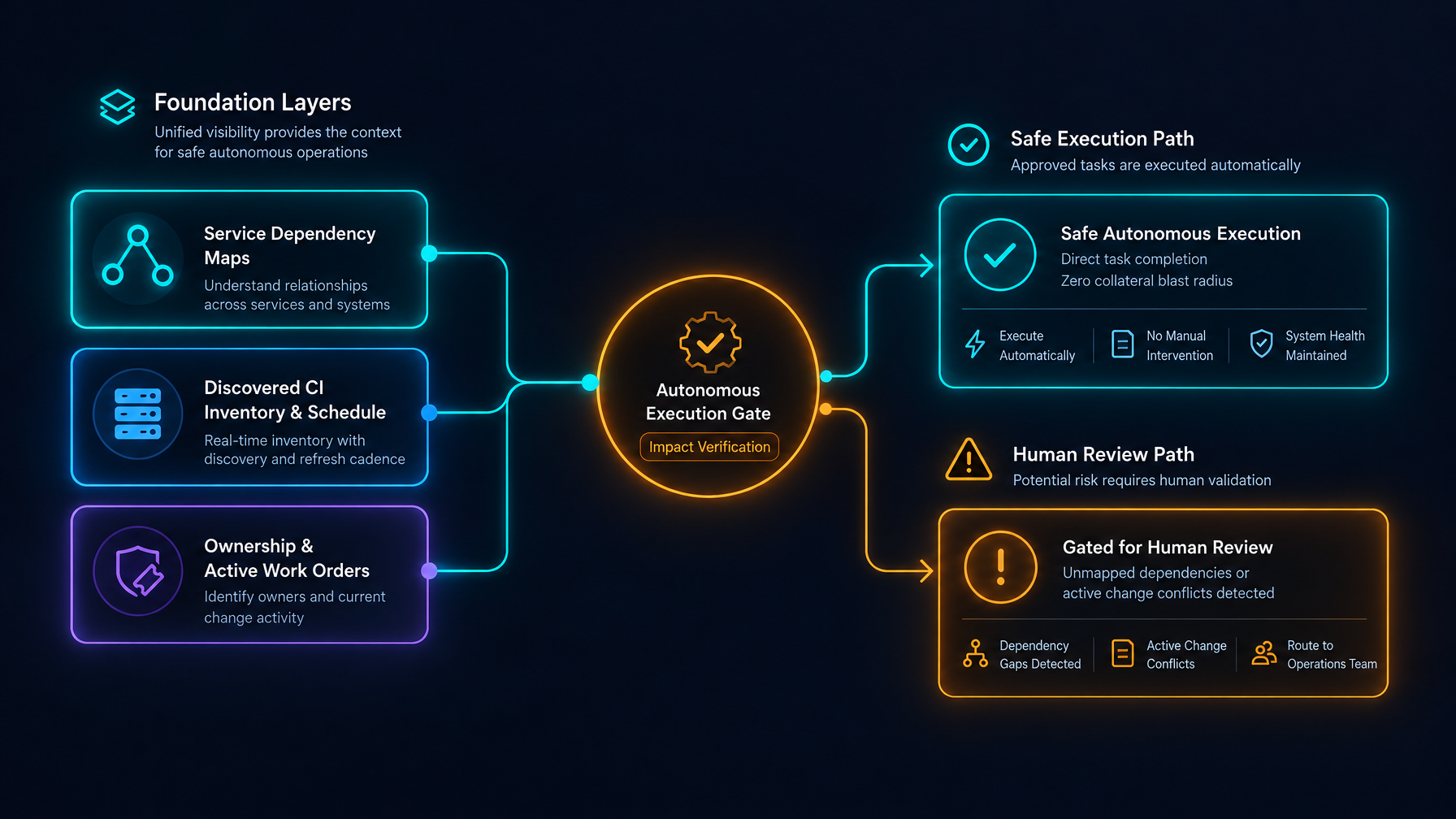
Human reviewers participating in change advisory boards routinely evaluate visual service maps, technical ownership records, and open incident queues before approving deployment windows. Experienced change managers recognize that technical modifications rarely occur in complete isolation within modern distributed environments. Reviewers deliberately cross-reference planned change tickets against maintenance calendars to ensure multiple teams avoid modifying interconnected infrastructure components simultaneously. Automated execution frameworks require those identical architectural inputs to make safe operational decisions without human intervention. Providing software agents with isolated execution scripts while withholding service dependency context creates severe operational exposure across enterprise infrastructure.
What Impact Analysis Needs From a Service Map
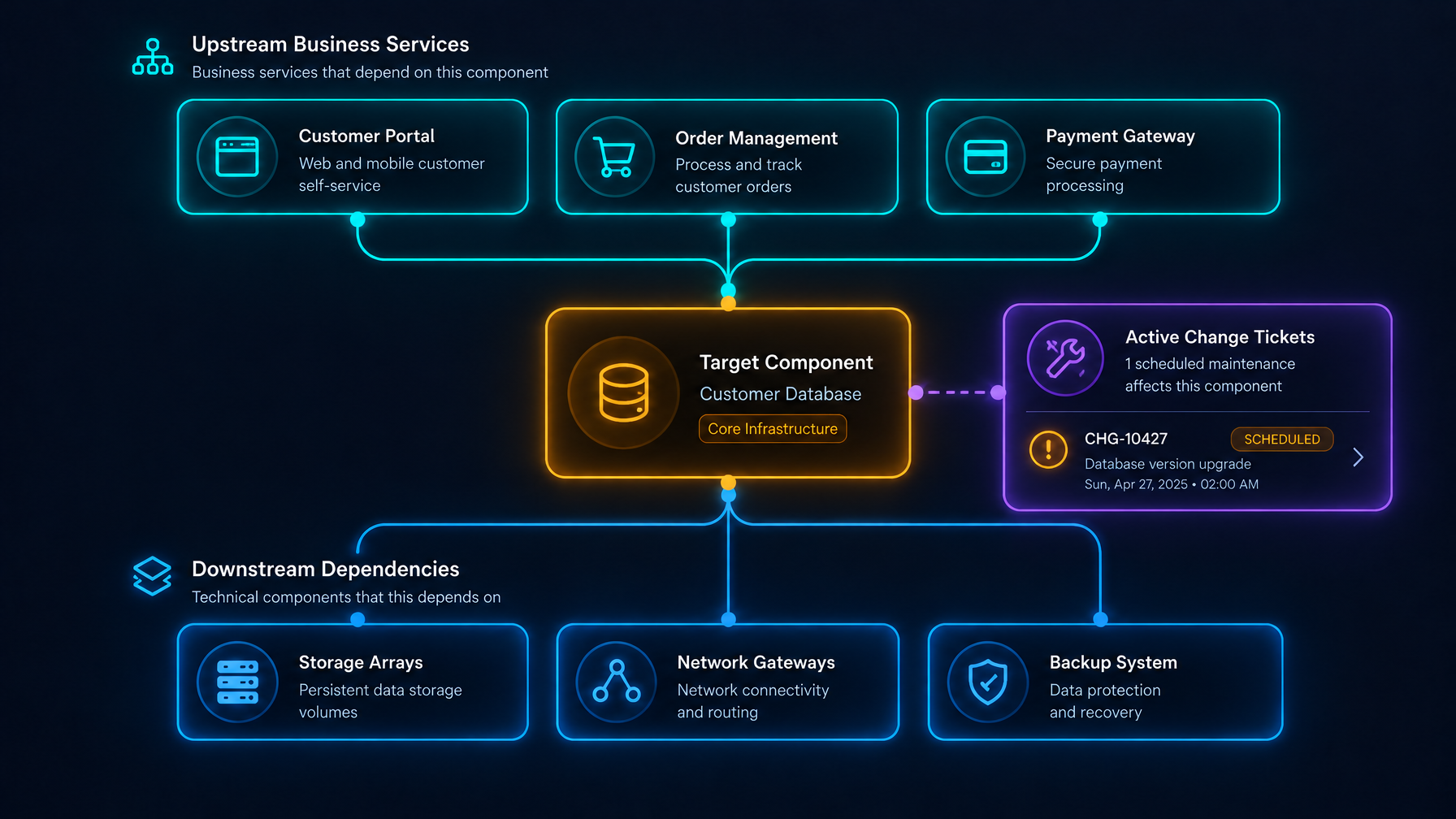
Evaluating operational risk effectively requires dynamic topological context that extends beyond raw inventory attributes. Automated platforms and human engineers require shared visibility into structural relationships to anticipate system behavior accurately. Raw lists of configuration items provide valuable inventory data, but they fail to illuminate how components interact to support essential business functions. Reliable impact analysis synthesizes multiple dimensions of operational intelligence into a unified architectural view.
Core operational inputs required from an authoritative service map include:
- Comprehensive dependency structures revealing all upstream parent applications and downstream infrastructure components
- Clear business service context identifying the exact operational criticality tier of the affected application
- Active work records detailing open incident tickets and scheduled changes already approved on the same components
- Real-time vulnerability exposure overlays illustrating security risks associated with connected assets
- Documented technical ownership attributes specifying the responsible engineering leads for rapid escalation
Structural dependency mapping ensures that both programmatic agents and human operators visualize the full chain of interconnected components. When an automated routine evaluates a proposed server reboot, the dependency graph reveals whether that physical host supports virtual instances hosting customer checkout gateways. Business service context assigns operational priority to those connections, allowing automated policies to distinguish between non-critical staging environments and revenue-generating production services.
Visibility into active work prevents catastrophic scheduling conflicts where an automated maintenance script modifies a component currently undergoing emergency incident troubleshooting. Overlaying vulnerability metrics allows risk engines to calculate whether modifying a compromised server introduces additional security exposure across adjacent network segments. Clear ownership records ensure that any automated exception or threshold breach routes immediately to the designated engineering team. Engineering teams can explore how change impact analysis bridges configuration data with enterprise ticketing platforms to prevent unintended operational downtime.
The Foundation Underneath the Map
Service dependency maps reflect the fidelity of the underlying discovery telemetry and service boundary models supporting them. Visual maps do not generate architectural truth spontaneously; they represent the precise quality of the discovery data ingested from production environments. Operations teams provide the foundational business service definitions, making explicit definition governance essential during planning stages. Without clear boundaries established by system architects, discovery tools catalog isolated infrastructure assets without understanding which business capabilities they deliver.
The scheduled discovery frequency determines the exact operational freshness of the resulting topological models. In modern cloud environments characterized by auto-scaling container clusters and ephemeral virtual instances, configuration parameters shift continuously throughout each operating day. High-frequency discovery cycles ensure that service maps reflect actual runtime conditions rather than historical design assumptions. Documented scan schedules provide engineering teams with transparent visibility into the operational age of every configuration record.
Clear discovery boundaries specify which enterprise environments provide automated coverage and which network segments require alternative audit procedures. Discovery tools must access multi-tenant cloud environments, on-premises data centers, software-defined networking layers, and remote office infrastructure to eliminate dangerous architectural blind spots. When discovery boundaries fail to encompass secondary cloud accounts or legacy database tiers, the resulting service maps remain dangerously incomplete.
Multi-source reconciliation rules harmonize telemetry from cloud providers, hypervisor consoles, identity platforms, and network probes to preserve record integrity. Without governed reconciliation logic, conflicting attribute data from disparate monitoring tools overwrites authoritative fields and creates continuous database churn. Authoritative IT discovery provides the multi-method visibility required to maintain dependable configuration baselines across complex enterprise environments.
A Readiness Check Before Scaling
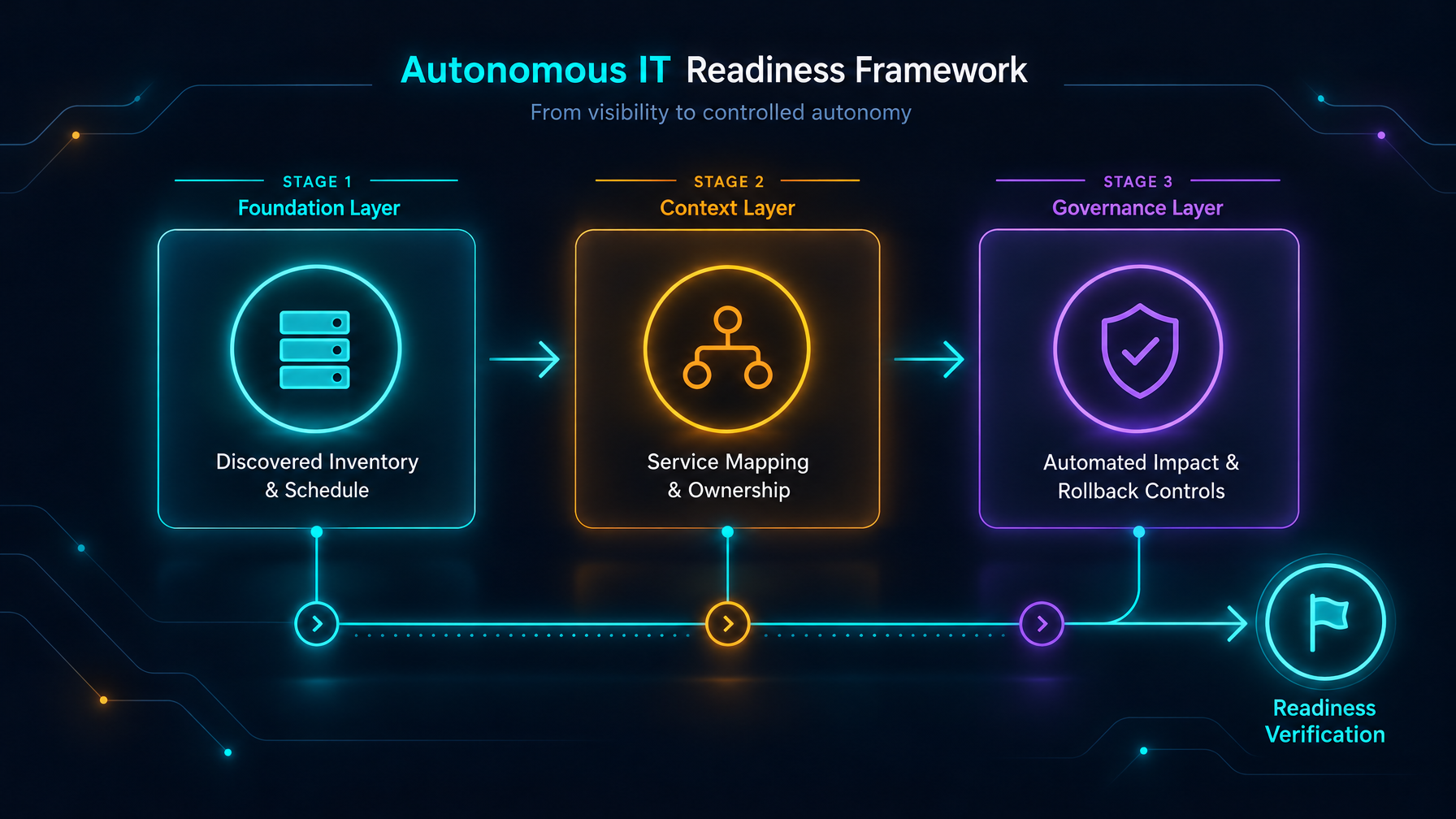
Engineering leaders must establish objective operational criteria before broadening autonomous execution privileges across additional production services. Human operators should retain direct control over remediation tasks until target infrastructure groups satisfy every operational benchmark. Rushing to scale autonomous agents across unverified infrastructure environments inevitably results in production outages that erode organizational confidence. A structured evaluation gate ensures that engineering teams address systemic data gaps before expanding programmatic privileges.
Checklist for evaluating autonomous workflow readiness:
- Business services defined clearly for all infrastructure workflows that automated agents will touch
- Named technical owners recorded for each business service and constituent infrastructure component
- High-frequency discovery cadence documented formally, with the timestamp of the latest discovery cycle visible
- Open incident tickets and scheduled changes visible within a unified topological interface
- Documented escalation pathways established for all exceptions and automated script failures
- Verified rollback procedures documented for every class of automated infrastructure change
- Human review thresholds established to gate all modifications exceeding designated impact levels
These seven operational controls operate across enterprise ticketing systems, dynamic service maps, discovery engines, and engineering runbook libraries. Service definitions and ownership assignments originate within enterprise architecture documentation and configuration repositories. Discovery schedules and environmental boundaries are maintained directly within automated discovery configurations. Active ticket visibility and change schedules synchronize continuously through bi-directional integrations with central service desk platforms. Escalation paths and automated rollback instructions reside within version-controlled operational runbooks accessible to autonomous execution frameworks.
How Service Mapping Supports the Check
Virima establishes dependable operational foundations by translating discovery telemetry into actionable topological intelligence that protects production stability. The ViVID™ service mapping engine constructs comprehensive dependency structures from discovery data, illustrating downstream blast radius before automated playbooks execute. The interface overlays open incident records, approved change tickets, recent modifications, and known vulnerabilities directly onto active dependency models. This unified operational perspective transforms static configuration records into dynamic decision support systems.
Virima maintains bidirectional synchronization with confirmed enterprise platforms including ServiceNow, Jira Service Management, Ivanti, Halo, Xurrent, Hornbill, and TeamDynamix. Platform teams configure service definitions through intuitive administrative interfaces or structured comma-separated values file imports. The topological visualization reflects environmental accuracy as of the most recent scheduled discovery cycle. By embedding service dependency context directly into existing ticketing workflows, Virima ensures that automated scripts and human engineers evaluate identical operational truth.
Explore how ViVID service mapping creates dynamic operational models that protect critical business services during automated deployments. Platform teams can also review how to configure a CMDB for agentic harness architectures to ensure reliable programmatic context delivery.
Technical teams evaluating enterprise adoption strategies can consult the official Gartner Symposium announcement to see how modern organizations structure live runtime truth for autonomous workloads.
Where to Start This Quarter
Enterprise teams should choose a single high-frequency change class and trace its operational impact across a visual service map during an engineering workshop. Selecting a routine operational workflow, such as standard application patching or routine database parameter updates, provides an ideal baseline for evaluating existing dependency data. Walking through a real production scenario as a cross-functional team highlights hidden dependencies and uncovers blind spots in current documentation.
Reviewing actual infrastructure connections exposes existing data gaps, allowing teams to assign missing owners and establish missing service definitions systematically. When engineers discover unmapped database connections or orphaned server instances during the exercise, they can update service boundaries immediately. Platform leads should formalize human review thresholds before permitting software agents to execute broad changes autonomously. Establishing clear impact tiers ensures that autonomous scripts manage low-risk operational tasks while complex modifications remain subject to human approval.
Organizations prepare for enterprise-wide automation by scheduling collaborative working sessions to evaluate planned changes against live service maps. Walking a scheduled change through a dependency map with technical specialists confirms whether existing configuration data provides adequate operational context for autonomous workflows.
Frequently Asked Questions
Why do automated agents require impact analysis before executing changes?
Programmatic instructions specify the technical parameters of the target component, while impact analysis evaluates every dependent business service that component supports. Autonomous tools risk disrupting adjacent infrastructure without visibility into upstream relationships.
What operational context does a service map add to change management workflows?
A service map provides structural dependency paths, business service criticality ratings, active incident queues, approved maintenance schedules, and assigned technical owners. These contextual inputs allow engineers and automated policies to calculate operational blast radius accurately.
How current is the dependency data displayed on an enterprise service map?
A service map reflects infrastructure relationships as of the most recent scheduled discovery scan. High-frequency discovery cycles refresh configuration baselines systematically to keep pace with dynamic cloud environments and ongoing infrastructure updates.
Who defines business service boundaries within the service mapping platform?
Enterprise operations teams define core business services directly through the administrative user interface or by importing structured files. The platform then constructs detailed dependency models by mapping discovered infrastructure assets against those defined service boundaries.
Does automated impact analysis eliminate the need for human change approvals?
Impact analysis informs governance policies by calculating risk scores, allowing leadership to establish clear thresholds where complex modifications still require human approval. Autonomous routines handle verified low-risk tasks while escalating high-impact changes to engineering personnel.
What core elements belong in an automated change rollback plan?
A complete rollback plan defines the explicit operational failure trigger, the designated technical owner, the exact baseline configuration state, and the automated verification steps required to confirm normal service restoration.