Hybrid Cloud CMDB for Migration Planning in Milan: Stop Migrating on Old Records

Hybrid cloud CMDB for migration planning in Milan answers one question before every wave moves: what is running, what connects across the boundary, and who confirmed the record this week.
The following scenario is an illustrative composite built from common migration patterns. An infrastructure team in Milan signs off wave 2 of a hybrid migration on a Friday afternoon. The wave list comes from spreadsheets reconciled six weeks earlier plus exports from two tools scoped to different domains. A month-end consolidation job reads from a server that appears in none of those registers. The team finds the server after cutover when the job fails, and the receiving finance team escalates the missing output Monday morning.
Milan carries many estates shaped this way. The Milan Monza Brianza Lodi Chamber report counted 6,043 foreign-owned firms in Milan province in July 2026, representing 32.7% of the national total, with more than 2 million workers in the wider area. How many of those estates connect daily to group platforms hosted elsewhere while local registers still describe only the Milan site?
What migration guidance says about dependencies
Migration guidance from three large publishers points to the same planning gap around dependencies. The table below summarizes each source in its own terms.
| Source | What the source reports | How to read it |
|---|---|---|
| Flexera 2026 State of the Cloud | 73% of respondents use hybrid cloud, and understanding application dependencies ranks as the largest barrier to cloud migration at 54% | Global survey of 753 respondents across industries |
| Microsoft Cloud Adoption Framework | Map internal dependencies through network monitoring, ask workload owners to confirm tool findings, group workloads to minimize broken dependencies, and keep dependency data in a central repository updated on a regular cadence | Vendor framework guidance for assessment |
| AWS Prescriptive Guidance | Determine application and infrastructure dependencies during detailed portfolio discovery and build a high-fidelity migration plan from that inventory | Vendor migration strategy guidance |
| AWS Cloud Operations Blog | Spreadsheets receive infrequent updates while CMDB tools frequently hold outdated records, and the post recommends two to four weeks of data collection for its own visualization tooling | 2021 context on planning effort |
Microsoft guidance states discovery tools reduce manual effort while warning those tools might miss undocumented dependencies. That warning explains why owner confirmation sits inside the Microsoft assessment path. The central repository recommendation also matters because wave plans age quickly when dependency data lives across spreadsheets.
For sequencing background, Virima covers wave order in cloud migration planning with dependency mapping. For the broader hybrid concept, see the hybrid cloud CMDB transformation guide. This article focuses on the planning record that supports each wave.
Why estates in Milan are hard to plan from
Three patterns show up repeatedly in Milan enterprise estates with group ownership, acquired entities, and parallel cloud accounts.
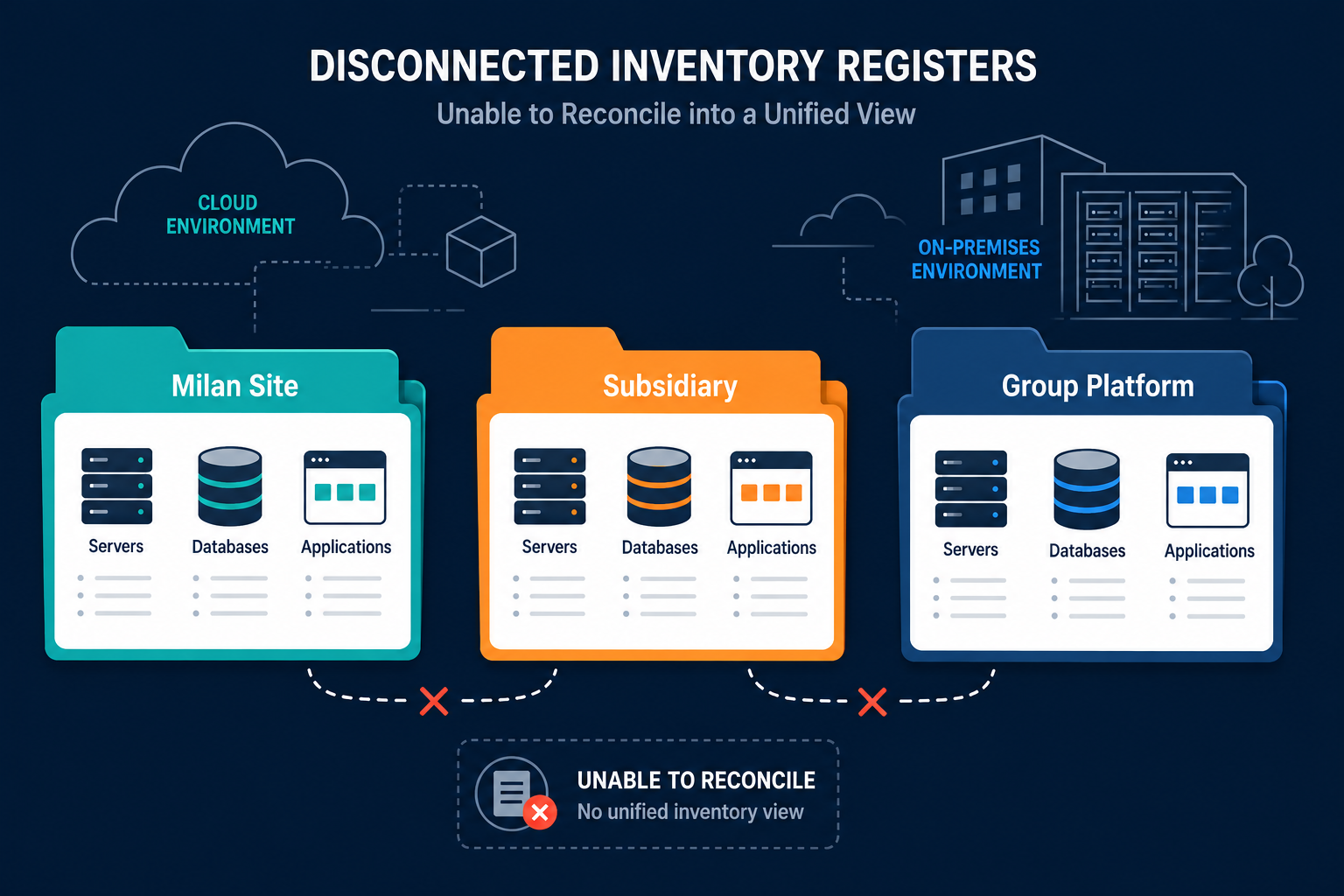
Records stop at the old organizational boundary. The Milan site keeps one register, a subsidiary keeps another register, and the group platform team keeps a third register with different naming rules. Each register reflects the domain its owner controls. Consolidation happens in spreadsheets shortly before wave planning starts. Fields get renamed, owners get dropped, and timestamps get lost during that consolidation.
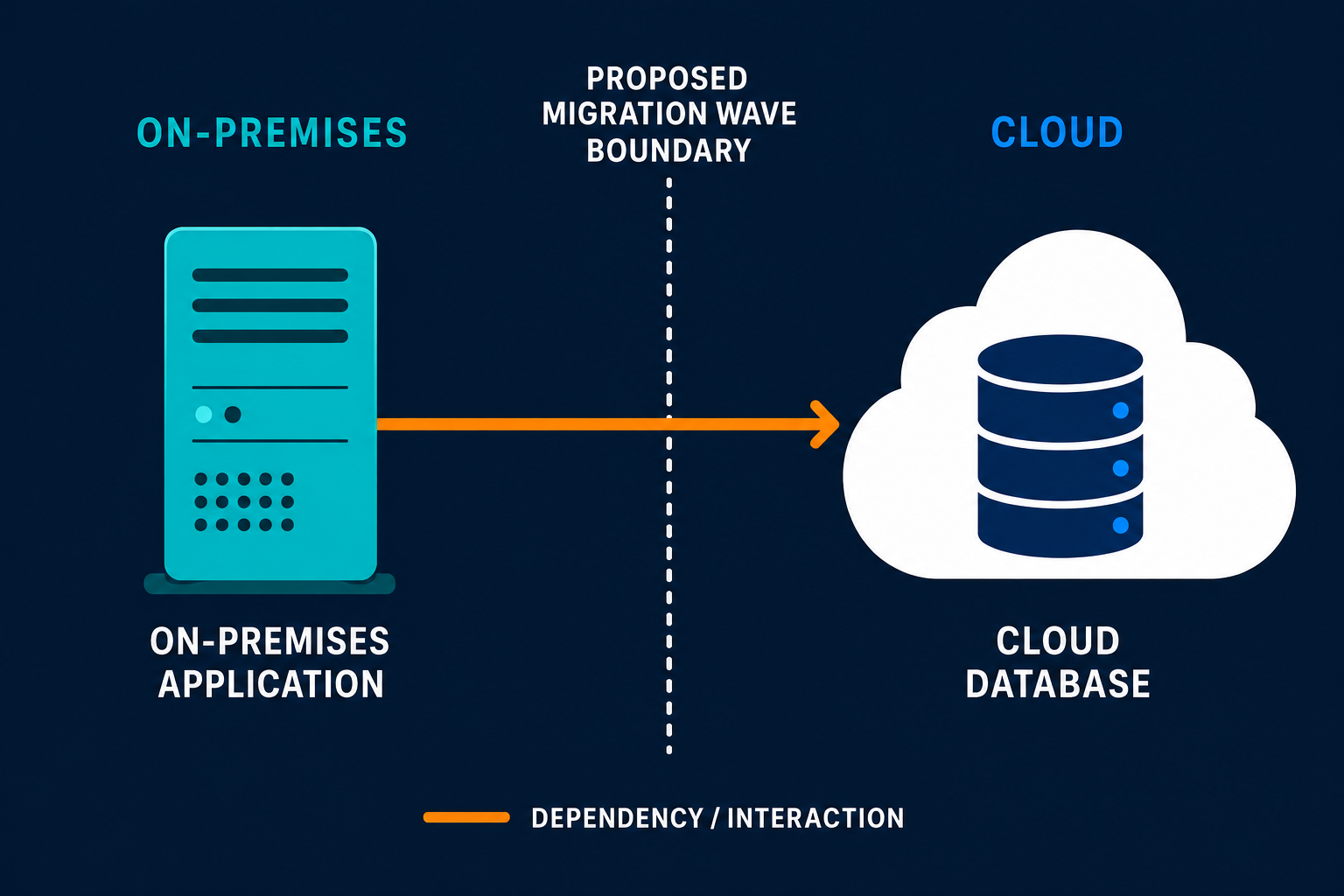
Dependencies cross the on-premises and cloud line every day. An application hosted on-premises calls a database hosted in Azure during every transaction cycle. An integration service in AWS pulls nightly files from a file server under a Milan desk. Microsoft guidance uses a direct example for this pattern: when App A calls Database B continuously, move both components together or maintain connectivity until both components reside in the cloud. Planning teams need that cross-boundary call visible before assigning either side to a wave.
Retired sources stay open after cutover. A physical server leaves production, yet the record remains active because retirement awaits a named owner decision. A virtual machine stops serving traffic, yet the cloud console keeps billing the instance because termination awaits approval. Duplicate records accumulate while infrastructure costs continue. The next wave then starts from a register mixing live systems with retired systems.
Result: The wave plan omits dependencies owned outside Milan; a stranded dependency surfaces only at cutover when the boundary splits the pair; duplicate records, continued infrastructure spend, and a stale baseline carry into wave planning.
Ephemeral cloud resources add volume to this challenge. Short-lived instances appear for scaling, testing, or batch work and disappear within hours. Virima describes that pattern in whether a CMDB belongs in cloud environments. The planning lesson stays practical: the record needs scheduled refreshes that match the pace of change.
Why the record carries the plan between waves
Assessment tooling serves a migration with a defined scope and timeline. The tool collects data for the move, supports wave decisions, and steps back after cutover. The CMDB serves a longer purpose as the system that records what the estate contains before planning starts, between waves, and after each wave closes.
Leadership attention supports that longer view. The global Flexera State of the Cloud survey reports cost efficiency as the top measure of cloud progress for 81% of organizations. Cost efficiency depends on knowing what moved, what remained, what retired, and what still bills every month. That knowledge lives in the record.
Milan teams facing supervisory register deadlines can see the parallel in CMDB for DORA compliance in Milan. Supervisors ask for a current register of systems and relationships. Migration waves ask for the same currency with a different use: a trustworthy starting point for the next set of moves.
Hybrid Cloud CMDB for Migration Planning in Milan
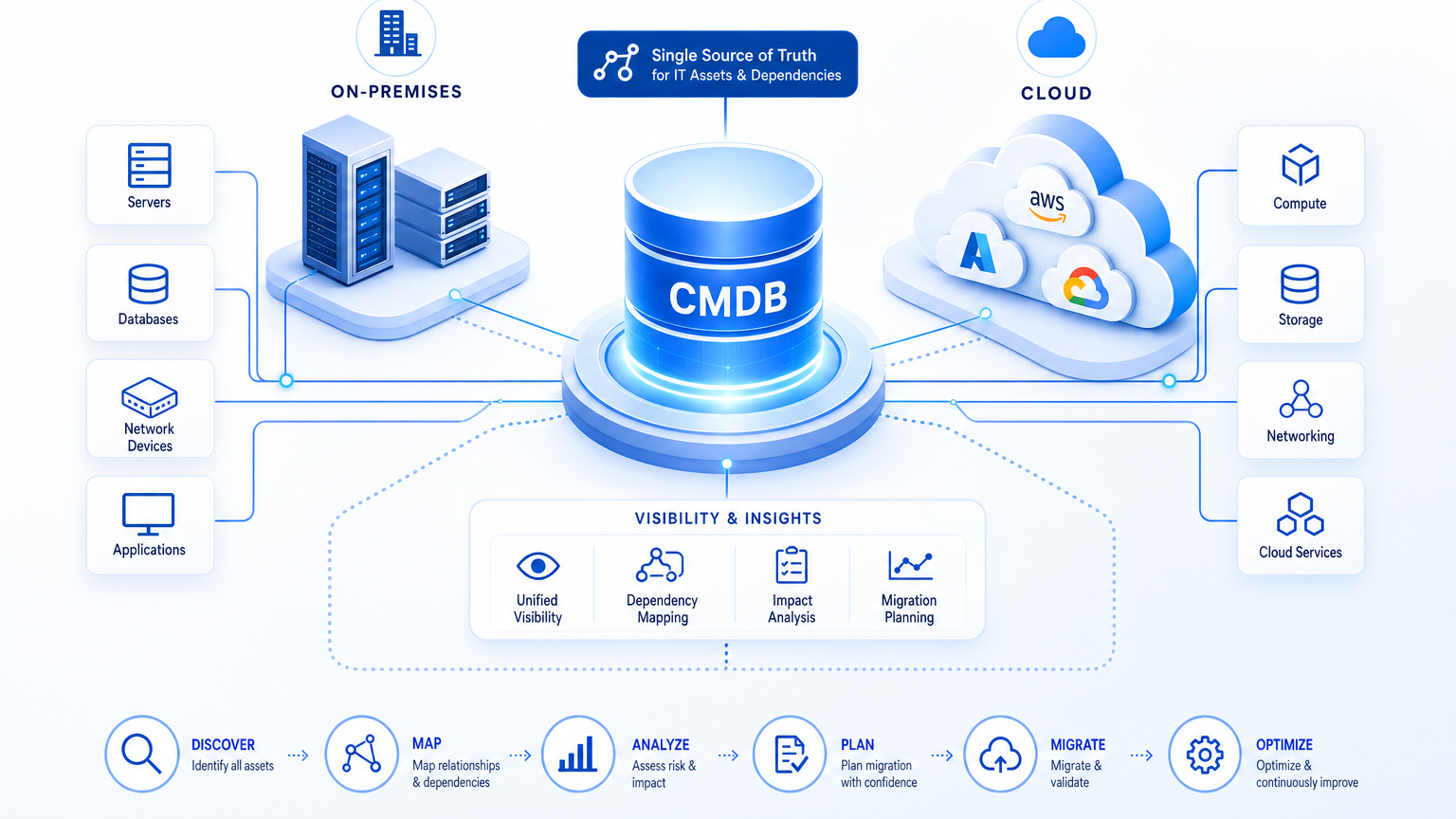
A discovery-fed hybrid record gives Milan planning teams one place to check both sides of the move. Three mechanisms make that record useful during migration planning.
Discovery covers on-premises infrastructure and cloud accounts together. Agentless probes and agents collect on-premises inventory across servers, network devices, and endpoints within network reach and protocol compatibility. AWS and Azure imports bring cloud inventory into the same record using credentials configured in the Virima interface. Coverage focuses on AWS and Azure, which matches the integration pages Virima documents today. Discovery runs on a high-frequency scheduled cadence set by the customer team. The cadence stays visible, the owner stays named, and each result carries a source with a timestamp.
Relationships show what crosses the planned boundary. ViVID service mapping displays server-to-server communication flows by port and protocol, which reveals what talks to what across on-premises and cloud infrastructure. Application owners define services based on operational knowledge of applications and supporting infrastructure. Planning teams review those flows during wave design and flag dependencies where the proposed boundary would separate callers from the systems they require. That review happens before scheduling, while adjustments remain inexpensive.
People validate ownership and criticality inside the record. Ownership and criticality come from Autonomic Social Discovery, which captures operational knowledge from the people supporting each system. Each configuration item carries its source and last verification timestamp. That approach follows Microsoft guidance asking workload owners to confirm tool findings with direct knowledge. The record therefore combines discovered facts with human confirmation in one place.
The comparison below shows how planning inputs differ between manual consolidation and a discovery-fed approach.
| Planning input | Spreadsheets plus tool exports | Discovery-fed hybrid CMDB |
|---|---|---|
| How the inventory list gets built | Interviews, spreadsheet merges, and point-in-time exports assembled before each wave | Scheduled IT discovery across on-premises and AWS plus Azure, reconciled against existing registers |
| Cross-boundary relationships | Reconstructed from memory and diagrams during workshops | Communication flows by port and protocol visible in service maps |
| Owner validation | Collected separately through email threads and meetings | Owners and criticality recorded alongside each item with source and timestamp |
| Evidence of currency | File dates on spreadsheets and export dates on reports | Last discovery timestamps plus verification history on each record |
| Effort between waves | Rebuilt largely from scratch for every wave | Updated through scheduled discovery with reconciliation focused on changes |
| What still needs people | Everything, including collection and validation | Service definitions, owner confirmation, retirement decisions, and wave choices |
Supporting pages describe each capability in depth: the CMDB as the system of record, IT discovery for collection methods, and service mapping for relationship context.
What the CMDB settles, and what stays with migration tooling
Clear scope keeps migration planning honest. The CMDB answers record questions with evidence. Migration tooling and the migration team own execution decisions. The table below separates those responsibilities.
| Planning question | Answered by the CMDB | Owned by migration tooling and the team |
|---|---|---|
| What exists on each side of the boundary | Current inventory across on-premises and cloud with verification dates | Performance baselines for sizing the target environment |
| What each system connects to | Communication flows and service relationships crossing the boundary | Application refactoring choices for cloud readiness |
| Who owns each component | Named owners with criticality and contact context | Wave sequencing decisions based on business priority and risk |
| When each record was last verified | Source plus timestamp on every item | Replication scheduling and cutover execution steps |
| Where the planned boundary cuts a relationship | Flagged cross-wave dependencies requiring a joint move or a bridge | Security and compliance classification for the target architecture |
The message for technology leadership stays straightforward: the record informs the wave plan with current facts, while the migration team decides wave order and execution timing.
Where the efficiency comes from
Efficiency comes from fewer surprises, faster reconciliation, and cleaner close-out after each wave. The mechanisms below describe where that efficiency appears and how teams measure progress internally.
Dependency discovery effort shrinks when collection runs on schedule. Workshop interviews and spreadsheet reconciliation consume planning weeks under manual methods. The AWS 2021 post describes two to four weeks of data collection for its own visualization approach, which gives a sense of the effort scale. Teams measure improvement by tracking hours required to build the dependency list for one wave. Scheduled discovery plus owner review replaces repeated interviews with targeted validation of changes.
Rework after cutover declines when cross-boundary pairs move together. Failed cutovers, rollbacks, and post-move fixes trace frequently to missed dependencies. Microsoft guidance recommends organizing waves to minimize broken dependencies for exactly this reason. Teams measure improvement by counting incidents per wave attributed to missed dependencies. Fewer flags during planning review translate into calmer cutover weekends.
Infrastructure spend after cutover gets cleaner close-out. Servers, instances, and contracts with named retirement owners leave the estate promptly. Contracts reconciled against live records reveal systems billing after retirement. Teams measure improvement by comparing contract line items against live records after each wave. Prompt retirement decisions protect budgets without affecting live services.
Software license exposure gets reviewed at each move. Installed software travels with migrated systems while entitlements remain tied to contracts and business units. The cross-industry Flexera State of ITAM report found 48% of organizations faced a vendor audit in the past year, 44% spent over $1M responding to audits across three years, and 43% reported significant savings from license reuse. Teams measure improvement by comparing installed software against entitlements before and after each wave. License review during planning prevents audit findings after migration.
Planning time between waves shortens as the record stays current. Manual methods require rebuilding the map after every wave. Scheduled discovery keeps the map current while reconciliation focuses on deltas. Teams measure improvement by tracking days from wave close to an updated map ready for the next wave. Shorter intervals keep migration momentum across quarters.
Cloud cost review gains a reliable starting point. Post-migration optimization needs ownership plus a review date for every significant resource. The global Flexera cloud survey ranks cost efficiency as the top success metric for 81% of respondents. Teams support that goal by assigning owners and cost review dates to migrated resources during close-out. Ownership makes optimization actionable.
License detail connects to IT asset management for entitlement tracking across moves.
Planning the next wave in the first 90 days
A focused 90-day start builds the record without pausing migration momentum. Each step below names the outcome plus the owner.
- Name the record owners during week one. Assign one owner for the migration record plus domain owners for infrastructure, applications, network, and cloud. Publish the roster where wave planners can find it. Ownership decisions prevent drift between waves.
- Run discovery on the first wave scope during weeks two through four. Include one on-premises site plus one AWS or Azure account tied to candidate applications for the first wave. Set a high-frequency scheduled cadence the team sustains through staffing changes. Record the cadence alongside the scope.
- Define services with application owners during weeks four through six. Build service definitions in ViVID with the people supporting each application. Review communication flows crossing the proposed boundary. Flag pairs requiring a joint move or temporary connectivity. Document each decision with names and dates.
- Reconcile discovery against existing registers during weeks six through eight. Compare discovered inventory against spreadsheets and older tool exports. Resolve duplicates, confirm owners, and correct naming differences. For every cross-boundary dependency, choose among three paths: move the pair forward together, build a bridge for the transition period, or update the connection design. Record the chosen path on the service map.
- Close out the wave with the same discipline during weeks eight through twelve. Update the record for every moved, retired, and retained system. Name an owner for every decommission. Rerun discovery to confirm the new state. Connect changes to the ITSM platform through the ServiceNow integration or the listed ITSM connectors so operations teams work from current data. The migrate apps and data centers use case describes how discovery outputs support migration workflows.
Check the next wave against the current record
Run a discovery pass across the next wave candidate applications and compare the result with the current dependency list. The comparison shows which relationships changed since the last review and which owners need to confirm updates before scheduling.
Start that check from Trusted Runtime Truth and align the first discovery scope with the applications planned for the upcoming wave.
Frequently asked questions
What does a hybrid cloud CMDB contain for migration teams?
A hybrid cloud CMDB holds discovered inventory plus relationships across on-premises and cloud infrastructure, with owners, criticality, sources, and verification timestamps supporting every wave review.
How does a hybrid cloud CMDB improve migration planning for Milan enterprises?
It shows what exists on both sides of the planned boundary, which relationships cross that boundary, and who owns each component, while the migration team retains decisions on wave order.
How do teams find dependencies between on-premises and cloud systems?
Teams combine scheduled discovery with communication flows by port and protocol, then ask application owners to confirm the findings before assigning systems to migration waves.
How is a CMDB different from a cloud migration assessment tool?
Assessment tooling supports a defined migration scope and timeline, while the CMDB persists as the verified record before planning starts, between waves, and after cutover completes.
Does Virima connect migration changes with ServiceNow and Jira Service Management?
Virima connects changes to affected configuration items, owners, and maintenance windows through ServiceNow, Jira Service Management, Ivanti, Hornbill, Halo, Xurrent, and TeamDynamix integrations.