Halo Discovery And Virima: A Powerful IT Discovery Duo

| Quick summary: Virima’s IT asset discovery and ViVID™ integration with Halo ITSM show you exactly what is running, how it connects, and what is at risk across your IT environment. Discovery-driven data feeds directly into Halo ITSM workflows, simplifies asset management, and strengthens security. However, only 43% of organizations report full visibility across their IT estate, according to the Flexera 2025 State of ITAM Report. Halo discovery with Virima is how you join that 43%. |
Key benefits at a glance
- Full asset discovery: Identifies all IT assets across hybrid environments using agentless and agent-based scanning.
- ViVID™ service mapping: Builds visual dependency maps from your service definitions for faster, safer decisions.
- Stronger incident and change management: ViVID™ overlays ITSM data onto dependency maps, supporting risk assessment and root cause analysis.
- Security and compliance: Integrates with the NIST National Vulnerability Database to flag known vulnerabilities. Simplifies IT audits with accurate tracking and reporting.
Read on to see how Halo Discovery and Virima work together to strengthen IT asset discovery and management.
Halo Asset Discovery and its Key Capabilities
Halo asset discovery is an IT asset management solution that gives organizations a detailed view of their IT assets. In practice, it tracks and manages both IT and non-IT assets: hardware, software, cloud services, and operational resources.
Key features of Halo Discovery include:
- Asset tracking: Manages IT and non-IT assets across on-premises, cloud, and hybrid environments.
- Remote monitoring and management (RMM): Enables oversight and proactive issue resolution for distributed infrastructure.
- Configuration management database (CMDB): Provides a centralized repository for asset relationships and dependencies.
- Cost reduction: Identifies underutilized assets to cut unnecessary spending.
- Risk mitigation: Flags vulnerabilities and supports compliance with IT policies.
Virima’s Advanced IT Asset Discovery
Virima’s IT asset discovery identifies hardware, software, and configuration details across your entire estate with high accuracy. It integrates with the Virima CMDB and service mapping to deliver a visual, discovery-sourced configuration management database that reflects your infrastructure as it actually exists.
Secure agentless discovery
Virima’s platform, built on AWS, provides secure multi-tenant data segregation, so your asset data stays isolated even in a shared SaaS environment. To protect sensitive data further, the platform follows the RACI model for role-based access and encrypts asset credentials locally, meaning scan credentials never leave your servers.
Discovery agent for Windows, macOS, and Linux
Virima’s discovery agent tracks network-connected devices, including remote PCs and off-network endpoints. Agents are available for Windows, macOS, and Linux. These agents also support software metering to help optimize license management and reduce software spend.
Vulnerability identification and prioritization
With built-in NIST NVD integration, Virima detects known vulnerabilities and ranks remediation based on asset criticality. As a result, your security team focuses on what matters most first.
Full coverage across hybrid environments
Virima discovers data center infrastructure, virtual assets, edge devices, and cloud resources covering on-premises and cloud environments, including AWS and Azure, from a single platform.
Detailed asset insights
Virima captures device-specific hardware details, OS attributes, software versions, patches, and security certificates. Taken together, these details give your team a complete, granular view of every discovered asset.
IT Asset Discovery with Halo ITSM and Virima: How the Integration Works
Virima’s IT asset discovery and ViVID™ give Halo ITSM teams the visibility to track, manage, and act on asset data across their entire infrastructure. Here is how the integration delivers value at each layer.
Enhancing IT visibility with high-frequency discovery cycles
Virima’s flexible discovery methods pair with Halo discovery to keep asset tracking accurate across on-premises, cloud, and hybrid environments.
Agentless discovery detects network-connected devices without installing software, which simplifies large-scale deployments. For assets that need ongoing monitoring, such as off-network laptops and remote endpoints, Virima’s agent-based discovery covers Windows, macOS, and Linux.
When integrated with Halo ITSM, this discovery data feeds directly into asset and service management workflows. As a result, IT teams gain up-to-date visibility into hardware, software, and cloud resources like AWS EC2, Azure Virtual Machines, and VPCs. In turn, this unified view helps organizations improve IT governance, reduce costs, and close security gaps.
The discovered data automatically populates Halo ITSM’s centralized CMDB, creating a single source of truth for IT assets and their relationships. That means no CSV imports, no spreadsheet reconciliation, and no stale records sitting in production for months.
Visualizing IT asset relationships with ViVID™
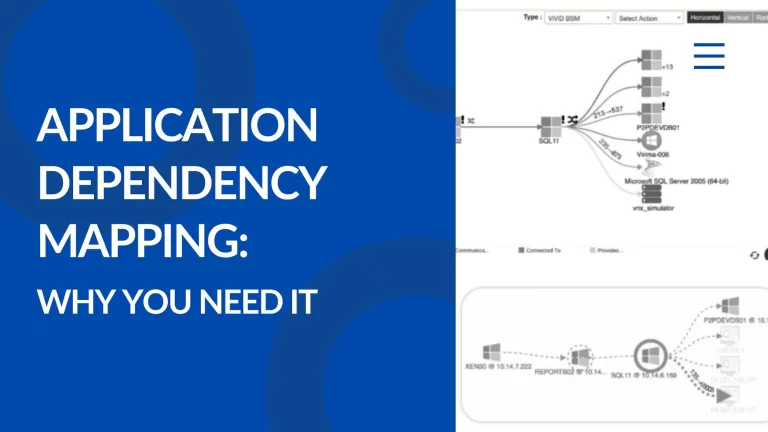
The Virima Visual Impact Display (ViVID™) turns static dependency maps into an operational dashboard. Specifically, it overlays open incidents, recent changes, planned changes, and event management alerts onto the maps built by Halo Discovery and service mapping, so your team sees live context, not just topology.
This overlay is critical for incident resolution, change management, and vulnerability prioritization. Instead of switching between tools and spreadsheets, your team sees impact context directly on the map.
ViVID™ helps IT teams answer operational questions fast:
- What is the risk exposure of making this change?
- Which assets or services could be impacted by this open incident?
- Who are the stakeholders involved in this incident or change?
By surfacing incident and change data from Halo ITSM directly on dependency maps, ViVID™ helps teams reduce MTTR and make better-informed change decisions.
NIST integration for cybersecurity and compliance
Virima’s IT discovery extends beyond asset management into cybersecurity asset management. To support this, Virima integrates with the NIST National Vulnerability Database (NVD) to perform NVD lookups for known vulnerabilities, including CPEs and CVEs, across every discovered asset.
This integration lets IT teams rank remediation efforts based on asset criticality, so the most business-critical systems get patched first.
Precise mapping of asset relationships also strengthens your security posture. If a critical CVE hits a shared library on one server, ViVID™ shows every service that depends on it. In that scenario, your team patches with full awareness of what might break, rather than discovering the impact after the fix goes live.
Simplifying IT asset management and audits
This integration strengthens IT asset management processes. Specifically, Virima’s high-frequency discovery cycles track hardware and software assets while gathering detailed information on configurations, relationships, and usage patterns. Discovery-sourced data also captures contextual attributes, such as ownership, lifecycle status, and business criticality, that give your CMDB the depth to support audits and compliance reporting.
This data supports managing assets across their full lifecycle, from procurement and deployment through production, reallocation, and retirement. At the same time, ViVID™ makes the CMDB visually consumable, so IT teams understand and act on asset relationships without digging through tables.
Built-in support for certificate management, software usage monitoring, and persistent configuration tracking helps IT teams address security risks proactively and walk into audits with the evidence already organized.
Integration beyond Halo ITSM
Virima’s IT discovery is not limited to Halo ITSM. Beyond Halo, it integrates with ServiceNow, Jira Service Management, Ivanti, Xurrent, and Hornbill, plus hypervisors, network and storage devices, and event management tools like SolarWinds and LogicMonitor.
Virima is also PinkVERIFY™ certified for ITIL 4 across six processes, including SACM, change management, and incident management. This provides an independent validation layer for organizations that need ITIL-aligned tooling across their ITSM stack.
This broad compatibility means organizations using multiple ITSM or monitoring tools can still consolidate discovery and visualization data into a unified view through Virima, with Halo ITSM as the operational hub.
| See how Virima delivers discovery-sourced runtime truth for Halo ITSM teams. Explore Virima Trusted Runtime Truth. |
Why Halo Discovery and Virima Give IT Teams the Edge
The Virima and Halo discovery integration gives IT teams a complete solution for managing assets across hybrid environments. In practice, it delivers accurate configuration data in a visual, actionable format that supports faster incident response, safer change management, and stronger cybersecurity prioritization.
With flexible discovery options, NIST NVD integration, and ViVID™ visualization, this Halo discovery integration keeps your CMDB accurate and your operations team equipped to make confident decisions.
Ready to see it in action? Schedule a demo today to experience Virima Discovery within Halo ITSM.
Frequently Asked Questions
What is the difference between agentless and agent-based discovery?
Agentless discovery scans network-connected devices remotely using protocols like WMI, SSH, and SNMP. Because no software installation is required on the target device, it suits large-scale environments where deploying agents to every endpoint is not practical.
Agent-based discovery installs a lightweight agent on the device itself, which reports back on a recurring basis. This method works best for off-network devices, remote laptops, and endpoints that are not always connected to the corporate network. Virima offers agents for Windows, macOS, and Linux, and supports both discovery methods. In practice, most organizations use a combination: agentless for data center and network infrastructure, agent-based for remote and mobile endpoints.
How ViVID™ service mapping improves IT operations
Service mapping changes how IT teams understand their infrastructure. With Virima’s halo discovery integration, your team defines which services matter, and Virima builds dependency maps automatically from those definitions, pulling in data from high-frequency discovery cycles.
These maps show business service dependencies, network topologies, and application interactions. When someone proposes a change to a database server, the map shows every application and service sitting downstream before the CAB even meets. That clarity directly supports capacity planning, change management, and incident prioritization.
Taken together, these capabilities, discovery, service mapping, ViVID™, and CMDB population form a complete IT operations management (ITOM) layer for Halo ITSM. Operations teams get the visibility and context they need without requiring a separate, costly ITOM platform.
How does CMDB integration improve incident response?
When an incident hits, the first question is always “what’s affected?” If your CMDB is stale or incomplete, your team spends the first 15 minutes just figuring out which services sit downstream of the failing component.
With Virima’s discovery feeding accurate data into Halo ITSM’s CMDB, incident responders can immediately see dependency relationships. ViVID™ overlays open incidents and recent changes onto these dependency maps, so the team sees not just what broke, but what else might be at risk. That context cuts mean time to repair (MTTR) and reduces the chance of a secondary outage from a change made without full visibility.
What does a Virima and Halo ITSM deployment look like?
Virima deploys as a SaaS platform hosted on AWS, with discovery scans configured per subnet and schedule. The integration with Halo ITSM uses bi-directional sync. CIs, relationships, and asset data discovered by Virima flow into Halo ITSM’s CMDB, and ITSM records (incidents, changes) feed back into ViVID™ for overlay visualization.
Most organizations start with agentless network scans to build an initial asset inventory, then layer in agent-based discovery for remote endpoints and software metering. Onboarding involves configuring scan schedules, mapping CI types to Halo ITSM’s CMDB schema, and setting up ViVID™ dashboards for the IT operations team.
| Schedule a demo to see Virima halo discovery in action. See Virima Discovery + Halo ITSM live. |