Open Infrastructure Mapping Tools for Smarter Enterprise IT Management

Picture an outage bridge where the only “map” is a Visio diagram last updated two quarters ago. The network team sees link flaps. App owners see timeouts. Security wants to know whether the affected segment touches regulated data. Nobody can answer the one question that matters: what depends on what, right now. That moment is why open infrastructure mapping tools keep showing up in enterprise searches.
The first instinct in mid-to-large organizations is often to start with free or open-source tooling to regain visibility without committing to a platform too early.
This guide clarifies what infrastructure mapping is, why it matters in hybrid environments, and how to evaluate open-source and enterprise solutions. It is especially relevant for regulated sectors where audit readiness, traceability, and access control are non-negotiable. The tooling list includes both open favorites and enterprise options.
What is Infrastructure Mapping, and Why Does It Matter?
Infrastructure mapping is the process of discovering and visualizing IT assets and their connections, showing how devices and services are physically and logically linked.
In enterprise operations, infrastructure mapping is not a “nice-to-have diagram.” It is a risk-reduction mechanism:
| A SolarWinds survey found that 77% of IT professionals report limited visibility across on-premises and cloud environments. This visibility gap drives the urgent need for infrastructure mapping tools that work across hybrid estates. |
- Visibility: A current map reduces blind spots and highlights what exists and how it connects—critical when environments sprawl across data centers and the cloud.
- Faster troubleshooting: Dependency context turns an alert storm into a prioritized impact view (what’s affected, what’s upstream/downstream).
- Planning & optimization: Migrations, refresh cycles, and cloud cost initiatives move faster when dependencies are explicit.
- Change impact analysis: Change approvals get safer when impacted services and downstream dependencies are visible.
- Compliance & audits: Regulated environments require defensible evidence of system inventories and interconnections; mapping supports audit readiness by reducing undocumented components.
Manual mapping rarely survives the velocity of hybrid environments. That is where infrastructure mapping tools—from open-source utilities to enterprise platforms—enter the conversation.
Challenges of Mapping Complex Infrastructure
Modern infrastructure is defined by change:
- Hybrid and multi-cloud footprints
- Frequent provisioning and deprovisioning of workloads
- Shared services and third-party dependencies
- Layered ownership across teams and vendors
Manual documentation (Visio, spreadsheets) becomes outdated the moment a new instance is deployed or a switch is replaced.
This reality drives adoption of mapping tools. Open-source solutions attract teams because they offer budget-friendly flexibility. However, trade-offs tend to emerge around scale, support, integration, and governance—particularly in regulated sectors, where tooling gaps can become compliance gaps.
Top Open-Source Infrastructure Mapping Tools
Open-source tools typically excel at specific parts of the mapping problem: discovery, topology, monitoring, and documentation. Strong outcomes often come from pairing tools intentionally.
Nmap: Discovery Foundation
Fast network discovery and security auditing.
Best for: Fast discovery, security-driven inventory validation
Limitations: Not a mapping UI; visualization requires additional tools
Netdisco: Network Inventory & Topology Tracker
Web-based network management with SNMP/CDP/LLDP discovery.
Best for: LAN topology, switch-port mapping, MAC/IP correlation
Limitations: Network-centric; limited application/service dependencies
OpenNMS Horizon: Monitoring + Topology Visualization
Display topology maps and node connections via SNMP.
Best for: Monitoring-centric environments needing topology
Limitations: Configuration-heavy; service mapping requires additional tools
Zabbix: Infrastructure Monitoring with Basic Mapping
Monitoring at scale with optional topology visualization.
Best for: Metrics and alerting backbone
Limitations: Mapping not primary; dependency mapping limited
NetBox: Network Source of Truth
Structured IPAM/DCIM and network modeling.
Best for: Network documentation maturity, modeling standards
Limitations: Not auto-populating; discovery typically external
iTop: CMDB Foundation
Open-core CMDB and service management framework.
Best for: CMDB foundation, change and incident tracking
Limitations: Requires configuration and tooling integration
Wireshark: Deep Validation (Not a Full Mapping Tool)
Validates traffic relationships and hidden dependencies.
Best for: Deep troubleshooting, verifying true dependencies
Limitations: Not scalable as enterprise mapping system
Lucidchart: Manual Map Presentation
Diagramming tool for infrastructure documentation.
Best for: Executive-ready diagrams once data is known
Limitations: Manual upkeep; not dynamic mapping
Pro tip: Open-source mapping succeeds when tools are combined intentionally (e.g., Nmap for discovery + Netdisco for topology + NetBox/iTop for governance). The hidden cost is integration and maintenance effort, which often becomes the limiting factor at scale.
Leading Commercial Infrastructure Mapping Solutions
Open infrastructure mapping tools are valuable. Many enterprises still evaluate commercial platforms because they reduce operational friction: faster deployment, support and SLAs, and pre-built integrations with CMDB and ITSM systems.
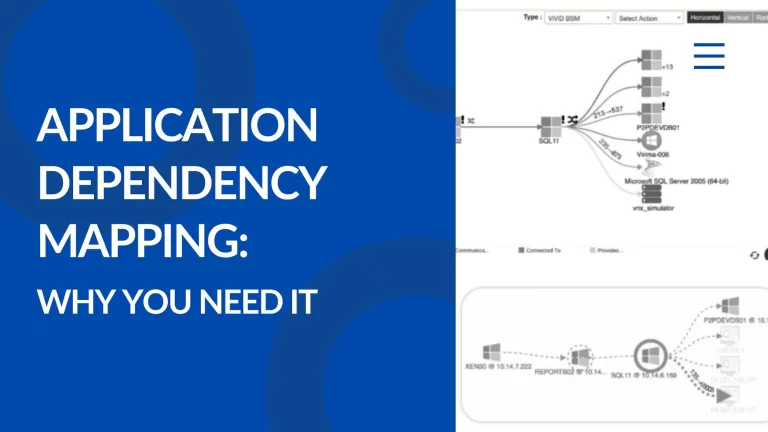
- Virima — designed to connect mapping to operational context through service and application dependency mapping and ViVID™, which includes infrastructure dependencies alongside business services. Virima integrates IT discovery with relationship reconciliation to maintain accuracy as environments change.
- Auvik — automated network discovery and topology visualization, positioning network mapping as an always-updated operational view.
- SolarWinds Network Topology Mapper (NTM) — frequently used in enterprises already standardized on SolarWinds.
- Device42 / Faddom — often discussed for discovery and dependency mapping workflows.
The value of enterprise tools is more usable and defensible context—especially when mapping must be audit-ready, tied to change records, and consumable by multiple stakeholders.
Open vs. Commercial Tools: How to Choose
This decision is rarely about license price alone. It is about risk tolerance, operating model, and governance requirements.
Open-Source vs. Commercial Tools Comparison
| Factor | Open-Source Tools | Commercial Tools |
| Initial cost | $0 license cost | Subscription/license fees |
| Maintenance effort | High (setup, upgrades, integrations) | Low/Moderate (vendor handles updates) |
| Scalability | Varies; tuning required | Built for enterprise scale |
| Support | Community only; no SLA | Vendor support + SLAs |
| Integration | Custom or limited | Pre-built (CMDB, ITSM, cloud, etc.) |
| Security & compliance | Deployment-dependent | Stronger RBAC, audit logging |
Decision guidance that holds up in regulated sectors:
- Open-source works well for discovery pilots and focused topology visibility.
- Commercial platforms become compelling when mapping must remain accurate through recurring discovery cycles, be auditable, and integrate into change, incident, and CMDB workflows.
Best Practices for Implementing Infrastructure Mapping
1. Define Scope and Operational Purpose
Mapping initiatives fail when “map everything” becomes the goal. Mature programs start with critical services.
2. Establish an Asset Baseline
Run discovery and validate results with owners. Baselines must include “unknowns” (unmanaged devices, shadow assets).
3. Choose Tools Strategically
Open-source stacks can work, but require defined data flows: where discovery lives and how updates propagate.
4. Validate the Map Like Production Data
Maps influence decisions. A validation workshop with network, servers, apps, and security stakeholders prevents false confidence.
5. Operationalize Recurring Updates
Maps lose accuracy without structured refresh cycles. High-frequency IT discovery and relationship reconciliation define the maturity line. This is where enterprise platforms such as Virima are often introduced to maintain accuracy as environments change.
Compliance, Security, and Infrastructure Maps
Infrastructure maps can support audit readiness by providing evidence of what exists and how systems connect. But the mapping tool itself also becomes part of the control surface.
Controls that matter:
- Role-based access to mapping views and discovery credentials
- Audit trails for changes to relationships and CMDB records
- Secure storage and access policies for exported maps and inventories
Open-source caution: Security posture depends on deployment discipline. Access to a complete network map is sensitive; governance gaps can create risk.
Building Your Mapping Strategy
Infrastructure mapping is not documentation work. It is operational risk management.
Open tools provide powerful building blocks for discovery and topology. Enterprise platforms become valuable when mapping needs to remain accurate through ongoing discovery cycles, stay governed, and integrate into IT operations and compliance workflows.
Virima fits naturally when the problem shifts from “getting a map” to “maintaining trusted operational context.” Virima Service Mapping and ViVID™ are built to support decision-making across incident response, change, and audit readiness.
| For organizations ready to move from ad-hoc mapping to continuous, audit-ready service intelligence, schedule a Virima demo to see how high-frequency discovery combined with service mapping and ViVID™ keeps infrastructure context accurate and actionable. |
Frequently Asked Questions
Are open infrastructure mapping tools secure enough for financial or healthcare environments?
They can be, but require careful deployment, access control configuration, and often additional tooling to meet audit requirements.
What breaks first as environments scale?
Dependency accuracy. Without high-frequency reconciliation, maps lose confidence, undermining incident response and compliance readiness.
Can open tools integrate with ITSM or CMDB systems?
Some can, but integration is often custom or manual. Native, governed synchronization is limited compared to enterprise platforms.
When should teams consider moving beyond open tools?
When downtime risk, audit pressure, or operational scale demands consistent service-level visibility and historical traceability.
Summary
Infrastructure mapping is foundational to enterprise IT risk management. Open-source solutions excel as discovery and topology building blocks. Commercial platforms add governance, integration, and confidence—critical when mapping must support compliance, change control, and incident response at scale.
Request a Virima demo to explore how high-frequency discovery combined with service mapping and ViVID™ keeps infrastructure context accurate and actionable across your hybrid environment.