Does Virima Support Pure Storage, NetApp & Arista Discovery?

IT teams evaluating Virima often ask one question first: can it find storage arrays and network switches, not just servers? NIST’s Cybersecurity Framework 2.0 (2024) names full asset inventory as a base requirement for good security posture. That includes storage and network gear. This FAQ answers the storage and network discovery questions IT managers, architects, and evaluators ask most.
Does Virima Support Pure Storage Discovery?
Yes. Virima automatically discovers Pure Storage FlashArray arrays using asset discovery methods. It connects to the FlashArray management interface over SSH with read-only credentials. From there, it pulls the array serial number and model, controller hardware details for CT0 and CT1, volume names and sizes, host objects with their device IDs (WWNs for Fibre Channel, IQNs for iSCSI), and host-to-volume connection maps.
Virima 6.1.1 introduced Pure Storage FlashArray discovery. The platform stores each discovered CI in the Virima CMDB and syncs it to connected ITSM platforms, including ServiceNow, Jira, Ivanti, Halo, and Xurrent.
Can Virima Discover NetApp Storage Devices?
Yes. Virima discovers NetApp ONTAP-based storage systems over SNMP and SSH. Discovery captures the NetApp cluster and node inventory (serial numbers, models, ONTAP version), storage virtual machine (SVM) configuration, volume names and sizes, and network interface (LIF) settings.
NetApp discovery lets IT teams populate storage CIs in the CMDB without manual entry. When combined with server discovery, Virima builds dependency maps between NetApp volumes and the compute systems that consume them via NFS or iSCSI. Change management teams use this cross-layer visibility to see what a change will affect.
Does Virima Support Arista Switch Stack Discovery?
Yes. Virima discovers Arista EOS switches over SNMP and SSH, including full switch stack setups. Discovery captures the switch hostname, model, serial number, EOS firmware version, physical interface inventory, VLAN setup, and LLDP neighbor data. Arista’s own EOS documentation confirms that EOS supports SNMP and eAPI (SSH-based) management. This allows outside tools like Virima pull full switch configuration and topology data.
For Arista environments built with SWAG (Switch Aggregation Group) or traditional stacking, Virima represents the stack as one logical CI with each member switch as a linked component. LLDP neighbor data lets Virima map the network relationships between switches and the servers connected to them, so teams get real infrastructure dependency data inside the CMDB.
Does Virima Discover Aruba Switches?
Yes. Virima discovers HPE Aruba switches over SNMP. Captured data includes switch hostname, model, serial number, firmware version, interface status, VLAN setup, and LLDP or CDP neighbor data.
Aruba discovery brings campus networks the same CMDB visibility that data center networks already get. Virima links Aruba switch CIs to server and endpoint CIs through topology discovery, so IT teams see the full picture of physical network connectivity.
What Storage Vendors Does Virima Support?
Virima discovers multiple storage vendors using different discovery methods. Pure Storage and NetApp received dedicated support in version 6.1.1:
| Vendor | Platform | Discovery Protocol |
|---|---|---|
| Pure Storage | FlashArray (all models) | SSH (Purity//FA CLI) |
| NetApp | ONTAP (AFF, FAS, ONTAP Select) | SNMP, SSH |
Beyond dedicated storage discovery, Virima’s agentless discovery engine can also identify storage arrays that expose SNMP management interfaces. That means teams still get basic device CI data even without a full protocol integration.
What Network Vendors Does Virima Discover?
Virima discovers network infrastructure from many vendors over SNMP and SSH, with dedicated support added for the following in version 6.1.1:
| Vendor | Platform | Discovery Protocol |
|---|---|---|
| Arista | EOS switches (all models) | SNMP, SSH/eAPI |
| HPE Aruba | ArubaOS switches | SNMP |
| Cisco Meraki | Cloud-managed switches and APs | Meraki Dashboard API |
Virima also discovers Cisco IOS, Juniper, and other SNMP-enabled network devices using standard MIBs.
How Does Virima Discover Storage Infrastructure?
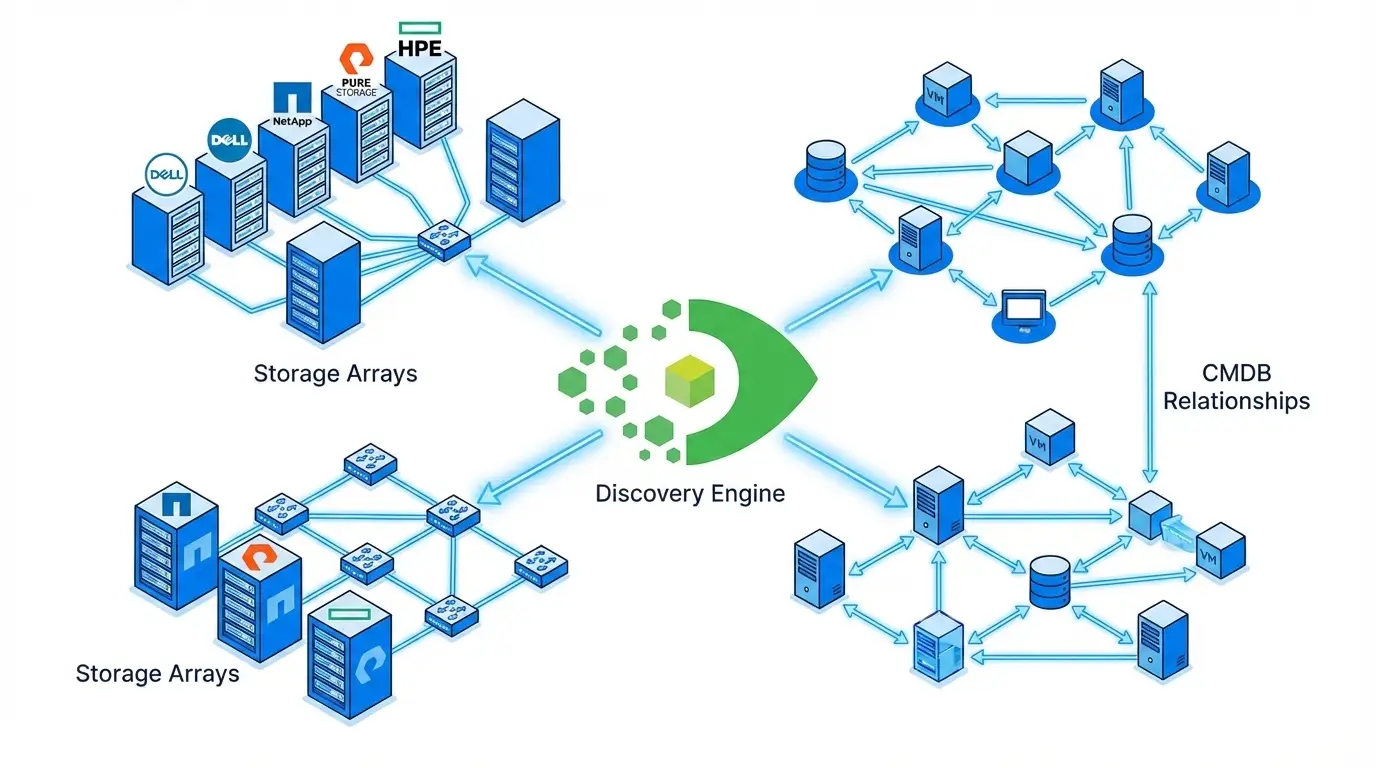
Virima’s storage discovery runs in three steps, as part of the broader Virima IT Discovery engine that also covers servers, network devices, and cloud resources.
Step 1: Target identification
The IT admin sets up discovery credentials for each storage system, either SSH username and password (or key) or an SNMP community string or v3 credentials. Discovery targets can be single IPs, IP ranges, or an imported asset list.
Step 2: Protocol-based enumeration
Virima connects to each storage target with the configured protocol. For SSH-based discovery on Pure Storage and NetApp, it runs a read-only command sequence against the management interface. For SNMP-based discovery on NetApp and Aruba, Virima polls standard and vendor-specific MIBs.
Step 3: CI population and relationship mapping
Virima maps each parsed response to a CI type in the CMDB. It creates or updates storage array, controller, and volume CIs, then builds relationships between storage CIs and previously discovered server or network CIs wherever it finds matching device ID or IP data.
Teams can schedule Virima discovery to run daily, weekly, or on demand. This keeps the CMDB current as new volumes are provisioned or host mappings change.
Storage and Network Discovery Coverage in Version 6.1.1
| Category | Vendor | Platform | Protocol | CI Types Discovered |
|---|---|---|---|---|
| Storage | Pure Storage | FlashArray | SSH | Array, Controller, Volume, Host |
| Storage | NetApp | ONTAP | SNMP, SSH | Cluster, Node, SVM, Volume |
| Network | Arista | EOS | SNMP, SSH/eAPI | Switch, Stack, Interface, Neighbor |
| Network | HPE Aruba | ArubaOS | SNMP | Switch, Interface, VLAN, Neighbor |
| Network | Cisco Meraki | Cloud-managed | API | Switch, AP, Network |
Why This Matters for CMDB Accuracy
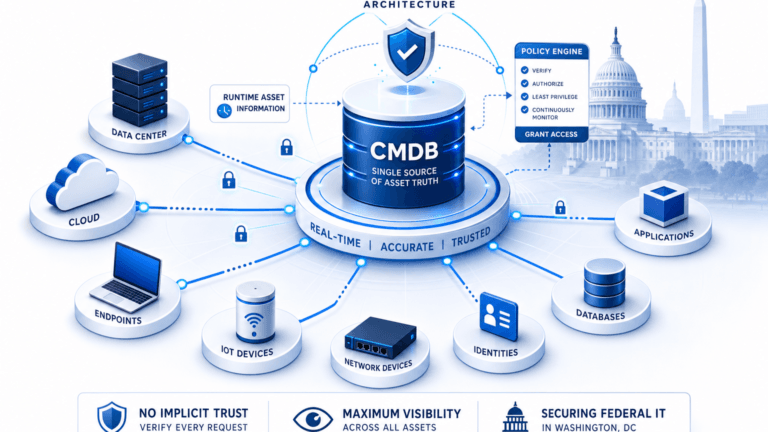
A Virima CMDB that only tracks servers and VMs misses half the picture. Storage arrays hold the data your applications depend on, and network switches carry every connection between them. When an incident hits, teams need to trace the path from application to server to switch to storage volume in minutes, not hours. Automated discovery across all four layers gives IT teams trusted runtime truth instead of a spreadsheet nobody trusts.
Virima 6.1.1 added dedicated discovery support for Pure Storage FlashArray, NetApp ONTAP, Arista EOS, and Aruba switches, addressing the most common storage and network gaps in enterprise CMDBs. Discovery uses SSH, SNMP, and vendor APIs to capture configuration items and relationships without manual data entry.
For IT teams expanding CMDB coverage past servers and virtual machines, Virima’s multi-vendor discovery engine applies the same automation to storage and network infrastructure that it already applies to compute and cloud resources
See Virima’s storage and network discovery in action. Schedule a demo at virima.com.
Frequently Asked Questions
Does Virima need agents installed on storage arrays or switches?
No. Virima discovers Pure Storage, NetApp, Arista, and Aruba devices agentlessly over SSH, SNMP, or vendor APIs. No agent software runs on the storage or network hardware itself.
How often does Virima refresh storage and network CI data?
Teams control the schedule. Discovery can run daily, weekly, or on demand, so the CMDB reflects new volumes, new switches, and changed host mappings as they happen.
Does Virima map relationships between storage, network, and server CIs automatically?
Yes. Virima builds these relationships automatically once it discovers matching device IDs or IP data across storage, network, and server CIs.
What credentials does storage and network discovery require?
Storage and network discovery needs read-only SSH credentials for Pure Storage and NetApp, and an SNMP community string or SNMP v3 credentials for NetApp, Arista, and Aruba.
Can Virima discover network vendors beyond Arista and Aruba?
Yes. Virima discovers Cisco IOS, Juniper, Cisco Meraki, and other SNMP-enabled network devices using standard MIBs, in addition to the dedicated Arista and Aruba support added in version 6.1.1.