How Virima Complements ORDR: Trusted Runtime Truth for IoT and OT Security

Security teams face a visibility problem that no single tool fully solves. ORDR discovers and secures every connected device on your network — IT, IoT, OT, and IoMT. Virima delivers the trusted runtime truth that tells you what each of those devices does, what business service it supports, what changed, and what your organization’s actual risk exposure looks like — what exists, how it’s connected, what will break, and who owns it. Used together, the two give IT and security teams what neither provides alone.
The Problem: Device Discovery Without Trusted Runtime Truth
Traditional IT discovery tools were built for managed IT assets — servers, workstations, standard network infrastructure. They were not designed for the explosion of IoT sensors, OT controllers, medical devices, and unmanaged endpoints that now make up a significant share of the enterprise environment.
According to ORDR’s research, IoT, OT, and IoMT devices account for approximately 40% of assets on a typical enterprise network. Most CMDB solutions are blind to them. Security teams can see anomalous behavior on these devices, but without trusted runtime truth — ownership, criticality, service relationships, change history — they cannot quickly answer the questions that matter most: What business service does this device support? Who owns it? Has it been recently changed? What is the blast radius if it goes offline or is compromised?
That gap between visibility and runtime truth is where incidents stall, investigations drag on, and remediation gets delayed.
What ORDR Does Well
ORDR is an asset intelligence platform trusted by 500+ organizations across healthcare, banking, manufacturing, and other industries where connected devices are mission-critical. Its proprietary discovery engine automatically identifies and classifies every device on the network — including assets that traditional agent-based and agentless discovery tools miss — and delivers real-time risk context: device type, manufacturer, firmware version, communication patterns, vulnerability exposure, and behavioral anomalies.
ORDR’s strength is breadth and speed. It sees the full device population, including the 40% that most CMDBs miss, and acts on that data in real time. What it does not do is tell you what those devices mean to your business — which services depend on them, who owns them in your organization, what changed last week, and what breaks downstream if one of them goes offline.
That is where Virima comes in.
What Virima Adds
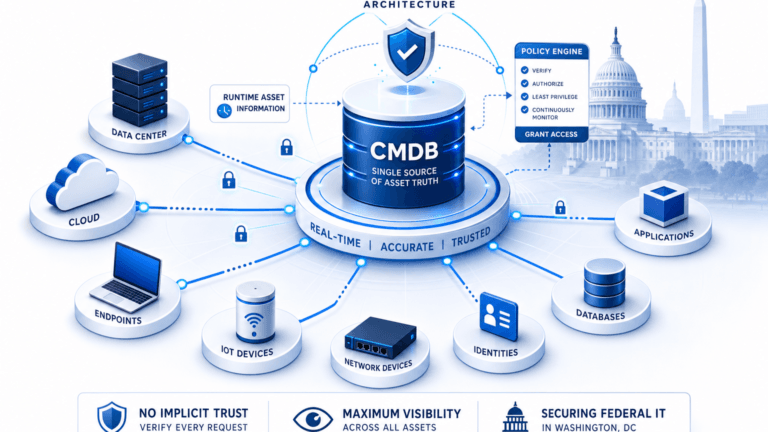
Virima’s role alongside a tool like ORDR is trusted runtime truth. Where ORDR identifies what is on the network, Virima answers what each asset means to the organization — what exists, how it’s connected, what changed, what will break, and who owns it.
When ORDR-surfaced devices are brought into Virima as configuration items (CIs), each device gains a full record: ownership, location, lifecycle stage, maintenance history, and its place in the service dependency map. Service definitions — which applications and services each device supports — are provided to Virima manually, via spreadsheet import, or through integrations such as Lean IX. Once those definitions are in place, Virima’s ViVID™ service mapping automatically builds and maintains visual dependency maps, showing which services depend on each device, what other CIs it connects to, and what the downstream impact looks like if it is compromised, patched, or taken offline.
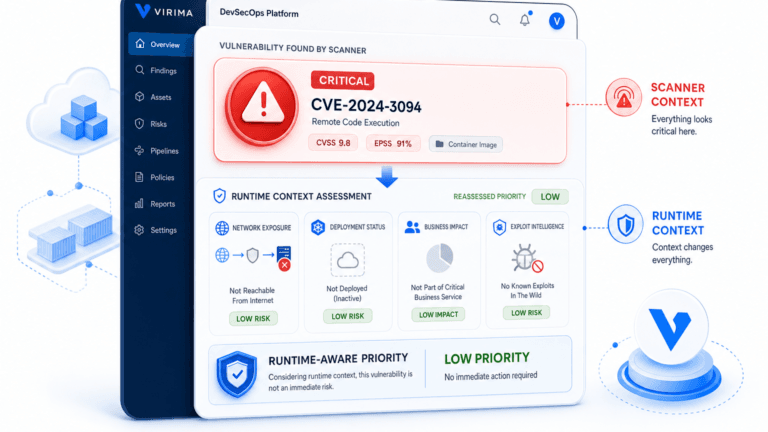
That runtime truth transforms a device alert from a data point into a decision. A security engineer looking at an ORDR alert can cross-reference the device’s record in Virima and immediately know whether that IoT device is isolated or is a dependency for a patient monitoring system, a production line controller, or a financial transaction service.
How the Two Work Together in Practice
ORDR and Virima address different layers of the same problem. ORDR operates at the network layer — real-time device detection, classification, risk scoring, and behavioral monitoring. Virima operates at the operational layer — ownership, service relationships, change history, blast radius, and policy-aware decision support.
Organizations that use both typically establish a workflow where ORDR-discovered devices inform CMDB population and maintenance in Virima. Device records surfaced by ORDR can be used to audit gaps in the existing CMDB, add missing CIs, and keep IT asset management records current — especially for the IoT and OT assets that traditional discovery misses. The result is a CMDB that reflects the full device population, not just the managed IT assets that agent-based scanning reaches. For organizations working to build a CMDB that is genuinely complete and audit-ready, closing that 40% gap matters significantly.
Four Scenarios Where Virima and ORDR Work Best Together
Incident response. When ORDR surfaces an alert on an IoT or OT device, the security engineer’s next question is always: what does this device connect to, and what breaks if it is compromised? That answer lives in the CMDB. With Virima’s ViVID™ service maps, root cause analysis that would otherwise take hours of manual investigation becomes a matter of minutes — a direct reduction in MTTR.
Vulnerability prioritization.
ORDR surfaces vulnerability exposure across the full connected device population. Virima’s CMDB adds the criticality layer: which vulnerabilities sit on devices that support high-priority business services? According to the IBM 2024 Cost of a Data Breach Report, the average breach costs $4.88 million globally. Prioritizing remediation by service criticality — not just CVSS score — focuses limited security resources on the exposures with the highest actual business risk.
Change management.
Before a patch or configuration change touches a connected device, ViVID™ shows the full blast radius. IT teams can see which services depend on the device, what other CIs are in the impact path, and whether the change window carries elevated risk. This reduces failed changes on devices that were previously outside the change management process entirely.
Compliance and audit readiness.
Regulators and auditors increasingly expect organizations to account for IoT and OT assets alongside traditional IT infrastructure. A Virima CMDB informed by ORDR’s device intelligence gives compliance teams a defensible, complete asset record — one that reflects the actual network environment rather than a partial inventory built from traditional scanning alone. For broader guidance, see CMDB best practices.
Bridging Security Visibility and Operational Truth
One persistent challenge in enterprise IT is that security teams and IT operations teams work from different data sets. Security tools surface device risk; CMDB and ITSM tools drive IT operations. When those data sets do not match, both teams make decisions with incomplete information.
Pairing ORDR with Virima directly addresses this. Security teams get the operational context — ownership, service dependencies, blast radius — behind every device they monitor. IT operations teams get visibility into the security posture of every asset in the CMDB. That shared trusted runtime truth is the foundation for faster decisions, fewer escalation loops, and better outcomes when something goes wrong.
Understanding active vs. passive IT asset discovery is relevant here — ORDR’s passive discovery approach is specifically designed for environments where active scanning risks disrupting sensitive devices, a common concern in healthcare and OT environments.
Who Benefits Most
This pairing is most relevant for organizations managing a significant population of IoT, OT, or IoMT devices alongside traditional IT infrastructure. Healthcare delivery organizations, financial services firms, and manufacturers are the most common environments — but the use case applies anywhere connected devices are part of the operational environment and need to be represented in a trustworthy CMDB.
For IT directors and CMDB owners, Virima closes the asset coverage gap that tools like ORDR expose. For CISOs and security architects, Virima adds the service context and blast radius visibility that turns device alerts into prioritized, governed decisions. For organizations moving toward AI-assisted and agentic IT operations, that trusted runtime truth across the full device estate is foundational — AI agents can only act safely when the data they rely on reflects what actually exists, what it connects to, and what will break.
The EMA ServiceOps report on CMDB maturity and real-time discovery covers the operational impact of CMDB accuracy in detail — and its findings apply directly to the visibility gap that Virima addresses.
See Virima in Action
ORDR gives your security team full visibility across the connected device estate. Virima gives that estate trusted runtime truth — what each device does, who owns it, how it connects, and what breaks if it goes down. Move faster. Act safely. Schedule a demo to see how Virima complements the security and discovery tools your team already uses.