The role of IT device management in boosting security and productivity

Picture a workplace where every device runs smoothly, data stays secure, and your team stays focused. That sounds great on paper, but the reality shifts fast once device counts start climbing. Unsecured endpoints, including laptops and mobile devices, and outdated systems disrupt operations and open your organization to risk. In fact, nearly 48% of organizations experienced data breaches caused by unmanaged devices in the past year. That is where IT device management steps in.
IT device management goes beyond tracking hardware and acts as a comprehensive management solution. It creates a secure, efficient environment where your team can do its best work. In this blog, we will cover how the right device management software strengthens security and improves productivity across your organization.
Understanding IT device management
IT device management is the practice of overseeing and controlling the devices across your organization, from laptops and servers to virtual machines, while keeping them secure and compliant. As your environment grows, so does the complexity of managing all these endpoints, especially when 67% of IT leaders report lacking full visibility into their device environments.
The right device management software keeps every asset secure, current, and running efficiently. That means regular updates, ongoing monitoring for security threats, enforcement of compliance policies across the board, and validation of each endpoint through a device certificate.
Why device management software matters
Unmanaged devices are easy targets. A single unpatched laptop can lead to a data breach that costs your organization thousands in remediation and downtime. Proper device management helps you cut that risk, especially when each endpoint is authenticated using a device certificate.
When devices are well-managed, your team spends less time troubleshooting and more time on productive work. Downtime drops, and output goes up.
Compliance is another driver. Many industries enforce strict rules around device security. The right software helps you maintain compliance, stay within those standards, and avoid penalties. Early detection also reduces cost. Catching a failing drive or an expired certificate before it causes an outage saves you from costly emergency repairs and unplanned downtime.
Device management, including mobile device management mdm, also supports remote and hybrid work. With the right tools, your team can monitor, update, and secure devices regardless of location.
Virima’s Work from Anywhere (WFA) agents, for example, track daily configuration changes and software usage on remote PCs and Macs over the internet, keeping your CMDB current even for employees who never connect to the corporate network.
How device management software strengthens security and boosts productivity
A solid IT device management platform strengthens data security, streamlines IT operations, and keeps performance consistent. Here is how.
Unified device visibility across your environment
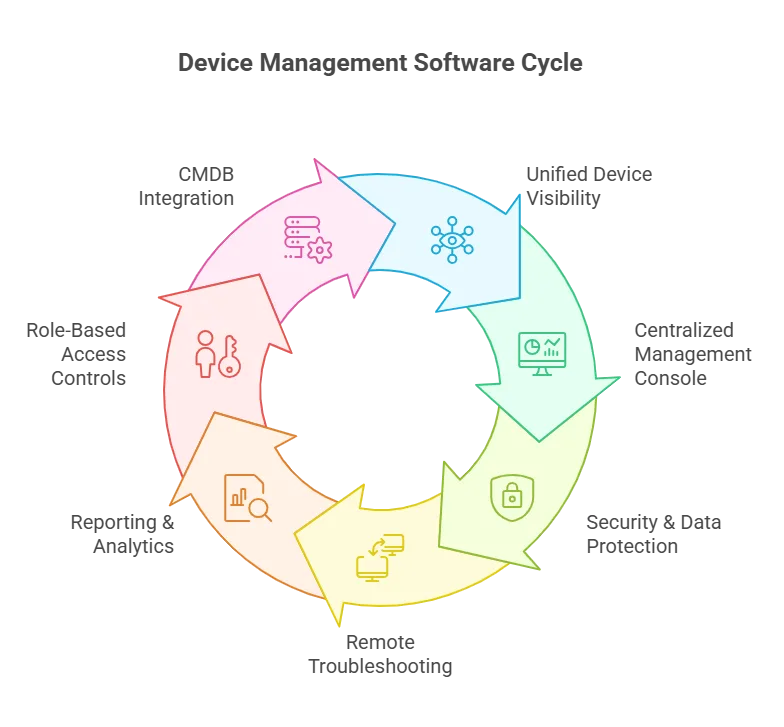
Device management software lets you oversee devices, including physical machines, virtual machines, cloud instances, and remote endpoints, from a single platform. This real-time visibility is the foundation of both security and compliance. You cannot protect what you cannot see.
Centralized management console
From one console, IT administrators can manage and secure devices by deploying software, configuring settings, enforcing policies, and monitoring device health. This cuts down on manual, repetitive work and helps your ops team move faster.
Security policy enforcement and data protection
Device management enforces security policies across all endpoints: encryption, access controls, remote wipe for lost or stolen devices, and enforcement of identity validation through a device certificate. These controls protect sensitive data without adding friction to daily workflows, often integrating with trusted certification authorities for identity validation.
Remote troubleshooting and support
Remote troubleshooting lets your IT team resolve issues on remote devices without being physically present. For distributed teams, this is the difference between a 30-minute fix and a multi-day wait for on-site support.
Reporting and analytics
Good device management software gives you clear reporting on device health, security compliance, and usage patterns. These insights help you make informed decisions about refresh cycles, policy updates, and resource allocation.
Role-based access controls
Role-based access controls let you define user access to devices and data. This limits your attack surface and ensures only authorized personnel reach sensitive systems.
The challenges of modern IT device management
Managing IT devices in a complex, evolving environment comes with real obstacles:
- Securing endpoints against threats: Protecting sensitive data from breaches and cyberattacks is an ongoing challenge, especially as attack surfaces expand.
- Managing diverse OS environments: A mix of operating systems like Windows, Linux, and macOS devices complicates patching, configuration, and policy enforcement.
- Maintaining data integrity at scale: The volume of data generated across thousands of devices makes storage, backup, and accuracy harder to manage.
- Keeping pace with new technology: Every new device type or cloud platform you adopt adds complexity to your management stack.
- Preventing unauthorized access: Restricting access to sensitive data requires continuous monitoring and enforcement, not a one-time policy.
- Balancing security with usability: Lock down too much and productivity suffers. Too little and your risk exposure grows.
Tackling these challenges requires a platform that scales with your environment. That is where Virima fits in.
How Virima strengthens IT device management
IT teams often struggle with device sprawl, inconsistent configurations, and the pressure to secure a growing number of endpoints. Even with the right knowledge, managing all of this manually leads to gaps. Virima addresses these challenges by combining IT discovery, asset management, and ML-powered service mapping into a single platform, giving your team dependency visibility across on-premises, cloud, and edge environments.
Optimized IT device lifecycle management
Virima’s ITAM solution manages hardware and software assets across their full lifecycle, from procurement to decommissioning. It integrates with automated discovery tools and a CMDB to give your team visibility into asset usage, compliance status, and performance through recurring scheduled scans. The reporting and analytics built into Virima support better decisions around refresh cycles, cost allocation, and capacity planning.
For organizations running hybrid environments, Virima also discovers cloud-based resources across AWS and Azure, bringing those assets into the same CMDB alongside on-premise and edge devices.
Faster vulnerability detection through automated asset discovery
Virima’s IT discovery uses both agent-based and agentless methods to scan and inventory devices across your network, from servers, network gear, and storage to virtual machines, containers, IoT devices, and cloud resources. With a complete, current inventory in place, discovery data is automatically checked against the NIST National Vulnerability Database for known CPEs and CVEs, at no additional charge.
ViVID then helps your team prioritize remediation based on both the criticality of the vulnerability and the criticality of the affected asset and business service. This approach catches risks before they escalate into incidents. For more on how discovery methods compare, see our breakdown of agent-based vs agentless discovery.
Compliance monitoring and audit readiness
Virima’s recurring scheduled discovery scans and ITAM tracking help your team spot underused or non-compliant devices, including those with expired or misconfigured device certificate credentials, before they become audit findings. Granular business rules in the CMDB automate CI updates and maintenance tasks, cutting the manual work that usually consumes audit prep cycles. When requirements change, the combination of automated discovery and flexible CMDB configuration lets you adapt without major disruption.
Virima is also independently certified for AICPA SOC 2 Type II, which means the platform itself meets the security and availability controls your auditors expect. You can also generate vulnerability reports directly from Virima to share with stakeholders and auditors, giving your compliance team ready-made evidence without extra tooling.
ViVID: Dependency visibility for better decisions
Virima Visual Impact Display (ViVID) turns dependency data into interactive visual maps, overlaying ITSM incidents, planned changes, event management alerts, and vulnerability data from the NIST National Vulnerability Database. This gives your team a clear picture of how assets and services connect, so when something breaks, you can rapidly pinpoint root causes and trace the blast radius.
ViVID helps prioritize remediation based on both the criticality of the vulnerability and the criticality of the affected asset and business service. It also supports change management by visualizing the potential cascading impact of planned changes, helping your team identify stakeholders and avoid change collisions before they cause outages. For ops teams managing hundreds of CIs, this combination of incident triage, vulnerability prioritization, and change risk visibility is what shortens mean time to recovery and reduces failed changes.
Boosting efficiency through ITSM integration
Virima integrates with ITSM tools, including ServiceNow, Jira Service Management, Ivanti, HaloITSM, and Cherwell, through codeless configuration to enhance incident response, change management, and configuration management. When a device issue triggers a ticket, the ITSM tool already has the device context from Virima’s CMDB and discovery data. Instead of asking “what changed?” and spending 20 minutes hunting through spreadsheets, your team can check ViVID for recent changes on the affected CI and its dependencies. That is where resolution times shrink.
Streamline your IT device management with Virima
IT device management is foundational to both security and productivity. Without the right tooling, device sprawl, compliance gaps, and slow incident response eat into your team’s capacity every day.
Virima brings discovery, ITAM, CMDB, and dependency visualization together under a unified ITOM framework, so your team manages devices from a single source of truth instead of juggling disconnected tools.
Ready to see the difference? Discover how Virima can streamline your IT device management.
FAQ
What role does a CMDB play in IT device management?
A Configuration Management Database (CMDB) is the single source of truth for every device, application, and dependency in your environment. Without a CMDB, device management relies on spreadsheets and tribal knowledge, and both go stale fast.
A CMDB tracks each device as a configuration item (CI), recording its attributes, relationships, and change history. When an incident hits, your team can see which devices are affected, what services depend on them, and who owns the fix. That turns a 45-minute triage into a 10-minute one.
For organizations managing thousands of endpoints, a well-maintained CMDB is the difference between reactive firefighting and proactive operations. Virima’s CMDB is built under the ITIL framework with ITIL-compliant Service Asset and Configuration Management (SACM) processes and maintains a full audit history with versioning of every CI update, so your team always has a defensible record of what changed, when, and why.
What is the difference between IT device management and IT asset management?
IT device management focuses on the operational state of devices: keeping them secure, patched, configured, and performing. IT Asset Management (ITAM) takes a broader view. It tracks the financial, contractual, and lifecycle aspects of every asset from procurement through disposal.
In practice, the two overlap. You need device management to keep endpoints healthy day-to-day, and ITAM to know when a device is approaching end-of-life, whether its license is compliant, and what it costs you. The best IT environments run both in tandem.
What are the best IT device management tools?
The right tool depends on your environment and what you need beyond basic device tracking. Most organizations need a platform that covers discovery, asset lifecycle, compliance, and dependency mapping, not just endpoint monitoring.
Look for tools that offer agentless discovery (so you are not deploying agents on every device), a CMDB for relationship tracking, and integration with your existing ITSM platform. Virima covers all three, with bi-directional sync into ServiceNow and Jira Service Management and the ability to receive alerts from event management tools like SolarWinds and LogicMonitor. That means your ITSM platform always has current device and configuration data from Virima’s CMDB, giving your incident and change management teams accurate context without manual data entry.
Why attribute authority matters for device management
Not all device data is equal. If your CMDB pulls attributes from multiple sources and does not reconcile conflicts, your team ends up making decisions on unreliable data. Virima’s discovery uses hundreds of out-of-the-box, extendable probes to collect detailed hardware and software configurations directly from each asset, then feeds that data into the CMDB through granular business rules that automate CI updates. The result: your CMDB reflects what is actually on the network, not what someone entered six months ago.
For operations teams, this translates to fewer false positives in change impact analysis, more accurate compliance reports, and less time spent verifying data before acting on it.