CMDB in Pharmaceuticals and Life Sciences: GxP Audit Guide

In the FDA’s fiscal year 2025 inspection reporting cycle, most of the warning letters issued to regulated laboratories and pharmaceutical manufacturers contained citations for documentation, record-keeping, and data integrity gaps. During an unannounced inspection at a mid-sized biologic manufacturing facility, an investigator requested the change control log for the underlying Manufacturing Execution System (MES) and its network time protocol (NTP) server. The IT team produced the validation package for the MES application itself. However, they could not produce a documented audit trail showing that a background switch replacement six weeks prior had preserved the system’s synchronized time-stamping across the production VLAN.
The result was an immediate FDA Form 483 observation citing 21 CFR Part 11.10(e) violations for failure to maintain secure, computer-generated, time-stamped audit trails for validated systems. The facility suffered a three-week hold on product release while external consultants audited every network dependency across the shop floor. The root cause was not a software bug or a compromised batch. It was unmapped infrastructure drift. The IT team knew the MES was validated, but nobody had mapped or tracked the hardware, database instances, and network connections that kept that validated state intact.
THE GXP VALIDATION GAP
| LAYER | COMPLIANCE STATUS | DETAILS |
|---|---|---|
| APP LEVEL | Documented | MES / LIMS / Quality System App (Validation Script Passed) |
| INFRASTRUCTURE | Unmapped | OS Patch -> Network Switch -> NTP Server -> Cloud DB Instance (Configuration drift here invalidates app-level compliance!) |
What is CMDB in pharmaceuticals and life sciences?
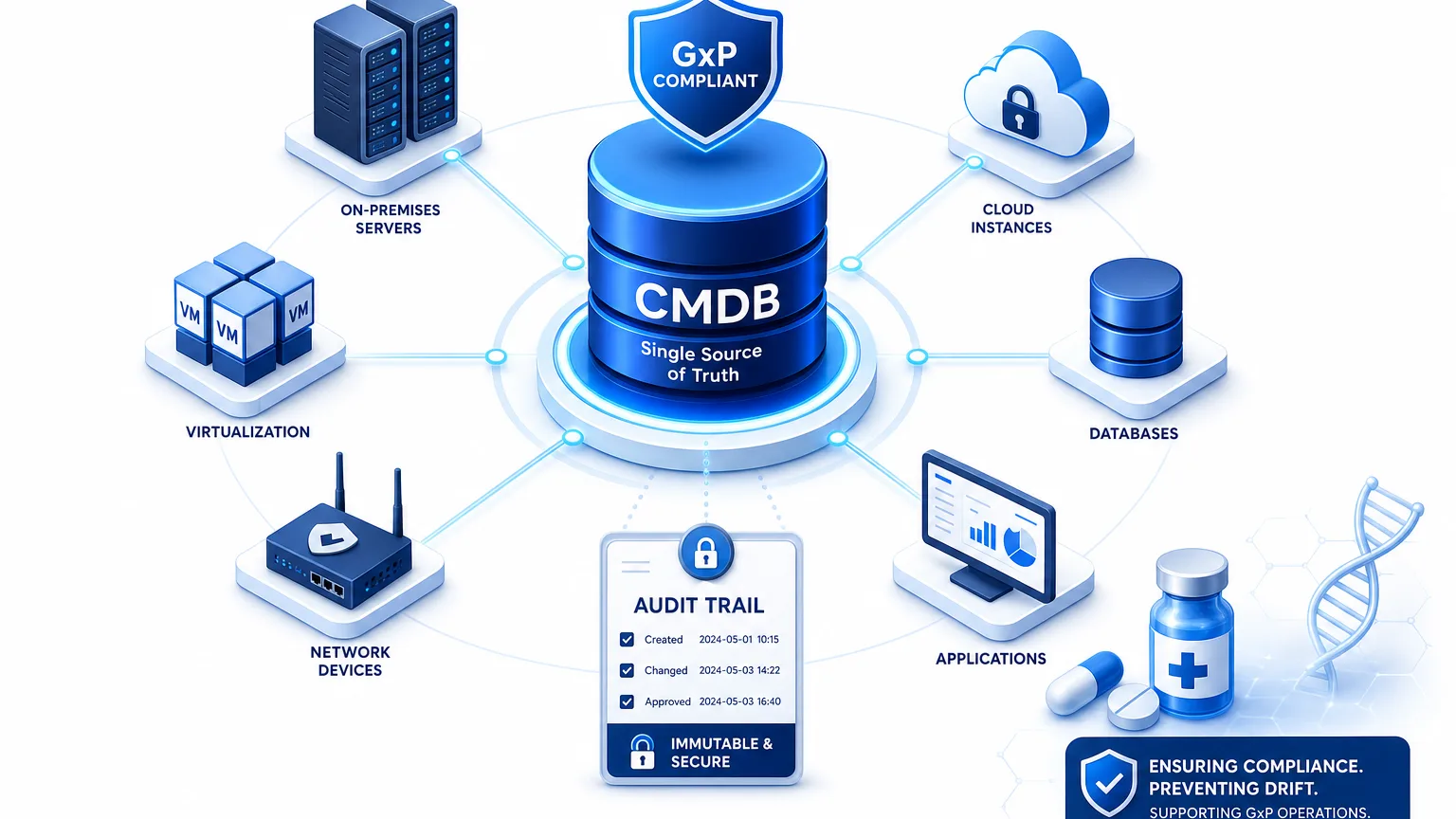
A Configuration Management Database (CMDB) in pharmaceuticals and life sciences is a centralized repository that discovers, records, and maintains relationship maps of every IT asset, application, database, and network interface that touches GxP (Good Laboratory, Clinical, or Manufacturing Practice) operations. Grounded in frameworks like ISPE GAMP 5 (Good Automated Manufacturing Practice), a life sciences CMDB does not merely list serial numbers. It binds software validation status directly to the live underlying infrastructure, establishing a continuous state of control.
In regulated life sciences, a system is only considered “validated” if it operates in a verified, repeatable state. When an application undergoes Computer System Validation (CSV) or Computer Software Assurance (CSA), the validation protocols assume a static environment. A life sciences CMDB captures the actual runtime dependencies linking validated applications (such as LIMS, CAPA, eQMS, or ERP) to their supporting servers, storage buckets, and API endpoints.
Core GxP CMDB Requirements
Automated Asset & Dependency Discovery: Identifying physical, virtual, and cloud CIs across laboratory, plant, and corporate networks without manual data entry.
GxP Impact Classification: Tagging configuration items (CIs) based on whether they directly or indirectly impact product quality, patient safety, or data integrity.
21 CFR Part 11 Audit Trail: Logging every detected change, attribute update, and relationship shift with immutable, time-stamped records.
Qualified Change Integration: Linking discovered infrastructure changes directly to authorized Change Control tickets in Jira, ServiceNow, or Ivanti.
The Hidden Problem: Static Spreadsheets vs. Live Infrastructure
THE GXP AUDIT RISK MATRIX
| OPERATIONAL SITUATION | AUDIT OUTCOME & CONSEQUENCE |
|---|---|
| Validation team qualifies LIMS app using manual Excel inventory | Server patch changes OS dependency; audit trail fails during FDA inspection |
| Facility expands biotech line with new IoT sensor controllers | Network switch configuration drifts; batch data loses clock synchronization across VLANs |
| IT deploys cloud storage bucket for analytical instrument data | Unmapped database endpoint exposes audit logs to unauthorized modification, breaching Part 11 |
Without automated discovery, system documentation degrades within days of validation sign-off. When auditors ask for proof of control, manual spreadsheets fail to demonstrate that the live infrastructure matches the validated qualification baseline.
Why is CMDB in pharmaceuticals and life sciences important?
In life sciences, IT failures do not just cause downtime. They trigger regulatory enforcement, product holds, and public warning letters. Under FDA 21 CFR Part 11, regulated companies must ensure that electronic records are trustworthy, reliable, and backed by complete audit trails. According to official FDA Inspection Observations Data and FDA Current Good Manufacturing Practice (cGMP) Regulations, cGMP data integrity deficiencies and unvalidated facility equipment changes represent two of the most persistent triggers for 483 citations.
When a database parameter changes, an OS patch deploys, or a cloud instance scales, the validated status of a GxP application is compromised unless that change is detected, documented, and evaluated through formal change management.
Three failure modes a CMDB prevents
- The unmapped patch invalidation. An IT technician deploys a security patch to a Linux server hosting a validated Laboratory Information Management System (LIMS). Because the server’s dependency on a legacy database driver was never documented, the patch alters database read/write behavior. Chromatographic data timestamps drift by four seconds, invalidating two weeks of stability testing records. Result: Retesting costs exceed $450,000, and product release is delayed by a full month.
- The change control blindspot. A plant engineer updates a router configuration during routine maintenance on a bioprocess facility floor. The router connects temperature monitoring sensors to the central electronic Batch Production Record (eBPR) system. Because the router was not flagged as a GxP-impacting CI in a static inventory, no formal change control ticket was opened. During an inspection, the auditor finds an unapproved network modification.
- The audit trail disconnect. During a regulatory audit, inspectors request the complete change history for a Chromatography Data System (CDS) over a two-year period. The organization produces application logs from the software vendor, but cannot supply corresponding records for the virtual machine hosting the app or the SAN storage housing the raw data files. Result: Regulators issue a formal observation for incomplete audit trail controls, forcing an emergency third-party compliance overhaul.
The real cost of fragmented system records
What does unmapped IT infrastructure cost a life sciences company during a regulatory audit?
Unmapped infrastructure risks FDA Form 483 citations and delayed batch releases. In severe, repeated data-integrity cases, it can also contribute to consent decrees. Compiling evidence manually takes weeks of billable consultant hours and exposes compliance gaps across uninventoried cloud and plant networks.
For quality assurance and CSV leaders
Quality teams spend hundreds of hours manually compiling Computer System Validation (CSV) packages and periodic reviews. When inspectors arrive, QA leaders sit in the “front room” while back-room teams frantically pull system logs, change tickets, and network diagrams from disparate tools. If an undocumented hardware change surfaced during an audit cannot be reconciled with a signed change request, the entire validation package comes under scrutiny.
For IT operations and engineering
IT infrastructure teams in biotech and pharma operate under intense pressure to maintain high availability while supporting digital transformation. Executing routine OS updates, firewall rule changes, or cloud storage migrations without clear visibility into GxP asset dependencies creates constant anxiety. Engineers hesitate to touch systems because they cannot predict which validated application will break or lose compliance status.
For regulated life sciences executives
For executive leadership, unvalidated infrastructure drift represents an existential business risk. A single FDA Warning Letter or Import Alert can halt manufacturing lines, erode market capitalization, and delay critical clinical trials. Becton Dickinson recorded a $124 million liability in its fiscal year 2025 filings for the estimated cost of responding to a single FDA Warning Letter. Viatris separately projected roughly a $500 million revenue impact tied to its 2024 FDA inspection remediation, according to Certivo’s analysis of recent FDA warning letters and data integrity enforcement. Both figures trace back to the same category of infrastructure gaps a life sciences CMDB is built to close.
How automated CMDB discovery fixes this
Solving the life sciences compliance gap requires moving from static inventory records to automated, discovery-driven infrastructure tracking. A modern CMDB continuously scans the environment to maintain an accurate map of all CIs, dependencies, and configuration changes.
AUTOMATED GXP DISCOVERY & CONTROL PIPELINE
| STAGE | ACTION | FUNCTION |
|---|---|---|
| STAGE 1 | DISCOVER | Scans lab, plant, and cloud networks for physical and virtual CIs |
| STAGE 2 | MAP DEPENDENCIES | Builds live relationship topology from App -> DB -> Server -> Network |
| STAGE 3 | VERIFY COMPLIANCE | Compares live state against CSV baseline and flags unauthorized drift |
Automated GxP discovery across hybrid stacks
A life sciences CMDB uses multi-platform agentless scanning to locate physical lab equipment controllers, virtual machines, cloud instances, and network devices across corporate and manufacturing environments. By recording running processes, active ports, and database connections, discovery captures the ground truth of what is running across your estate. Learn more about automated IT discovery for regulated systems.
Live dependency and service mapping
Once CIs are discovered, service mapping establishes the exact data flows connecting applications to infrastructure. If a LIMS application relies on a specific Oracle database, a SAN volume, and an authentication server, the CMDB builds a dynamic service map reflecting those links. When a change is proposed, engineers review the map to assess the exact blast radius on GxP-validated applications.
Continuous configuration drift detection
Instead of waiting for annual periodic validation reviews, automated discovery runs on scheduled cycles to detect configuration drift in near-real-time. If a registry key, IP address, or OS version changes on a server supporting an eQMS, the CMDB flags the delta. The change is automatically compared against approved change control records in your ITSM platform, ensuring that unapproved modifications are caught before an auditor finds them.
Manual inventory vs. Discovery-Driven CMDB
| Compliance Feature | Manual Excel / Static Inventory | Automated Discovery CMDB |
|---|---|---|
| Asset Accuracy | 50-60% accurate; stale in days | 95%+ accurate; updated routinely |
| Dependency Visibility | None; documented in static PDF | Dynamic relationship mapping |
| Change Control Reconciliation | Manual audit of paper/ticket logs | Automatic drift vs. ticket delta |
| Audit Preparation Time | Weeks of manual document assembly | Minutes to produce live maps |
| 21 CFR Part 11 Integrity | Vulnerable to human oversight | Immutable, time-stamped logs |
These figures reflect typical patterns observed across regulated IT environments, not a single benchmark study; treat them as directional, not a cited statistic.
Life Sciences CMDB Scenarios in Practice
- Scenario 1: Preparing for an unannounced FDA cGMP inspection
- Context: An FDA investigator requests the complete system architecture and change history for an automated inspection system on a sterile fill-finish line.
- Traditional path: Quality and IT spend a full day or more searching file shares for outdated Visio diagrams and manually matching Jira tickets to server logs.
- CMDB path: The team opens the CMDB service map for the fill-finish system, showing a verified topology diagram, hardware specs, OS revisions, and a time-stamped audit trail of every approved change over the past 24 months.
- Scenario 2: Pre-executing a change control impact analysis
- Context: IT needs to upgrade the hypervisor software on an enterprise server cluster hosting both corporate email and a validated Document Management System (eCTD).
- Traditional path: Engineers execute the upgrade assuming only corporate IT is affected, inadvertently causing an unannounced restart of the eCTD database during a regulatory submission window.
- CMDB path: The engineer runs an impact analysis query in the CMDB. The service map reveals that the cluster hosts two virtual machines supporting the eCTD system. The change is routed through formal GxP change control, complete with validation regression testing.
- Scenario 3: Resolving cloud infrastructure drift in biotech R&D
- Context: A biotech firm uses AWS cloud infrastructure to host genomic sequencing pipelines under GxP data integrity rules.
- Traditional path: A DevOps engineer modifies an AWS Security Group rule to troubleshoot an analysis run, inadvertently leaving an S3 bucket endpoint exposed to non-validated subnets.
- CMDB path: Scheduled cloud discovery detects the modified Security Group rule within hours, creates an alert for unauthorized configuration drift, and logs the incident for QA review.
How Virima Powers CMDB in Pharmaceuticals and Life Sciences
Virima delivers an enterprise discovery, CMDB, and ViVID™ service mapping platform engineered to support regulated IT environments. By providing complete visibility across physical, virtual, cloud, and edge assets, Virima enables life sciences organizations to establish a continuous state of control.
VIRIMA REGULATED IT VISIBILITY ARCHITECTURE
| COMPONENT | CAPABILITY | TARGET ENVIRONMENT |
|---|---|---|
| AGENTLESS DISCOVERY | Scans physical, virtual, and cloud assets | Data Centers & Cloud Networks |
| ViVID™ DEPENDENCY MAPS | Visualizes impact vectors & dependencies | Application & Infrastructure Layers |
| ITSM INTEGRATION & DRIFT | Aligns discovery with Change Requests | ServiceNow, Jira, Ivanti Alignment |
Immediate operational impact
Virima’s agentless discovery engine scans complex hybrid networks, identifying servers, storage arrays, network switches, database instances, and software assets. Built-in classification features allow compliance teams to tag CIs by GxP criticality, validation status, and data integrity risk level. Discover how to streamline regulated IT operations with discovery and mapping.
Continuous accuracy and ViVID™ service mapping
With ViVID™ (Virima Visual Impact Display), IT and Quality teams gain dynamic, interactive dependency maps that illustrate how infrastructure CIs connect to business services and validated applications. When evaluating infrastructure changes, ViVID™ visually highlights the impact vectors, letting teams determine whether a proposed maintenance task touches GxP-validated systems. Read more about how CMDB structure supports regulated system governance.
Integration with regulated ITSM workflows
Virima integrates directly with enterprise ITSM platforms, including ServiceNow, Jira Service Management, and Ivanti. When discovery detects a configuration shift on a validated asset, Virima can automatically cross-reference the event against active change requests. If no authorized ticket exists, the system flags the unauthorized drift, giving QA and IT Ops immediate visibility into potential compliance breaches. For a broader look at building an audit-ready ITAM program alongside this, see How Virima simplifies IT asset management audits.
Moving from Static Inventories to Discovery-Driven Control
Transitioning from manual spreadsheets to an automated CMDB establishes a defensible, audit-ready compliance posture that scales with business growth.
| OLD WAY: REACTIVE AUDIT DEFENSE | NEW WAY: CONTINUOUS RUNTIME CONTROL |
|---|---|
| Static Excel spreadsheets updated during annual periodic reviews | Automated discovery runs on scheduled cycles across lab and plant networks |
| Manual change reconciliation during high-stress regulatory inspections | Real-time reconciliation between live state and authorized ITSM change tickets |
| High risk of FDA 483 observations due to unmapped infrastructure drift | Defensible, time-stamped audit trails supporting 21 CFR Part 11 compliance |
The Compliance Benefits Cascade
Reduced Audit Stress & Preparation Time: Regulatory evidence is generated continuously, reducing the time required to assemble CSV packages and periodic reviews from weeks to hours.
Elimination of Unauthorized Infrastructure Drift: Automated scanning ensures that every OS patch, hardware swap, and network reconfiguration is captured and reconciled against formal change control.
Accelerated Incident Diagnosis: When a GxP system experiences performance degradation or data synchronization errors, IT teams use service maps to pinpoint the root cause immediately.
Five steps to getting started
- Categorize your GxP system perimeter: identify all validated applications (LIMS, eQMS, MES, ERP, CDS) and establish boundary definitions for supporting IT infrastructure.
- Execute agentless infrastructure discovery: deploy automated discovery across data center, lab, plant, and cloud subnets to capture an accurate baseline of all physical and virtual CIs.
- Map dependencies to validated applications: use service mapping tools to link underlying servers, databases, storage arrays, and network devices directly to their respective GxP business applications.
- Integrate discovery with ITSM change governance: connect your CMDB to Jira, ServiceNow, or Ivanti so that every discovered configuration change is automatically checked against approved change requests.
- Establish periodic drift review workflows: configure automated alerts for unauthorized configuration changes on GxP-tagged CIs, so QA teams can remediate issues long before an inspector arrives.
Establish Audit-Ready System Records with Virima
Maintaining validated system records requires moving beyond static inventory lists. With Virima’s automated discovery and ViVID™ service mapping, life sciences organizations gain complete visibility into their GxP infrastructure, ensuring every dependency is mapped and every change is accounted for before an auditor asks to see it.
Request a customized demonstration to see how Virima helps life sciences organizations maintain validated system records and simplify GxP compliance: https://virima.com/request-demo/
Frequently Asked Questions
What is CMDB in pharmaceuticals and life sciences?
A life sciences CMDB maps physical, virtual, and cloud CIs to GxP-validated applications. It establishes continuous infrastructure visibility, ensuring change records support 21 CFR Part 11 and cGMP data integrity mandates during regulatory audits.
How does a CMDB support 21 CFR Part 11 audit trails?
A discovery-driven CMDB logs attribute updates, dependency changes, and system modifications with immutable, time-stamped records. This provides regulators with an authoritative audit trail proving that GxP infrastructure remains in a validated state of control.
How does Virima classify GxP-impacting CIs for GAMP 5 risk categorization?
Virima’s discovery engine tags configuration items with GxP criticality and validation status as they’re found, so compliance teams can apply GAMP 5’s risk-based categorization (Category 1 or Category 4) without manually cross-referencing a separate inventory.
Why are spreadsheets inadequate for GxP asset tracking?
Manual spreadsheets lack automated change detection, cannot capture complex infrastructure dependencies, and lack secure audit trails. They degrade quickly, leaving organizations vulnerable to FDA Form 483 observations during unannounced inspections.
How does Virima integrate with existing life sciences ITSM tools?
Virima synchronizes discovered CI data and ViVID™ dependency maps directly with platforms like ServiceNow, Jira, and Ivanti. This automatically reconciles live infrastructure shifts against authorized GxP Change Control tickets to detect unauthorized drift.