What Is the Simplest Asset Management Tool for Sysadmins?

A sysadmin takes over asset tracking three weeks before an audit and finds four versions of the same spreadsheet. Two people are editing the same row, and a dozen laptops that were reimaged last quarter now show up as new devices. The spreadsheet did not fail because nobody cared. It failed because nothing merges records automatically once an asset changes hands or gets rebuilt. The simplest asset management tool for sysadmins solves exactly that problem. It discovers devices on a schedule, keeps one record per asset tied to a durable identifier, and reaches a trustworthy inventory in about a week — asset management for small IT teams that works without a month-long setup project.
Busy sysadmins judge simplicity by time-to-truth, not feature count. If the first week produces a clean sysadmin asset inventory with durable identifiers, the tool is simple enough to keep. Category surveys for growing companies belong on the asset management software for small business guide, while wider market scans sit in the top asset management tools roundup.
What makes the simplest asset management tool for sysadmins
Simple means the tool earns its keep without a dedicated project manager. Discovery runs on a schedule, records merge on serial number or cloud instance ID rather than hostname, and the same CI (configuration item) stays usable when a laptop is reimaged or a VM is rebuilt.
Simple also means the daily path stays short. A sysadmin should open one screen, see what changed since the last discovery cycle, and export a list for audit or ticket work without rebuilding spreadsheets. The NIST IT asset management glossary frames ITAM as controlled identification and tracking of technology resources across their useful life. That is exactly the workload a lean team must automate before headcount grows.
That daily path matters more as the stack grows. Flexera’s 2025 State of ITAM report found that overall technology-stack visibility fell to 43% from 47% year over year. SaaS-specific visibility dropped from 54% to 50% over the same period. A tool that needs a dedicated project manager to interpret it is not simple, no matter what the vendor calls it. A simple tool closes that gap on its own, every discovery cycle, without a manual reconciliation step.
What makes an asset management tool simple for sysadmins?
A simple tool auto-discovers devices on a schedule, stores one authoritative record per asset using durable keys such as serial or instance ID, and reaches a usable inventory within about one week without a long implementation project or dedicated project manager.
Why do asset records need a durable identifier instead of a hostname?
A simple asset tool merges records on a durable identifier — serial number or cloud instance ID — not hostname, because hostnames change every time a laptop is reimaged or a VM is rebuilt. Tools that key on hostname create duplicate “new” assets after every rebuild, which is why spreadsheets and basic trackers drift out of sync with reality.
Sysadmin asset management options by fleet shape
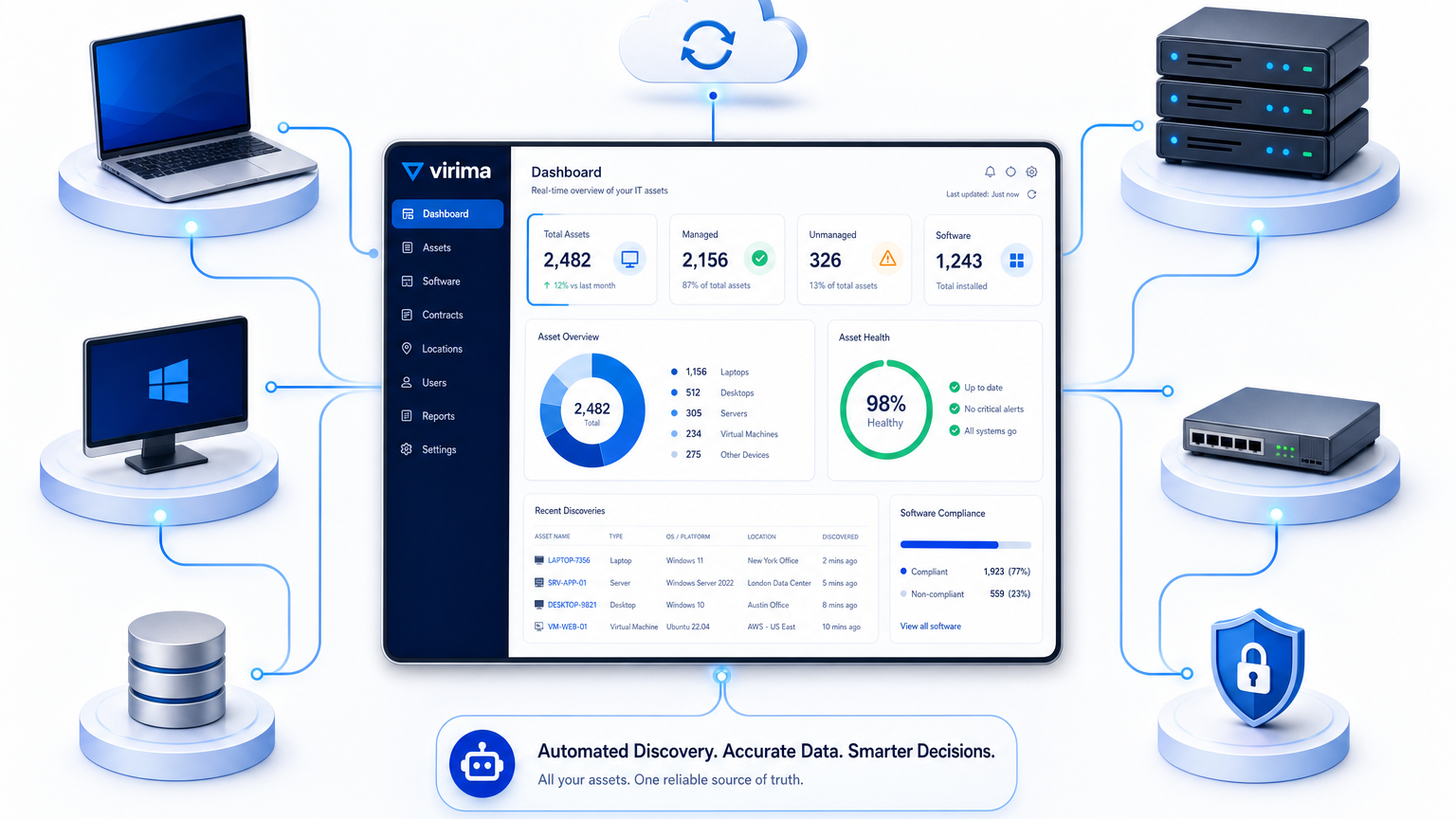
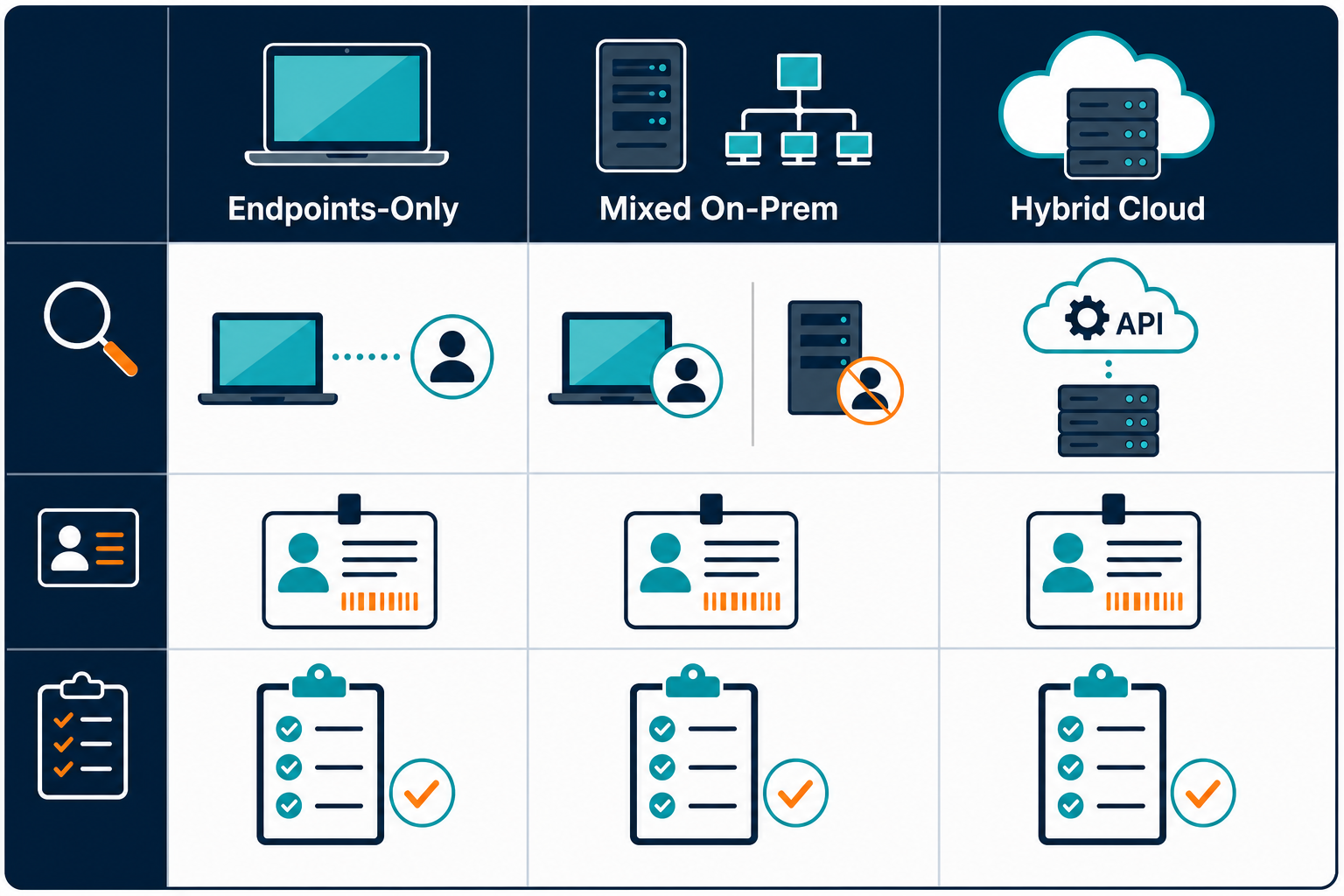
Options scale with how the estate behaves, not with marketing labels. Homogeneous laptop fleets — common for small IT teams supporting a few hundred endpoints or fewer — lean on endpoint agents plus a purchase register. Mixed server and network estates need agentless sweeps alongside agents. Hybrid shops add cloud API discovery for AWS and Azure instances so virtual assets land in the same system of record. The IT Discovery feature page breaks down how agentless, agent-based, and API-based methods combine for exactly this kind of mixed estate.
Lightweight trackers and open-source inventory tools fit when the only job is a checked-in list — a lightweight ITAM setup with no discovery layer behind it. Platforms with discovery plus ITAM fit when licenses, warranties, and ticket context share the same CI. Full ITSM suites fit when request workflows already own the desk and asset data is a feed, not a second help desk. NIST SP 1800-5 stresses authoritative tracking across physical, virtual, and cloud boundaries. That is the bar any simple choice must still clear as the estate diversifies.
Sysadmins should also separate personal preference from operational coverage. A tool that feels simple on a single subnet can still miss remote laptops and cloud instances. It can also miss network gear that never joins the domain. Prove coverage with a short discovery pilot on production-like credentials before you retire the spreadsheet that still holds warranty dates and owner names.
One-week setup roadmap
Day one defines scope and credentials: subnets, directory or cloud read access, and the fields that must exist on every record (serial, owner, location, status). Day two runs the first scheduled discovery pass and reviews false merges. Day three normalizes manufacturer and model strings so the same laptop model is not three different titles.
Day four attaches purchase or warranty data where files already exist, without inventing finance workflows the team does not run. Day five wires ticket or CMDB consumers if an ITSM desk is already live, using the integrations hub rather than one-off partner deep links. Day six exports the first audit-ready inventory and spot-checks remote devices. Day seven locks the discovery schedule and names the owner who reviews exception queues each week.
This roadmap assumes the team already knows its networks. It does not assume a six-month data-cleanup program before value appears.
How long should a simple asset tool take a sysadmin to set up?
A practical target is about one week from credentials to a usable inventory export. Day one covers scope and access, mid-week runs discovery and normalization, and week end locks the schedule plus the owner who reviews exceptions after each discovery cycle.
When you outgrow spreadsheets and lightweight tools
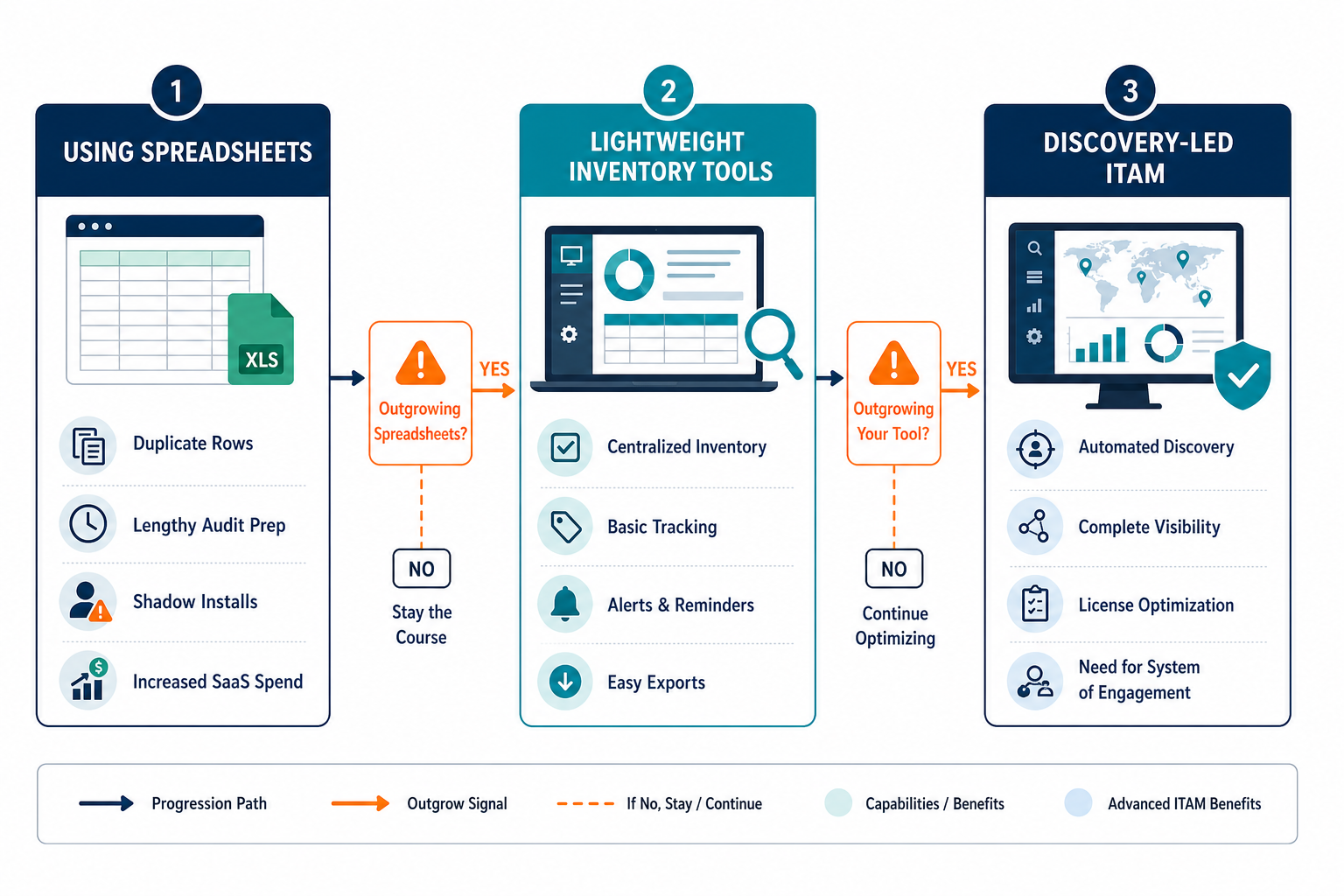
Knowing when spreadsheets stop working is less about headcount than about behavior. Spreadsheets fail when two people edit the same row, when hostnames change after rebuilds, and when SaaS and cloud instances never appear in the sheet. Lightweight inventory fails when license true-ups, warranty renewals, and change tickets need the same CI the scanner recently updated.
Some vendors peg this transition to a specific asset count, commonly somewhere between 50 and 100 assets. That threshold is a proxy, not a cause: a 30-asset estate with shared spreadsheet edits and unmanaged cloud instances outgrows manual tracking faster than a static 150-asset estate that rarely changes.
Is there a specific asset count where spreadsheets stop working?
No single count applies. Spreadsheets fail from behavior, not volume — two people editing the same row, hostnames changing after a rebuild, and SaaS or cloud instances that never get added manually. These three signals, not a 50-to-100-asset threshold, mark the point where scheduled discovery becomes simpler than manual upkeep.
Outgrow signals include duplicate rows for one serial, audit prep that still takes days, and shadow installs found only after a vendor notice. At that point the simplest move is a platform that keeps discovery and ITAM on one record, then feeds the desk as a system of engagement. ServiceNow, Jira Service Management, Ivanti, Cherwell, Hornbill, Xurrent, HaloITSM, and TeamDynamix remain plain-text partners in that model.
The same Flexera report found that 35% of IT teams say wasted SaaS spend increased over the past year, even as more teams actively track usage. That is the outgrow signal in financial terms. The tool stopped keeping true-ups current on its own, so waste crept back in no matter how carefully anyone watched it. The free-to-paid upgrade path for lightweight inventory tools covers exactly this threshold in more depth.
Before the next spreadsheet rebuild, review how Trusted Runtime Truth keeps discovery-sourced records explainable for operators who still own the pager. Teams that outgrow this stage without wanting a year-long project often move to Business Pro, which packages the full discovery and ITAM platform for lean IT teams that still need authoritative estate data.
Honest tradeoffs without a price sheet
Category alternatives trade depth for speed in predictable ways. Pure inventory tools stand up quickly and stop at the list. Help-desk bundles store assets beside tickets and often under-serve multi-source discovery. Enterprise suites cover process breadth and ask for longer configuration.
Discovery-led ITAM platforms prioritize scheduled multi-source truth and CMDB-ready CIs, then hand clean records to the desk you already run. They can also run standalone with no ITSM desk in place at all, which matters for sysadmins who need to track IT assets without ServiceNow or any other ticketing platform live yet. The best-of-breed path for pairing discovery and ITAM with an existing service desk walks through that model without asking anyone to replace a working ITSM tool.
| Option | Typical setup time | Record key | License tracking |
|---|---|---|---|
| Pure inventory tool | Days | Manual entry, often hostname | No |
| Help-desk bundle | One to two weeks | Ticket-linked asset ID | Limited |
| Discovery-led ITAM | About a week | Serial number or cloud instance ID | Yes, tied to the CI |
| Enterprise suite | Weeks to months | Configurable CI key | Yes, full lifecycle |
No public article should invent list prices or seat meters for named products. Evaluate proof of discovery coverage, durable join keys, export quality, and time-to-first clean inventory in your own lab. The IT asset management feature set is the Virima capability map when the shortlist includes discovery-sourced ITAM rather than a tracker alone.
That evaluation should not stop at vendor claims, or even your own team’s confidence in its data. A 2025 WanAware survey of 600 enterprise leaders found that 95% of IT leaders say they trust their own asset data. That confidence drops sharply once the data leaves the IT team and reaches finance, security, or an auditor. A short discovery pilot settles the question with evidence instead of confidence.
Choose simple that stays true
The simplest asset management tool for sysadmins is the one that discovers on a schedule, merges on durable identifiers, and delivers a trustworthy list inside a week. Start light if the estate is tiny and static. Move to discovery-led ITAM when licenses, cloud instances, and tickets share the same operational truth. This is the on-ramp to enterprise CMDB practice, not a separate destination — the same discovery-sourced records that start a sysadmin’s week-one inventory are what later anchor service maps and change approvals at scale.
Ready to replace fragile trackers with discovery-backed records your desk can trust? Schedule a demo to walk a one-week setup path on your own subnets and cloud accounts.
Frequently Asked Questions
Is a spreadsheet enough for 100 laptops?
A spreadsheet can hold one hundred static rows for a short period if a single owner updates every change the same day. It breaks when devices rebuild, staff share edits, or cloud and SaaS assets never appear in the sheet, which is when scheduled discovery becomes the simpler path.
What is the cheapest asset management option?
The lowest cash outlay is usually a shared spreadsheet or an existing open-source inventory install you already operate. The lowest total cost appears when discovery prevents audit true-ups and lost devices, so compare labor hours and audit risk alongside license line items rather than list price alone.
Do I need an agent on every machine?
Many estates combine endpoint agents for deep laptop detail with agentless network and cloud API discovery for servers and instances. Choose the mix that covers your subnets and cloud accounts on a schedule without blocking machines that cannot run an agent.
How long does setup take?
Plan about one week from access credentials to a first clean export when networks and cloud roles are ready. Longer timelines usually mean unresolved ownership of subnets, missing read permissions, or an attempt to perfect finance workflows before the inventory exists.
Does Virima’s discovery work before I have an ITSM desk in place?
Yes. Discovery-led ITAM builds the CMDB and inventory first, independent of any ticketing tool, so a sysadmin can run scheduled discovery and keep one record per asset before a service desk exists. Integrations with ServiceNow, Jira Service Management, Ivanti, Cherwell, Hornbill, Xurrent, HaloITSM, or TeamDynamix connect later as a feed into whichever desk the team eventually adopts.
How does agentless discovery handle devices that can’t run an agent?
Agentless discovery sweeps the network and queries devices through existing protocols and credentials, so servers, network gear, and other systems that cannot host an agent still show up in the inventory on the same schedule as agent-covered endpoints. Combining both methods is how a mixed estate reaches full coverage without exceptions.