Shadow IT Discovery on a Healthcare Network: What 607 CMDB Gaps Revealed

Shadow IT discovery in healthcare is the process of scanning a clinical network to identify all connected assets — medical devices, unmanaged workstations, personal endpoints, and shadow applications — that exist outside the formal IT asset inventory. In clinical environments, this process surfaces device categories that standard IT procurement never captures, creating documentation gaps with direct HIPAA Security Rule implications for covered entities.
A 900-bed regional hospital system asked us to run agentless IT discovery across their network ahead of a HIPAA shadow IT audit. Their IT team had 1,240 assets in the CMDB, including servers, workstations, network devices, and a small number of clinical systems that had been manually registered over several years. When discovery completed, the return was 1,847 assets. The 607-asset gap was not a CMDB maintenance problem. It was a structural picture of how shadow IT accumulates in clinical environments where IT and clinical operations run on separate procurement tracks.
This article walks through what the shadow IT discovery scan revealed, why the HIPAA implications differ significantly by asset category, and what the triage looked like when the audit timeline was six weeks away.
Why shadow IT discovery in healthcare differs from corporate networks
Shadow IT discovery in healthcare is not the same exercise as running discovery in a corporate office. The types of devices that create compliance gaps differ. The regulatory stakes are higher. The asset categories that create gaps in healthcare CMDBs include devices that standard IT onboarding never captures: clinical equipment, connected medical devices, and departmentally deployed workstations. These operate under biomedical and clinical workflows, not IT change management.
The HIPAA implications differ by category — and that difference determines triage order.
Trusted Runtime Truth helps IT teams across mixed environments, including clinical and operational technology networks, achieve complete asset visibility and compliance readiness.
The environment before discovery ran
The hospital system’s IT team had maintained their CMDB manually since their last ITSM platform migration three years prior. The 1,240 assets in the CMDB represented devices that had been onboarded through IT’s formal procurement and provisioning process: end-user workstations ordered through IT, servers deployed by the infrastructure team, and a small set of clinical systems whose IT components had been registered during the EMR deployment.
Clinical departments, biomedical engineering, and staff brought devices onto the network outside IT’s procurement track. Clinical departments purchase equipment independently. Biomedical engineering maintains devices under a separate operational model. Staff bring personal devices to work. Each of those channels creates network-connected assets that never trigger an IT provisioning ticket.
That gap is not unusual. According to the HHS Office for Civil Rights 2025 HIPAA Enforcement Highlights (hhs.gov), impermissible access to electronic protected health information remains the leading category of HIPAA breach, and the majority of confirmed breaches involve devices or systems that were not included in the covered entity’s asset inventory at the time of the incident. In every healthcare environment we run discovery on, the CMDB underrepresents the live network. Healthcare discovery engagements typically find CMDB undercounts of 30–50% in environments with dual IT/clinical procurement tracks.
The 607-asset gap: four categories with different HIPAA stakes
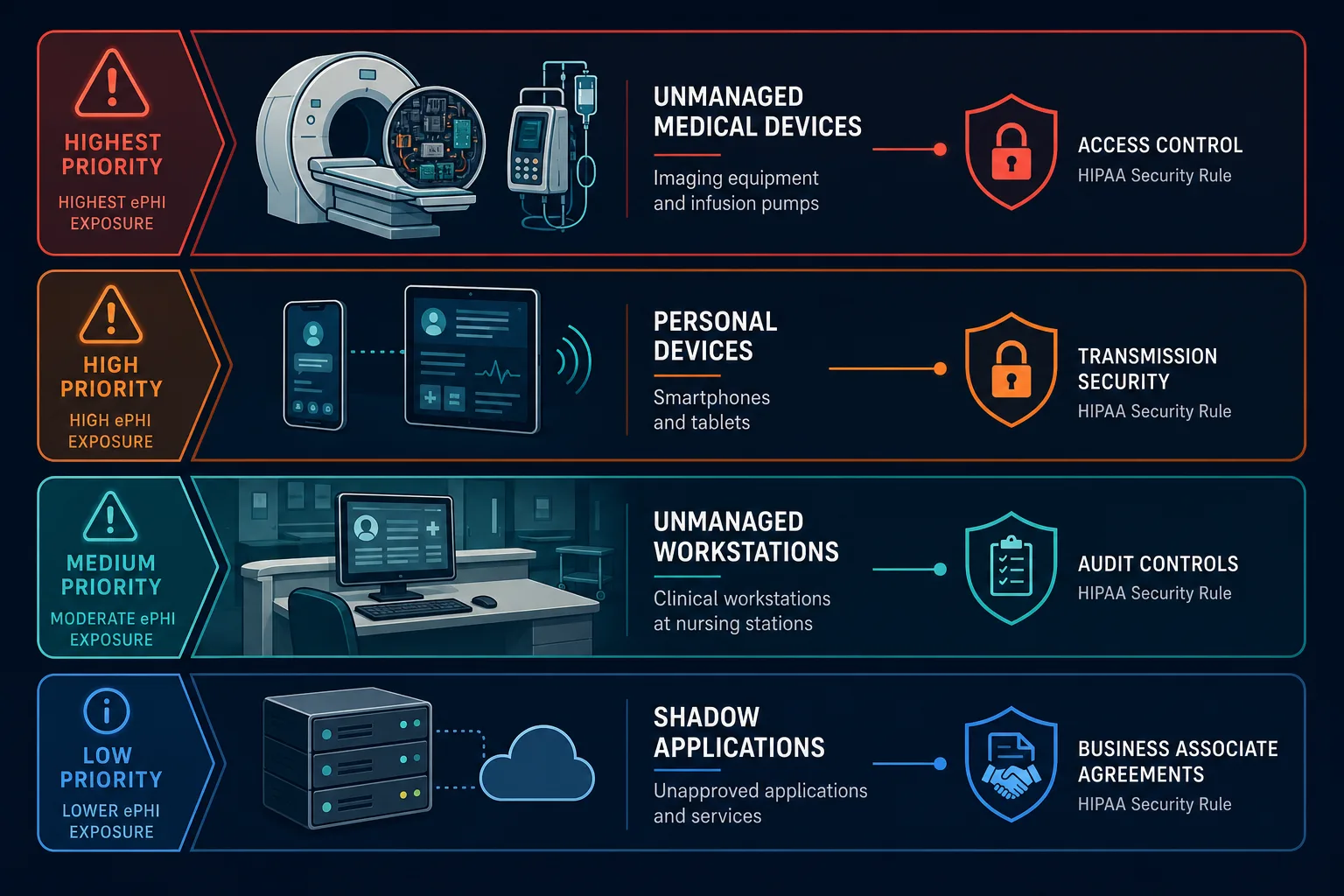
Unmanaged medical devices with no CMDB record (214 assets)
The largest discovery-sourced gap category was 214 medical devices, including imaging equipment, infusion pumps, patient monitoring systems, and connected diagnostic tools, that were active on the hospital network with no corresponding IT record.
These devices had been deployed under biomedical engineering governance. They had maintenance schedules, vendor service agreements, and clinical approval documentation. What they did not have was an IT asset record, a network security assessment, or any documentation of their data handling in relation to electronic protected health information.
Why unmanaged medical devices create HIPAA exposure
HIPAA’s Security Rule requires covered entities to implement technical safeguards for all electronic systems that create, receive, maintain, or transmit ePHI. Medical devices that connect to the clinical network and transmit patient data fall within HIPAA scope. This applies regardless of whether IT manages them. When those devices have no CMDB record, the covered entity cannot demonstrate that access controls, audit logging, or transmission security requirements have been applied to them. This creates a direct documentation gap in any HIPAA audit.
The HIPAA Security Rule’s requirement for addressable implementation specifications around access control and audit controls applies to all ePHI systems. A patient monitoring system that transmits data over the clinical network is within scope. Without an IT record, there is no way to demonstrate that the required controls were evaluated, implemented, or documented.
For this category, the triage action was immediate coordination between IT and biomedical engineering to create CMDB records, document the data handling function of each device, and schedule a security assessment against the HIPAA technical safeguards checklist. Understanding how CMDB Audit Essentials: Ensuring Data Accuracy and Compliance works for clinical device populations is essential for this workflow.
See how Virima identifies unregistered medical devices on clinical networks — without agents, without disrupting clinical workflows. Schedule a demo
Category 2: Personal devices connecting via staff WiFi (188 assets)
188 devices were personal devices, staff phones, tablets, and personal laptops, connecting to the clinical network through a staff WiFi SSID that lacked network access control enforcement. The SSID was intended for staff use, but no access policy prevented personal devices from joining. No network access control (NAC) solution checked whether connecting devices were managed or registered.
The HIPAA implication for this category is different from the medical device category. The risk is not data handling configuration. The risk is ePHI transmission: if staff were accessing EMR systems, patient portals, or clinical applications from personal devices, that access may have occurred on endpoints where the hospital cannot enforce encryption, remote wipe capability, or session timeout requirements.
What is the HIPAA risk of personal devices on a healthcare network?
Personal devices connecting to a healthcare network are not automatically a HIPAA violation, but they create a documentation problem. If staff use those devices to access ePHI through EMR systems, clinical apps, or patient portals, the covered entity must demonstrate that those access events were authorized, logged, and conducted on endpoints that meet the required transmission security and access control standards. Devices not in the CMDB cannot be included in that documentation.
The triage response for this category was a policy enforcement project: NAC configuration to require device registration before network access, and a review of EMR access logs against the 188 identified device MAC addresses to determine whether any ePHI access had occurred from unregistered endpoints.
Category 3: Unmanaged workstations in clinical areas (112 assets)
The workstation picture was similar in scale but different in cause. 112 workstations in clinical areas, nursing stations, exam rooms, and procedure suites, had no IT record. They had been deployed under departmental capital budgets without going through IT procurement, and clinical operations had been managing them independently for patching and local configuration.
The HIPAA implication here is the technical safeguards gap. HIPAA requires covered entities to implement automatic logoff, unique user identification, and emergency access procedures on all systems that access ePHI. Workstations deployed outside IT’s visibility cannot be confirmed to have those controls in place.
IT Asset Management for these devices was a straightforward onboarding project: create CMDB records, assign ownership to the relevant clinical department, schedule an IT security assessment, and enroll the devices in the standard endpoint management platform. Understanding Keeping up with IT regulatory compliance using Virima requires full asset visibility before a compliance assessment becomes meaningful.
Category 4: Shadow applications running on clinical servers (93 applications)
93 shadow applications were found running on clinical servers, applications that had been deployed by departmental IT staff or clinical informatics teams without going through the formal software approval and security assessment process.
The applications ranged from departmental scheduling tools and custom reporting scripts to third-party clinical workflow applications deployed without vendor security review. Some were processing patient data. None had gone through the formal software lifecycle process that would document their ePHI handling classification, their data flow to external systems, or their backup and recovery configuration.
Why shadow apps create unique HIPAA risk compared to shadow devices
Shadow devices create access control and audit gaps. Shadow applications create data flow gaps. An application processing patient data outside the formal software lifecycle may transmit ePHI to external systems without authorization, store data unencrypted, or create undocumented business associate relationships. Under HIPAA, a business associate agreement (BAA) is required whenever a vendor or application transmits, processes, or stores ePHI on behalf of a covered entity — a documentation obligation that only arises when the application is in the formal software inventory. Applications outside the approved software inventory are automatically outside that analysis.
The triage for shadow applications required a data flow assessment for each of the 93 applications. Four of the 93 applications were transmitting patient data to external endpoints without documented business associate agreements in place.
What the triage looked like six weeks from audit
The 607-asset gap that shadow IT discovery revealed could not be fully remediated in six weeks. What the team could do was create a documented response that showed the auditor a defensible gap closure plan for each category.
The framework for that documentation was the Achieve simplified compliance mapping with Virima solutions approach: every unrecorded asset gets a CMDB record, an owner, a data handling classification, and an open remediation ticket with a target completion date.
For the four categories, the priority order was determined by HIPAA breach risk, not asset volume. Unrecorded devices create the most direct HIPAA compliance exposure when they handle ePHI. Medical devices with ePHI transmission moved to the front of the queue. Shadow applications with undocumented external data flows followed immediately.
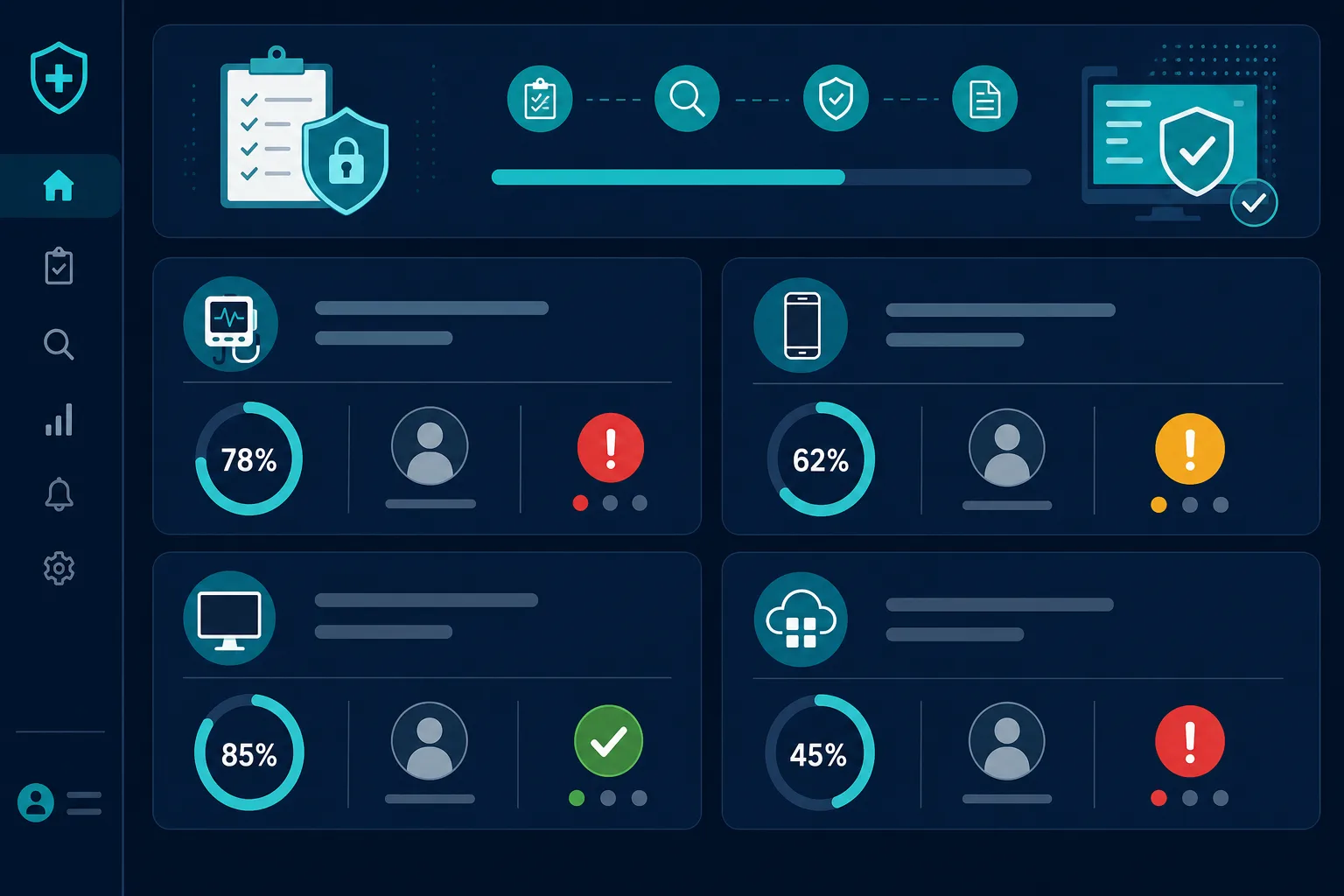
Six weeks after the discovery scan, all 607 gap assets had CMDB records with assigned owners. The medical device documentation had been provided to the auditor as part of the HIPAA Security Rule technical safeguards response. The four shadow applications with undocumented external data flows had been suspended pending a security review. The audit proceeded with a complete asset inventory for the first time.
What shadow IT discovery in healthcare finds
The 607-asset gap at this hospital was not exceptional. The mix of medical devices, personal devices, unmanaged workstations, and shadow applications appears in some proportion in every healthcare environment we run discovery on. The specific counts vary by hospital size and IT maturity. The categories do not.
What varies significantly is the HIPAA implication by category, and that difference determines triage priority. Treating all 607 gap assets as a uniform “CMDB cleanup” project misses the point. Medical devices handling ePHI and shadow applications transmitting patient data to external endpoints require immediate escalation. Personal devices and unmanaged workstations require onboarding.
The Agent-based vs. agentless discovery: which is best for your business? approach that produced these results did not require IT agents installed on every clinical device. Discovery read the network and returned everything that was present, regardless of whether an IT record existed. That is the starting point for a HIPAA audit that the IT team can defend.