How do end-of-support assets create operational and audit risk?

The patch window closes, and one host still fails the standard build check. Ops knows the box is old. Nobody can prove whether it still sits under a crown-jewel service or only under a forgotten lab VLAN. Finance still carries it on a refresh list from two years ago. That is how end-of-support assets create operational and audit risk: not as a theory about aging hardware, but as a live gap between what vendors stopped supporting and what discovery still finds running.
This guide is for ITAM managers, CMDB owners, SecOps leads, and IT operations managers who already track refresh programs. It isn’t a lifecycle-management primer, a single-migration EOL case study, or a vulnerability-scanner buyer guide. The focus is how that same gap plays out when install and CI truth lag vendor support calendars, and how discovery-sourced end-of-support inventory closes it before the next outage or sample.
Answer first: the risk is authority lag, not the calendar date alone
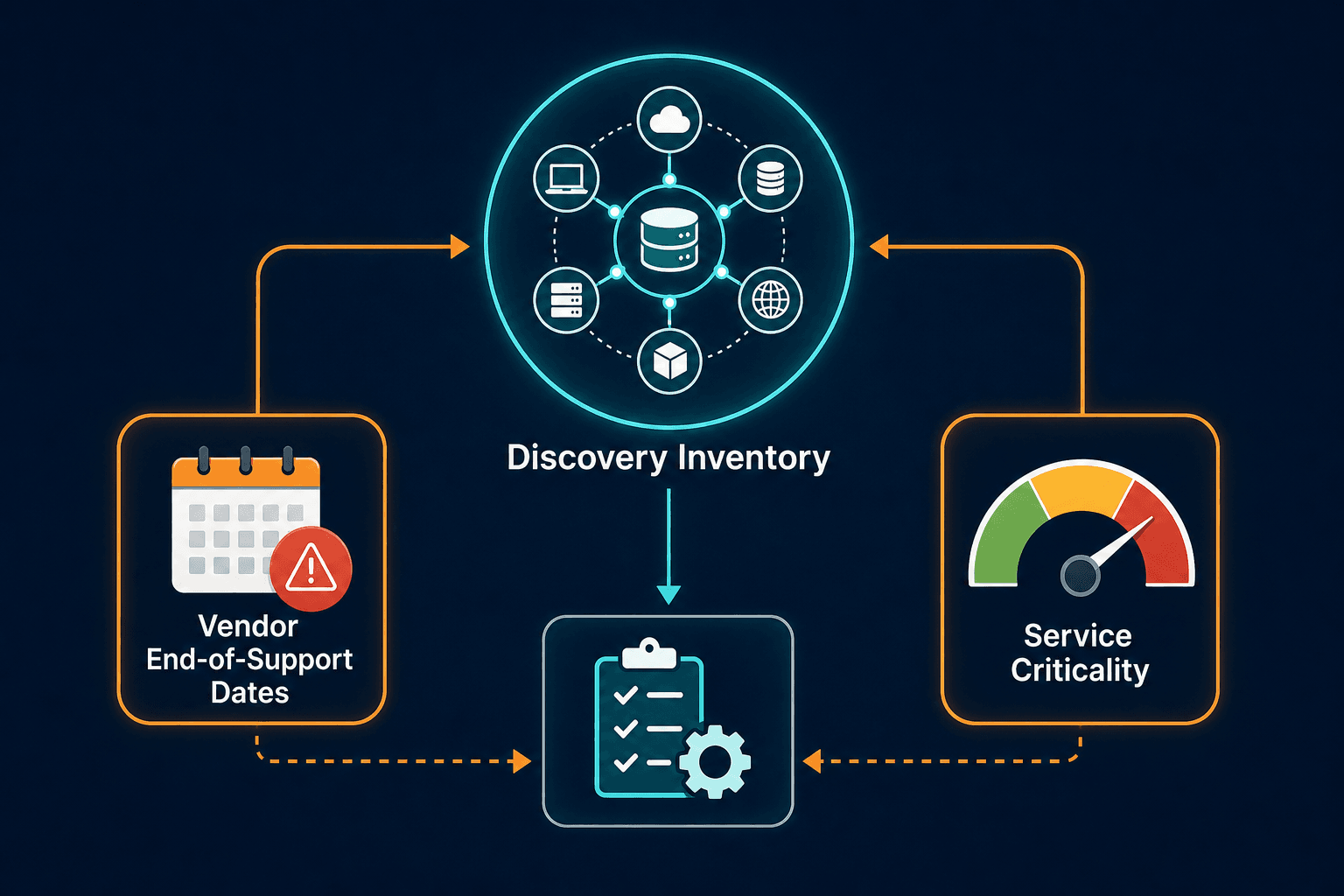
End-of-support assets create operational and audit risk when three facts fail to meet: vendor support status, discovery-proven existence, and business-service context. The calendar date is public. The risk appears when teams cannot show which unsupported OS builds, appliances, and applications still run, who owns them, and which services they still touch.
EOL and EOS are distinct vendor labels — EOL marks the end of a product’s active life, EOS marks the end of guaranteed support — but for this risk model both reduce to the same question: does support still exist for what discovery finds running today?
Operational risk shows up as unpatchable failures, longer MTTR, and change paths nobody trusts. Audit risk shows up as sample failures, incomplete populations, and control narratives that cannot prove coverage of unsupported estates. Both start from the same root: purchase and refresh lists freeze, while runtime installs keep moving.
Flexera’s 2024 State of ITAM Report keeps pressure on incomplete technology intelligence as a cost and control problem. When teams cannot trust what they hold, they pay again in emergency buys, extended support contracts, and delayed findings. What gets labeled EOL EOS operational risk on a lifecycle slide is that same class of failure under a different name.
When partial inventories still drive change and compliance decisions, start with Trusted Runtime Truth. Pressure-test whether existence and last-seen facts for aging platforms still come from discovery after the last cleanup sprint ends.
How do end-of-support assets create operational and audit risk?
They create risk when vendor support ends while discovery still finds those assets running without clear owners or service context. Ops cannot patch or plan impact safely. Auditors cannot trust populations that mix supported and unsupported systems without proof of what still exists.
Operational risk: unpatchable paths and blind blast radius
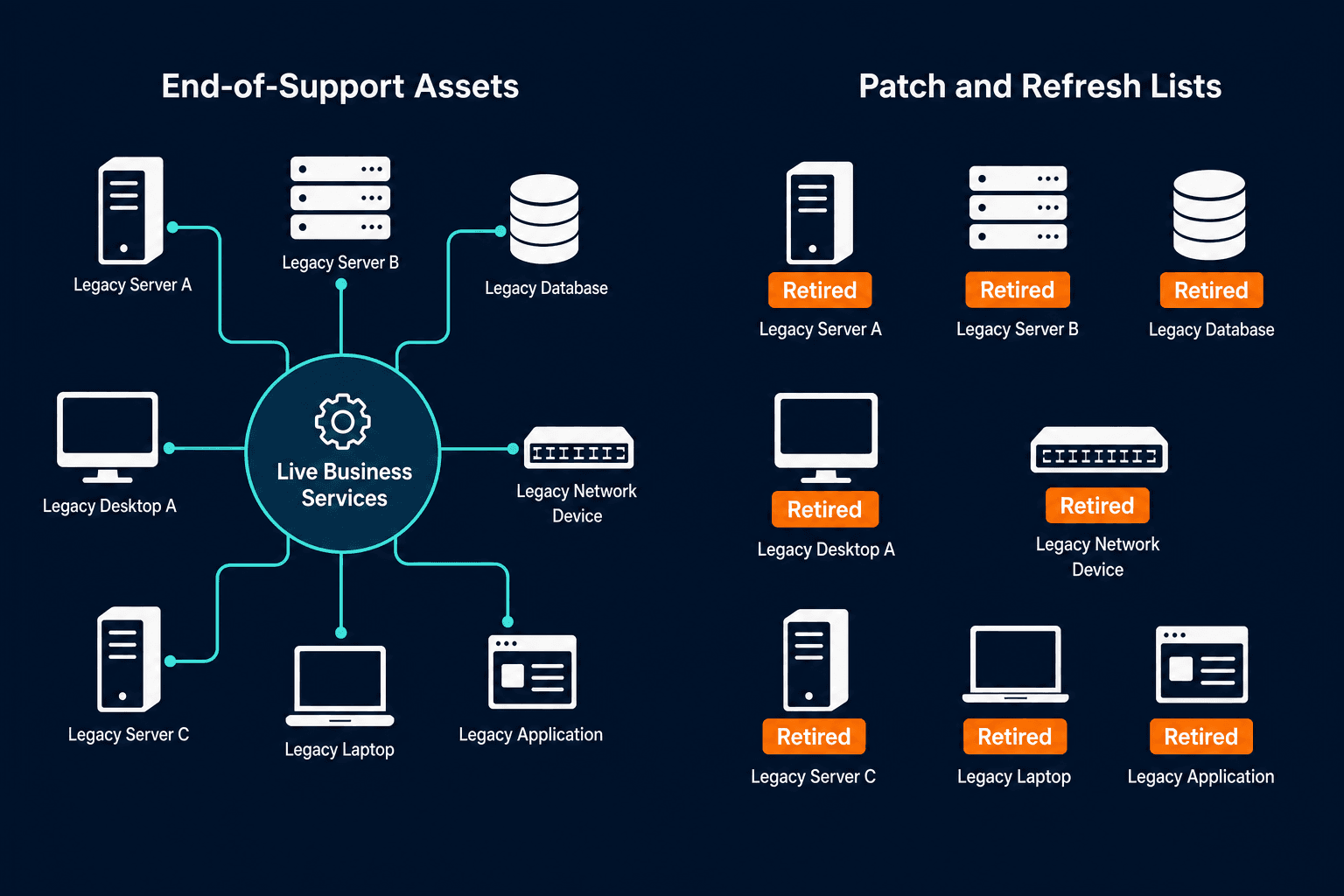
That same gap shows up first on the floor, operationally. When a vendor stops shipping security updates, the host becomes a permanent exception in the patch program. Incidents on that host force manual workarounds. Change boards approve paths that assume modern builds. On-call teams inherit tribal knowledge instead of CI truth.
Unsupported does not mean unused
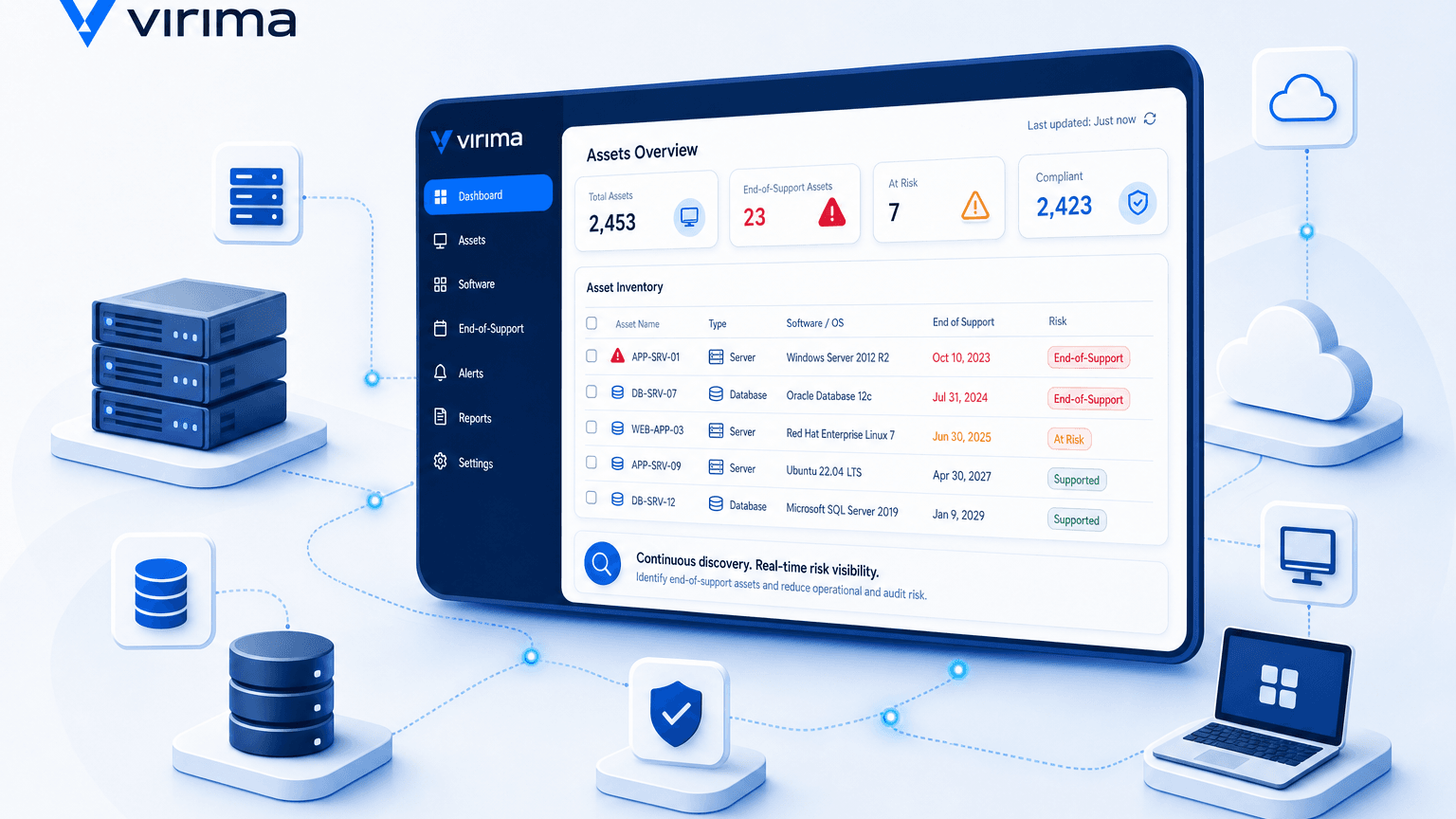
Many end-of-support assets stay in production because a line-of-business app still depends on them, a plant system cannot move, or a migration project slipped. runZero’s 2026 EOL benchmarking research found roughly 8.5% of enterprise assets were already running end-of-life operating systems, with 5% sitting fully outside any security support window. Lifecycle spreadsheets mark them for retirement. Discovery may still see them answering on the network every cycle. The operational risk is treating the spreadsheet as truth while runtime evidence says otherwise.
Service context decides severity
An unsupported lab laptop is not the same risk as an unsupported database host under a customer-facing service. Without dependency context, leaders rank EOS by age instead of blast radius. Once service definitions exist, ViVID™ service maps can show installed-on and runs-on links for those hosts. ViVID™ builds those maps from defined services rather than generating service compositions automatically. Maps stay useful only while infrastructure CIs stay discovery-fresh.
CISA BOD 23-01 keeps public pressure on accurate, timely asset visibility for risk programs. Federal language is not every enterprise’s compliance frame. The operational lesson travels: incomplete inventory is a control failure when unsupported systems remain invisible or mis-owned.
Audit risk: populations, samples, and unsupported exceptions
Auditors and internal control teams sample from inventories that claim completeness. EOS assets audit exposure grows when those inventories omit aging systems, bury them in free-text notes, or cannot prove last-seen evidence. Samples then miss the hosts that carry the highest residual risk.
Control narratives need discovery-aged evidence
A control that says unsupported systems are inventoried and risk-accepted fails when ITAM cannot produce a current list joined to owners and compensating controls. One environment found 12% of devices had no assigned owner, and that gap is exactly where audit samples fail. Discovery-sourced install and CI records give a defensible population. Manual lists from last year’s refresh workshop do not.
A ghost CI exists in the CMDB but not in reality; an unsupported assets CMDB gap is the reverse — the asset is real and still running, but its support status and ownership never made it into the record. Both break the same audit population, for opposite reasons.
Product security pressure keeps rising
CISA’s Product Security Bad Practices guidance keeps manufacturers and operators focused on practices that leave customers exposed, including weak lifecycle handling of aging products. Enterprises that cannot inventory end-of-support assets in their own estates inherit that exposure as customer-side risk. Pair discovery-sourced CMDB truth with dedicated vulnerability and GRC tools. Do not force one platform to own every scanner and every control attestation.
Why do auditors care about end-of-support assets beyond the vendor calendar?
Because controls claim the estate is known, owned, and risk-treated. If unsupported systems still run outside the inventory used for samples, the population is incomplete. Discovery-aged existence and ownership evidence is what makes the exception list defensible.
What is the fastest way to check end-of-support audit readiness?
Run a five-point check: confirm every scope has an active discovery method and a current cycle, normalize OS and product titles against vendor support data, prefer recent discovery evidence over static lists when they disagree, route unsupported finds into ownership workflows, and rank remediation by service impact rather than age alone.
Closing the gap: discovery authority for end-of-support operational and audit risk
That authority gap is closable. Treat support status as a join key on discovery-proven assets, not as a separate spreadsheet track.
Discover what still runs
Agent-based discovery fits deep OS and software inventory where agents are allowed. Credentialed agentless discovery fits locked ranges. Cloud API pull covers images and instances that never sit on the corporate LAN. That cadence — high-frequency discovery cycles on agreed scopes — keeps discovery-sourced end-of-support inventory visible between annual refresh workshops.
Virima does not claim passive continuous event-driven discovery today. Scheduled agent, agentless, and cloud cycles on a written policy still beat annual EOS surveys that only run before budget season.
Join vendor support status to install truth
Normalize product and OS titles so support calendars can match discovery records. Flag assets past vendor support. Open ownership workflows for unknowns. Prefer recent discovery evidence when purchase, CMDB, and scanner lists disagree on existence. That same discipline keeps ghost CIs from lingering past a real refresh cycle instead of aging quietly in the CMDB.
Internal teams evaluating platform fit should review how Virima IT discovery combines agent-based and agentless methods with software and hardware inventory on a shared schedule. EOL and EOS tracking in ITAM becomes useful when the underlying install list is still honest.
Rank by service impact, then fund the path
Reclaim, isolate, extend support, or migrate based on service criticality, not only asset age. That risk peaks where unsupported CIs still sit under high-impact services without a named owner and compensating control.
Integrations can push that inventory truth into ServiceNow, Jira Service Management, Ivanti, HaloITSM, Xurrent, and Hornbill workflows. Tickets stop inventing separate EOS lists. Partner connections sit on the Virima integrations hub.
See how discovery-sourced inventory surfaces end-of-support assets before they become silent operational and audit risk.
Score readiness before the next true-up or control test
Use a five-point scorecard before funding another point tool.
- Every scope that can hold aging platforms has a named discovery method and a last successful cycle newer than policy allows.
- OS and product titles are normalized so vendor support status can join installs.
- Multi-source reconciliation prefers recent discovery evidence for existence.
- End-of-support assets open ownership and risk-acceptance workflows instead of free-text notes.
- High-impact services have dependency context on discovery-fresh CIs so unsupported hosts are ranked by blast radius.
When those conditions hold, end-of-support assets operational and audit risk becomes a measurable control instead of a seasonal surprise. Flexera’s ITAM research cited above keeps showing why incomplete technology intelligence still hurts cost and audit programs. Durable lifecycle control needs durable install truth, not another static refresh workbook.
If your teams still discover unsupported systems only during audits or major incidents because inventory never became discovery authority, the scorecard above is the place to start. Validate cadence and join keys against the estate you already run, then request a demo to see discovery-sourced CI and software truth matched to end-of-support risk without maintaining five competing aging-asset lists.
Frequently Asked Questions
How do end-of-support assets create operational and audit risk if they are already on a refresh roadmap?
Roadmaps freeze intent. Runtime estates keep changing. If discovery still finds unsupported systems running without current owners or service context, ops and auditors face real exposure even when a future refresh line exists on a slide.
Is end-of-support the same as end-of-life for this risk model?
Vendors use both labels with different nuances. For operational and audit risk, the practical question is whether security and functional support still exist for what discovery finds running. Treat both as support-status joins on live inventory.
Does reducing EOS risk require continuous passive scanning?
No. High-frequency scheduled discovery cycles on agreed scopes meet the need for many enterprises. Continuous passive collection on every segment is a different capability and may not sit in the stack today.
How is this different from an EOL server migration case study?
Migration case studies, like one completed migration that still left 14 servers running past cutover, walk a single cutover story. This article focuses on the ongoing control: how end-of-support assets create operational and audit risk whenever inventory authority lags vendor calendars across the whole estate.
Does Virima’s discovery flag end-of-support assets automatically, or does it require manual tagging?
Virima’s agent-based, agentless, and cloud discovery normalize OS and software titles so support-status data can join against install records without manual tagging per host. Ownership and risk-acceptance workflows still route through the ITSM tool of record — ServiceNow, Jira Service Management, or another connected platform.