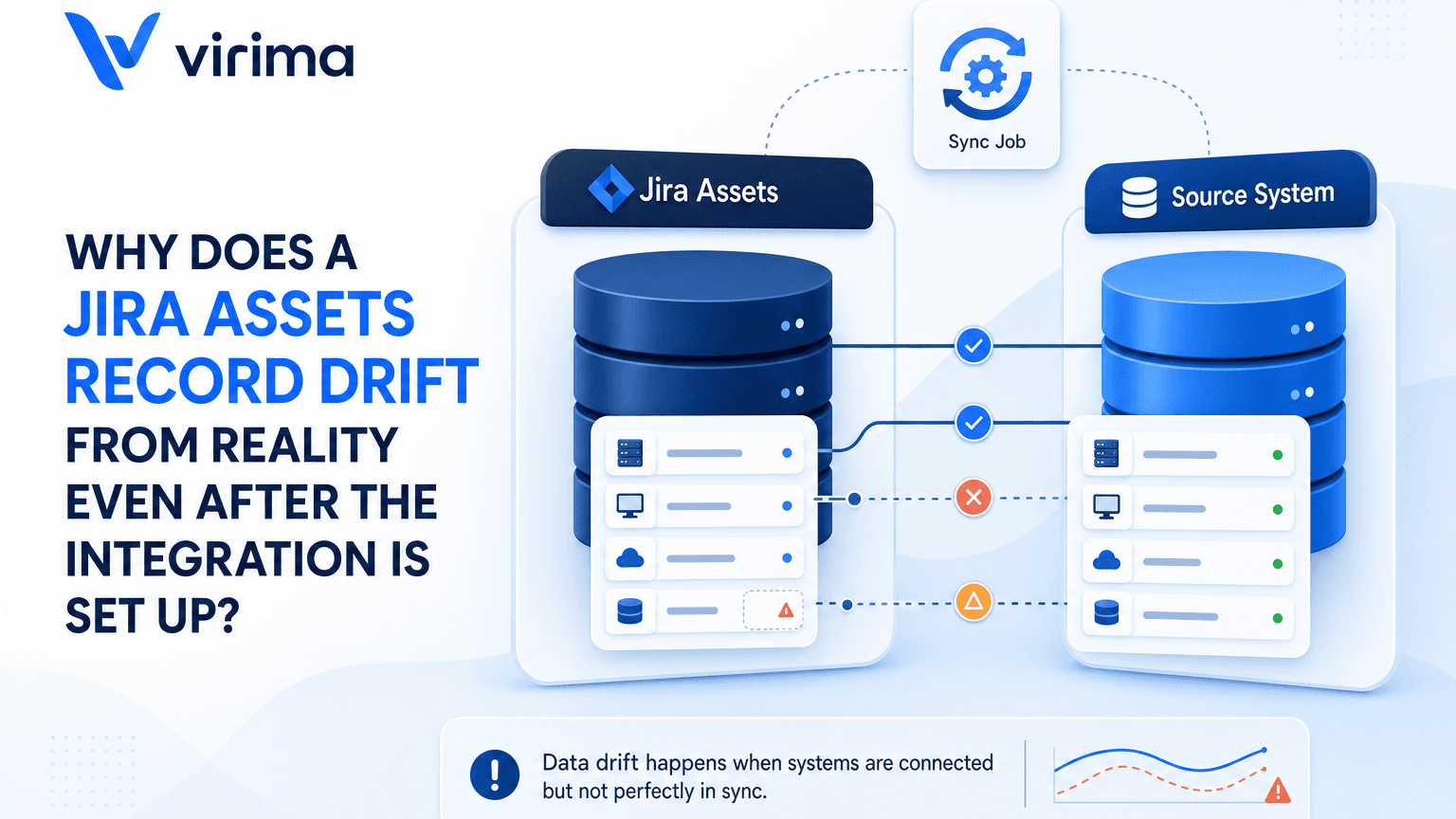
Why does a Jira Assets record drift from reality even after the integration is set up?

The connector shows green. Last night’s job finished without errors. A technician still opens a Jira ticket against a server that left the rack two weeks ago. The Assets object still says Active. Nobody broke the integration. The integration did exactly what a sync is built to do: move fields on a schedule.
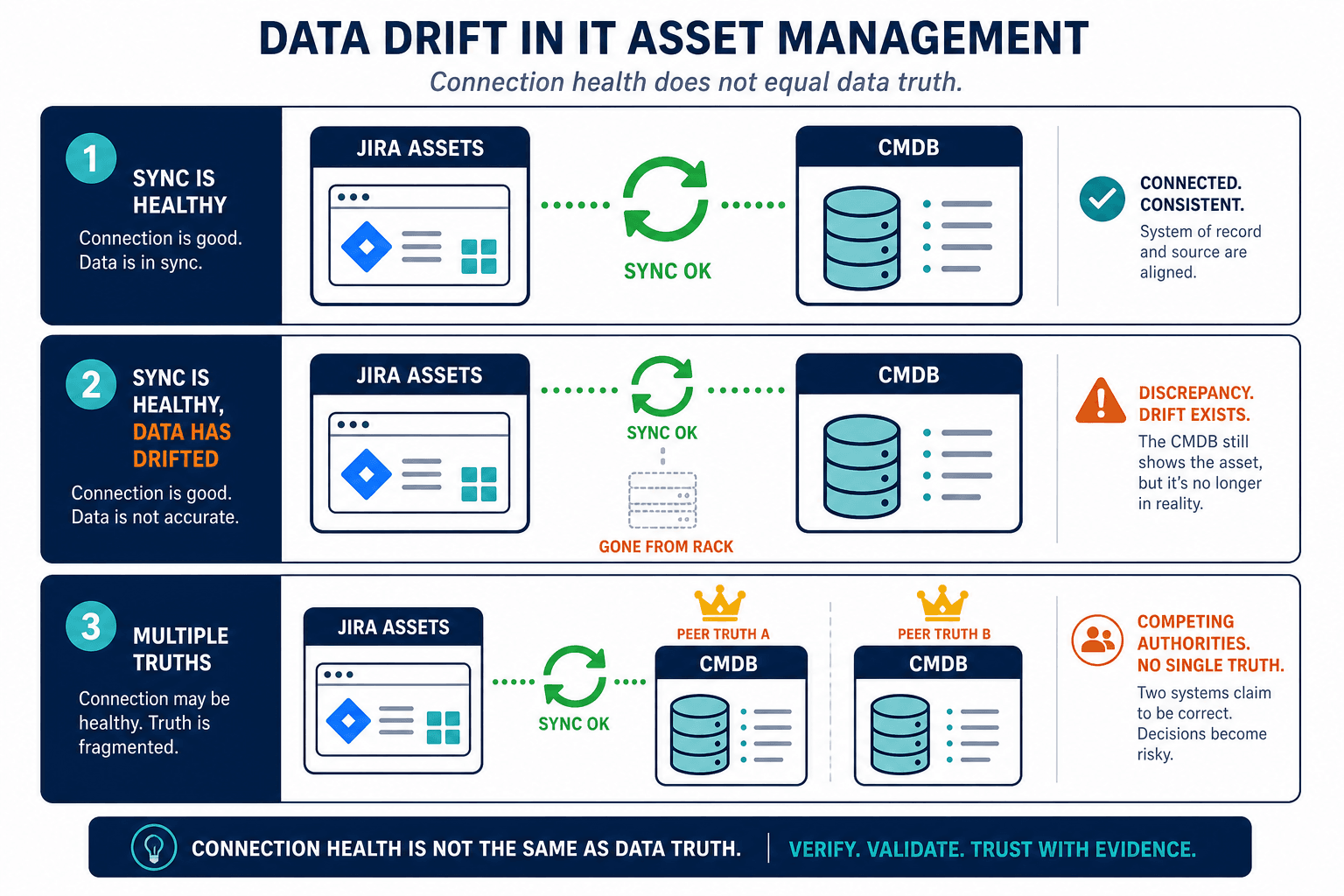
A Jira Assets record (formerly Jira Insight) drifts after integration is already running clean, because an integration moves data between two systems on a schedule — it does not unify that data into one accurate record. A connection can still move stale or conflicting values and call the run a success. The failure sits in whether each side’s data was actually accurate at the moment the job ran. That gap shows up in three specific ways: decommissioned assets that never got closed out, new assets that existed before the next discovery cycle caught them, and two systems each configured as the authoritative CMDB when they disagree.
Flexera’s 2025 State of ITAM press coverage keeps returning to the same pressure: teams lose visibility while cost and inventory complexity rise. A healthy connector does not erase that pressure if discovery, lifecycle status, and source-of-record rules stay weak.
The decommission gap
A server leaves the environment. Power is cut. The hypervisor removes the guest. Cloud control plane deletes the instance. Unless that lifecycle event becomes a status change that reaches Jira Assets, linked tickets keep treating the CI as live.
The sequence is ordinary. Someone reopens an old incident. A change ticket reuses the same object key. A dependency field still points at the retired host. The technician plans work against a node that is not there.
The sync job can still succeed on the next run because nothing in the payload said the CI should leave Active. The job never received a decommission signal. That is a lifecycle-event gap — the decommission gap — not a broken connector.
Manual close-out fails under load. People forget. Handoffs skip the Assets update. Weekend tear-downs never reach the CMDB owner. These ghost CIs — also called phantom assets — then pollute impact lists and ownership reports.
CISA Binding Operational Directive 23-01 (issued 2023, still in effect) pushes agencies toward timely asset inventory discipline for known-exploited vulnerability response. The same discipline applies when commercial teams keep retired hardware visible as if it still ran production.
Product path: treat absence and lifecycle signals from discovery as first-class status updates that push downstream into the ITSM object model. Decommission should not depend on a person remembering a form after the rack goes dark. CI lifecycle tracking and multi-source reconciliation close the record when the estate no longer answers, then the reflection in Jira follows that source of record.
Related practice detail: what happens to CIs when IT assets are decommissioned.
Why do decommissioned servers still show as active in Jira Assets?
Because sync only copies fields it receives. If discovery never marks the CI retired, or nobody updates status manually, the Assets object stays Active. The connector can succeed while the lifecycle event never enters the payload, so tickets keep linking to a host that is already gone. This decommission gap in Jira Assets is the single most common driver of ghost CIs.
The discovery-lag gap
A new asset lands in the environment before it lands in either CMDB. Cloud autoscaling, a VMware clone, a network device on a new subnet, or a laptop image can appear hours before the next scheduled discovery pass. Virima discovery runs on high-frequency scheduled cycles, not as passive continuous listening. That leaves a real, bounded window where the asset exists and no CI key exists yet.
During that window, two bad outcomes show up in Jira. The ticket stays unlinked because there is nothing to attach. Or someone creates a placeholder Assets object by hand so the ticket can move.
When discovery later creates the authoritative CI, both records can survive if reconciliation does not merge them. The estate then carries a duplicate pair with different keys, owners, or attribute sets. Sync distributes both versions on the next job.
Shortening the discovery interval shrinks the window. It does not remove the need for merge rules. Shorter intervals also mean more scan load and more network chatter across the environment — a tradeoff worth weighing against how wide the discovery-lag window actually runs. Placeholder objects created under ticket pressure must join to the discovery-sourced CI instead of remaining as permanent twins. Multi-source data reconciliation and CI population from discovery are the controls that keep the manual shortcut from becoming a second inventory.
For the runtime picture teams should trust before they edit either side, see Trusted Runtime Truth.
What is discovery lag between a new asset and its Jira Assets CI?
It is the time between when hardware or cloud capacity is live and when the next scheduled discovery cycle writes a CI. Tickets opened in that window stay unlinked or get manual placeholders that can duplicate the later discovery record if merge rules are weak.
The two-CMDB problem
Jira Assets can operate as a CMDB in its own right. Teams edit objects from the ticket UI. Schema owners extend types. Automation rules write attributes.
A discovery-sourced CMDB does the same job from scans and API imports. When both stay editable as peers, the integration links two truths rather than one truth and one reflection.
Whichever side a person touched last looks correct in the UI until the next sync overwrites it, in whatever direction the job is configured to win. Conflicts then look like “the integration flipped my field” when the real issue is dual authority. Attribute-level last-write-wins without a designated source of record turns governance into a race.
That uncertainty carries a real cost. Forrester research cited in Oomnitza’s CMDB accuracy analysis found fewer than half of organizations trust the data in their CMDB enough to act on without double-checking it first. A live dual-authority sync is exactly the kind of gap that keeps that number low.
This only stabilizes when one side is explicit source of record and the other is a consumer view. Structurally, the discovery-sourced CMDB should own what is running, how it connects, and lifecycle state. Jira Assets should display and attach that data to work management, not maintain a second independent inventory. Configure the integration as reflection, not as peer-to-peer democracy over the same CI facts.
Partner platforms such as Jira stay plain text in runbooks. Delivery of CI and relationship data into ITSM belongs on one hub: all integrations.
Why is having Jira Assets and a discovery CMDB both editable a problem?
Because each store can diverge between syncs. Edits on either side create competing truths. The next job then overwrites fields based on direction rules, not on which value matches the live estate. Designate discovery-sourced data as source of record and treat Assets as the ITSM reflection.
See how discovery-sourced CI lifecycle status and reconciliation resolve each of the three drift patterns — decommission, discovery-lag, and dual-authority — before they reach Jira.
Failure modes at a glance
Put together, these three mechanisms are what most teams mean by Jira Assets CMDB drift — a working connector sitting next to data nobody fully trusts.
| Failure mode | What triggers it | What it looks like in practice | What actually closes the gap |
|---|---|---|---|
| Decommission gap | Asset leaves the estate without a status event into the CMDB or Assets object | Active CI on retired host; tickets and changes still link to it | Discovery-detected lifecycle or absence signals push retired status downstream; stop relying on manual close-out alone |
| Discovery-lag gap | Provision completes before the next scheduled discovery cycle | Unlinked tickets or hand-built placeholder CIs that later collide with discovery | Tighter discovery cadence plus reconciliation that merges placeholders into the discovery-sourced CI |
| Two-CMDB problem | Jira Assets and a discovery CMDB both accept authoritative edits | Field flip-flops after sync; “the integration broke my data” | One source of record (discovery-sourced CMDB); Assets configured as reflection for ITSM, not a peer inventory |
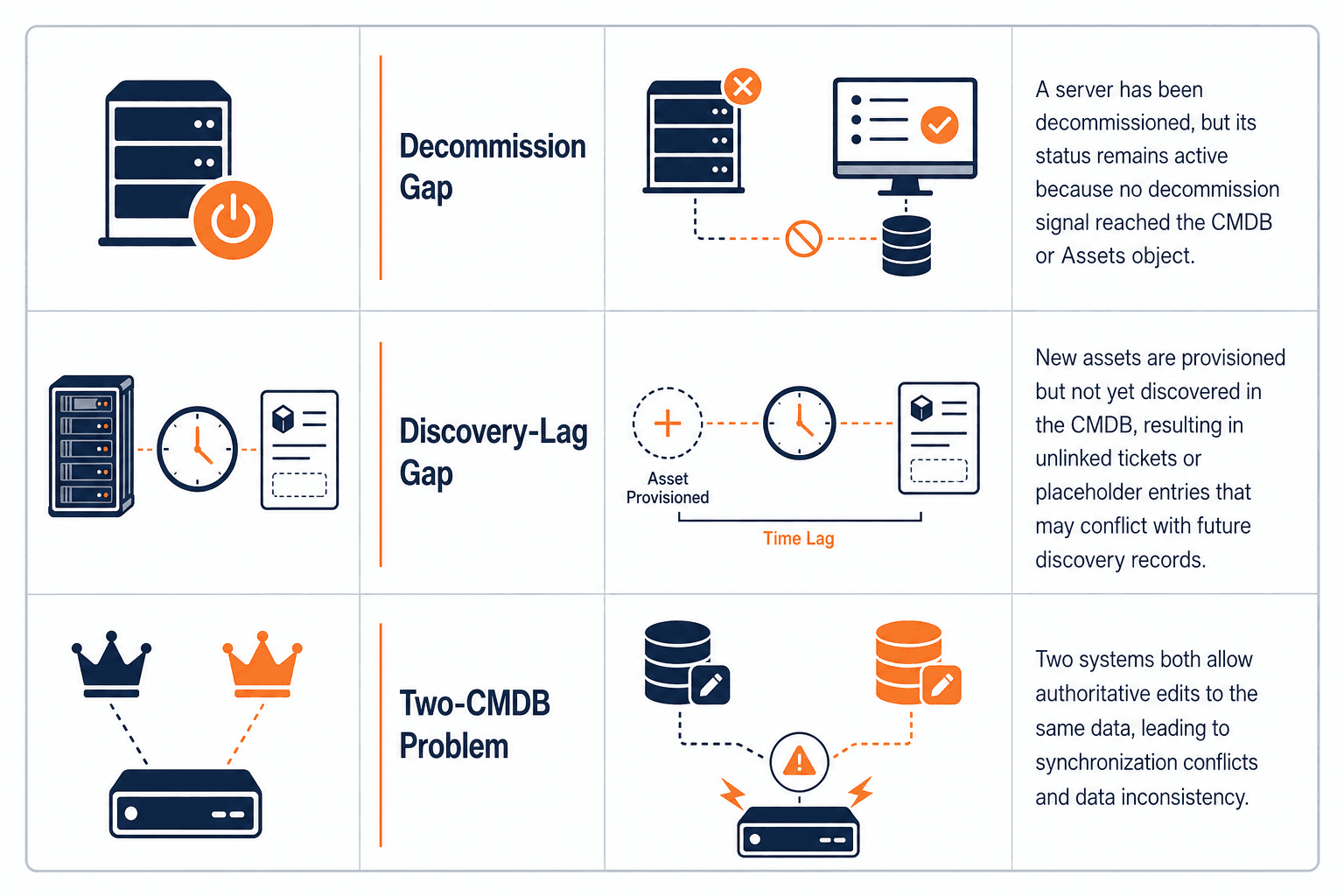
Faster sync helps only the middle row, and only at the edges. It does not invent a decommission event that never entered either system. It does not decide which peer CMDB wins a governance fight. Treat connector frequency as one control among lifecycle detection, reconciliation, and source-of-record design.
Make the connector carry truth, not only traffic
Green job history is a weak comfort metric. Ask three questions instead:
- Does decommission leave the object model, or only the rack?
- Does new estate appear before ticket pressure forces a placeholder?
- Is only one system allowed to author CI truth?
When those answers are weak, Jira Assets will drift after every successful sync for the same structural reasons.
If your Assets schema still accepts free edits while discovery maintains a second inventory, set source-of-record rules before you tune the schedule again. That’s what stops a Jira Assets record from drifting after integration is already in place. See how discovery-sourced CMDB data feeds Jira Assets instead of competing with it.
Frequently Asked Questions
Does faster sync frequency fix these gaps?
Only in part. Higher frequency can shrink the discovery-lag window so new assets appear in the object model sooner. It does not create a decommission status that never entered either system, and it does not resolve two editable CMDBs competing for authority. Treat faster sync as a partial fix for one of three failure modes, not a full repair.
How do you tell if a Jira Assets record is currently accurate or has not synced yet?
You need a freshness or confidence signal on the CI, not only a last-sync timestamp on the connector. Prefer last discovery verification time, source system, and reconciliation state on the object itself. If the UI only shows when the job ran, you still cannot tell whether the payload reflected a recent discovery pass or an older assumed value.
Should Jira Assets or the CMDB be the source of truth?
The discovery-sourced CMDB should be source of record for what is running, how it connects, and lifecycle state. Jira Assets should consume and display that data for ticket and change workflows. When Assets stays a full peer author of the same facts, sync becomes a conflict distributor instead of a reflection path.
Does Virima’s discovery-sourced CMDB integrate with Jira Assets without replacing it?
Yes. Virima keeps the discovery-sourced CMDB as source of record for what’s running and how it connects, and feeds that data into Jira Assets as a consumer view — teams keep working in Jira while Virima owns discovery, reconciliation, and lifecycle status.