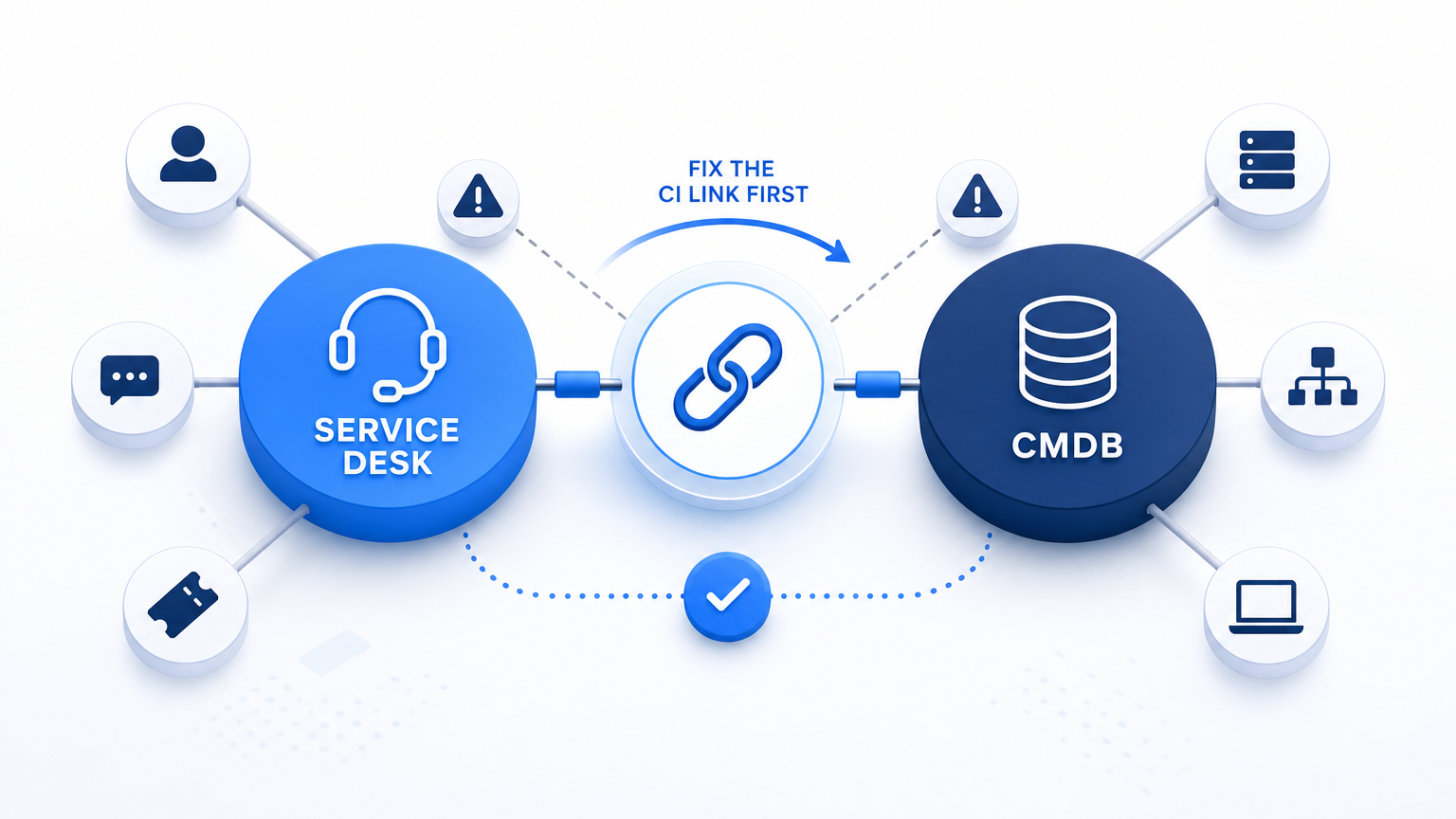
When the Service Desk and the CMDB Disagree, Fix the CI Link First

A major incident opens against a server the CMDB shows as retired. Another server with the same hostname is running in production. Last week’s change closed against a different configuration item entirely. The CMDB service desk mismatch burns the first twenty minutes of the bridge call while responders argue about which record describes the system that is actually down.
This piece answers three questions for the team that owns that argument. How incident and change records fall out of step with the configuration items they reference. What integration controls settle the conflict by rule. How incidents and changes stay tied to the right configuration item over time.
What It Means When the Service Desk and the CMDB Disagree
Disagreement means two records hold different facts about one configuration item. The ticket names one server. The configuration management database names another record for the same workload. Both records look complete until someone compares serial number, last-seen date, or owning service.
Five patterns cover most cases responders see:
| Pattern responders see | What each system holds |
|---|---|
| Ticket names the wrong CI | Incident references a hostname that now belongs to a replacement host. |
| Retired CI still receives tickets | CI lifecycle state shows retired, yet new incidents link to it. |
| One device exists as two CIs | Discovery source and manual entry created parallel records for one asset. |
| Change closes with no CI update | Change record shows implemented, CI attributes still show pre-change values. |
| Owner or criticality differs | ITSM tool shows one owner, CMDB shows another, and neither cites a source. |
This scope covers the CI link and CI attributes. Ticket categorization, priority math, and assignment rules sit outside this piece.
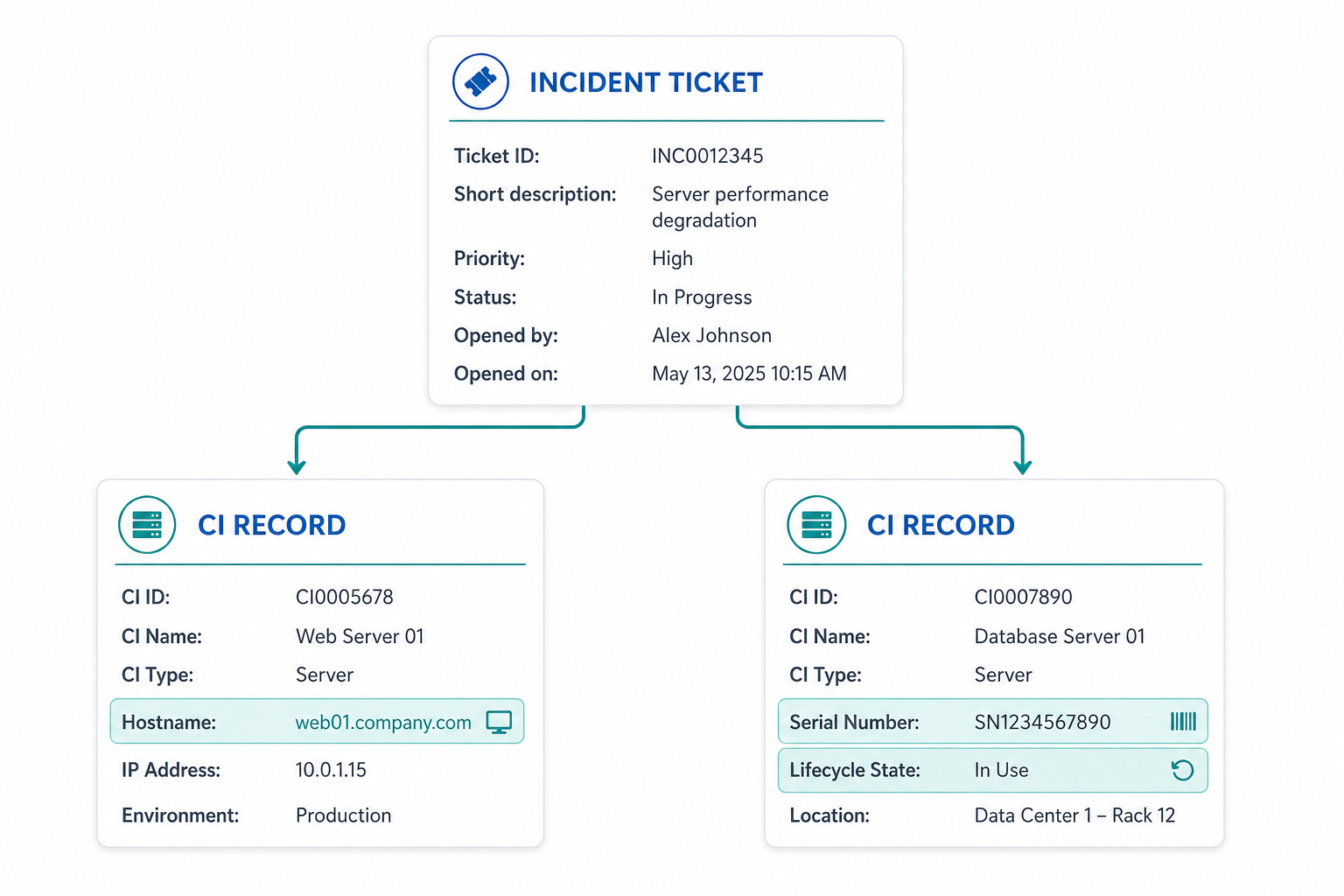
What does it mean when the service desk and the CMDB disagree?
They hold different facts about the same configuration item. A ticket may reference a retired host, a change may close without updating CI attributes, or two records may describe one device. The link between ticket and CI needs correction.
Why the Gap Shows Up During an Incident or a Change Review
Incidents expose a weak CI link within minutes. Responders open the linked CI, check dependencies and recent changes, and plan containment around that context. When the link points to a stale record, triage follows dependencies that no longer exist and misses related incidents tied to the correct record. Lansweeper has made the same observation in its ServiceNow CMDB writing, noting that linking to an outdated CI can mislead responders more than leaving the link empty.
Changes expose the same gap from the planning side. ServiceNow practitioners have described how inaccurate CMDB data weakens incident, problem, and change work because impact analysis rests on records that no longer reflect production. That view appeared in a ServiceNow Community article on CMDB data inaccuracies, and it still describes the failure well. A change advisory board approves scope based on listed CIs. The listed CIs omit a shared database or load balancer. Implementation touches an unlisted dependency and causes an outage that review never considered.
Three failure modes follow, scoped to environments where the CI field accepts free text or unvalidated selection:
- Responders work the wrong system because the ticket CI resolves to a decommissioned host while the replacement host runs under a similar name. Result: Containment actions target a machine that carries no production traffic.
- Two changes collide because neither change record listed the full set of affected CIs. Shared infrastructure sits outside both scopes, so sequencing never accounts for it. Result: The second implementation overwrites or restarts a component the first change depends upon.
- The audit trail points to CIs that no longer exist. The change history looks complete until an auditor asks for evidence tied to current inventory, and the cited hosts have no discovery sightings for months. Result: The team reconstructs history from tickets instead of citing the CMDB.
Three Integration Seams Where Records Drift Apart
Records drift at three seams between discovery, the CMDB, and the ITSM tool. Each seam has a control that settles conflicts by rule. Conflict rules only work after someone configures them, so skepticism about out-of-the-box resolution is warranted.
Seam one is matching. The same server arrives from discovery with a serial number and from the ITSM tool with a hostname an analyst typed. The sync cannot correlate the two identifiers, so it creates a second CI. The control is matching against existing records before the sync creates anything. Correlators compare serial number, cloud instance ID, MAC address, or other durable identifiers first, and only create a new CI when no match clears the threshold.
Seam two is authority. Two sources report different values for one attribute. Discovery reports the observed operating system version. The ITSM tool carries a manually updated version from last quarter. The control is an authority rule per attribute, with each conflict logged alongside source, timestamp, and rule applied. Discovery usually leads on existence and last-seen facts. People who maintain business context usually lead on owner and criticality. Last write wins has no place here because recency alone says nothing about trust.
Seam three is direction. Facts that people maintain inside the ITSM tool change there and never travel back. An owner changes after a reorganization. An approval note clarifies scope. Enrichment added during major incident review stays on the ticket. The control is a return path that carries ownership changes, approvals, and enrichment notes back to the CMDB record so the next incident inherits the correction.
| Disagreement pattern | Seam | Control |
|---|---|---|
| Wrong CI on ticket | Matching | Correlate on durable identifiers before creating CIs. |
| Retired CI still linked | Authority on lifecycle state | Discovery leads on existence and last-seen evidence. |
| Duplicate CIs for one device | Matching | Match against existing records before sync. |
| Change closes, CI unchanged | Direction plus authority | Return implementation facts, then reconcile observed state. |
| Owner or criticality differs | Authority plus direction | Designated source per attribute, return path for human updates. |
Which record wins when the CMDB and the ITSM tool conflict?
No record wins by default. Teams assign a trusted source for each attribute. Discovery usually governs existence and last-seen facts, while assigned owners govern business fields, and every conflict is logged with source and rule.
Trusted Runtime Truth Keeps One Record for Assets, Dependencies, and Ownership
Incidents, changes, and CI records each answer part of the question responders ask during an outage. What exists right now. How the affected system connects to services. What changed recently. What else could break. Who owns the decision. Virima calls that combined record Trusted Runtime Truth, which is the discovery-sourced record covering assets, services, dependencies, ownership, change history, and blast radius.
See how Trusted Runtime Truth keeps assets, dependencies, change history, and ownership in one record.
Tying Incidents to CIs So the Link Survives
Durable incident linkage rests on validation at ticket creation plus freshness behind it. Analysts select the CI from a validated list drawn from the CMDB rather than typing a hostname from memory. The ITSM integration refuses links to retired CIs and suggests the replacement record instead. High-frequency scheduled discovery refreshes CI relationships on a configured cadence, so the validated list reflects current inventory instead of last quarter.
For the mechanics of mandatory CI linkage inside Virima, use the guide on mandatory CI linkage on incidents rather than repeating that setup here. That guide covers the field-level behavior. This section covers the surrounding discipline that keeps the link trustworthy.
Three practices support the link after creation. First, related-incident matching runs against the CI and its dependencies, so a network event surfaces sibling tickets on connected hosts instead of appearing isolated. Second, open incidents and recent changes appear as overlays on ViVID service maps, which gives responders the affected asset, its upstream and downstream dependencies, and recent change activity in one view. Third, when ownership or criticality changes during incident review, that correction returns to the CI record so the next ticket inherits accurate business context. Integration depth varies by ITSM platform, so validate the return path behavior for each connected tool during implementation.
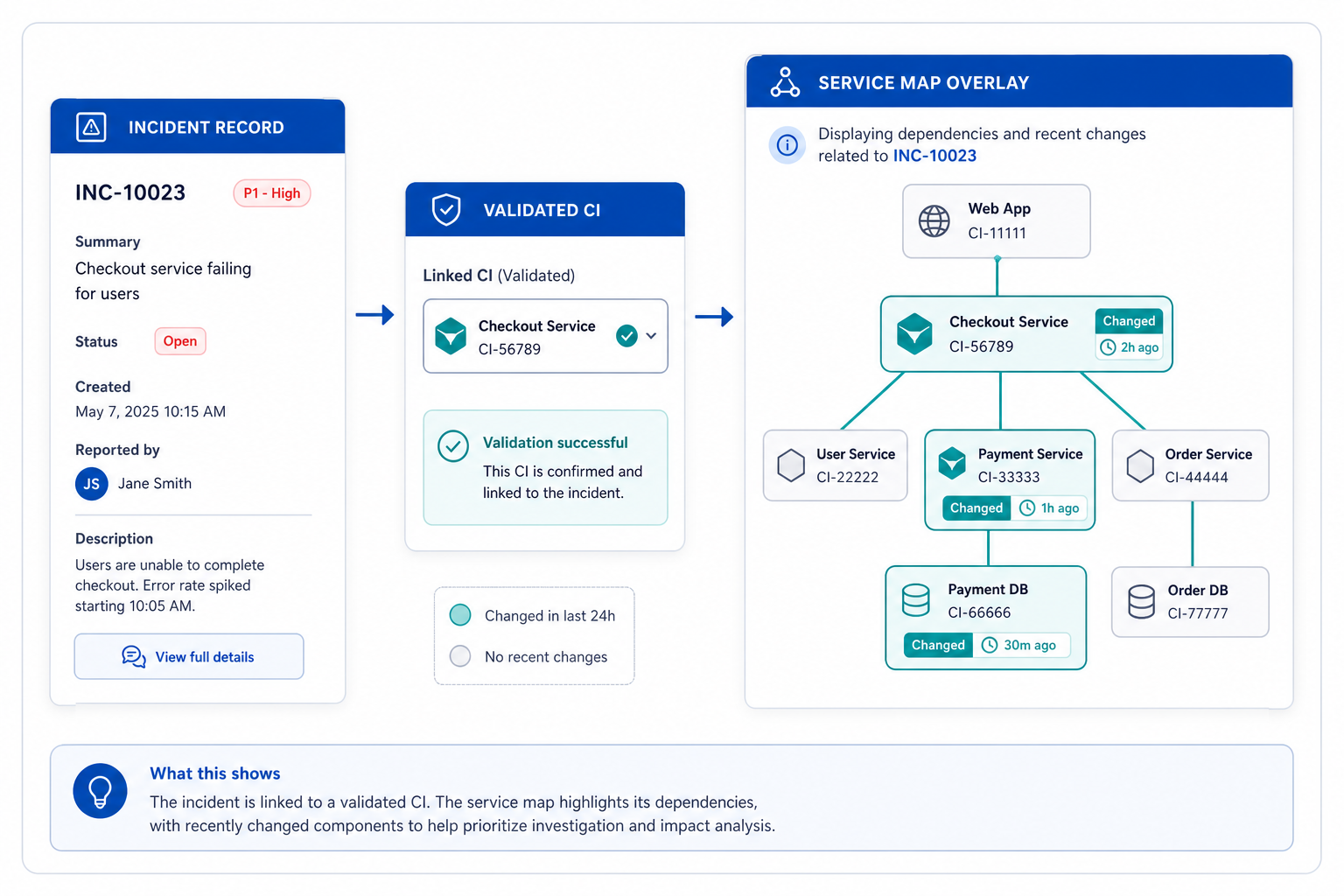
Why should incidents link to configuration items?
A linked CI gives responders the affected asset, its dependencies, and recent changes when the ticket opens. Validated selection plus refreshed CI data keeps impact analysis and related-incident matching grounded in current inventory.
Tying Changes to CIs, Then Checking the Result
Change linkage works in two passes, before approval and after implementation. Before approval, the change record names every CI it affects, widened by dependency data rather than limited to systems the requester remembers. Blast radius review happens ahead of the change window, using service relationships to surface shared databases, load balancers, and downstream consumers. For the broader change-management framing, the Virima guide on CMDB in change management covers CIs across the change lifecycle.
After implementation, scheduled discovery compares observed state against the plan. A match closes the change with evidence. A mismatch opens follow-up work with a named decision-maker and a due date. The drift check uses the same logic described in the Virima post on as-observed versus as-expected, which this section references without repeating.
Authority matters when discovery and the change record conflict. Discovery leads on existence and last-seen facts because it reports what the scan observed. Business fields stay editable by the people who maintain them. The decision owner reviews the evidence, updates the record, and records which source governed each attribute so the next review follows the same rule.
A Four-Week Routine to Settle the Disagreements
A short routine converts the controls above into steady progress. Sample 50 recent tickets and count wrong or missing CI links, which establishes the baseline mismatch rate for the next month. Write an authority rule for each contested attribute, starting with lifecycle state, owner, and criticality, which removes ad hoc judgment from the next conflict. Make the CI field a validated selection tied to current CMDB records, which prevents free-text entries from creating new duplicates. Review the weekly conflict log with service owners and adjust matching thresholds or authority assignments, which keeps the rules aligned with inventory churn.
Teams that declare each service once find this routine easier to sustain because incident and change review can reference named services instead of reassembling scope from hostnames every time.
Where Virima Fits When Tickets and CIs Diverge
Virima discovers infrastructure across on-premises, cloud, and virtual environments on a scheduled cadence, reconciles multi-source data into CI records, and syncs those records with connected ITSM platforms. Matching runs before the sync creates records, which limits duplicates from hostname variance. Attribute-level authority rules govern which source prevails on conflict, with conflicts logged by source, timestamp, and rule applied.
Open incidents and recent or planned changes appear as overlays on ViVID service maps, which places ticket activity beside dependency and ownership context during triage and change review. Targeted rescans can refresh a CI record when an incident or change review questions its currency. Discovery leads on existence and last-seen facts while business fields remain editable by the people who confirm them.
Virima does not replace the ITSM tool. Authority rules require configuration before they settle anything. Overlay depth varies by platform, so review the platform behavior in the full list of all ITSM integrations before committing to scope.
Close the Gap Between the Ticket and the CI Record
Start with the CI link on the next major incident review. Confirm the ticket referenced the system that actually failed, then correct the matching or authority rule that allowed the mismatch.
To see validated CI linkage, authority rules, and map overlays against your own inventory, schedule a demo.
Frequently Asked Questions
What does it mean when the service desk and the CMDB disagree?
They hold different facts about the same configuration item. A ticket names a retired server, a change closes without a CMDB update, or two records describe one device. The gap surfaces during incidents and change reviews.
Why should incidents be linked to configuration items?
A linked CI gives responders the affected asset, its dependencies, and recent changes when the ticket opens. Without a valid link, impact analysis and related-incident matching rest on guesses about what the ticket touches.
How do changes get tied to configuration items?
The change record names every CI it affects before approval, using dependency data to widen the list. After implementation, a discovery scan compares observed state with the plan, so mismatches open follow-up work.
Which record wins when the CMDB and the ITSM tool conflict?
No record wins by default. Teams set an authority rule per attribute. Discovery usually leads on existence and last-seen facts, while business fields such as owner or criticality stay with the people who maintain them.
How does Virima work with ITSM tools such as ServiceNow and Jira Service Management?
Virima syncs discovered CIs to connected ITSM platforms, matches them against existing records to avoid duplicates, and overlays open incidents and changes on ViVID maps. Depth varies by platform, so check each integration page.