Gartner Guidance On Containing AI Risk: What Does an AI Central Bank Mean Functionally

On 19 October 2026, two Gartner Fellows opened Gartner IT Symposium/Xpo in Orlando with a warning about artificial intelligence (AI). Daryl Plummer and Kristin Moyer told the room that AI risk is growing faster than AI value.
Gartner’s own survey figures show the distance. Of the organizations surveyed, 71% expect to deploy agentic AI within the next 12 months, yet only 21% have agentic AI governance capabilities in place.
Only 25% of chief information officers (CIOs) align technology and business risk.
Gartner’s answer is an idea it calls the AI central bank. Most coverage so far repeats the keynote.
This post reads the Gartner AI central bank more closely: what it is, what its four functions do day to day, and what it needs underneath.
Anyone who builds, runs, or relies on AI workflows will meet the questions it raises: who owns this system, what does it touch, and what happens when it acts.
Virima exhibited at Booth 151 at the same event, and its news release on Trusted Runtime Truth sets out what it brought.
This is not a booth recap. It is a working reading of one idea, with the limits stated where they matter.
What Gartner Proposed, in Gartner’s Words
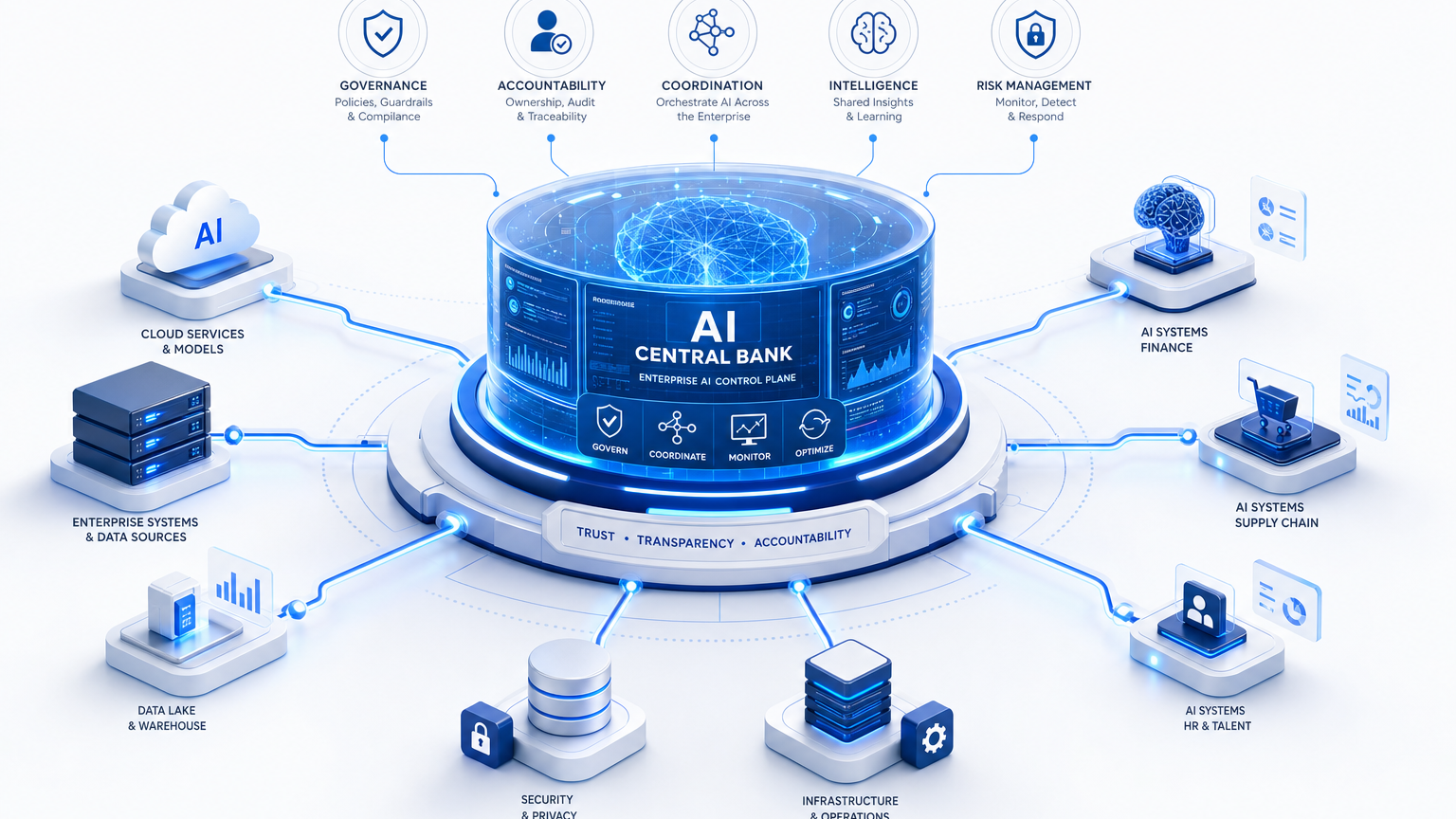
Gartner describes the AI central bank as “a virtual control plane for AI decision-making across the enterprise.” A control plane is the layer where decisions about AI are coordinated, separate from the AI systems that do the work.
Gartner says the idea rests on alignment, coordination, and collaboration, not centralization.
The keynote article gives its purpose: to “improve visibility, coordinate decisions and balance value with risk across the enterprise.” It adds that the approach helps address the “invisible chains of accountability” that appear as AI systems become more autonomous.
In the same article, 86% of CIOs report that their AI risk is growing faster than AI value, and on average they say risk is growing four times faster.
Gartner is careful about the limits. Its release says so directly: “What it will not do is eliminate risk, and it will not drive value.”For the human side, the keynote article tells CIOs to make “people to the rescue” their mantra.
Gartner’s Day 1 highlights summarize the keynote’s message in one line: value and risk “can’t be managed separately.”
The central bank sits inside a wider framework, the Gartner Value-Risk Flywheel. Value and risk compound together, and two forces shape the result. Momentum accelerates outcomes, and drag slows them. Good drag, in Gartner’s words, “protects value through governance, cybersecurity, accountability and spending discipline.”
Bad drag adds bureaucracy and rework without reducing risk.
The release names four functions: the central bank “creates accountability, governs technology, manages economics, and creates shared intelligence.”
The keynote article words them as accountability and governance, technology integration, cost economics, and shared intelligence.
Neither document explains how any one of them works in practice, so the next section does.
What is Gartner’s AI central bank?
Gartner describes the AI central bank as a virtual control plane for AI-decision making across the enterprise. It coordinates owners, decisions, and records through alignment rather than centralization. Gartner states it will not eliminate risk and will not drive value on its own.
The Four Functions, One at a Time
Gartner gives the four functions as names, not procedures.
What follows is Virima’s reading of what each would involve. It is an interpretation, not Gartner’s guidance.
Each function is read against one input, the estate record. That is the recorded view of what an information technology (IT) estate contains, who owns each item, and how the items connect, as far as discovery reaches.
| Function (Gartner’s release) | What it does day to day (our reading) | What it reads from | Who holds it |
|---|---|---|---|
| Creates accountability | Names an owner for each AI use case and each system it touches, and documents who decides | Owner records and change history | CIO with GRC |
| Governs technology | Sets which AI systems may connect to which systems, and reviews those links | The dependencies between services and infrastructure | CTO with CISO |
| Manages economics | Tracks AI spend against the value each use case returns | Finance and usage data | CIO with finance |
| Creates shared intelligence | Gives every seat one view of what AI exists, what it touches and who owns it | One shared inventory and record | All seats |
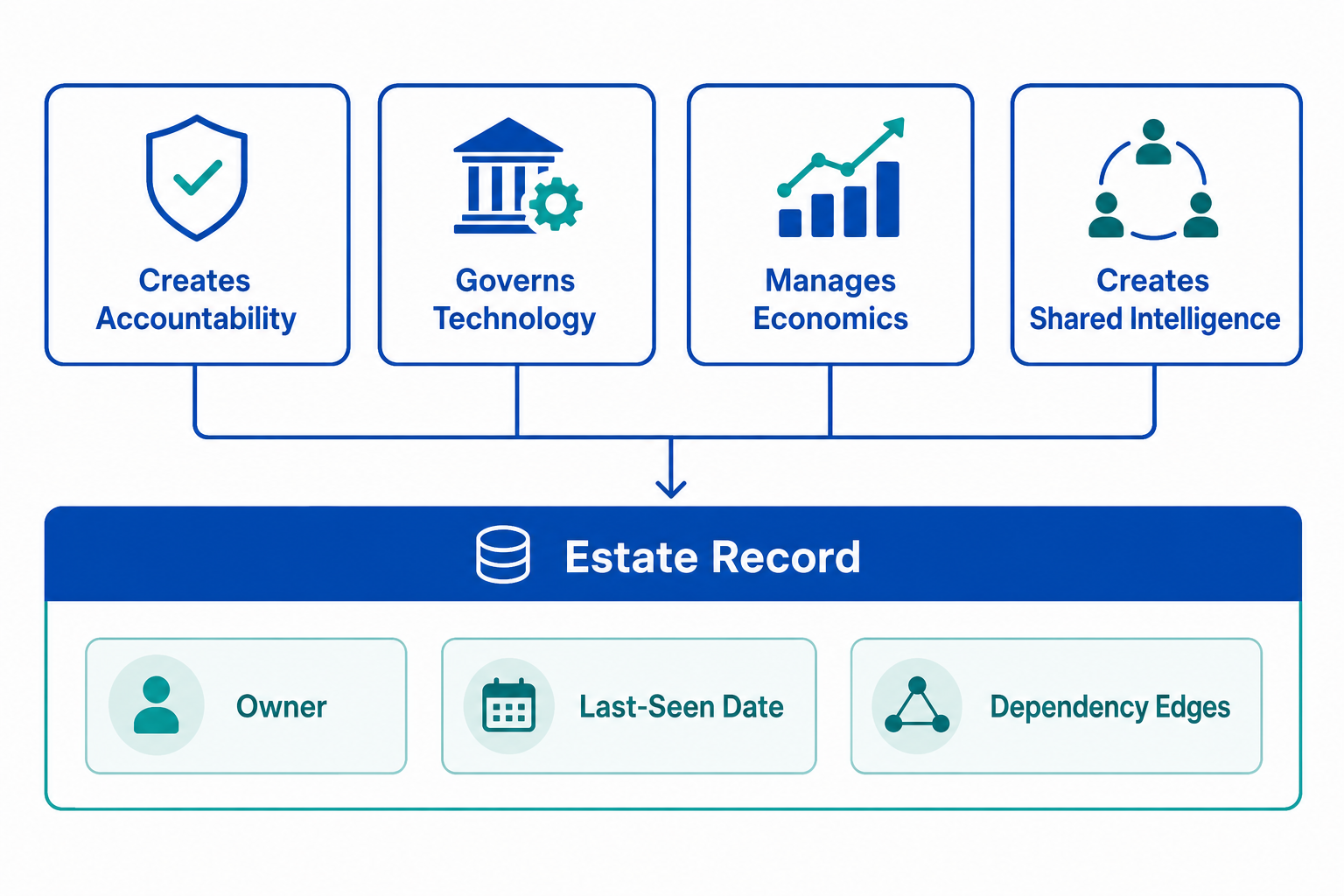
Creates accountability: an owner on record and a decision with a date
The operating question is plain: when an AI system acts, whose decision was it, and where is that written down?
Autonomy sharpens the question, because an agent can trigger actions across several systems before anyone reviews the first.
The National Institute of Standards and Technology (NIST) AI Risk Management Framework expects the roles and responsibilities for managing AI risk to be documented. It also expects executive leadership to take responsibility for decisions about risk.
In practice, that means an owner field on every record and a dated history of changes. A configuration management database (CMDB) holds both for the systems it records.
It does not make anyone accountable. A name on a record is where accountability starts, and the decision still has to be made by a person.
Governs technology: the connections are the risk surface
Here the operating question is which systems an AI system can reach, and who approved each link. NIST asks organizations to have policies for third-party AI risk, and contingency processes for failures in third-party data or AI systems.
A contingency process needs a map of what depends on the third party.
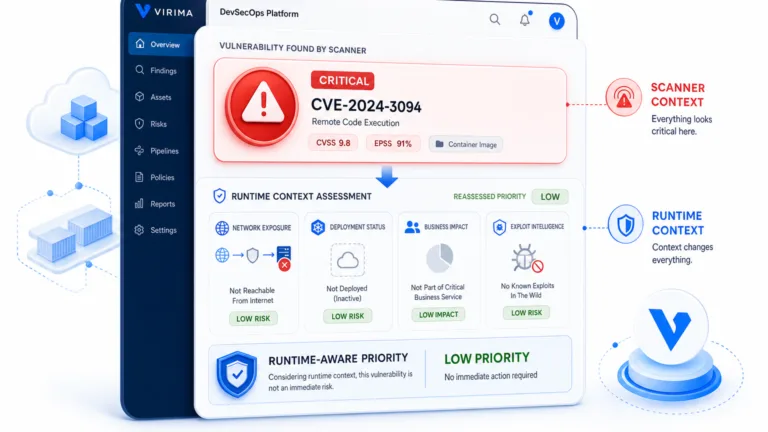
Once a team defines a service, Virima’s ViVID™ service mapping builds its dependency structure from discovery data and shows which systems it touches, including links to a provider’s platform.
The map shows your side of the link. It does not see inside the provider’s platform.
Manages economics: the function Virima does not serve
The operating question is what each AI use case costs and what it returns. Gartner’s Day 1 highlights report that 44% of chief executive officers (CEOs) find it difficult to demonstrate AI-driven financial returns to stakeholders, so the need is real.
Cost allocation and spend tracking come from finance and usage data. Virima is not a cost-management tool, and an estate record does not answer this function.
Saying so plainly matters, because a control plane that claims every input will be trusted on none of them.
Creates shared intelligence: one inventory, read by every seat
The operating question is whether the CIO, the CISO, the ITAM lead, and the GRC lead can each open the same list and see the same owner.
Shared intelligence starts with the principle NIST states in one line: “Mechanisms are in place to inventory AI systems.”
The estate record covers the infrastructure, cloud accounts, and services in discovery scope, each with a source and a last-seen date. It does not cover AI models, prompts, or agents. The next section explains why that distinction matters.
When four seats need one view of what exists, who owns it, and what each AI use case touches, start with discovery-sourced runtime truth under the control plane, not another disconnected list.
What a Control Plane Needs Underneath It
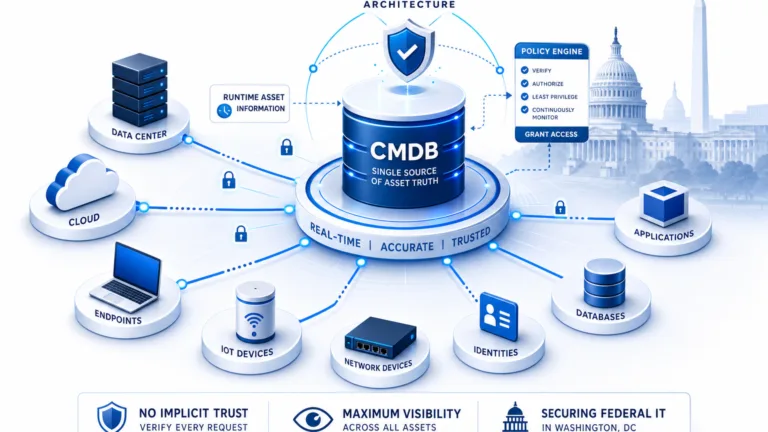
A control plane coordinates what it can name. Before an AI central bank can govern anything, the organization needs four answers on record: what exists, who owns it, what it touches, and what changed.
The keynote article we read mentions visibility only as a general benefit.
It does not mention an inventory or the dependencies between systems.
Two lists supply those answers, and they are not the same list.
The first is an AI register: the use cases, models, agents, and named owners the central bank oversees. The organization writes and keeps it.
The second is the estate record: the servers, cloud accounts, applications and services those AI systems run on and reach. Many organizations already hold part of the second list in a configuration management database, a store of the systems a company runs, who owns each one and how they connect.
The register says what AI exists. The estate record says what it touches.
A record is only as current as its last scan, so each item carries a last-seen date.
The central bank should read that date before relying on an answer.
The governance lag is documented elsewhere too. Deloitte’s State of AI in the Enterprise survey of 3,235 leaders in 24 countries found that 21% have a mature governance model for agentic AI.
In the same survey, 74% expect their organizations to use AI agents at least moderately by 2027.
Gartner’s 21% measures a different thing, governance capabilities in place, so these are two separate surveys that point the same way.
Virima’s own view matches this limit.
As its earlier post on why a CMDB alone is not AI governance argues, a record supplies inputs and people make decisions.
For the agent-level version of this argument, see the post on the agent harness and the enterprise view.
What does an AI central bank need under the control plane?
It needs an AI register of use cases, models, and agents with owners, plus an estate record of the servers, cloud accounts and services those systems reach. Each estate item should carry a source and a last-seen date so decisions rest on current discovery, not stale lists.
A First Meeting Agenda for Your AI Central Bank
Gartner calls the AI central bank virtual and built on alignment. In practice, it starts as a meeting.
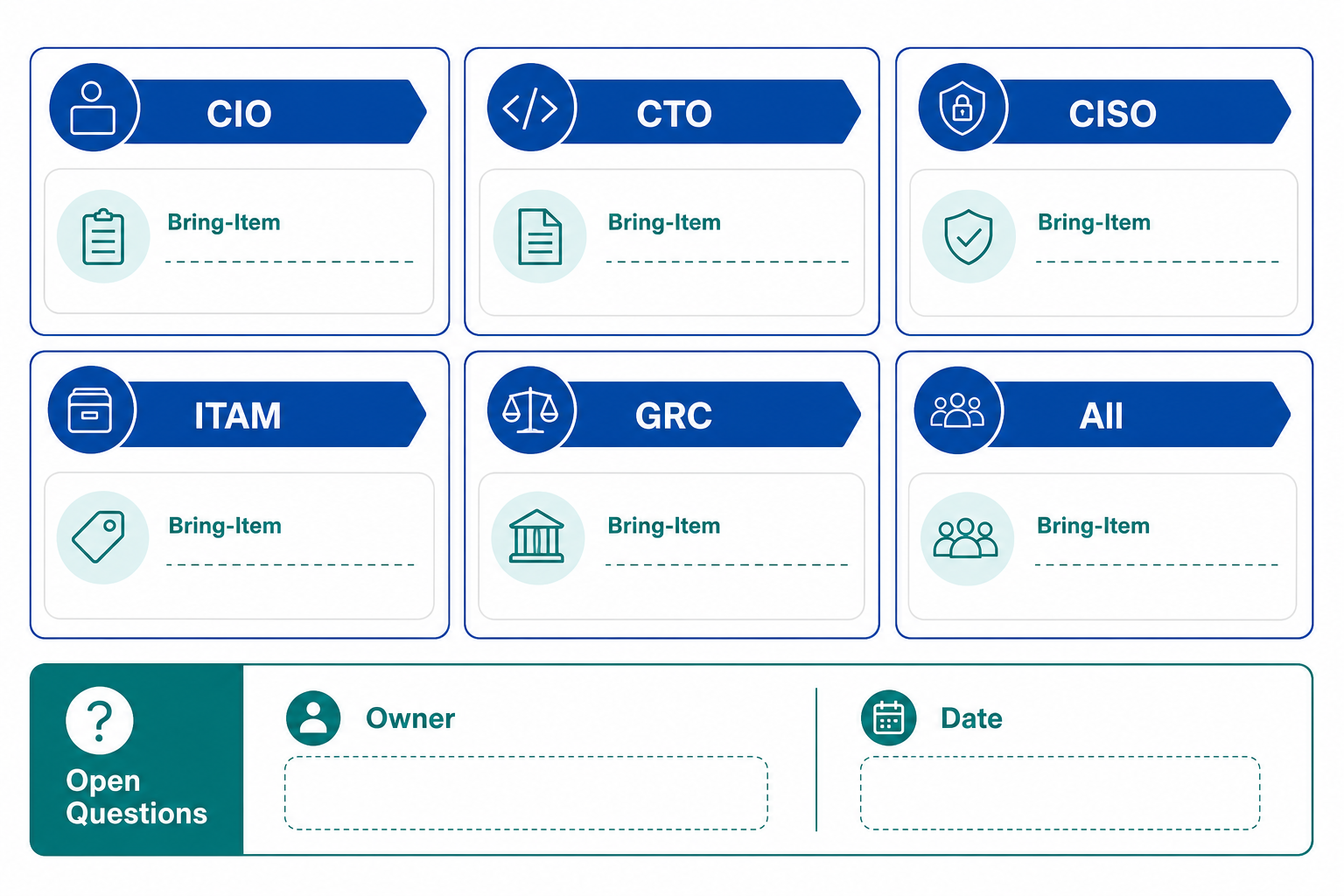
This agenda gives each seat one item to bring. It is a template for your own meeting, not a case study.
- CIO or vice president: the list of AI use cases in flight, each with a named business owner and a date for its next review.
- CTO: for each use case, the systems it connects to and who approved each connection.
- CISO: the systems and connections that sit outside the inventory, and how the security team learns when one is touched.
- ITAM leader: the lifecycle status of each system and who signs off its retirement. Retirement is a decision, so the record should name who makes it and why.
- Compliance or GRC leader: the evidence that exists today of who decided what, and who can retrieve it. A reporting and auditing view is one place that evidence can be drawn from.
- All seats: the one question nobody can answer yet, with an owner and a date.
Gartner’s governance analysts make a related point.
At the Asia-Pacific Symposium in September, Svetlana Sicular, a Gartner Vice President Analyst, advised: “Make evidence building a key part of governance actions in case things go wrong.”
- Item five is where that starts.
- Item six records what the group does not yet know, and who will find out.
- Review the list again at the next meeting, and carry any open item forward with its owner.
- Keep each answer to a line. An answer that needs a paragraph is usually two answers from two different tools.
Where Virima Fits, and the Problem It Is Built to Solve
Take item two on the agenda. Which systems does each AI use case connect to?
Where records sit in separate tools, the answers rarely agree. Discovery data may not reconcile cleanly across tools, records go stale between scans, and ownership is often unclear.
The person who maintains the configuration database ends up reconciling lists when the question needed a lookup. That is the problem Virima is built to address: one estate record that every seat can read from.
For a CIO, the practical gain is a shorter path from a governance question to an answer that a named person stands behind.
Virima offers no outcome figure here because none has a stated basis. A useful internal measure is the time it takes to list the systems behind one named AI use case, before and after.
| What Virima supplies | Where it comes from |
|---|---|
| Discovery-sourced records, each with a source and a last-seen date, built on high-frequency scheduled discovery | IT discovery and CMDB |
| Dependency maps for the services your team defines, with open tickets, scheduled and recent changes, and vulnerabilities overlaid | ViVID™ service mapping |
| Ownership and lifecycle status on asset records | IT asset management |
| Two-way sync with information technology service management (ITSM) tools such as ServiceNow, Jira Service Management, Ivanti, Halo, Xurrent, Hornbill and TeamDynamix | Published integrations |
| Read and write access through a Representational State Transfer application programming interface (REST API): JSON, with GET, POST and PATCH, using an API key and tenant ID issued by Virima | REST API post |
At Booth 151, Virima brought its CMDB, IT discovery, ViVID™ service mapping and impact assessment.
The news release describes the approach, which Virima calls Trusted Runtime Truth, as linking infrastructure records to service dependencies, ownership and change history.
The limits are worth stating in the same breath.
Virima does not discover or register AI models, prompts or agents. It is not an AI governance platform, a cost-management tool, an identity system, a vulnerability scanner, or a GRC tool.
The record covers what discovery reaches. It does not see inside a vendor’s platform or cover operational technology.
Published cloud integrations are Amazon Web Services and Microsoft Azure.
What to Ask Any Vendor That Says It Is Your AI Central Bank
Gartner calls the AI central bank virtual, so no single product is one.
A vendor that claims to be it deserves the same questions you would ask of any supplier, and Virima should answer them too.
| Ask | A concrete answer sounds like | A thin answer sounds like |
|---|---|---|
| Which of the four functions do you serve, and which do you not? | A named list that includes what is left out | “All of them” |
| Where does your inventory come from? | A named source with a last-seen date | Manual entry, or “automatic” with no detail |
| What can you not see? | Specific limits | None |
| Who owns each record? | An owner field and a dated history | A team name |
| What happens to AI systems that are not in your inventory? | A stated process and a named owner | “We will find them” |
See the Estate Record Behind the Questions
To see how Virima builds dependency maps from discovered infrastructure, start with the service mapping overview.
If your governance questions still stall on which systems sit under each AI use case, schedule a demo and walk one named use case against a discovery-sourced estate record.
Frequently Asked Questions
What is an AI central bank?
Gartner’s term for a virtual control plane for AI decision-making across the enterprise, built on alignment, coordination and collaboration rather than centralization. Gartner introduced it at the opening keynote of IT Symposium/Xpo on 19 October 2026.
What are the functions of an AI central bank?
Gartner’s release lists four: it creates accountability, governs technology, manages economics, and creates shared intelligence. The keynote article words them slightly differently, and neither document explains how each function works day to day.
Is an AI central bank a product I can buy?
Gartner describes it as virtual and says it will not eliminate risk or drive value. It is a way of coordinating owners, decisions, and records, not a single tool, so any vendor claiming to be one deserves questions.
Does an AI central bank need a configuration management database?
Gartner’s materials do not mention one, but in Virima’s reading, the body needs a record of the servers, cloud accounts, and services its AI systems reach. A separate AI register should sit beside it.
Did Virima exhibit at Gartner IT Symposium/Xpo 2026?
Yes, Virima exhibited at Booth 151 at Walt Disney World Swan and Dolphin Resort in Orlando from 19 to 22 October 2026. The event page lists what it brought, including discovery and service mapping.