Prove What Exists, What Changed, and Who Owns It Before the Board Asks

Picture a board member asking a CTO five plain questions after a high-visibility incident: what exists, how it connects, what changed, what breaks, and who owns it. Each question lands with a different team, and each team hands back a different kind of answer. The CTO must stand behind all five answers and has produced none of them. That’s the moment a CTO finds out whether they can prove IT asset dependencies and ownership, or only describe them.
GAO report GAO-26-108937, published September 30, 2026, found this same gap at federal scale. The report reviewed 22 civilian federal agencies and their inventories of networked IoT and OT devices: fifteen had established an inventory, eleven were maintaining it, and ten included all required information, such as asset description and software version. Only seven had fully addressed all three of OMB’s requirements.
The finding covers federal networked devices and says nothing about private enterprise estates. Its lesson applies anywhere: holding an inventory and keeping it complete are separate achievements.
What counts as proof: IT asset dependencies and ownership
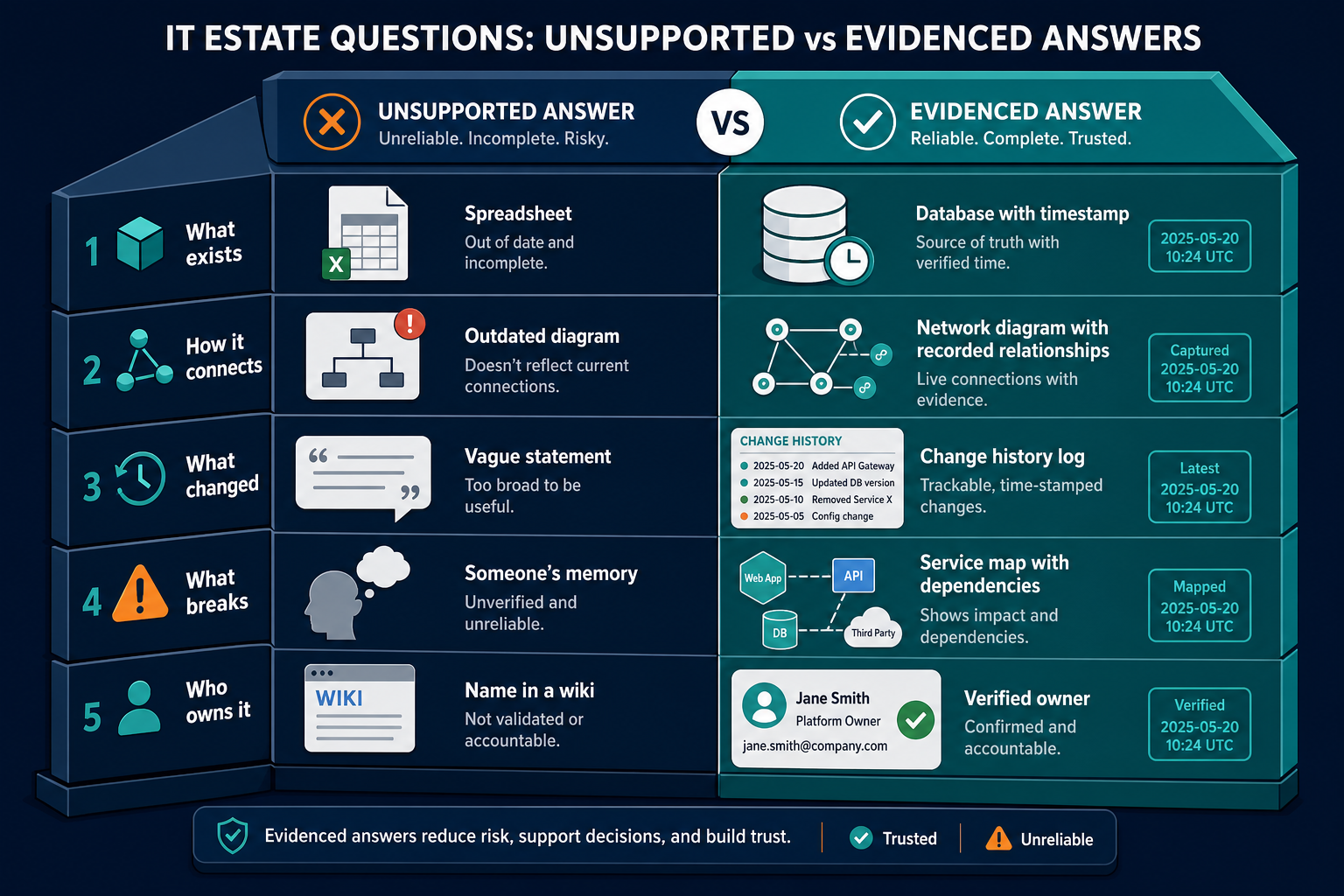
An answer counts as proof when it arrives with a source, a timestamp, and a person who can contest it. A spreadsheet total meets none of those tests. A record tied to a discovery source and a last-seen time meets all three.
| Question | Answer without proof | Answer with proof |
|---|---|---|
| What exists | A spreadsheet total | A record tied to a discovery source and a last-seen time |
| How it connects | An architecture diagram | Relationships with a recorded source and date |
| What changed | A statement that nothing unusual happened | A dated change history |
| What breaks | A senior engineer’s memory | A service map built from recorded dependencies |
| Who owns it | A name in a wiki | A named owner confirmed by that person |
NIST SP 800-53 Rev. 5 control CM-8 asks organizations to document an inventory of system components. The inventory should reflect the system accurately and include every component. Accuracy and completeness are two separate properties worth grading independently: accuracy means the data recorded about each asset is correct, and completeness means no asset is missing from the record at all — an inventory can score well on one and still fail the other. Auditors map these same two properties onto traceability (can each record be traced back to its source) and accountability (can a named person stand behind it), which is exactly what IT asset inventory accuracy requires in practice.
Few estates clear that bar today. An EMA Research benchmark published in October 2026 found that only 7.5% of organizations that call their IT asset management merely optimized report 95%+ CMDB accuracy, compared with 55.6% of organizations that call their practice AI-ready.
A record shows evidence, and people judge that evidence. No inventory, map, or report replaces an audit, and none of them decides whether a control is satisfied. Readers who want the full definition of the category can find it on the Virima category page.
Why each question gets answered by a different team
Most estates answer these questions from five separate places. Each source is reasonable on its own. The gaps appear when one person needs all five answers about the same service on the same day.
Five answers, five owners
- What exists comes from the inventory or asset team.
Result: a count with no connection to the other four answers. - How it connects comes from architects’ diagrams.
Result: a picture that was accurate on the day somebody drew it. - What changed comes from the ITSM tool.
Result: a ticket that records what was planned, which can differ from what happened. - What breaks comes from a few senior engineers.
Result: an answer that leaves the company when they do. - Who owns it comes from a spreadsheet or a wiki.
Result: a name nobody has confirmed recently, and discovery audits regularly turn up assets with no owner assigned at all.
Consider how a single service question travels. The CTO asks about the payments service. The asset team returns a server count, the architects return a diagram from last year’s design review, and the ITSM team returns a list of tickets. Each answer is honest, and each is partial. Nobody can say which of them is most recent, because none of them carries a timestamp that the others share.
Ownership adds a second layer of delay. A wiki page may list a service owner, yet the page only records who was named at the time. Confirming that the person still owns the service means asking them directly, and that conversation rarely happens before the board meeting.
The dependency question carries the largest release risk, and the post on unpriced release risk from unknown dependencies covers it in depth. This article focuses on who holds each answer and how quickly it can be checked.
What a slow answer costs each seat
A slow or unsourced answer lands differently depending on who asked for it.
- For you as CTO: you decide on an answer you could not check.
- For the board or audit committee: the answer arrives with no source to attach to it.
- For the CISO: exposure cannot be scoped until someone reconciles the inventory.
- For platform engineering: change reviews often begin with a search for the owner.
- For finance: spend stays attached to systems that are difficult to name.
Three ways to grade the answers you already have
The exercise runs on one closed incident. The CTO runs it and needs no new tool.
- Time to answer. Record how long each of the five questions took and who gave the answer. Set your own target after you see the first results.
- Source and timestamp. For each answer, ask where it came from and when someone last confirmed it. An answer with neither is a recollection.
- Who can contest it. Name the person who can say the answer is wrong, and check that someone asked them.
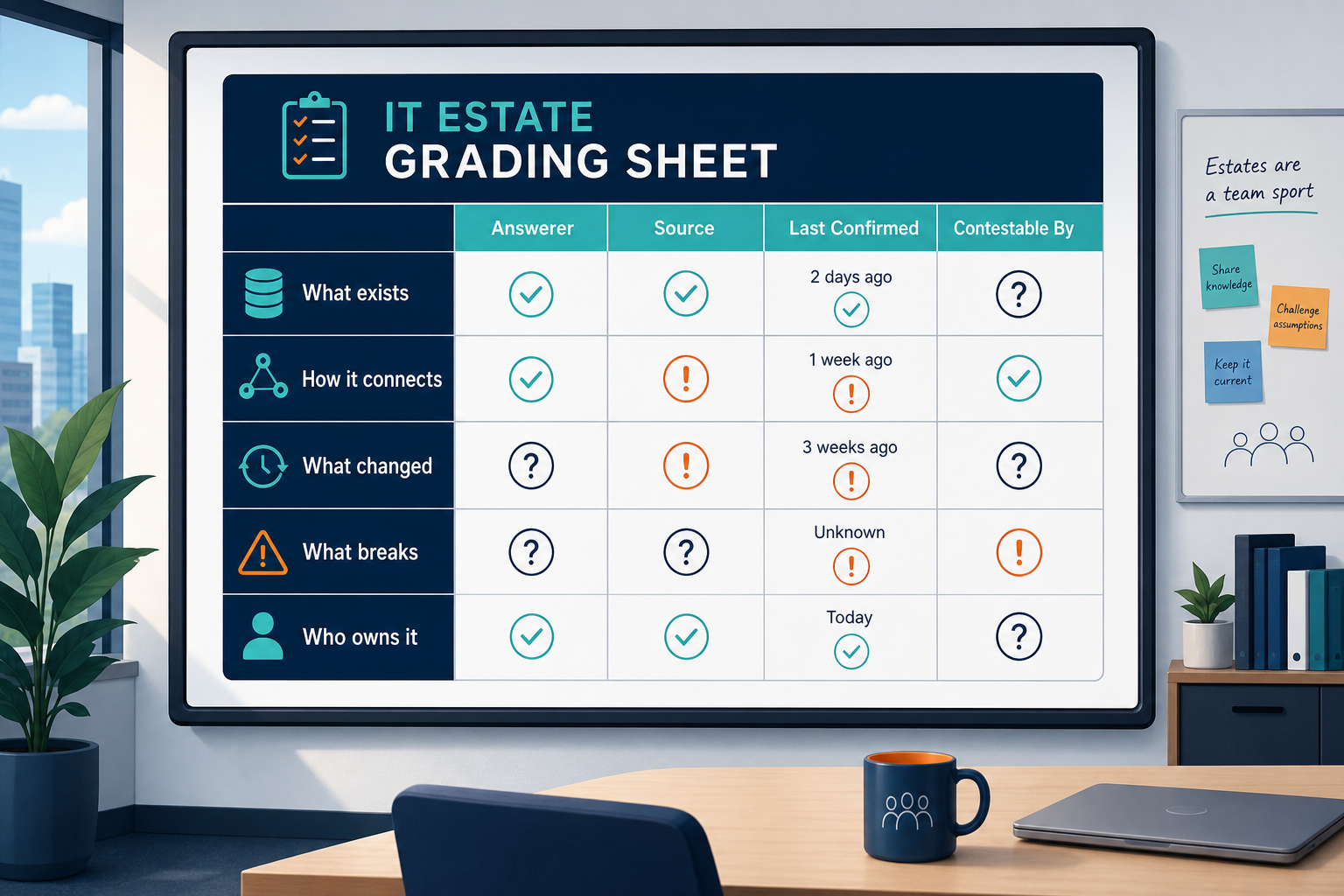
| Question | Who answered | Source | Last confirmed | Contestable by |
|---|---|---|---|---|
| What exists | ||||
| How it connects | ||||
| What changed | ||||
| What breaks | ||||
| Who owns it |
When a spreadsheet is enough
A small, stable estate with one owner per system can answer all five questions from a well-kept sheet. The grading exercise shows within an hour or two whether yours is that kind of estate. Estates that outgrow the sheet usually need a CMDB that holds the authoritative source record for the answers — which is also the foundation CMDB audit readiness is built on.
Three graded examples
These illustrative scenarios show how the grading plays out. They are examples and not customer case studies.
- The server nobody listed: the inventory shows the server, yet discovery has not seen it since March. The grade for “what exists” is low because the last-seen time contradicts the count.
- The owner who has left: the record names a person who moved teams last year. Nobody was asked to confirm, so the grade for “who owns it” is low.
- The change nobody recorded: the change history is silent while the service map shows a new connection. The grade for “what changed” is low because the two records disagree.
Each example produces a specific finding that can be assigned to a named person. The grade turns a vague worry about estate quality into a short list of records to repair, ordered by how much a wrong answer would cost.
Virima holds the record behind each of the five answers
Virima keeps one discovery-sourced record in which each answer carries a source and a date. Context in that record reflects the last discovery cycle, and discovery runs on a schedule you set.
What discovery supplies
Scheduled discovery populates configuration items and records their relationships, which covers what exists and how it connects. CI records keep a change history, which covers what changed. Each record shows where it came from and when it was last updated, so a reviewer can check the answer against its source.
Because discovery runs on a schedule, a server added or removed between cycles appears on the next cycle. The CTO can read the timestamp on each record to see how current the answer is.
What people supply
People provide the service definitions that tell ViVID™ which applications and websites make up each business service. They can enter the definitions manually, import a spreadsheet, or bring them in through integrations. ViVID™ service maps then build the dependency map from those definitions, which answers what breaks. Owners confirm their own services, because a person has to stand behind that answer.
What stays outside
Ticket content and change approvals remain in your ITSM tool. Virima sits beside it and does not replace it.
Run the five-question test on one incident
The test fits into a single working session.
- Pick one closed incident that crossed two teams.
- Ask the five questions about the affected service.
- Write down who answered, the source, and the time taken.
- Grade each answer using the three methods above.
- Take the lowest-graded question to your next architecture review.
The result is a one-page summary the CTO can show the CIO. The lowest grade becomes the next investment decision.
Bring one service to a working session
Choose the service that scored lowest and bring it to a working session with the Virima team. We will go through the five questions against that service using your own discovery data. Request a demo to schedule it, or request a free trial to explore the record yourself.
Frequently Asked Questions
Can we prove what exists, how it connects, what changed, what breaks, and who owns it?
Yes, to the extent each answer has a source, a timestamp, and a person who can contest it. Virima supplies the discovery record, and your people supply service definitions and owner confirmation.
What evidence should a CTO ask for on a dependency?
Ask which system recorded the dependency, when it was last seen, and which team can confirm it. A dependency with a recorded source and date can be checked, while a remembered one cannot.
How can we check who owns a service?
Ask the person named as owner to confirm in writing, and record the date of that confirmation — that confirmation step is service ownership verification, and it’s the one most estates skip. Owners who have moved teams or left surface quickly during this check.
Do we need a CMDB to answer these questions?
A small estate with one owner per system can use a well-kept spreadsheet. A CMDB becomes useful when the estate changes faster than people can update a sheet by hand.
Does Virima replace our ITSM or inventory?
Virima runs alongside your ITSM tool and shares data with the platforms listed on the integrations page. Discovery, CMDB, and service mapping add the record behind the tickets.