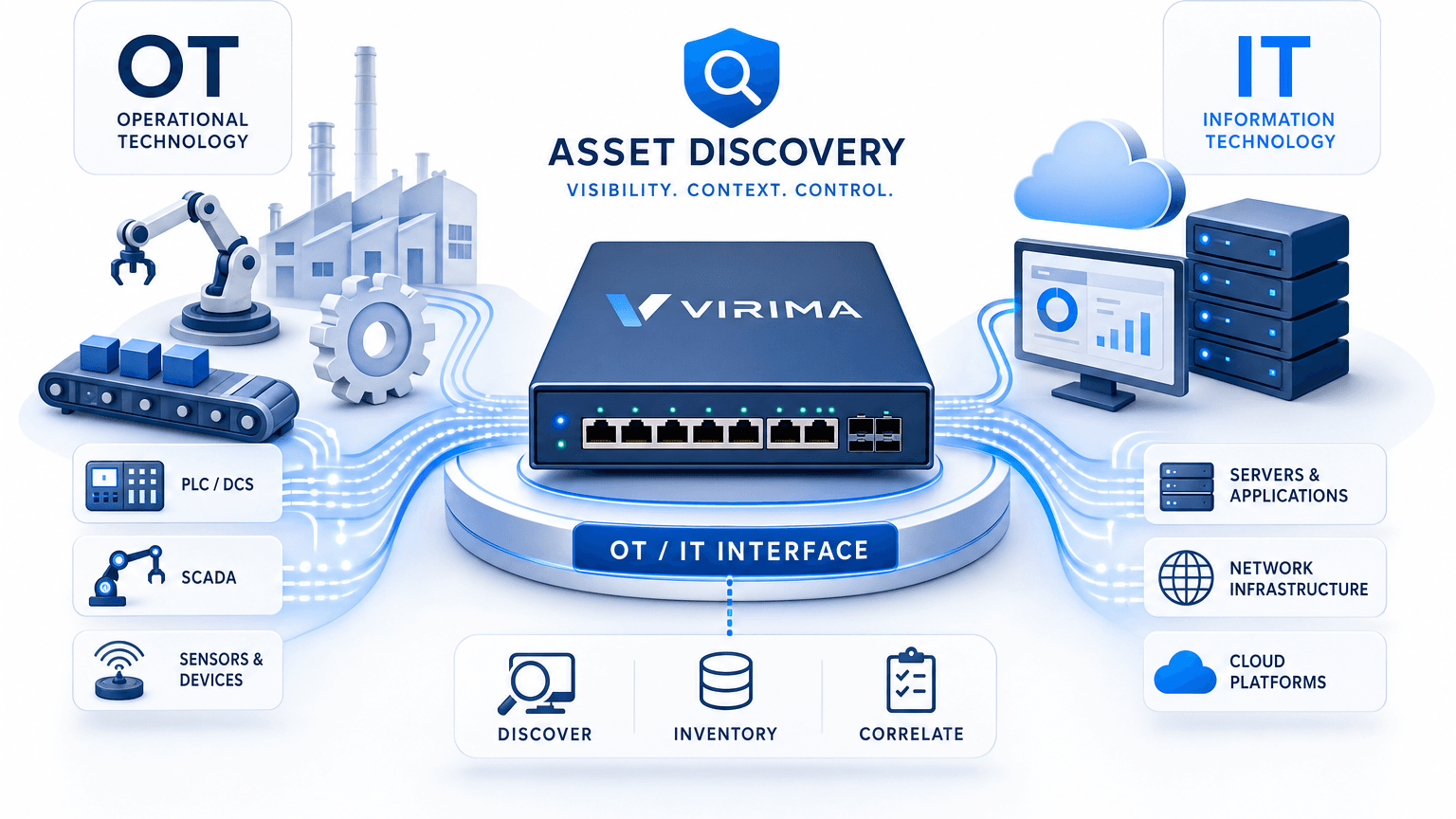
OT/IT Asset Discovery for Chicago Manufacturing and Industrial Teams

A weekend maintenance window at a Chicagoland plant rarely fails on the ERP server named in the ticket. It fails on a line-side Windows box still talking to the historian, a contractor laptop left on the plant VLAN, or a switch bridging corporate IT into a cell nobody fully owns. Manufacturing and industrial teams split work between plant operations and enterprise IT, sharing cables, identity systems, and change calendars while keeping separate asset lists. When those lists diverge at the OT boundary, downtime risk, cyber prep, and audit work inherit the same gap.
This guide covers OT/IT asset discovery for manufacturing teams with a Chicago operating lens: what discovery must cover at the plant-adjacent boundary, how ownership and scan policy splits create inventory debt, and how discovery-sourced CMDB records support change impact without forcing every PLC into the same tool as a laptop.
Why plant estates break single-domain inventory models
Standard enterprise asset programs assume one network authority and one configuration management database (CMDB) owner. OT/IT asset discovery for manufacturing means inventorying the plant-adjacent IT layer — historians, HMI hosts, jump boxes, and boundary network gear — on a schedule shared by plant engineering and corporate IT. Chicago manufacturers break both of those assumptions in practice. Corporate IT owns email, ERP, and data centers. Plant engineering owns cells, controllers, and production schedules. Integrators leave temporary gateways after projects. Cloud analytics for quality and MES often land on AWS or Azure while floor systems stay on-prem.
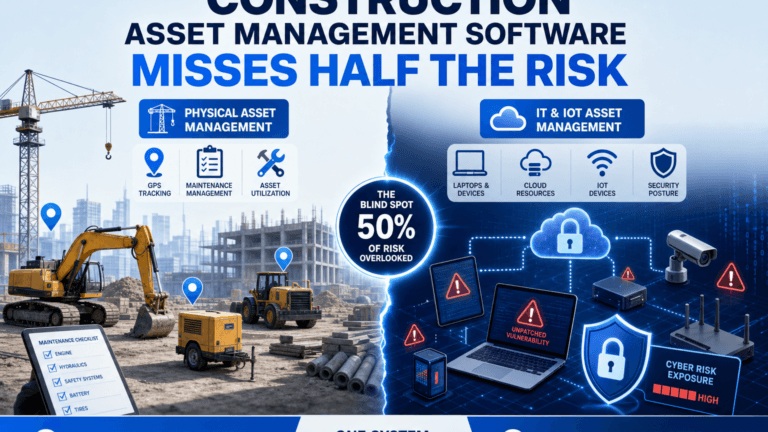
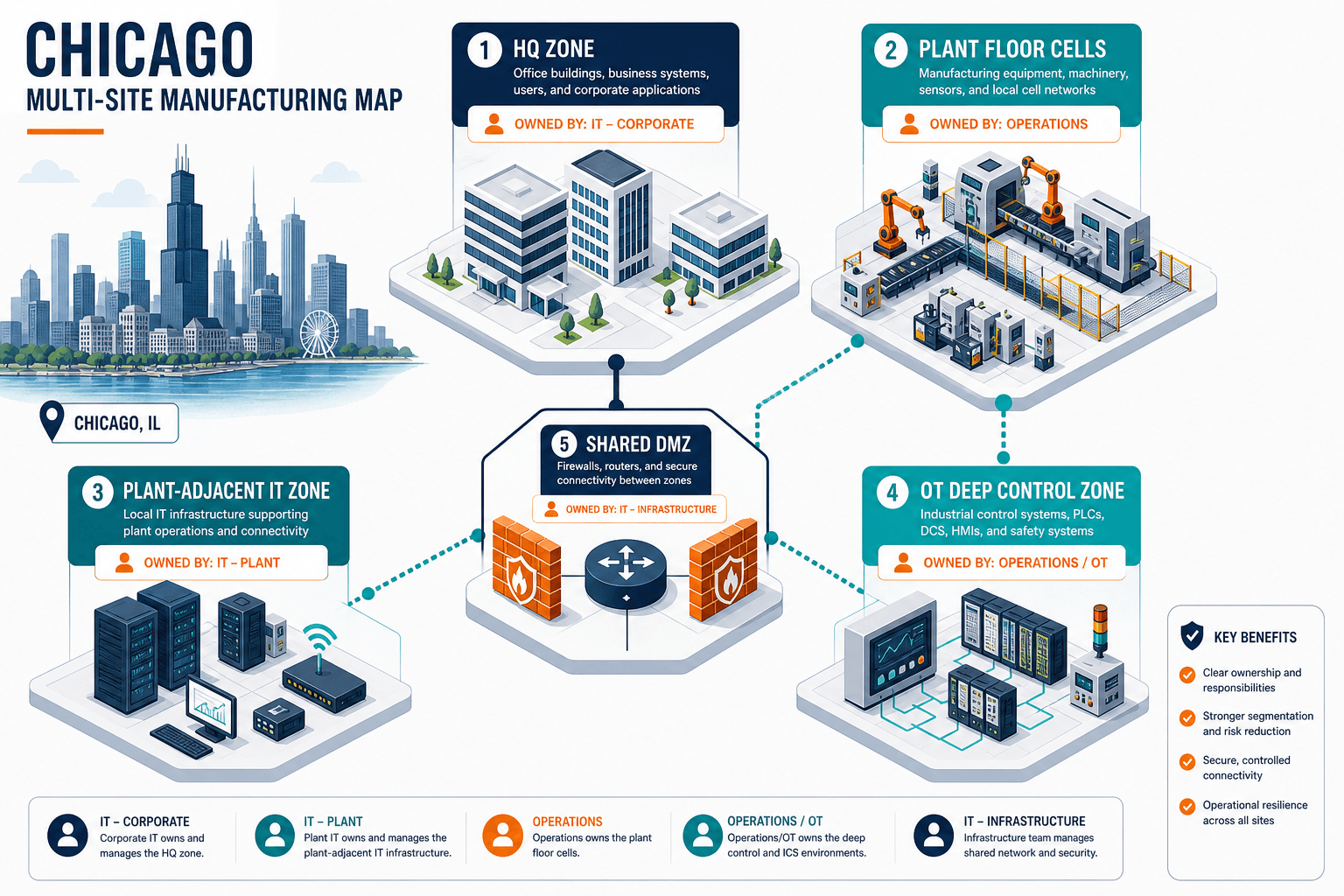
Three inventory layers form and rarely reconcile on their own. The first layer is enterprise IT: identity, HQ apps, warehouses, and cloud subscriptions. The second layer is plant-adjacent IT: historians, HMI hosts, engineering workstations, jump boxes, and network gear that sits one hop from industrial control. The third layer is deep operational technology (OT) and industrial control systems that specialized OT security platforms are built to see. When discovery only samples HQ ranges on a slow schedule, plant-adjacent devices stay as tribal knowledge until a line stop or an insurer questionnaire forces a scrub.
The operational cost shows up before the board deck. Cascades often start on an unmanaged edge host rather than the named production cluster. Only 1 in 8 organizations, 12.6 percent, report full ICS visibility, per the SANS State of OT Security 2025 report. Discovery that only refreshes after major projects will miss the next contractor kit and the next temporary interface host. High-frequency discovery cycles across agreed plant and enterprise ranges reduce that surprise before the change board meets.
When partial inventories still drive weekend changes, start with Trusted Runtime Truth and pressure-test whether your discovery scope matches the plant-adjacent estate you already run.
What makes OT/IT asset discovery for manufacturing harder than single-campus IT inventory?
Manufacturing splits ownership across enterprise IT, plant engineering, and integrators, so one procurement path and one CMDB owner rarely exist. Plant-adjacent hosts and temporary gateways join outside central buying, and discovery must cover HQ and plant ranges on a shared schedule or inventory debt compounds until downtime forces a manual scrub.
Ownership and scan policy friction on Chicago industrial sites
Chicagoland industrial corridors host multi-site manufacturers, food processors, metals, logistics-linked plants, and contract manufacturers under related brands. Plant managers protect uptime first while security teams want complete inventory and IT wants agents plus credentialed scans. OT specialists warn that aggressive active probes on control networks can disrupt production if windows are wrong. Each constraint is rational on its own, yet together they produce permanent dark corners where new media access control (MAC) addresses appear without a matching configuration item (CI).
CISA industrial control systems guidance keeps public attention on ICS and OT risk for critical and industrial environments. That pressure does not automatically align asset systems of record. Plant engineering may track assets in maintenance systems while enterprise IT runs ServiceNow or another ITSM CMDB and security runs a separate OT visibility tool. Gartner research puts typical CMDB accuracy at around 60 percent, per Oomnitza’s analysis of CMDB data quality. That gap is part of why every team can claim its own list is complete while the shared path between ERP and the line still hosts unknowns.
Operators who close those corners treat discovery scope as a negotiated map. They document which plant-adjacent ranges IT may touch with agentless methods and which engineering workstations accept agents. They also record which cloud accounts feed inventory APIs and which deep OT segments stay reserved for OT-safe methods or specialized platforms, and they name who merges plant and enterprise sources into one authoritative CI when the same serial or hostname appears twice.
Teams already managing manufacturing asset programs can connect this boundary discovery scope to broader manufacturing IT asset management practices, and to ITIL Change Management and CMDB Accuracy: Why One Depends on the Other, so inventory feeds life cycle and control workflows instead of sitting in a silo.
What OT/IT asset discovery for manufacturing must cover at the boundary
Coverage design beats tool branding for these estates.
Define scope and method per zone
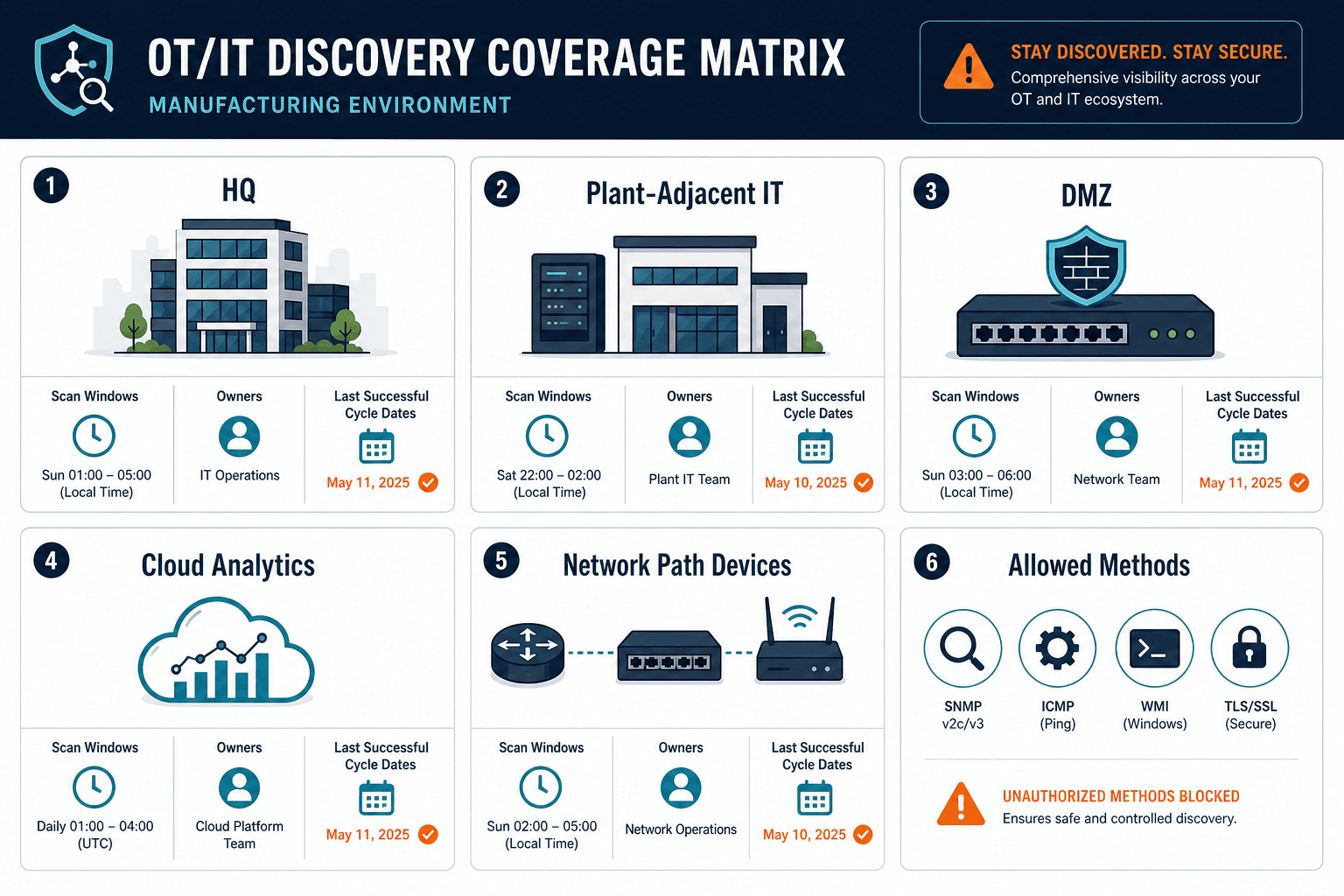
Chicago manufacturing teams need a written scope that names each zone IT and plant engineering jointly agree to discover:
- HQ and warehouse ranges
- Plant-adjacent IT subnets
- DMZ and jump paths
- Engineering laptop pools
- AWS and Azure accounts used for plant analytics
- Network devices that define the path between ERP and the line
Each scope entry also needs a method:
- Agent-based collection for deep software inventory where allowed
- Credentialed agentless scanning where agents are blocked
- API pull for AWS and Azure
- Network device collection for boundary switches and firewalls
Set cadence faster than new assets appear
Cadence matters as much as method. Quarterly sweeps fit capital projects and fail change management. New VMs, contractor kits, and temporary gateways appear weekly. Visibility thins out fastest here: the same SANS 2025 report found it drops to 10 percent at the SCADA/HMI layer (supervisory control systems and operator interfaces), thinner still at PLC and RTU (programmable logic controllers and remote terminal units). High-frequency discovery cycles keep last-seen data close enough to trust during CAB review and incident bridges. They do not need to mean continuous passive packet collection on every ICS segment if that capability is not in the enterprise stack. They do mean scheduled passes short enough that a month-old blind spot on plant-adjacent IT is treated as a defect, not a norm.
Capture relationship data beyond a hostname list
Relationship data is the third coverage requirement. A flat list of hostnames will not tell a change owner whether a historian still supports a quality interface that ERP depends on. Once service definitions are provided by operations or enterprise architecture, dependency maps can show installed-on and runs-on links that matter for impact analysis. Virima ViVID™ builds those maps from defined services rather than inventing service composition automatically. That boundary keeps maps honest when plant apps share infrastructure with corporate systems in ways org charts never drew.
Internal teams evaluating platform fit should review how Virima IT discovery combines agent-based and agentless methods so plant constraints and deep endpoint inventory can coexist without forcing a single technique everywhere. Pair enterprise discovery with OT-specialized visibility where deep controller and protocol detail is required. Do not force one tool to own both jobs if the plant risk model says otherwise.
What should OT/IT asset discovery for manufacturing cover first on industrial sites?
Start with plant-adjacent IT, DMZ paths, engineering hosts, boundary network gear, and cloud analytics accounts that can reach production data. Deep OT and ICS detail often needs OT-safe methods or specialized platforms. Enterprise discovery still closes the gap that leaves contractors and jump boxes invisible to change and security teams.
Building discovery-sourced truth plant and enterprise leaders can share
When discovery runs on shared scope and cadence, the next failure mode is political, not technical. Plant, enterprise IT, security, and integrator owners must agree which system is authoritative for a CI class and how conflicts resolve when two tools report different OS versions or owners. Multi-source reconciliation should prefer discovery evidence with recent last-seen data over static imports that nobody revalidates. Manual overrides stay allowed for business metadata without freezing hardware facts scanners still observe. The same Gartner CMDB research found that most enterprises cannot see at least 20 percent of their IT assets at any time. The plant boundary is usually where that blind spot shows up first.
Virima approaches this as Trusted Runtime Truth for the operational estate: what exists, how it is connected, what changed, and who owns it, sourced from discovery rather than from the last spreadsheet edit. Automated discovery refreshes CIs while the CMDB holds relationships and health signals. Once services are defined, dependency maps give leaders a shared blast-radius view before weekend changes. Integrations can push that truth into ServiceNow, Jira Service Management, Ivanti, HaloITSM, Xurrent, and Hornbill workflows so tickets stop inventing separate plant and HQ asset lists. Partner connections sit on the Virima integrations hub, and teams standardizing that reconciliation process can also see Virima blog post on CMDB reconciliation across multiple discovery sources.
For Chicago manufacturing and industrial teams, the practical win is fewer weekend surprises. Plant-adjacent hosts that joined last month appear beside the ERP interfaces they can affect, with owners and last-seen dates before an insurer or customer audit asks.
See how OT/IT asset discovery for manufacturing covers plant-adjacent IT and boundary networks so Chicago industrial teams stop running changes on partial asset lists.
What good looks like before the next line change window
Leaders can score readiness with a short operational checklist:
- Every plant-adjacent and HQ range that can reach production or quality data has a named discovery method and a last successful cycle newer than the change freeze policy requires.
- Unknown devices open an ownership workflow instead of remaining unlabeled forever.
- CMDB health tracks completeness and staleness so executives see inventory debt as a metric, not an anecdote — the same Gartner CMDB research found that three-quarters of CMDB deployments fail to meet their goals over data quality and completeness gaps, exactly what this checklist catches early.
- Service maps for MES, quality, and ERP-facing services exist from defined compositions and stay tied to infrastructure CIs that discovery still confirms.
Teams building out this checklist can also see Manufacturing IT Asset Management: Managing OT and IT Infrastructure Convergence.
How do Chicago industrial teams know OT/IT asset discovery is working?
Plant-adjacent and HQ ranges that can reach production data show recent last-seen cycles, unknown devices open ownership workflows, and CMDB health tracks staleness as a metric. Service maps for MES and ERP-facing services stay tied to infrastructure CIs that discovery still confirms before major change windows.
When those conditions hold, OT/IT asset discovery for manufacturing becomes a managed control across brands, plants, and cloud accounts. Discovery-sourced CMDB records and dependency context give a shared runtime picture before the next patch window, integrator cutover, or customer security review.
If your teams still reconcile plant and HQ inventories by hand before major changes, request a Virima demo and validate whether your discovery cadence can support the industrial estate you already run.
Frequently Asked Questions
Why do contractor devices stay missing from plant asset lists?
Integrators and temporary gateways often join plant-adjacent ranges outside central procurement and enterprise scan policies. Without shared discovery scope across HQ and plant networks, those hosts stay missing until downtime or audit forces a manual hunt.
How often should Chicago manufacturers run OT/IT boundary discovery?
Cadence should beat how fast new VMs, contractor kits, and temporary interface hosts appear. Many teams treat month-old blind spots as defects. High-frequency discovery cycles on agreed ranges beat annual or quarterly-only sweeps for change and security readiness.
Can one tool replace both enterprise discovery and deep OT visibility?
Enterprise discovery covers plant-adjacent IT, servers, network paths, and cloud accounts that IT owns. Deep controller and protocol visibility often needs OT-safe methods or specialized OT platforms. Many manufacturers run both and reconcile ownership at the boundary.
How does Virima help manufacturing teams with OT/IT asset discovery?
Virima runs agent-based and agentless discovery on agreed ranges, populates a CMDB with multi-source reconciliation, and builds ViVID™ dependency maps after services are defined. Teams use that discovery-sourced truth inside ITSM workflows instead of maintaining separate plant and HQ spreadsheets.
Does Virima require replacing existing OT security tools to add plant-adjacent IT discovery?
No. Virima’s discovery covers plant-adjacent IT, servers, network paths, and cloud accounts alongside existing OT-specialized platforms rather than replacing them. Teams keep deep controller and protocol visibility where it already works and add CMDB reconciliation for the plant-adjacent layer those tools were not built to inventory.