IT Asset Discovery for Research Hospitals in Boston

A Friday patch window at a Longwood-area research hospital rarely fails on the server the team named in the change ticket. It fails on a lab workstation that still talks to the EHR interface, a cluster node spun up for a grant last quarter, or a VLAN nobody fully owned. Clinical operations, sponsored research, and university IT share cables and identity systems while they keep separate budgets, separate tools, and separate lists of what counts as an asset. IT asset discovery for research hospitals exists to close exactly that gap, before change risk, audit prep, and incident response inherit it.
Boston academic health systems sit at that intersection every day. Integrated missions of care, research, education, and community health multiply the environments that must stay visible without slowing science or bedside care. This guide covers what that discovery has to include for academic health systems, how ownership fragmentation creates inventory debt, and how discovery-sourced records feed a trustworthy CMDB and service context.
Why research hospital estates break generic inventory models
Standard asset programs assume one procurement path, one network authority, and one configuration management database (CMDB) owner. Research hospitals break each of those assumptions in practice. Clinical engineering tracks imaging and bedside devices on a different cadence than enterprise IT tracks laptops and virtual machines. Principal investigators buy compute for grants with residual funds that never enter central purchasing. Imaging and lab vendors leave appliances on the network after go-live with thin documentation and long support tails.
Three inventory layers that don’t reconcile
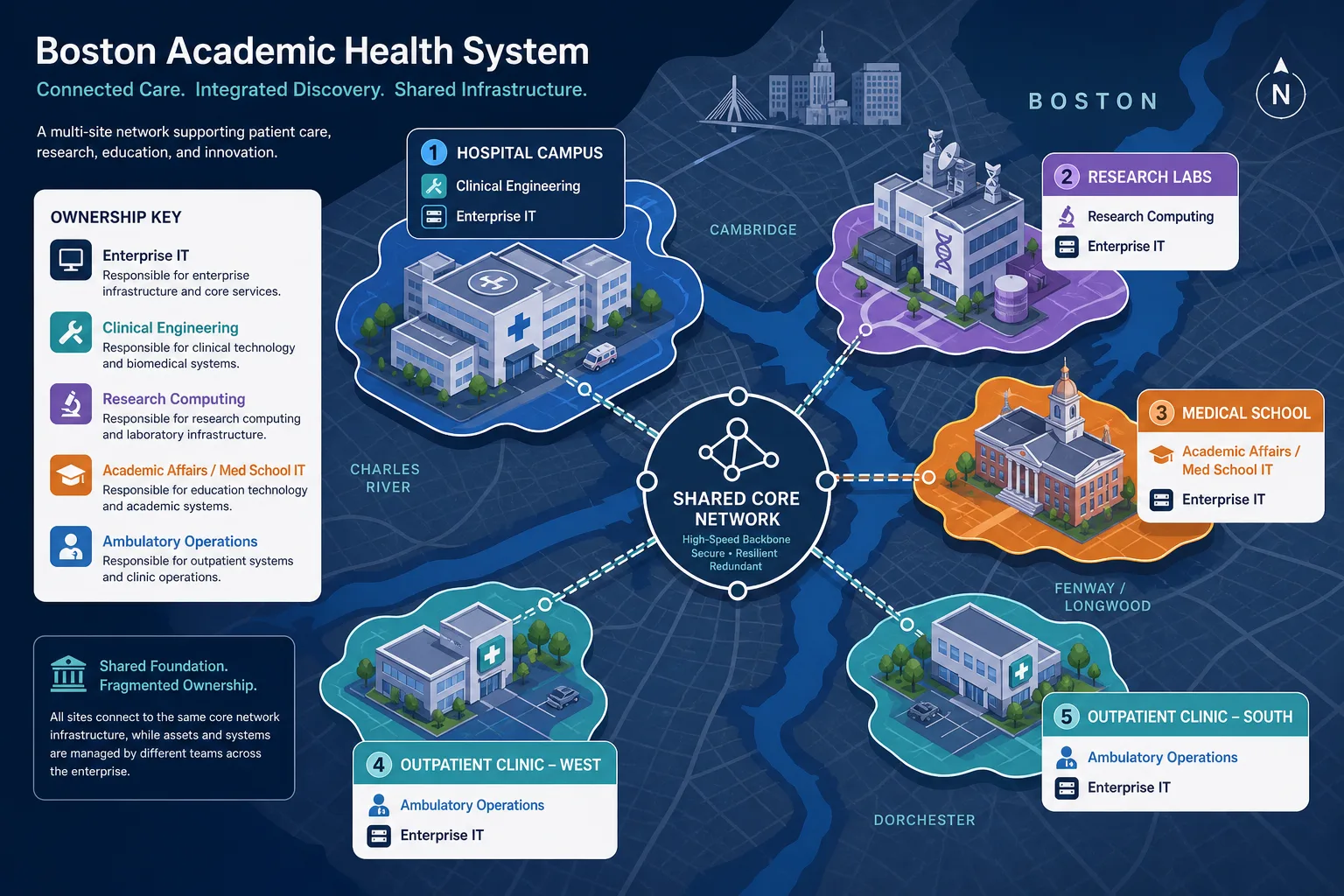
Those patterns create three inventory layers that rarely reconcile on their own. The first layer is enterprise IT: identity, core apps, data centers, and cloud subscriptions on AWS and Azure. The second layer is clinical and biomedical technology: devices that sit near patients or lab benches and still traverse enterprise networks. The third layer is research computing: high-performance clusters, specialty storage, and project VMs that appear and disappear with funding cycles. When discovery only samples the first layer on a slow schedule, the other two stay as tribal knowledge until an outage or an auditor forces a manual scrub. Biomedical device data has to land in the same CMDB as laptops and servers, not a separate spreadsheet, or clinical engineering and enterprise IT will keep flagging the same device as two different problems.
The cost of that lag is operational, not academic. Cascades often start on an unmanaged edge device rather than a core cluster the change ticket named. Discovery that only refreshes known subnets after major projects will miss the next grant rack and the next temporary imaging cart. That risk is not hypothetical: a 2025 hospital cybersecurity survey found 43% of hospital security leaders name complete device visibility as their top challenge. The average hospital now carries 10 to 15 connected medical devices per bed, and the same survey put average vulnerabilities at 6.2 per device, with 99% of hospitals managing at least one device carrying a known exploited vulnerability (HIT Consultant, 2025). High-frequency discovery cycles across clinical, research, and campus ranges reduce that surprise before the change board meets.
When partial inventories still drive weekend changes, start with Trusted Runtime Truth and pressure-test whether your discovery scope matches the estate you already run.
What makes IT asset discovery for research hospitals harder than single-campus enterprise inventory?
Research hospitals split ownership across enterprise IT, clinical engineering, and sponsored research computing, so one procurement path and one CMDB owner rarely exist. Grant-funded gear and vendor appliances join the network outside central buying. Discovery must cover all three layers on a shared schedule or inventory debt compounds until outage or audit forces a manual scrub.
Ownership splits that keep Boston academic health systems partially blind
Academic health systems in Greater Boston often span teaching hospitals, outpatient sites, medical schools, and research institutes under related brands. AAMC material on academic health systems stresses how clinical care and scientific discovery share one mission. That mission alignment does not automatically align asset systems of record. Hospital IT may own an ITSM CMDB while the university and research computing groups keep separate inventories for faculty devices and clusters.
Credential and scan policy friction follows ownership across the estate. Clinical networks limit active scanning windows to protect care systems. Research labs resist agents on instruments still under vendor warranty. Cloud accounts for multi-site trials often stay only partially listed. Together those constraints create dark corners where new media access control (MAC) addresses appear without a matching configuration item (CI).
Operators who close those corners treat discovery scope as a negotiated map, not a one-time project. They document which ranges clinical engineering will allow agentless methods to touch, which research subnets accept scheduled scans, and which cloud subscriptions feed inventory APIs. They also name a reconciliation owner who merges hospital, university, and research sources into one authoritative CI when the same serial or instance ID appears twice.
Internal teams evaluating platform fit should review how Virima IT discovery combines agent-based and agentless methods so clinical constraints and deep endpoint inventory can coexist without forcing a single technique everywhere.
HIPAA inventory pressure meets research network reality
Covered entities already treat asset awareness as part of risk analysis under the HIPAA Security Rule. Recent federal rulemaking attention has pushed technology asset inventory and network mapping further into the center of proposed cybersecurity expectations for electronic protected health information. The Federal Register publication of the HIPAA Security Rule NPRM includes explicit discussion of technology asset inventory standards. Even while rule text evolves, boards and compliance leaders in Boston research hospitals already ask for living inventories rather than annual spreadsheet exports.
Research environments complicate that inventory ask every week. A workstation that processes de-identified research data one week may sit one hop from protected health information systems the next week after a project change. Shadow analysis servers and roaming medical school laptops sit outside standard patch rings. Inventory that only covers the electronic health record (EHR) farm will not answer leadership questions about the full estate that can affect confidentiality, integrity, or availability.
What discovery evidence auditors expect
Discovery programs that support compliance work produce more than a device count. They produce evidence of coverage: last-seen timestamps, method of discovery, owner, location or subnet, and relationship to known clinical or research services. Those fields turn an inventory into something auditors and risk committees can interrogate. They also give SecOps a place to hang vulnerability context for Windows Server overlays without pretending every operating system is covered by one scanner. Pair discovery output with a CMDB that rejects silent orphans so unknown devices cannot stay forever as tickets without owners.
How does IT asset discovery for academic health systems support HIPAA-ready inventory work?
Discovery feeds a living technology asset inventory with last-seen data, ownership, and network placement across clinical and research ranges. That inventory supports risk analysis and proposed federal expectations for technology asset inventory and network maps. Spreadsheet exports from a single department cannot show whether grant systems and vendor appliances still sit adjacent to care systems.
What academic health system IT discovery has to cover in research hospital networks
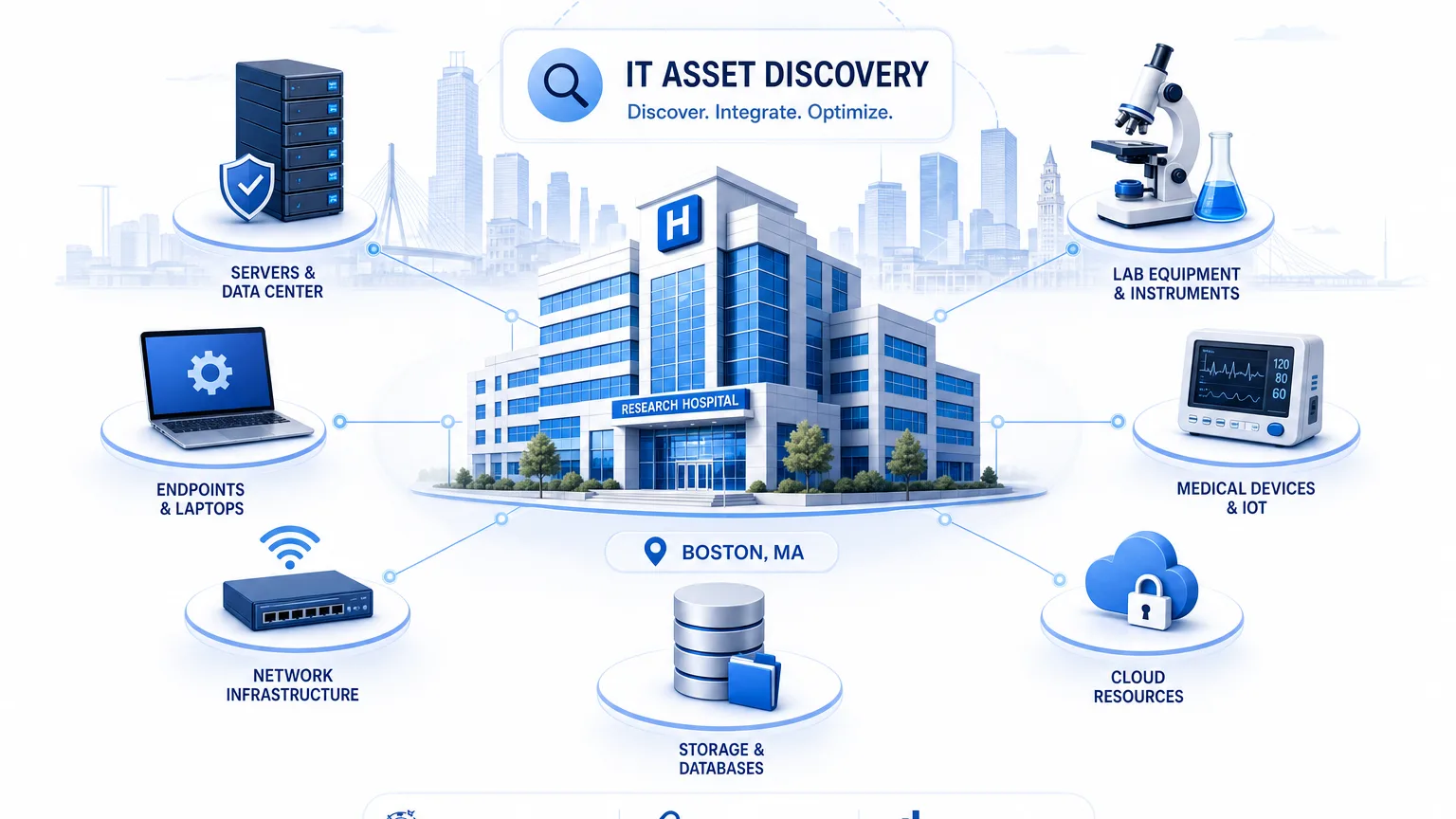
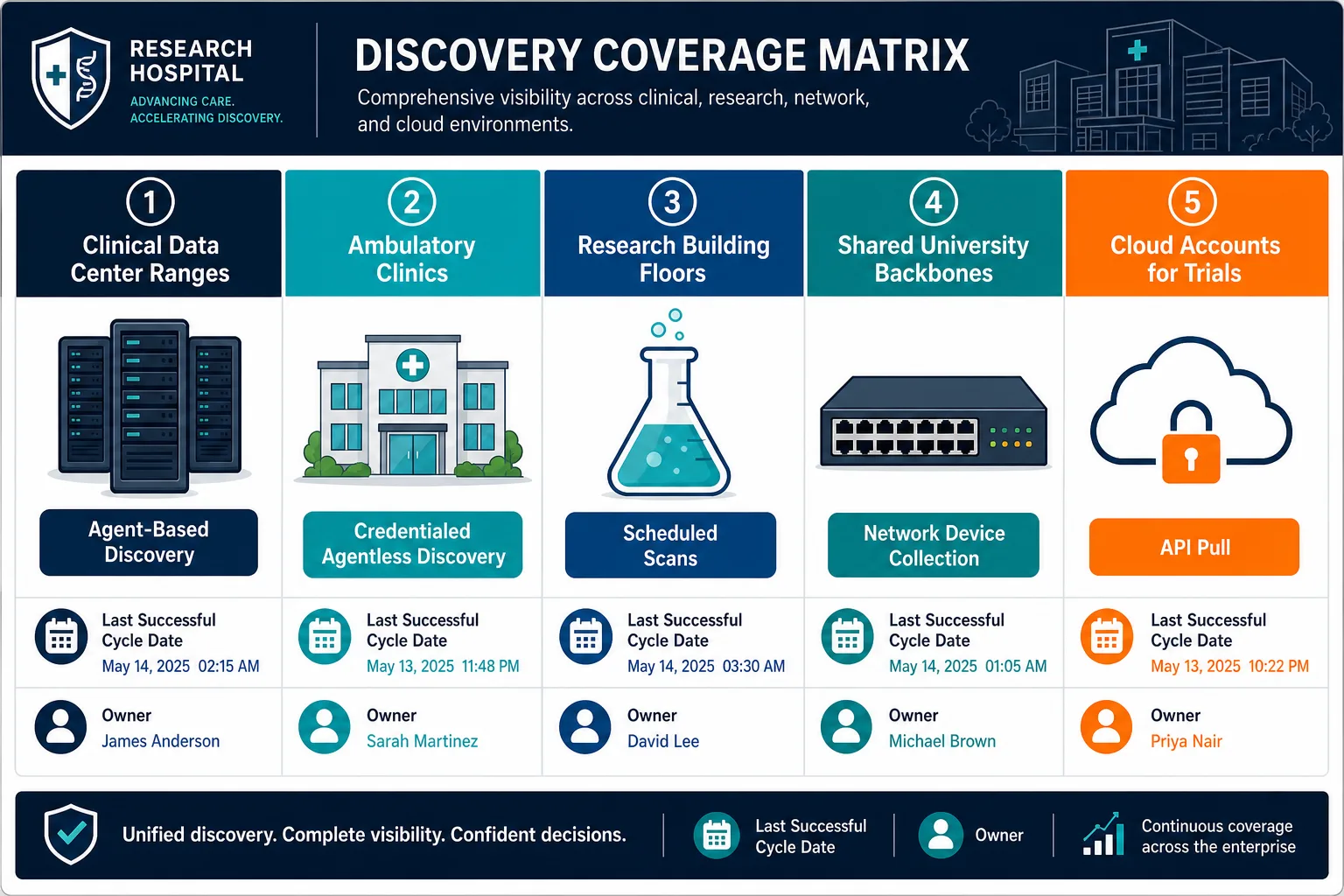
Coverage design beats tool branding for these estates. Boston research hospitals need a written scope, by zone and method:
- Clinical data center ranges — agent-based discovery for deep software inventory
- Ambulatory clinics — credentialed agentless discovery where agents are blocked
- Research building floors — credentialed agentless or scheduled scans negotiated with lab owners
- Shared university backbones that carry hospital traffic — network device collection for the path between lab and clinic
- Cloud accounts used for trials and imaging archives — API pull for AWS and Azure
That gap compounds fast when scope is left informal: industry analysis citing IDC research puts roughly 30% of enterprise IT assets as orphaned or unmanaged, and separate estimates citing Gartner research suggest 83% of enterprises cannot see at least 20% of their assets at any given time (see Virima’s CMDB TCO analysis, which aggregates both figures, for the full breakdown).
Cadence matters as much as method. Quarterly sweeps fit hardware refresh planning and fail change management. New VMs, loaner imaging carts, and conference-week demo kits appear weekly. High-frequency discovery cycles keep last-seen data close enough to trust during CAB review and incident bridges. They do not need to mean continuous passive packet collection if that capability is not yet in the stack. They do mean scheduled passes short enough that a month-old blind spot is treated as a defect, not a norm.
Relationship data is the third coverage requirement. A flat list of hostnames will not tell a change owner whether a research database server still supports a clinic-facing interface. Once service definitions are provided by operations or enterprise architecture, dependency maps can show installed-on and runs-on links that matter for impact analysis. Virima ViVID™ builds those maps from defined services rather than inventing service composition automatically. That boundary keeps maps honest when research apps share infrastructure with care systems in ways org charts never drew.
Teams that already manage healthcare asset life cycles can connect this discovery scope to broader healthcare IT asset management practices so inventory feeds license, warranty, and retirement workflows instead of sitting in a silo.
Building discovery-sourced truth clinical and research leaders can share
When discovery runs on shared scope and cadence, the next failure mode is political, not technical. Hospital, university, and research owners must agree which system is authoritative for a CI class and how conflicts resolve when two tools report different OS versions or owners. That governance work has a real payoff: industry analysis citing Gartner research puts only 25% of organizations as achieving meaningful value from their CMDB investment, and unresolved ownership conflicts are a common reason why (see Virima’s guide to hospital asset management, which aggregates the source data). Multi-source reconciliation should prefer discovery evidence with recent last-seen data over static imports that nobody revalidates. Manual overrides stay allowed for business metadata without freezing hardware facts scanners still observe.
Virima approaches this as Trusted Runtime Truth for the operational estate: what exists, how it is connected, what changed, and who owns it, sourced from discovery rather than from the last spreadsheet edit. Automated discovery refreshes CIs while the CMDB holds relationships and health signals. Once services are defined, dependency maps give leaders a shared blast-radius view before weekend changes. Integrations can push that truth into ServiceNow, Jira Service Management, Ivanti, HaloITSM, Xurrent, and Hornbill workflows so tickets stop inventing separate asset lists. Partner connections sit on the Virima integrations hub.
For Boston research hospitals, the practical win is fewer Friday surprises. Lab gear that joined last month appears beside the EHR interfaces it can affect, with owners and last-seen dates before an auditor asks. That is inventory as operational safety for care and science.
See how IT asset discovery for research hospitals covers clinical, lab, and campus ranges so Boston academic health systems stop running changes on partial asset lists.
What good looks like before the next grant rack arrives
Leaders can score readiness with a short operational checklist. First, every clinical and research subnet that can reach care or research data has a named discovery method and a last successful cycle newer than the change freeze policy requires. Second, unknown devices open an ownership workflow instead of remaining unlabeled forever. Third, CMDB health tracks completeness and staleness so executives see inventory debt as a metric, not an anecdote. Fourth, service maps for patient-facing and research-facing services exist from defined compositions and stay tied to infrastructure CIs that discovery still confirms.
When those conditions hold, IT asset discovery for research hospitals becomes a managed control across brands and budgets. Discovery-sourced CMDB records and dependency context give a shared runtime picture before the next patch window, trial go-live, or regulatory review.
Teams that still reconcile hospital, lab, and campus inventories by hand before every major change are the ones this checklist is written for — the Virima CMDB is built to hold that reconciliation instead of a spreadsheet.
Frequently Asked Questions
Why do research lab devices stay missing from hospital asset lists?
Grant purchasing, vendor appliances, and lab-owned ranges often sit outside central procurement and enterprise scan policies. Without shared discovery scope across research and clinical networks, those devices stay missing until an incident forces a manual hunt.
How often should academic health systems run IT asset discovery?
Cadence should beat how fast new VMs, loaner clinical gear, and research nodes appear. Many teams treat month-old blind spots as defects. High-frequency discovery cycles on agreed ranges beat annual or quarterly-only sweeps for change and audit readiness.
Can discovery alone build service maps for EHR and research apps?
Discovery finds infrastructure and relationships it can observe. Service composition still needs definitions from operations or architecture inputs. Once those definitions exist, dependency maps can stay current as infrastructure changes without pretending services invent themselves.
How does Virima help Boston research hospitals with IT asset discovery?
Virima runs agent-based and agentless discovery, populates a CMDB with multi-source reconciliation, and builds ViVID™ dependency maps after services are defined. Teams use that discovery-sourced truth inside ITSM workflows instead of maintaining separate hospital and lab spreadsheets.
Does Virima’s discovery work across hospital, research, and cloud ranges without separate tools?
Yes. Virima runs agent-based, agentless, and API-based discovery across clinical, research, and cloud ranges from one platform, then reconciles duplicate records into a single CI authority. Teams write the scope map once — clinical, research, campus, and cloud ranges with allowed methods and owners — and attach service definitions for the care and research services that create the most change risk.