Network Inventory for Lean IT Teams: When Device Spreadsheets Stop Scaling

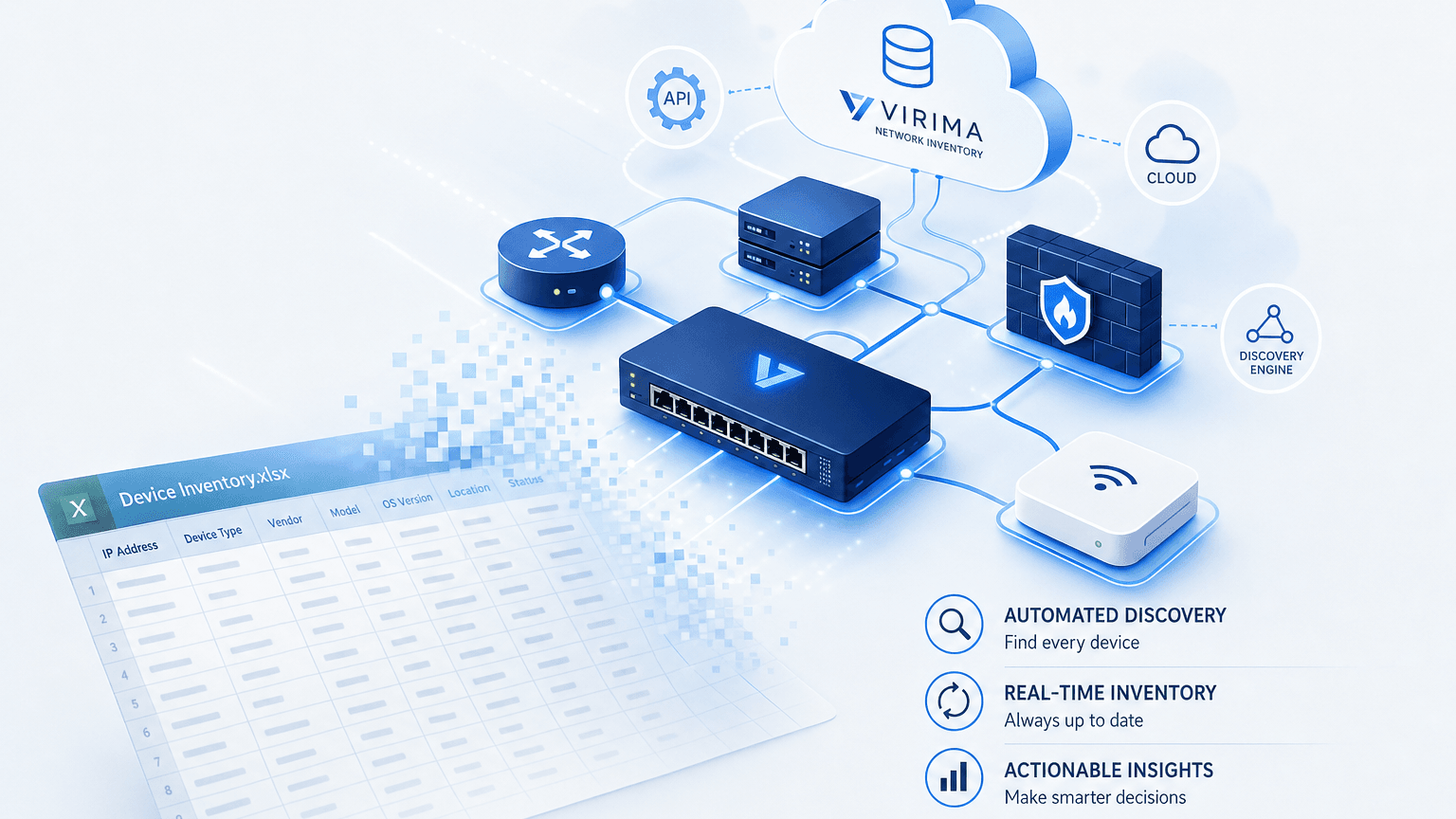
Device spreadsheets work until the switch someone forgot is the one that takes a floor offline. A lean IT team can keep a clean laptop list for months and still miss the branch firewall swapped on a Saturday. Network gear never sits still the way a desk PC does, and the sheet rarely gets the same update. That is the real ceiling on network inventory for lean IT teams: not missing a product category, but losing proof of what is live when change, incident, or audit work starts.
This piece is the growing-estate path beside the broader network inventory management guide. That guide explains what the category covers. Here the question is different. When spreadsheets and free tools stop scaling for switches, routers, firewalls, and access points, what breaks first, and what does a discovery-backed record need to look like without a full platform rebuild?
What good enough network inventory meant on a spreadsheet
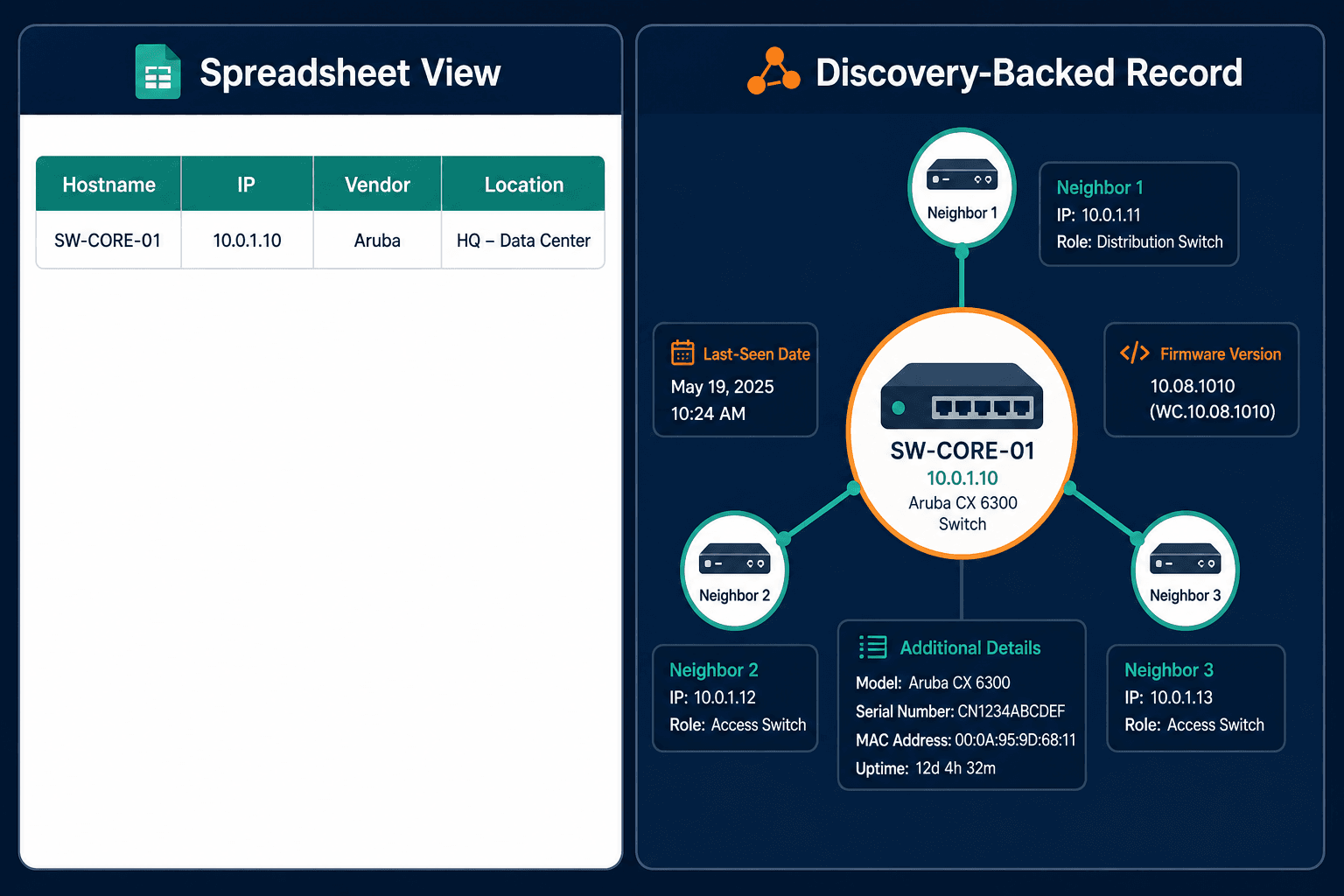
Early on, a shared workbook feels honest. Columns cover hostname, IP, vendor, location, and maybe a serial. One admin owns the file. Updates land after planned work. For a small core, that can hold for a while.
The model assumes three things that fail as the estate grows. First, every device is known to the person who edits the sheet. Second, weekend and emergency changes get written down with the same care as a maintenance window. Third, the sheet is still trusted when someone new joins or an auditor asks for evidence.
Network devices break those assumptions faster than endpoints. They rarely get reassigned to a person. They rarely run a standard OS you can agent. Topology moves when a new AP goes up, a firewall rule is added mid-incident, or a stack member is replaced after hours. Industry outage research shows why this matters: when the record of what changed doesn’t match what’s actually running, triage takes longer and the outage lasts longer. The Uptime Institute Global Data Center Survey Results 2025 finds operators still struggle with resilience and recovery once a failure hits — a stale inventory is one reason recovery stalls. Manual change volume is what makes a static spreadsheet drift out of sync with the network it describes.
So the spreadsheet does not fail because the team is careless. It fails because the update path cannot keep pace with how network devices actually change.
Where lean IT network inventory hits the ceiling first
The first failures are operational, not theoretical.
Forgotten or undocumented gear. A temporary switch left in place after a cutover. A branch firewall installed by a contractor. An access point added for a conference room that never left the project channel. None of them appear in the sheet until something breaks or a scan finally finds them.
No agent path on the infrastructure layer. You cannot treat a Cisco switch or Fortinet firewall like a Windows laptop. Tools built only around endpoint agents never see that layer, no matter how strong they are on desktops. Lean teams that already run solid computer inventory still have a dark network tier. Endpoint-focused inventory is a related but separate problem — see computer inventory software for growing IT teams for that gap.
Topology drift after hours. The change that mattered most is often the one made under pressure and never logged. Six months later, the sheet still shows the old neighbor. Incident triage starts on the wrong device. Change risk is scored against a map nobody trusts.
Audit and ownership proof. Federal and industry guidance keeps returning to the same foundation: you cannot secure or govern what you cannot inventory. CISA Binding Operational Directive 23-01 puts asset visibility at the front of vulnerability detection for federal networks. Lean private-sector teams face the same logic on a smaller stage. If the only proof is a dated workbook, the conversation stalls before controls are even discussed.
Handoff cost. When the person who knew the network leaves, the sheet becomes a set of stale labels. New staff rebuild tribal knowledge under ticket pressure instead of starting from a current device record.
Those failures show up as longer MTTR, risky change windows, and inventory meetings that re-collect facts the network already told you once.
What network inventory for lean IT teams has to hold
Moving off the spreadsheet does not mean buying a monitoring console and calling it inventory. Monitoring answers health right now. Inventory answers what exists, how it connects, and whether the record is current enough for change and audit work.
What the record needs to carry
A useful network device inventory record for lean IT needs more than “a switch exists at this IP.” At minimum it should carry:
- Identity fields: hostname, management IP, vendor, model, serial where available
- State fields: firmware or OS version, uptime signals, end-of-support flags when known
- Placement: site, rack or closet, environment tag
- Relationships: neighbors via protocols such as CDP or LLDP, and links into the wider CI set
- Freshness: last successful discovery or last-seen, so the team can see drift
Discovery method, frequency, and where it lives
Discovery for that layer is mostly agentless. SNMP, CDP/LLDP, and related credentialed or protocol-based methods reach devices that will never run an endpoint agent. Cloud-adjacent network components in AWS or Azure need API-based discovery into the same record set, not a second disconnected list. Teams that want the discovery capability path can review IT discovery as the product surface for agent and agentless coverage.
Frequency matters as much as method. High-frequency scheduled discovery cycles keep the record usable between audits. A quarterly manual refresh will not match how often topology moves. Continuous or event-driven claims are a different product class. Lean teams should evaluate what actually runs on a schedule they control and can explain.
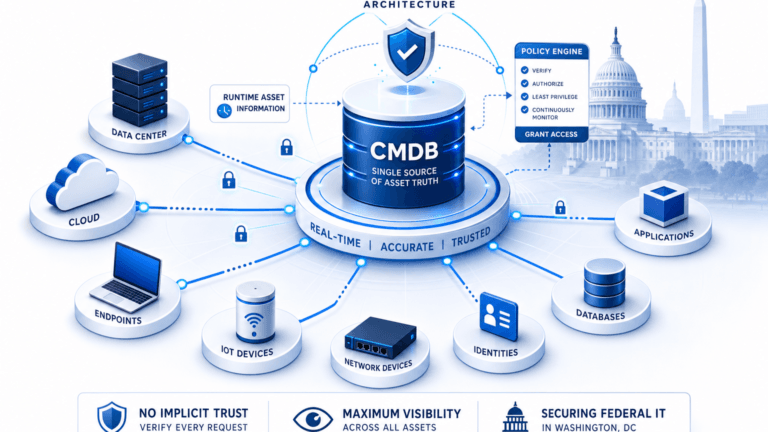
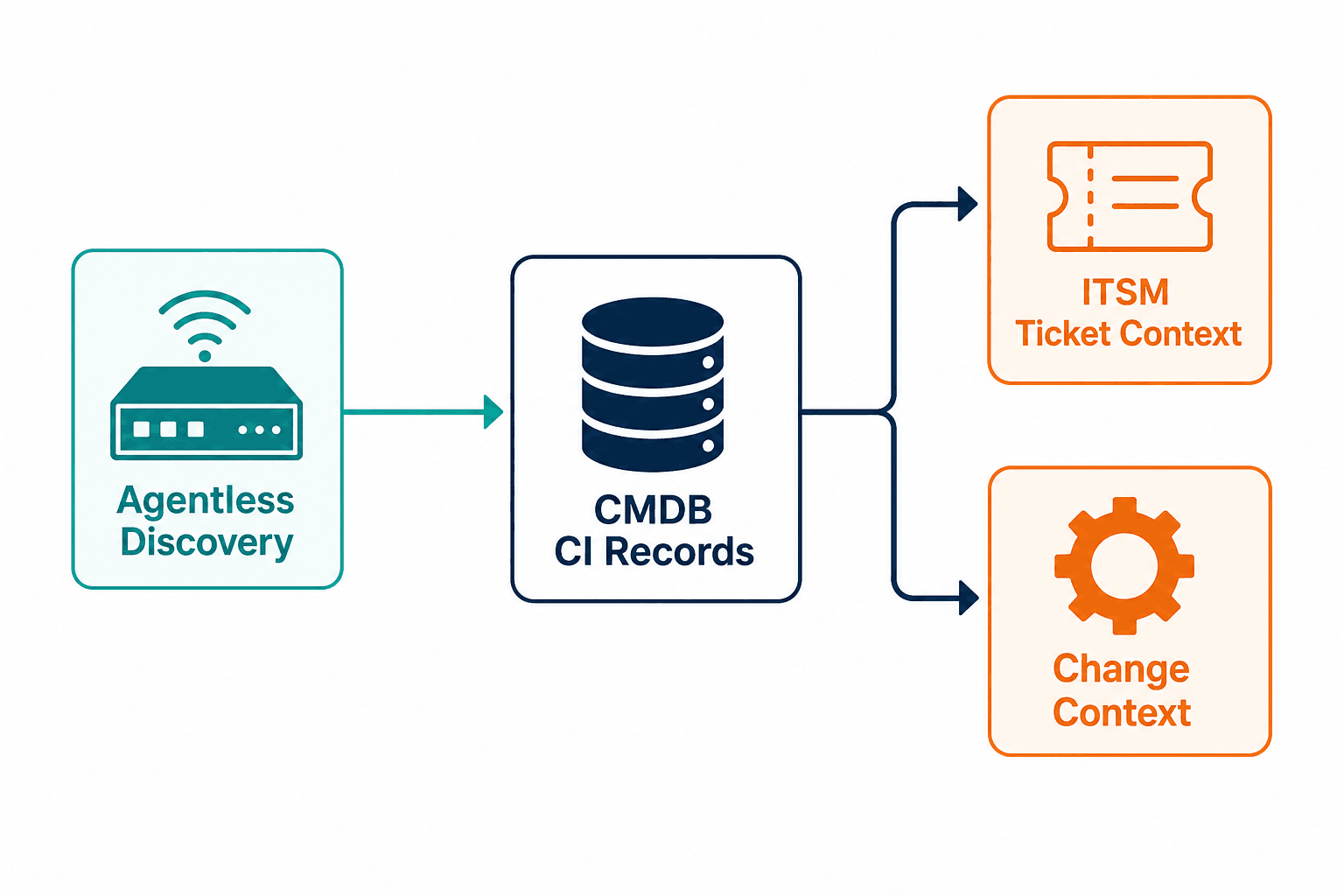
The inventory only becomes operational when it feeds a CMDB-style system of record, not when it lives forever as another export. Tickets, change forms, and service questions need a stable CI identity and relationship graph. A CSV dump from a scanner is a starting point, not the finish line.
When do device spreadsheets stop working for network inventory?
They stop working when topology changes faster than the file is updated, when network devices cannot run agents, and when weekend or emergency swaps never reach the sheet. At that point lean IT needs discovery-backed records with freshness and neighbor data, not a better-formatted workbook.
Minimum bar: discovery authority, CMDB, and ITSM handoff
Lean staffing is an operating constraint. It is not a reason to accept a weaker truth layer. The bar that holds under change and incident pressure looks the same at a few thousand assets as it does in a larger estate — a five-person team supporting 2,000 endpoints needs it too. The difference is who runs the tooling and how packaging is sold, not whether relationships and freshness exist.
Evaluate any path with enterprise criteria:
- Discovery authority on network classes. Agentless coverage for switches, routers, firewalls, and wireless, plus API discovery for cloud network objects in AWS and Azure where you run them.
- Typed relationships, not only lists. Neighbor and dependency links that support blast-radius questions during incident triage, not a flat asset table.
- CMDB as the system of record. Discovered data lands as CIs with ownership and lifecycle, not as a one-time import that decays.
- ITSM handoff. The inventory must reach the tools people already open for tickets and changes. Partner names stay plain; the join path matters more than logo walls. Virima connects through a single integrations hub at all integrations when teams need ServiceNow, Jira, Ivanti, and related desks fed from discovery.
- Explainable freshness. Operators can see when a device was last confirmed and what method confirmed it.
Service maps sit on top of that foundation once service definitions are provided. Map automation builds dependency views from those definitions and live infrastructure links — it does not invent which apps form a business service without that input. Lean teams still reach full service context; it just isn’t conjured from zero input.
If you want the category framing behind discovery-sourced ground truth for change and agentic work, start with Trusted Runtime Truth.
How growing IT estates close the gap without a lite product
Growing estates do not need a stripped starter map product. They need the same discovery, CMDB, ITAM, and ViVID™ service maps depth larger programs use, run with a small operator set and a contact-led commercial motion.
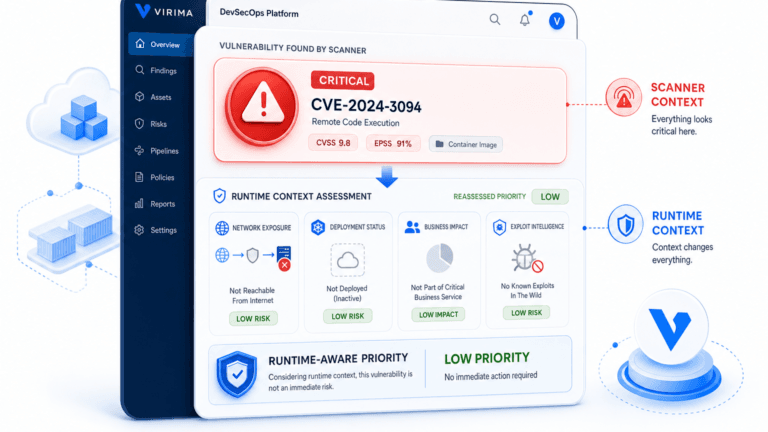
Virima’s path for that buyer is full platform capability under a lean operating model: agent and agentless discovery including network device classes, multi-source CI population, relationship mapping, CMDB health signals, ITAM lifecycle fields, and service maps once definitions are supplied. Network inventory is not a side spreadsheet feature — it is part of the same truth layer endpoints and cloud objects join.
Teams that have outgrown free inventory tools and workbook-led network lists can review fit on a scoped conversation, not a generic demo script. The evaluation should still demand enterprise bars: discovery authority, typed relationships, CMDB currency, and ITSM handoff. Packaging should not lower the bar.
If network device truth still lives in a spreadsheet while change and incident work need live CIs and neighbors, see how discovery-sourced inventory sits under the estate without replacing your ITSM overnight.
A practical move off the sheet
You do not need a multi-year transformation plan to leave the workbook. A tight sequence works for lean crews:
- Scope the dark layer. List sites and device classes the sheet claims to cover. Mark what has no last-verified date.
- Stand up agentless discovery for network classes. Credential and segment the ranges you are allowed to scan. Confirm switches, routers, firewalls, and APs appear with usable identity fields.
- Promote discoveries into CMDB CIs. Deduplicate against any existing endpoint or cloud records so one hostname does not become three rows.
- Capture neighbors and critical links. CDP/LLDP and related relationship data turn a device list into something change owners can use.
- Set high-frequency scheduled cycles. Pick a cadence the team can staff and explain. Watch last-seen and failed scan queues like any other ops signal.
- Hand off to ITSM. Push or sync CIs so tickets and changes reference the same identities operators already trust in the inventory view.
- Retire the sheet as system of record. Keep exports for ad hoc analysis if needed. Stop treating the workbook as proof.
What should lean IT require from network inventory software?
Require agentless discovery for network devices, CI records with freshness and neighbor relationships, CMDB as system of record, and a clean handoff into existing ITSM tools. Lean headcount changes who runs the process, not whether those capabilities exist.
Where to start when the spreadsheet is the risk
If a forgotten switch can still take a floor offline, the inventory problem is already a change and incident problem. Spreadsheet-led network inventory for lean IT teams stops scaling when topology moves faster than the file and when infrastructure devices never accept an agent. The fix is discovery-backed CIs with relationships and scheduled freshness, full platform depth under a lean operating model, and an ITSM handoff that reuses the desks you already run.
See how Virima approaches discovery-sourced network and estate truth on a request demo conversation scoped to your sites and device classes.
Frequently Asked Questions
Is a network inventory spreadsheet enough for lean IT?
It can work briefly for a small static core. It fails when topology changes often, emergency swaps go unlogged, or auditors and new hires need proof beyond a dated file. At that point you need discovery-backed records with last-seen and relationship data.
Why can’t lean teams put an agent on network switches and firewalls?
Those devices run closed, purpose-built systems. They do not accept endpoint agents the way laptops and servers do. Inventory for that layer depends on agentless methods such as SNMP and CDP/LLDP, plus API discovery for cloud network components.
How is this different from general computer inventory?
Computer inventory focuses on endpoints, installs, and assignment. Network inventory focuses on infrastructure devices and how they connect. Growing teams often need both. Strong laptop inventory does not automatically light up switches and firewalls.
Do we need a full CMDB owner to leave the spreadsheet?
You need a clear system of record and a discovery cadence someone owns, even if that is a part-time role. Automated population and scheduled cycles reduce manual row edits. They do not remove the need for ownership of exceptions and credentials.
Where does Virima fit for growing estates?
Virima provides full discovery, CMDB, ITAM, and ViVID™ service maps capability, including agentless network device discovery, under packaging aimed at growing IT estates. It is a truth layer that can feed existing ITSM tools, not a lite map product and not a helpdesk replacement.