Why CMDB Relationship Data Gaps Slow Incident Triage

CMDB relationship data is the mapped record of dependencies between configuration items — which services run on which hosts, which applications depend on which databases, and which business services each CI supports. A CI is the asset record; a CI relationship is the record of how that asset connects to others. When that mapping is absent, an incident responder cannot determine blast radius — the full set of services and dependencies affected by a failure or change — from the CMDB alone. In enterprises where orphaned CIs are common, each P2 incident against an unmapped CI adds an average of 16 minutes to triage compared to fully relationship-mapped CIs.
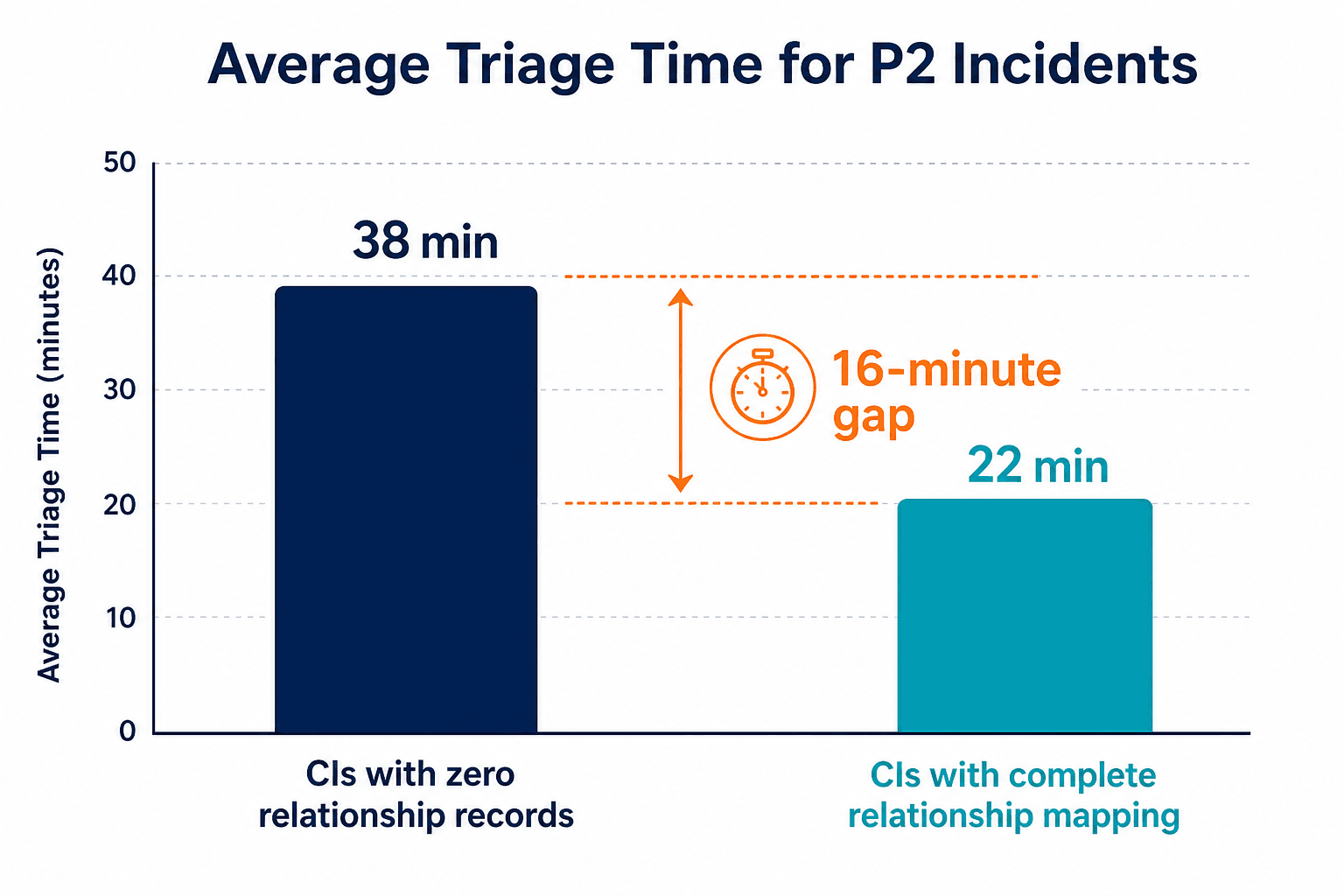
When a P2 incident lands and the CMDB shows nothing about what that CI connects to, your team doesn’t use the CMDB — they call someone who might know. Accurate CI relationship mapping is the difference between a 22-minute triage and a 38-minute war room. In enterprises where orphaned CIs are common, that gap compounds across hundreds of incidents a year. This article traces the three structural failure patterns that produce CIs with zero relationship records, quantifies what they cost in triage time, and covers how automated relationship discovery eliminates them.
The operational cost of a CI with no relationships
An orphaned CI is a configuration item with no mapped CMDB relationship data — no record of what it depends on, what depends on it, or which business service it supports. Orphaned CIs are not edge cases. In enterprise CMDBs maintained primarily through manual processes, it is common to find that 20% or more of CI records carry zero relationship data.
In one illustrative scenario that represents a pattern seen across infrastructure teams: 847 out of 3,800 CIs had no relationship records — middleware instances, network devices, and database servers that existed in the CMDB as isolated entries with no context.
That isolation has a direct impact on CMDB incident triage performance. When those CIs appeared in a P2 incident, triage averaged 38 minutes. After automated discovery mapped their relationships, the same CI type averaged 22 minutes per incident. Across 14 P2 incidents over nine months, the 16-minute gap added up to more than three and a half hours of cumulative triage time — time spent hunting down dependencies the CMDB should have answered immediately.
CMDB-assisted incident triage means the dependency context is available at the moment the ticket opens, not assembled afterward. The macro picture is consistent with that pattern. Industry ITSM benchmarking research indicates that organizations with complete dependency mapping resolve incidents 40–60% faster than those relying on incomplete CMDB data — a finding documented across IT operations teams running automated discovery. Gartner has estimated in widely-cited ITSM research that 75% of CMDB deployments fail to deliver on their intended goals — and incomplete relationship data is one of the most cited reasons. (Note for human review before publishing: verify Gartner publication year; replace this stat if the source predates 2024.)
If you’re still quantifying your own gap, the measurement framework in the section below gives you the two metrics to pull from your own CMDB. If you’re ready to see automated discovery in action, schedule a demo.
Three structural patterns that produce CIs with zero relationships
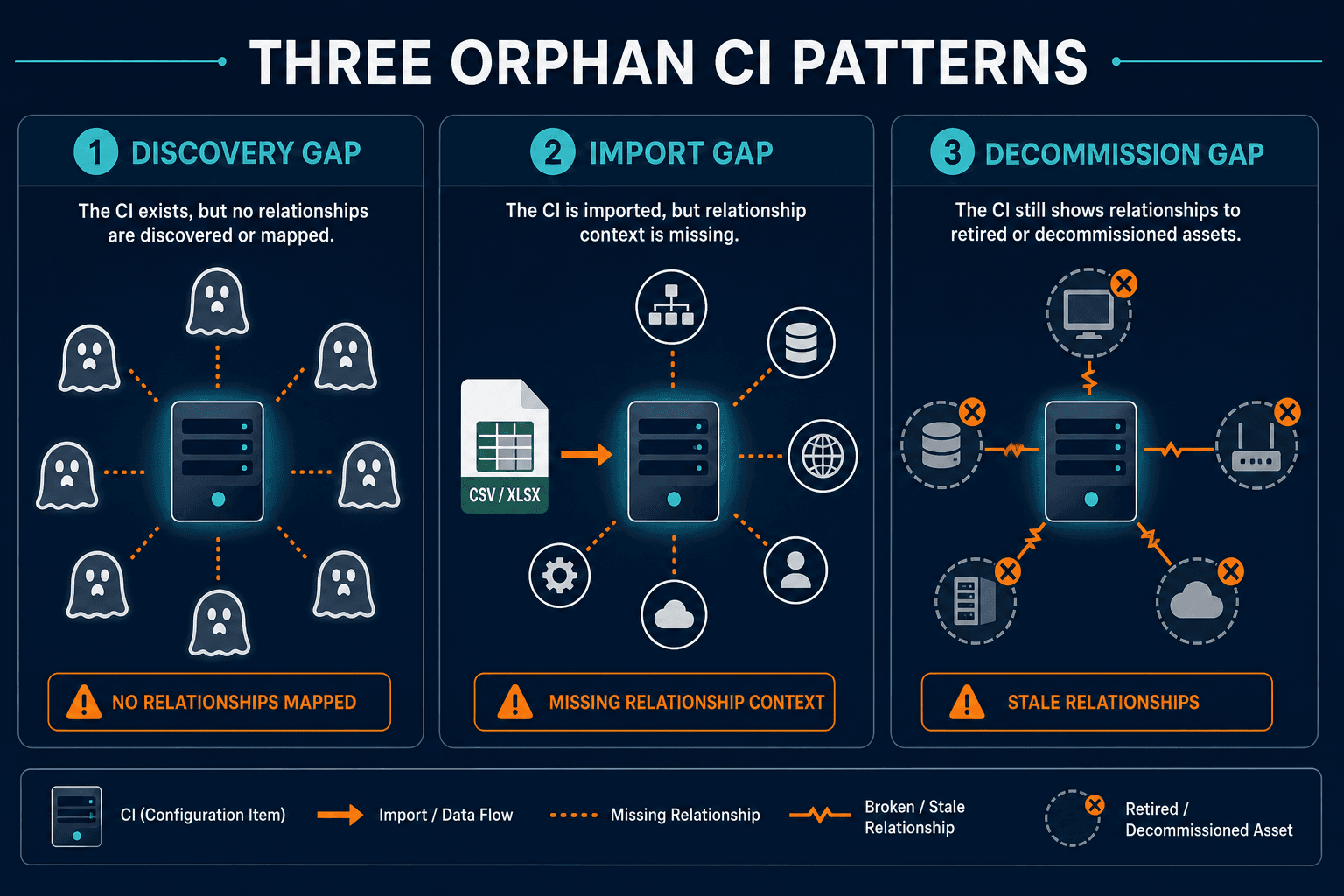
Missing CMDB relationship data is rarely random. It follows structural patterns tied to how organizations populate and maintain their CMDB. Three failure modes account for most orphaned CIs.
Discovery coverage gaps
Most CMDB discovery configurations are built around servers, endpoints, and directly addressable network devices. Middleware components — message brokers, load balancers, API gateways — and the runtime connections between them are often outside the default discovery scope. A discovery schedule that sweeps the network every 24 hours may inventory every server in the estate. But it often misses the middleware listener bridging the application tier to the database cluster.
In the illustrative scenario above, the CI type responsible for the triage delay was middleware: 312 out of 847 orphaned CIs were middleware instances. The discovery pattern in place scanned the host server correctly but did not walk the connections from that host to the services it supported — so the CMDB had the server, but not its relationships.
Network devices and database instances showed similar patterns: 287 network CIs and 248 database instances were in the CMDB with no relationship data. Discovery had found the assets. It had not found what they connected to.
Manual import without relationship context
CMDB migration projects and bulk imports from spreadsheets or legacy ITSM tools reliably create CI records — but almost never import relationship data. When an organization moves from one ITSM platform to another, or runs a one-time discovery sweep to bootstrap the CMDB, the import creates entries for thousands of CIs. The relationships between those CIs, which existed implicitly in how the infrastructure operated, do not transfer.
The result is a CMDB that looks populated — the CI count is high, the record count is impressive — but that cannot answer the question that matters during an incident: What does this thing connect to?
Decommissioning without CMDB retirement
Infrastructure retires at a different rate than CMDB records. When a server is decommissioned, the physical or virtual asset is removed from the environment. The CMDB entry often persists, along with any relationship records pointing to that asset. Over time, those stale records produce a different kind of orphan: a CI whose relationships exist in the CMDB but point to assets that no longer exist in the environment.
This is the inverse failure. Instead of a CI with no relationships, you have a CI whose relationships are broken. During triage, following a broken relationship link is just as disorienting as finding no relationship at all — and it sends responders in the wrong direction before they realize the CMDB data cannot be trusted.
What responders actually do when the CMDB has no relationship data
When the CMDB cannot tell a responder what depends on a CI or what that CI depends on, the responder finds the answer another way. They open a Slack channel. They call the engineer who originally deployed the service. They run a network trace. They escalate to someone with institutional knowledge who can reconstruct the dependency map from memory.
This workaround loop is not a failure of individual engineers — it is a predictable response to an unavailable tool. The CMDB exists, the responder knows it exists, but it cannot answer the question in front of them, so they bypass it. When this happens consistently enough, the CMDB loses organizational trust. Teams stop updating it because they stop using it. The relationship data gap becomes self-reinforcing.
The triage delay is not only the time spent locating the dependency. It includes the escalation chain built to reach someone who knows the environment — and the misrouted ticket that goes to the wrong team before anyone identifies the right one. All of that time passes before anyone starts working the actual root cause. All of that time is time where the incident is open and the service is degraded.
This is why organizations that fix CMDB relationship data see MTTR improvement — mean time to resolution, the total time from detection to fix — measured in minutes, not seconds. Not because their engineers become faster, but because the context is there at the start of CMDB incident triage instead of something assembled through parallel investigation.
How automated discovery closes the relationship gap
The three structural failure patterns above — discovery coverage gaps, import-without-relationship-context, and decommissioning drift — share a root cause: relationship data that depends on human action to create and maintain will eventually drift from reality. Automated discovery is the corrective for CMDB relationship data gaps.
Discovery-driven CI relationship mapping works by scanning actual infrastructure connections, not relying on records of them.
Agentless and agent-based discovery
Virima’s agentless discovery scans the network and identifies live connections between CIs: which services run on which hosts, which hosts connect to which databases, which middleware components bridge which application tiers. Agent-based discovery extends that coverage to endpoints and applications requiring local access.
In the illustrative scenario, the difference between a static discovery configuration and a relationship-aware scan was dramatic. After the first automated discovery cycle ran against the full estate, the median confirmed relationships per CI rose to 4.2. The 847 orphaned CIs did not represent undiscovered assets — they represented assets whose connections had never been mapped. A single scan cycle surfaced those relationships because the scan walked the connections, not just the assets.
API-based discovery for cloud environments
API-based discovery pulls relationship context from cloud platforms — AWS, Azure — where infrastructure topology is directly queryable. Cloud resources expose their dependency structures through provider APIs, making it possible to map relationships between cloud services and on-premises CIs without network scanning.
ViVID™ service maps: relationship context at triage
Virima’s ViVID™ service maps surface those relationships visually. The responder sees the full dependency picture from a single CI outward through every layer it touches. When a P2 incident opens, the responder sees the full context — every upstream and downstream dependency, the business services that CI supports, and any open incidents or changes affecting connected assets. That context is available in seconds, not assembled over 38 minutes of parallel investigation.
Measuring your CMDB relationship gap
Before you can close a CMDB relationship gap, you need to know how large it is. Two metrics give you that picture from data already in your CMDB.
Orphan CI rate is the percentage of CIs with zero mapped relationship records. Pull a count of all CI records, then filter for those with no outbound or inbound relationships. In the illustrative scenario above, 847 out of 3,800 CIs — 22.3% — had no relationship records. Any orphan CI rate above 10% signals that your discovery configuration has coverage gaps, your last ITSM migration imported CIs without their relationships, or your decommissioning process is leaving stale records behind.
Relationship completeness by CI class breaks that figure down by category: middleware, network, database, and server CIs often have very different orphan rates depending on your discovery configuration. In the scenario above, middleware had the highest orphan rate because the discovery scope was built around servers and endpoints. Identifying which CI class has the highest orphan rate tells you where to focus your discovery configuration fix first.
Running these two metrics quarterly — or after any ITSM platform migration — gives you a baseline to track. MTTR improvement CMDB programs that reduce orphan CI rate by 10 percentage points or more consistently see measurable triage time reduction within the first incident quarter.
Connecting CMDB relationship data to the incident workflow
Accurate CI relationship mapping only reduces triage time if it reaches the responder at the right moment. That means connecting CMDB relationship data to the tools where incidents are worked, not to a separate CMDB portal that requires a context switch.
Virima integrates directly with ServiceNow, Jira Service Management, Ivanti, and other ITSM platforms to surface CI relationship context where incidents are already managed. When an incident opens against a CI in ServiceNow, the relationship data from Virima’s discovery is already there — correctly assigned, with blast radius context attached. The responder does not need to open a second tool or run a separate query.
The ongoing discipline is keeping that relationship data current. A one-time discovery run closes the gap at a point in time. Continuous scheduled discovery — with configurable frequency by CI class and environment type — means that when infrastructure changes, the CMDB follows. Discovery frequency varies by CI class: servers typically run daily, cloud resources hourly or on change event. Middleware is added and its connections are discovered. A server is decommissioned and its record ages out. The relationship map reflects the environment as it is, not as it was during the last manual update.
That runtime accuracy is what makes responders actually use the CMDB during an incident — instead of calling someone who might know. Your responders will use a CMDB they trust. They will not use one where the relationship data might point to assets that no longer exist.