Manufacturing Software Licensing and Hardware Tracking

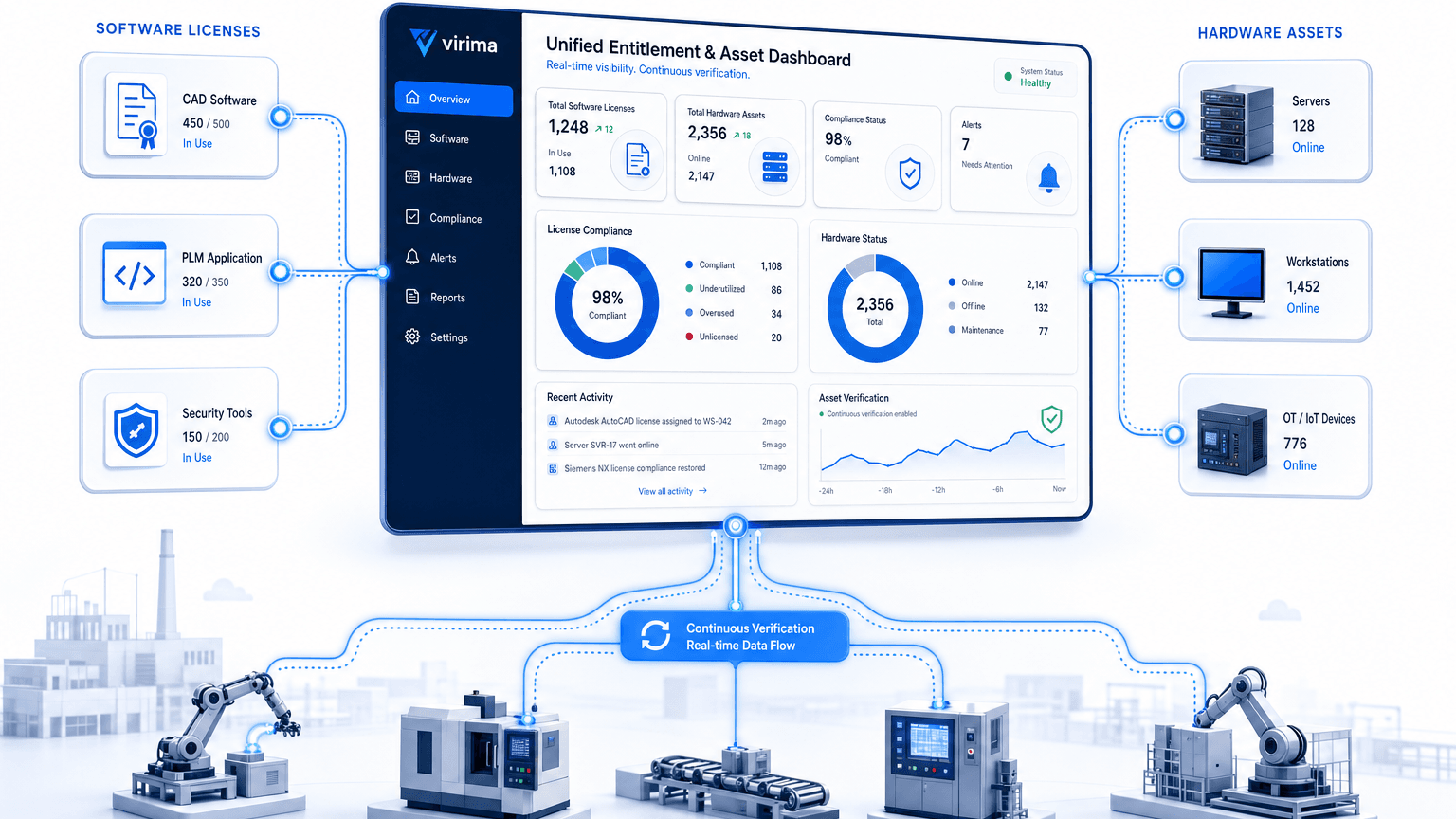
A production line in Munich runs SCADA software licensed per core; a plant in South Carolina hosts CAD workstations nobody has mapped since the last retrofit. When a vendor audit letter or a failed server hits either one, IT has no record to point to. Manufacturing software licensing and hardware tracking is the discipline of unifying software entitlements and physical asset records across every plant and corporate site into one continuously verified system of record.
Why is tracking software licenses and hardware challenging for global manufacturers?
Global manufacturers struggle with asset visibility due to distributed sites, isolated plant floor OT networks, legacy infrastructure, and complex core-based software licensing models. Unmapped hardware upgrades and localized software installations lead to costly vendor audit penalties and unexpected equipment failures that halt production lines.
The Structural Breakdown of Asset Tracking in Industrial Environments
Without centralized, automated tracking in place, IT asset managers (ITAM) and enterprise infrastructure directors face two compounding threats: software audit penalties from unmonitored core-density scaling on servers like the ones supporting that Munich plant floor, and unscheduled production downtime from aging, unmapped hardware reaching end-of-life (EOL) without notice. Closing that gap means moving past manual spreadsheets and siloed site inventories toward one system of record that continuously discovers every IT and OT asset, matches it against software entitlements, and maps its dependencies before a mismatch turns into an audit finding or a line stoppage.
In a typical enterprise IT environment, IP-addressable discovery scans can inventory most virtual machines and corporate laptops. In manufacturing, however, network architectures are intentionally segmented to protect operational technology (OT) from external cyber threats. Following the Purdue Model for Industrial Control System architecture, plant networks (Levels 0 through 3) are isolated from corporate networks (Levels 4 and 5) by industrial firewalls and DMZs.
This necessary security boundary creates a blind spot for traditional IT asset management tools: software licenses installed on engineering workstations, human-machine interfaces (HMIs), and edge industrial PCs (IPCs) remain invisible to corporate IT teams. Standard discovery tools cannot see past that boundary, which is why manufacturing-ready discovery platforms place gateway probes at the Level 3 DMZ instead — collecting inventory without crossing into control-system traffic, as detailed below. For a closer look at how converged environments change these visibility requirements, see Virima’s guide to manufacturing IT/OT convergence.
1. Core-Based and Proprietary License Drift
Industrial software vendors, such as Siemens, Rockwell Automation, Dassault Systèmes, and SAP, enforce stringent licensing terms. Server-side engineering software and ERP components often charge per CPU core, per active connection, or per named user.
When local plant engineers spin up virtual machines or upgrade server host CPUs to improve local throughput, they unintentionally alter core counts. Because corporate IT asset management has no visibility into localized hypervisor changes, the company breaches license agreements. During an audit, vendors assess retroactive licensing fees and non-compliance penalties that can easily reach seven figures. Nearly a third of organizations now report audit-related financial liabilities exceeding $1 million, more than triple the share reported two years earlier, and audit frequency at companies with more than 5,000 employees has climbed to 66 percent, up from 50 percent in 2023 (The Rising Cost of Software Compliance: 2025 Survey).
2. Ghost Hardware and Unmapped Edge Devices
On manufacturing plant floors, hardware lifecycle management is notoriously difficult. Industrial PCs, rack servers managing vision inspection systems, and network switches controlling assembly lines are frequently installed during facility retrofits without formal change tickets.
These unmapped devices, often called ghost hardware, run critical manufacturing execution systems (MES) without ever appearing in an OT hardware inventory CMDB. Ghost hardware refers to industrial PCs, switches, or edge servers installed during a plant retrofit without a formal change ticket, leaving no record in the corporate CMDB. When ghost hardware fails, technicians must first identify what the device was before they can find a replacement or assess what services it supported — on the plant floor, that means lost time locating spare parts and determining which software services depended on that specific machine. Virima blog post on hardware lifecycle and EOL/EOS risk management covers how discovery-sourced hardware records shorten that identification step.
How does automated discovery unify IT and OT hardware tracking across global sites?
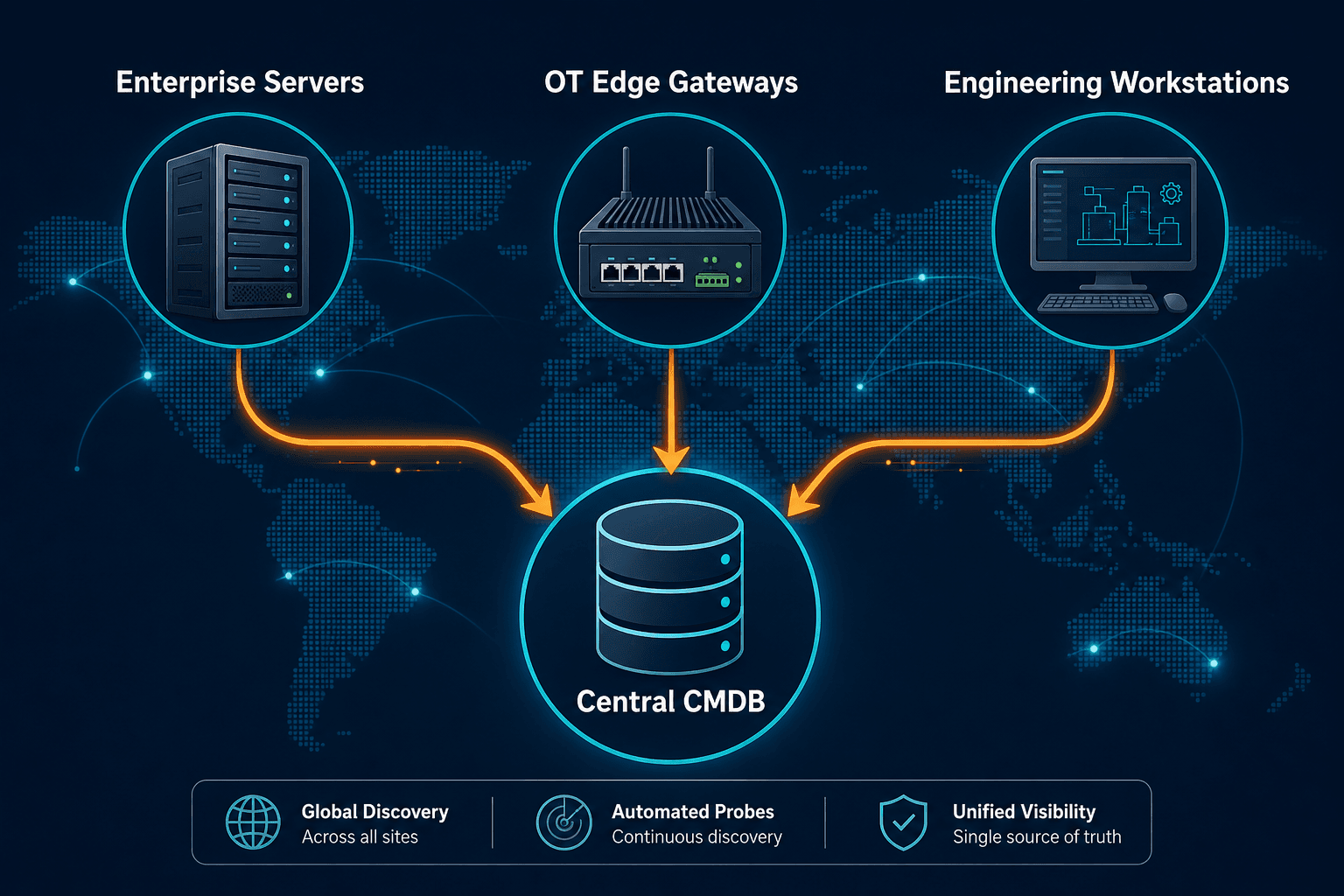
Automated discovery uses agentless and agent-based probes deployed across regional hubs and DMZ boundary servers. It continuously scans IP-connectable devices, identifies hardware specifications and installed software, and maps dependencies without disrupting industrial control protocols or risking plant floor uptime.
Building an Automated Asset Discovery Architecture for Global Facilities
To overcome network segmentation and air-gapped site restrictions, global manufacturers require a flexible discovery framework that captures hardware specifications, operating systems, hypervisor configurations, and installed software builds across every site. Gartner projects that 75 percent of the world’s largest manufacturers will have IT/OT integration strategies in place, and manufacturers that close this gap report 15 to 20 percent lower operating costs as a result (The Hidden Cost of OT/IT Integration Gaps in Manufacturing).
Deploying Agentless and Light-Agent Discovery Probes
Rather than attempting to run invasive network sweeps across sensitive OT segments, enterprise discovery platforms employ targeted discovery probes:
- Regional Datacenter Probes: Perform deep, agentless queries (WMI, SSH, SNMP) across corporate IT servers, storage arrays, and hypervisors (such as VMware ESXi or Microsoft Hyper-V) to extract CPU, RAM, disk, and core specs.
- Plant DMZ Gateway Probes: Situated at Level 3 of the Purdue Model, these probes query local management servers and engineering workstations, extracting installed software inventories and build numbers without touching low-level Programmable Logic Controllers (PLCs).
- Targeted Light Agents: For remote or intermittently connected devices, such as field laptops and standalone diagnostic hardware, lightweight agents collect inventory data locally and sync with the central CMDB whenever a secure connection is established.
By consolidating these inputs into a single IT discovery platform, IT asset managers obtain an accurate, global inventory of hardware assets and software installations. To see how automated discovery connects with enterprise ITSM platforms, explore the Virima integrations hub.
Aligning Hardware Specifications with Software Entitlement Pools
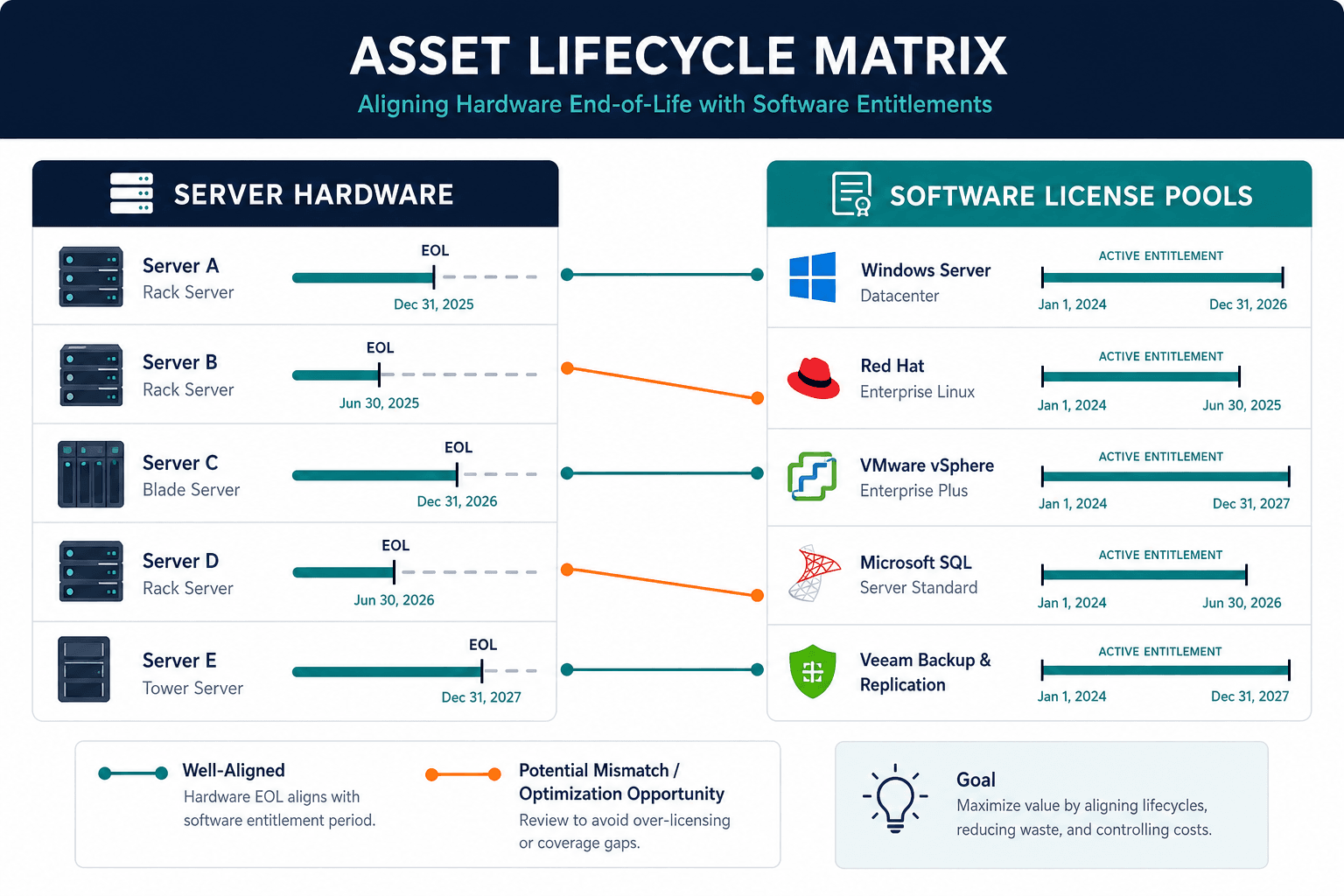
Capturing asset inventories is only the first step. To ensure compliance and optimize procurement, hardware inventory data must be matched against software license entitlements.
Core-Density and Virtualization Mapping
When enterprise database or ERP software runs inside virtual machines, calculating compliance requires knowing the physical host’s CPU core count and socket density.
A modern discovery platform automatically maps virtual machines to their underlying physical host servers and feeds that mapping directly into a live CMDB rather than a static spreadsheet. If a plant IT team migrates a virtual machine running a core-licensed database from a 16-core host to a 64-core host, the discovery engine detects the host reassignment. It immediately updates the CMDB, recalculating core consumption and alerting asset managers before a vendor audit uncovers the mismatch.
Software Asset Management (SAM) and License Optimization
By comparing discovered software instances against purchased entitlements inside a unified IT asset management system, organizations identify two primary financial opportunities:
- Eliminating Over-Licensing: Regional sites often purchase standalone licenses for CAD or simulation software that sit idle for months. Unifying global visibility enables cross-site license harvesting and pooling.
- Mitigating Under-Licensing Penalties: Detecting unlicensed or unauthorized software copies on engineering systems allows IT to regularize licenses or remove non-compliant installations before formal vendor audits occur. Enterprises with mature compliance programs like this typically spend well under one percent of their IT budget on the effort and return six to fourteen times that cost through audit defense and license optimization, according to the same 2025 software compliance survey cited above.
Establishing Service Context and Blast Radius Analysis
Knowing that a server exists in a plant in Nagoya is useful; knowing that the server hosts the primary middleware connecting the plant’s MES to the global SAP instance is critical. Unplanned downtime in manufacturing now averages $260,000 per hour, with automotive plants often exceeding $2.3 million per hour when a line goes down (The Real Cost of Unplanned Downtime in Manufacturing).
Service mapping transforms flat asset inventories into dynamic dependency maps. By visualizing how hardware components, operating systems, databases, and application software interact, IT operations and site managers gain immediate insight into service risk. Platforms built around this kind of dynamic mapping, such as Virima’s ViVID™ service maps, turn a dependency tree into a visual blast-radius view that a site manager can act on in minutes rather than hours.
Change Impact and Maintenance Planning
When a hardware maintenance window is scheduled at a manufacturing site, engineers must know exactly which business processes will be affected.
With dynamic service mapping, an IT director can select a physical server scheduled for firmware updates and immediately view its dependency tree. If the map shows that taking the server offline will disrupt barcode labeling on Packaging Line 4, the maintenance window can be rescheduled or failover systems activated, preventing costly line stoppages.
To learn how organizations establish complete operational visibility across complex infrastructure, visit Trusted Runtime Truth.
Best Practices for Implementing Global Asset Governance in Manufacturing
Implementing effective asset tracking across international facilities requires aligning people, processes, and technology. Leading global manufacturers follow four core implementation principles:
- Define Standard Asset Taxonomies: Standardize naming conventions, CI categories, and criticality ratings across all international sites to ensure uniform reporting in central dashboards.
- Schedule High-Frequency Discovery Cycles: Run automated discovery scans on a scheduled basis (daily for corporate server pools, weekly for plant DMZ segments) to detect hardware modifications and software drift. Manufacturers that close the IT/OT visibility gap this way cut unplanned downtime by 35 to 50 percent and extend asset lifespan by 20 to 40 percent, per the same OT/IT integration report cited above.
- Integrate Discovery with ITSM and ITAM Workflows: Connect the central CMDB directly to service desk and asset management systems, whether that is ServiceNow, Jira Service Management, or another platform already in place. Virima integrates directly with these tools rather than replacing them, so plant and corporate IT keep working in the systems they already know. When a hardware ticket is opened, technicians immediately see accurate asset history and license details.
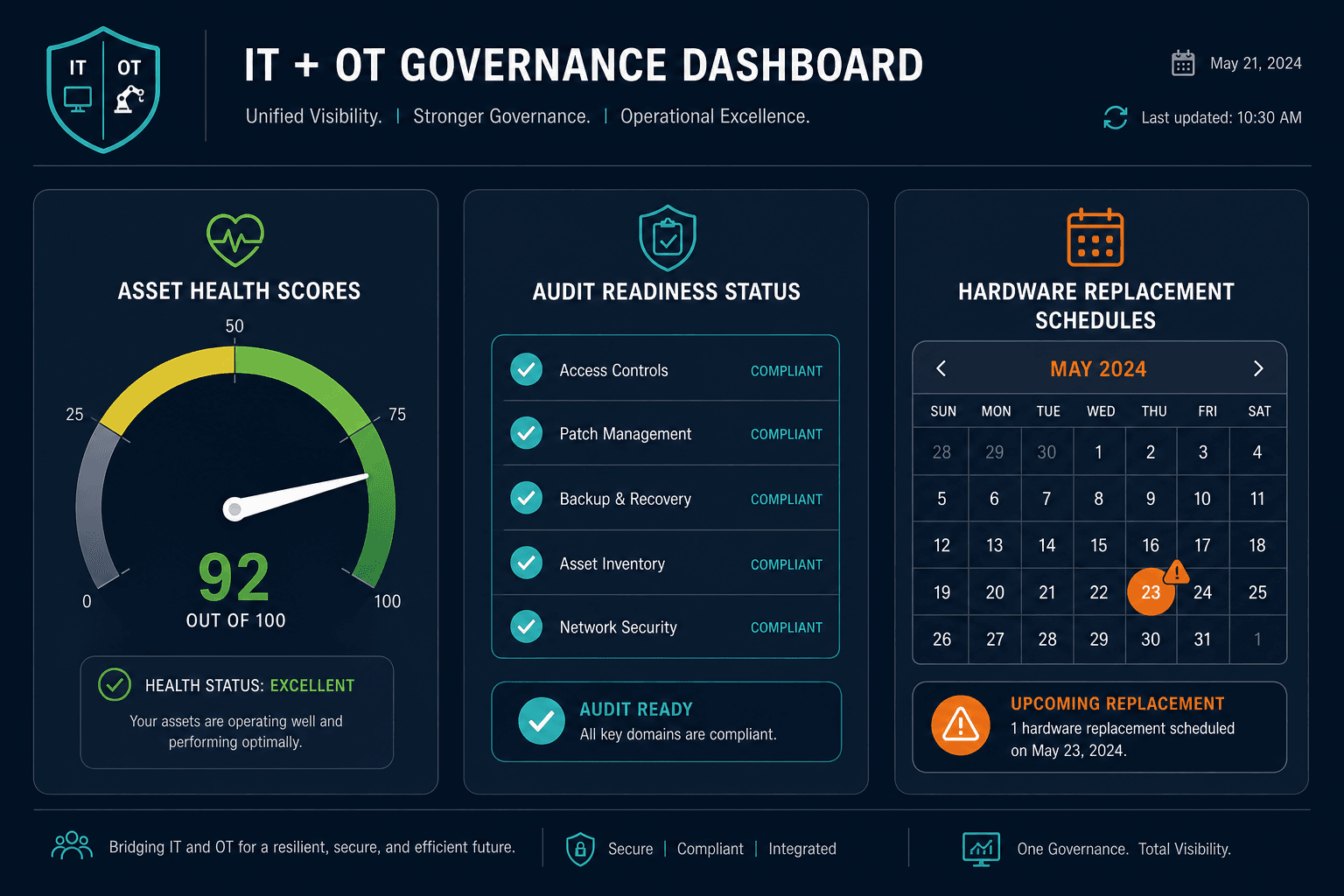
- Establish Joint IT and OT Governance: Form a joint steering committee comprising corporate IT directors, plant engineering leads, and compliance managers to review asset health, software audit readiness, and hardware replacement schedules. CMDB Audit Essentials: Ensuring Data Accuracy and Compliance has a closer look at running this kind of review cadence.
When planning software license renewals and hardware refresh cycles across global facilities, use these four principles as a working checklist against your own site list — they surface the gaps most audits and outages trace back to before either one happens.
What are the financial benefits of automated software and hardware tracking in manufacturing?
Automated tracking eliminates software audit penalties, reduces maintenance costs on ghost hardware, enables cross-site software license harvesting, and prevents million-dollar production outages caused by unmapped hardware failures during planned maintenance windows.
Modernizing Global Manufacturing Infrastructure Operations
As industrial enterprises adopt smart manufacturing initiatives, edge computing, and cloud-connected factory operations, the boundary between corporate IT and plant-floor OT continues to dissolve. Continuing to rely on regional spreadsheets or static site inventories exposes manufacturers to severe financial, operational, and compliance risks. Unplanned downtime already costs the world’s largest manufacturers an estimated $1.4 trillion a year, and stale asset and license records are a direct contributor to that figure, not a side effect of it, per the same downtime report cited above.
By implementing automated multi-site discovery, core-aware virtualization mapping, and dynamic service dependency maps, global manufacturing organizations achieve complete asset intelligence. They protect their bottom line against software compliance penalties, extend hardware lifecycle ROI, and ensure uninterrupted production across every site worldwide.
Frequently Asked Questions
How does automated discovery handle air-gapped or restricted OT networks in manufacturing facilities?
Automated discovery uses gateway probes placed within DMZ layers or Level 3 network boundaries. These probes collect localized asset metadata without traversing air-gapped boundaries or sending intrusive traffic into sensitive control networks, preserving operational safety while ensuring central asset visibility.
Why do traditional SAM tools struggle with manufacturing software license compliance?
Traditional Software Asset Management (SAM) tools focus primarily on desktop operating systems and standard SaaS applications. They lack core-aware discovery capabilities for complex server topologies, virtual machine host relationships, and specialized industrial software deployed across isolated plant subnets.
How does Virima help global manufacturers manage hardware EOL and EOS risk?
Virima automatically discovers enterprise hardware, server host specs, and edge systems across all sites, mapping them into a unified CMDB. By cross-referencing hardware models with vendor lifecycle dates, Virima alerts infrastructure leads to upcoming EOL and EOS milestones before aging hardware causes production outages.