CMDB in Manufacturing: Tracking Enterprise Systems and Corporate Network Assets

Manufacturing technology looks orderly when architecture diagrams simplify it. Real environments contain many systems with different responsibilities.
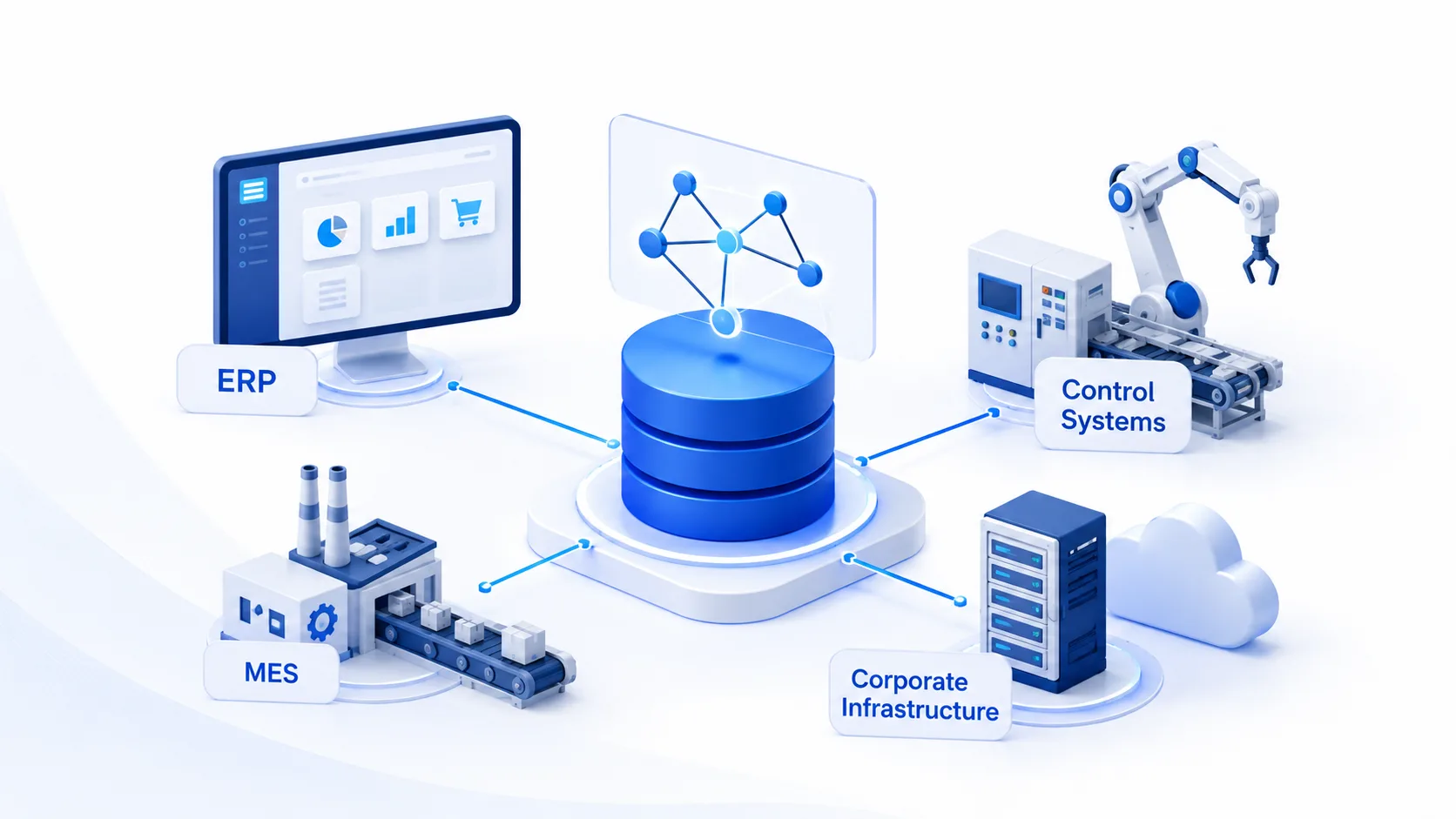
ERP platforms manage planning, procurement, finance, and logistics. MES platforms coordinate production execution across manufacturing operations.
Control systems operate machinery and monitor physical processes. Corporate infrastructure connects applications, users, sites, and services.
Those boundaries exist because each layer serves different needs. Yet modern manufacturing increasingly connects information across those boundaries.
NIST notes that manufacturers increasingly connect operational and enterprise systems. Those connections improve productivity while creating new dependencies.
That creates a different configuration-management problem for manufacturers. Inventory alone cannot explain how those systems depend on each other.
A manufacturing CMDB must therefore model relationships between systems. Those relationships become critical during changes, outages, and incidents.
What is a CMDB in manufacturing?
A manufacturing CMDB records technology components and their relationships. Those components include applications, servers, networks, databases, and clouds.
The database creates context around each configuration item. That context connects infrastructure with applications and business services.
An asset inventory might confirm that servers exist. A CMDB explains which services depend upon those servers.
It can connect applications with databases and infrastructure. It can also connect infrastructure with ownership information.
For manufacturers, another relationship carries particular operational importance. Enterprise systems increasingly interface with production-facing manufacturing technology.
The CMDB should make those dependencies visible without overreaching. It should not become the factory’s universal database.
What does a CMDB do in a manufacturing environment?
A manufacturing CMDB records enterprise technology components, applications, servers, networks, databases, cloud resources, and maps the relationships between them. It connects infrastructure records with the services and business workflows that depend on them, giving IT teams context to understand impact before changes happen and dependencies before incidents escalate.
Manufacturing technology was deliberately separated into layers
Manufacturing systems did not become separated through organizational negligence. Their separation reflects genuinely different operational responsibilities and constraints.
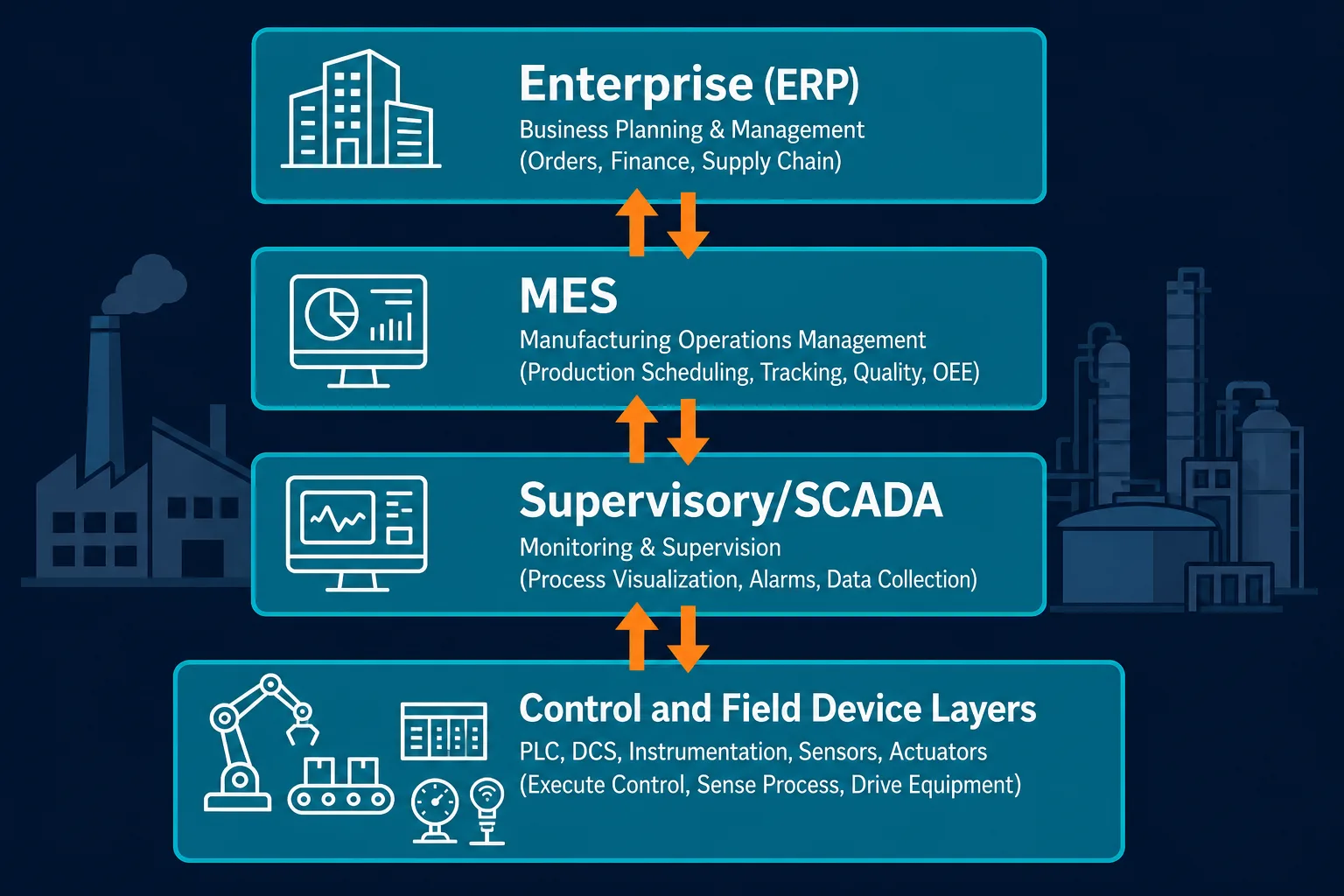
ISA-95 formalizes this architecture across several functional levels. Enterprise planning occupies a different layer from production control.
ERP operates around business planning, logistics, and commercial processes. MES coordinates production activities closer to manufacturing execution.
Supervisory systems manage production conditions and process-level operations. Controllers interact more directly with machinery and physical processes.
Those systems should not necessarily share identical management practices. Their availability, safety, and change requirements remain fundamentally different.
However, information increasingly moves between these functional layers. Siemens describes ERP and MES as complementary interconnected systems.
Planning information moves downward toward manufacturing execution systems. Production information then moves upward toward enterprise systems.
That distinction matters for configuration management in manufacturing. Convergence does not eliminate architectural boundaries between systems.
Instead, convergence makes relationships across those boundaries more important. The CMDB’s value begins with making those relationships legible.
Accurate inventories can still produce incomplete operational visibility
Large manufacturers usually maintain several forms of inventory. Finance knows equipment purchases and associated financial records.
Endpoint platforms identify workstations, servers, and installed software. Network platforms understand routers, switches, firewalls, and connections.
Application teams maintain records around enterprise business systems. Plant teams maintain records around manufacturing technologies separately.
Each system may contain completely accurate information locally. Yet the combined operational picture can remain incomplete.
Fonterra provides a useful example of this problem. The manufacturer operates facilities and offices across multiple locations.
Its disparate technology tools previously limited accurate infrastructure visibility. A common CMDB became foundational to its management environment, connecting records that previously existed only in separate tools.
Nissan faced a related enterprise-systems visibility challenge globally. Its CMDB consolidates automatically collected and imported system information, providing broader visibility across applications and operations.
The previous environment could not provide that consolidated perspective.
These examples reveal a more important configuration-management problem. Manufacturers often have data without having shared context.
The requirement therefore extends beyond collecting additional technology records. Teams need relationships connecting records originating across different systems.
The CMDB should not replace manufacturing source systems
A CMDB should not become every system’s replacement. ERP already manages information suited to enterprise planning.
MES already understands manufacturing execution and production workflows. Network platforms understand infrastructure connectivity and network configuration.
Cloud systems understand workloads running inside cloud environments. OT systems understand industrial devices and production-side configuration.
Those platforms remain authoritative for their respective responsibilities. The CMDB should connect their relevant configuration context instead, relating items across otherwise separate technology domains.
A server becomes useful when applications depend upon it. An application becomes useful when business services depend upon it.
A network connection gains context through connected enterprise systems. Ownership information then identifies responsibility for those components.
The goal is not replacing specialized manufacturing systems. The goal is making important dependencies understandable across them.
Corporate networks now carry manufacturing dependencies
Corporate networks increasingly connect systems supporting production workflows. That makes network assets more than background enterprise infrastructure.
Firewalls may separate enterprise and production-facing network zones. Switches may support systems used across manufacturing sites.
Remote access platforms may support specialized maintenance activities. Integration services may exchange ERP and production information.
A CMDB should therefore represent relevant corporate network assets. Those records become useful when relationships accompany them.
Knowing a firewall exists provides only limited operational value. Knowing which services traverse that firewall provides context.
Knowing a switch exists also provides limited insight. Knowing affected applications makes the record operationally meaningful.
Manufacturing CMDB design should therefore prioritize relationship quality. Configuration-item volume alone does not indicate useful visibility.
Manufacturing discovery cannot use one universal approach
Automated discovery helps keep enterprise configuration records current. However, manufacturing environments require more careful collection practices.
NIST specifically warns that active scanning can create operational risks in sensitive OT environments. NIST recommends considering how asset information gets collected and testing techniques offline to reduce unexpected operational consequences.
Manual collection may remain necessary for particular components. Passive approaches may suit other production environments better.
That creates an important boundary for manufacturing CMDB programs. Enterprise discovery practices should not be copied everywhere blindly.
Corporate IT can support frequent automated discovery safely. Production environments require methods appropriate for operational constraints.
This distinction does not weaken the visibility requirement. It changes how trustworthy visibility must be collected.
NIST’s 2026 OT asset-management work reinforces this challenge. Legacy systems and distributed assets complicate complete inventories. Diverse protocols and operational constraints create additional limitations. Yet incomplete inventories weaken cybersecurity and modernization efforts.
Manufacturing configuration management therefore requires appropriate source federation. Different environments can contribute information through different mechanisms.
How should manufacturers approach asset discovery without disrupting production systems?
NIST guidance recommends against applying standard active scanning to OT environments, which can create operational risks in sensitive production systems. Manufacturing CMDB programs should use passive collection methods, offline testing of discovery techniques, and manual inventory for production-side components, while reserving automated active discovery for corporate IT infrastructure where it can run safely.
Discovery should challenge what the CMDB already believes
A CMDB cannot remain reliable through population alone. Infrastructure changes continuously across distributed manufacturing environments.
Servers move, applications change, and cloud resources appear. Software upgrades alter configuration without changing physical hardware.
Network paths change during modernization and infrastructure refreshes. Ownership also changes between teams and organizational structures.
Discovery should therefore test previously recorded configuration information. Disagreement between sources becomes valuable configuration-management information.
A record may show software version seventeen installed. Discovery may observe software version eighteen running instead.
The CMDB should not simply preserve both answers indefinitely. Reconciliation determines which source governs the relevant attribute.
The same principle applies across infrastructure configuration records. Recorded state should remain testable against observed state.
A trusted CMDB is therefore continuously maintained infrastructure context. It is not documentation created during implementation projects.
Relationships matter more than configuration-item counts
A manufacturer can populate thousands of configuration items. That number says little about operational usefulness alone.
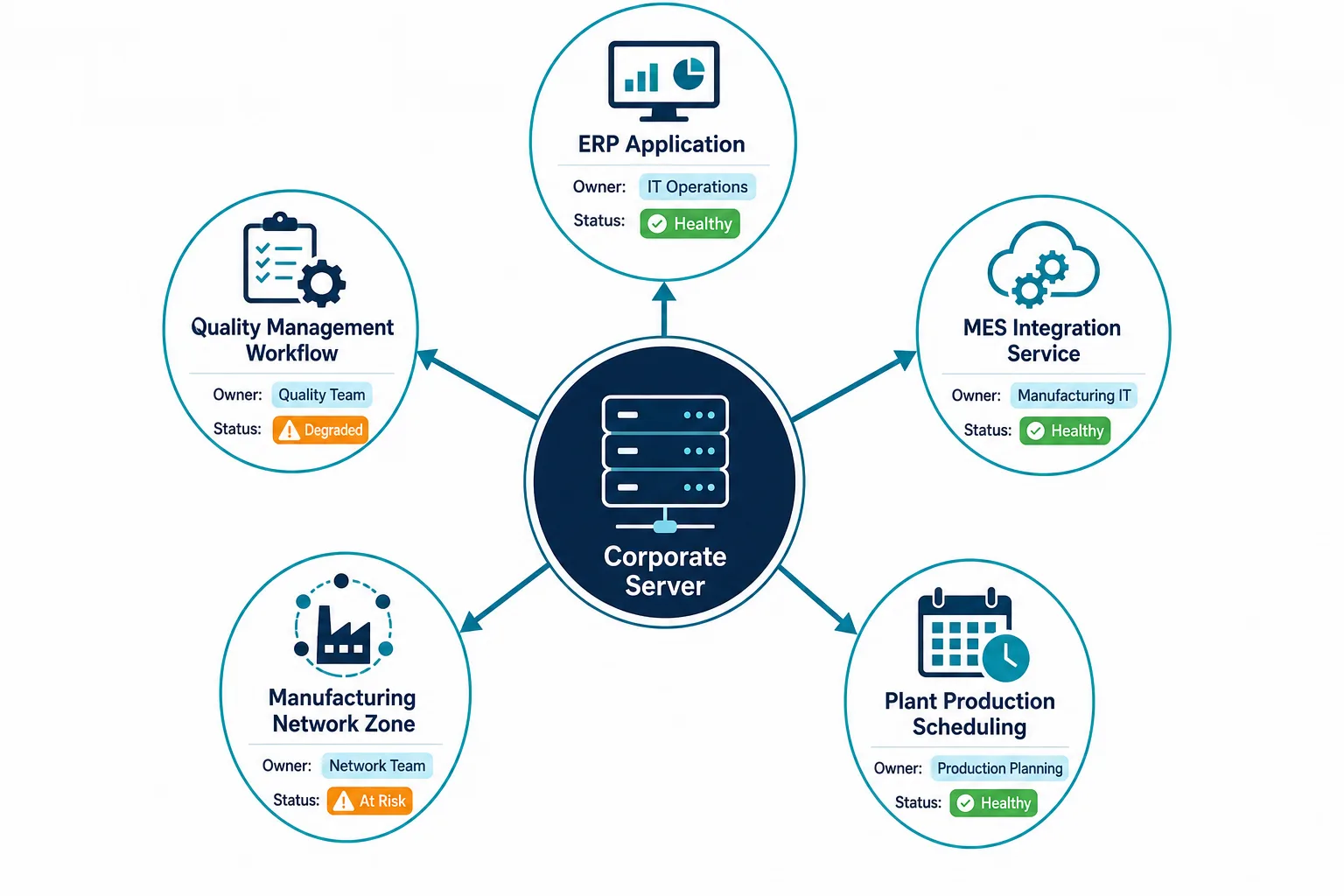
The important question concerns what depends on each item. A database record confirms a technology exists. The CMDB should expose which services, applications, and workflows depend upon it, and what those dependencies mean for manufacturing operations.
This distinction separates inventory from configuration management. Inventory records things while configuration management relates them.
A manufacturing CMDB becomes useful through dependency quality. Those relationships support decisions across incidents, changes, and security reviews.
Change management requires relationship context before approval
Manufacturing creates higher consequences for poorly understood infrastructure changes. Many changes initially look like ordinary enterprise maintenance.
A server team may schedule an operating-system update. Network teams may plan replacing an aging switch.
Database administrators may upgrade a clustered database environment. Cloud teams may migrate workloads between infrastructure platforms.
Each change can appear routine inside its domain. Its manufacturing impact may be completely different.
The server may support production scheduling applications. The switch may carry manufacturing integration traffic.
The database may support quality-management or inventory workflows. The cloud workload may exchange plant information continuously.
Before approving changes, teams need dependency information available. Manual investigation creates delays and inconsistent impact assessments.
The CMDB provides a relationship model for review. Teams can identify services and owners before changes happen.
That does not automate every change decision completely. It provides better context for responsible operational decisions.
Incident response depends on the same relationship model
Monitoring tools often identify the failing component first. Manufacturing operations care about the resulting service impact.
A failed server might support internal collaboration software. Another server might support production scheduling across plants.
Those incidents should not receive identical operational treatment. Dependency context helps teams distinguish their potential consequences.
The CMDB connects technical failure with service relationships. Incident teams can identify owners and affected systems faster.
That reduces time spent reconstructing dependencies during disruption. Relationships become especially valuable when infrastructure spans locations.
Fonterra’s environment illustrates why that context matters. Manufacturing sites depend on shared technology across distributed operations.
Configuration management therefore supports faster impact understanding. It does not replace monitoring or incident-management platforms.
Cybersecurity also depends on configuration context
Cybersecurity begins with knowing which technology actually exists. NIST treats asset visibility as foundational within OT security.
Its guidance recommends hardware, software, and firmware inventories. Those records should also include location and ownership information.
However, vulnerability severity alone cannot establish business priority. Operational context determines which remediation work matters first.
A vulnerable server may support low-impact internal tooling. Another vulnerable server may support production-facing business workflows.
The CMDB adds dependency context around those vulnerabilities. Security teams can understand affected services and ownership.
That improves prioritization without pretending risk becomes automatic. Human judgment still evaluates operational and security tradeoffs.
Choosing the right depth of CMDB representation
Not every industrial device requires the same level of CMDB representation. The right depth depends on which dependency questions the organization actually needs to answer.
Some manufacturers may integrate detailed OT configuration information. Others may represent production environments at higher levels of abstraction.
A plant MES instance may be sufficient initially. An OT gateway may represent an important enterprise boundary.
A production network zone may provide useful context. Individual sensors may add little enterprise configuration value.
Lion demonstrates a richer model in actual manufacturing. It aggregates OT configuration information across production environments, connecting enterprise and plant-side visibility.
The correct depth therefore depends on operational needs. CMDB scope should follow useful dependency questions first.
The objective should not maximize configuration-item volume. It should model dependencies required for better decisions.
That principle respects both IT and OT constraints. It also prevents CMDB programs from expanding without purpose.
What manufacturing CMDB records should explain
Useful manufacturing configuration records need several context layers. Identification alone rarely supports meaningful operational decision-making.
| Configuration question | Required context |
|---|---|
| What is this CI? | Server, network device, application, database, cloud resource |
| Where is it located? | Plant, office, datacenter, region, or cloud |
| Who owns the CI? | Technical, operational, and business ownership |
| What runs there? | Applications, databases, operating systems, and services |
| What connects there? | Network, application, and infrastructure relationships |
| What depends upon it? | Applications, business services, and integrations |
| Does production depend there? | MES, gateways, manufacturing interfaces, production workflows |
| What recently changed? | Previous configuration compared against observed configuration |
| What is its status? | Active, changing, deprecated, retired, or unavailable |
Those answers create a usable configuration model. They convert infrastructure records into operational decision context.
A practical CMDB workflow for manufacturing
Manufacturing CMDB operations can follow six connected stages. Each stage improves confidence in configuration and dependency data.
Discover → Reconcile → Relate → Contextualize → Govern → Verify
Discovery identifies enterprise infrastructure using appropriate collection methods. OT visibility should use methods suitable for production constraints.
Reconciliation combines information while avoiding duplicate configuration items. Source authority determines which attributes should remain trusted.
Relationship mapping connects infrastructure, applications, and supporting services. Those relationships make configuration data useful during operational decisions.
Contextualization adds ownership, location, and business-service information. Manufacturing interfaces can be represented wherever dependencies justify them.
Governance applies the model across operational IT workflows. Incidents, changes, security, and lifecycle work consume that context.
Verification continually compares recorded information against observed infrastructure. That process prevents configuration records becoming historical documentation.
Why configuration accuracy carries higher stakes in manufacturing
Corporate infrastructure in most organizations supports internal productivity. In manufacturing, that same infrastructure increasingly runs beneath production-adjacent workflows.
A change that disrupts an ERP integration can stop production scheduling. A network failure in the wrong zone can suspend a production-supporting service. Those consequences raise the cost of configuration inaccuracy beyond typical enterprise risk.
The CMDB’s value in manufacturing is therefore tied to dependency accuracy across the enterprise-to-production boundary, not configuration-item count.
Bringing manufacturing configuration visibility together with Virima
Virima provides the enterprise configuration layer described above. It does not replace ERP, MES, or industrial-control platforms.
Those systems should continue performing their specialized operational functions. Virima instead supports consistent visibility across enterprise infrastructure.
Virima Discovery identifies hardware, software, and configuration information across physical, virtual, cloud, and network environments. It also captures relationships across discovered enterprise technology, using agent-based, agentless, and API-based collection methods.
That discovery information feeds Virima’s CMDB data model. Multiple sources can contribute information about configuration items.
Source-aware reconciliation helps resolve conflicting configuration attributes consistently. That prevents the CMDB becoming another disconnected inventory repository.
Relationship information adds another layer of operational context. Virima maps dependencies across applications and infrastructure components.
Virima’s service mapping visualizes those relationships around business services. Teams can examine potential impact before changing infrastructure that spans manufacturing sites.
Virima ITAM adds ownership and lifecycle information alongside configuration. Hardware, software, licensing, and procurement context become connected.
For manufacturers, these capabilities support one shared objective. Enterprise infrastructure becomes easier to understand across distributed sites.
The CMDB can show which applications depend elsewhere. Discovery can keep configuration records aligned with reality.
ITAM can add ownership and lifecycle context around them. Service maps can expose dependencies around important enterprise services.
That combination does not make Virima the factory platform. It makes Virima an enterprise visibility and coordination layer.
Manufacturing systems can therefore retain specialized operational management. Enterprise teams gain clearer context around supporting infrastructure.
The result is not one universal technology database. It is a more dependable configuration model across boundaries.
Modern manufacturing increasingly depends on those boundaries working reliably. Virima helps keep their enterprise dependencies visible and explainable.
Request a demo of Virima CMDB for manufacturing environments
Frequently Asked Questions
Why do manufacturers struggle with configuration visibility even when they already maintain multiple inventory systems?
Multiple inventory systems each hold accurate information about the part of the environment they manage, but they rarely share context with each other. Finance knows what equipment costs. Endpoint platforms know software configurations. Network platforms know connectivity. Plant teams maintain their own records. Each source may be locally correct while the combined picture remains incomplete. The problem is not missing data but missing relationships connecting records from different systems into one operational model.
What is the difference between an ERP or MES system and a manufacturing CMDB?
ERP and MES systems are authoritative platforms for their specific operational domains. ERP manages business planning, procurement, and logistics. MES coordinates production execution. A manufacturing CMDB does not replace either. It connects configuration context across those systems and the infrastructure supporting them, mapping which servers, networks, and applications each platform depends on, and exposing those dependencies to IT teams making change, incident, and security decisions.
How should manufacturers approach OT asset discovery without creating operational risk?
NIST guidance recommends against applying standard active scanning methods to OT environments, since active scanning can create unexpected operational consequences in sensitive production systems. Manufacturing CMDB programs should use passive collection for production-side environments, test any discovery techniques offline before deployment, and rely on manual inventory for components where automated collection introduces risk. Enterprise IT infrastructure can support more frequent automated discovery where operational constraints permit.
How does Virima support CMDB for manufacturing environments?
Virima provides a discovery-driven CMDB layer for enterprise infrastructure in manufacturing organizations. Virima Discovery collects hardware, software, and configuration data across physical, virtual, cloud, and network environments using agent-based, agentless, and API-based methods. That data feeds a CMDB where source-aware reconciliation resolves conflicting records. Relationship mapping and service maps then connect infrastructure CIs with the applications and services depending on them, giving IT teams dependency context before changes and faster impact assessment during incidents.
Can Virima connect enterprise IT configuration records with production-facing system dependencies?
Virima is designed for enterprise infrastructure, not as a replacement for OT management platforms. It can represent manufacturing-relevant enterprise systems, including MES instances, OT gateways, integration services, and production-facing applications, as configuration items within its CMDB. Relationship mapping then connects those items to the corporate infrastructure supporting them. That allows enterprise IT teams to understand which production-adjacent systems depend on corporate infrastructure, without requiring Virima to manage the factory floor directly.