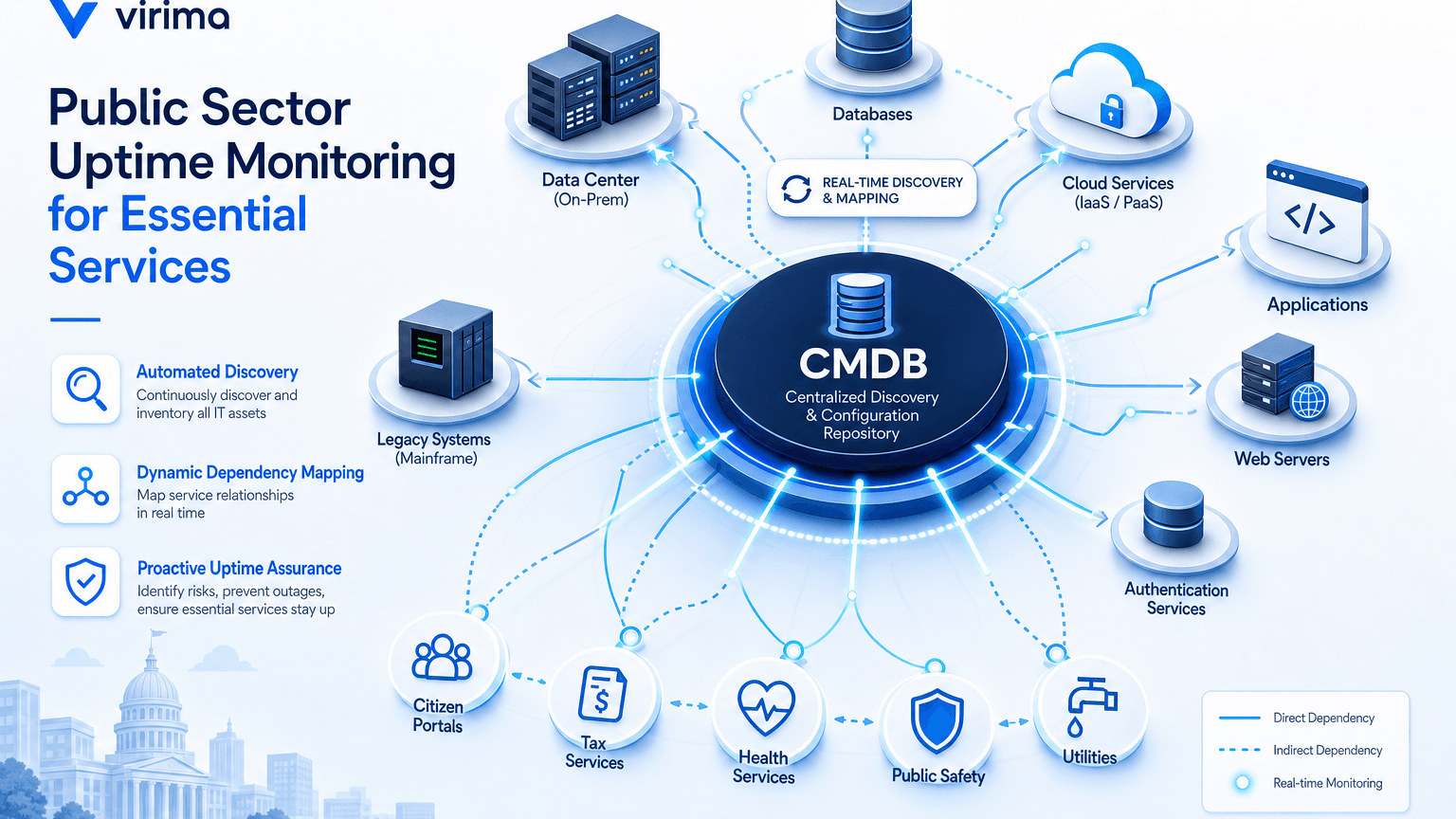
Public Sector Uptime Monitoring for Essential Services

When a state government portal or municipal emergency response system goes down, the fallout reaches far past internal IT. Unemployment benefit processing stalls, 911 dispatch systems drop calls, and property tax portals go dark, and citizens lose trust in the agency overnight.
Public sector infrastructure runs on a mix of legacy mainframes, regional data centers, multi-cloud workloads, and third-party SaaS. A single unmapped dependency can take down a service nobody flagged as fragile. Public sector uptime monitoring for essential services means replacing siloed tools with continuous automated discovery and dynamic service dependency mapping across the entire agency environment. IT Ops Directors at state and county agencies preparing for a FedRAMP or CJIS audit need that visibility most: it lets them see an outage coming instead of hearing about it from citizens first.
Why is maintaining uptime for essential public services challenging for government IT teams?
Government IT teams manage complex hybrid environments composed of decades-old legacy systems, modern cloud infrastructure, and distributed agency databases. Lacking unified service dependency mapping, unannounced infrastructure changes or hardware failures trigger cascading service outages that disrupt citizen access.
The infrastructure reality of public sector IT operations
Public sector IT environments rarely enjoy greenfield deployments. Instead, agencies inherit layers of technology accumulated across decades of legislative mandates, agency consolidations, and federal funding cycles.
According to a July 2025 GAO report, the federal government spends more than $100 billion a year on IT. Agencies have reported putting roughly 80 percent of that toward operating and maintaining systems they already have, legacy technology included, which leaves little budget or staff time to build the dependency visibility needed to catch a failure before it reaches citizens. That maintenance burden introduces three operational vulnerabilities that threaten service uptime.
1. The inter-agency dependency blindspot
Essential public services depend on interconnected agency systems. For instance, an online driver licensing renewal system relies on a central motor vehicle database, a state police background check API, a third-party payment gateway, and local DMV office web servers.
When these dependencies are managed in static spreadsheets or maintained across disconnected agency CMDBs, no single team holds a complete view of the service architecture. An unannounced network change in one department frequently severs database access for another, taking citizen-facing portals offline without warning.
2. High-blast-radius change management
In high-volume public agencies, routine maintenance and emergency patching carry elevated risk. Without clear visibility into which servers host specific database instances or middleware components, IT staff cannot evaluate change blast radius accurately.
A patch applied to a shared database host might restore a security credential while inadvertently breaking the data feed for a regional child welfare portal. That kind of outage forces agency engineers into emergency war-room sessions, lengthening Mean Time to Resolution (MTTR).
3. Untracked third-party and grant-funded systems
Grant-funded and contractor-run systems often sit outside an agency’s central CMDB, even when they’re part of the dependency chain behind a citizen-facing service. Many agency systems are funded by grant programs, run by contractors, or stood up by an individual department outside the central IT budget, so they rarely make it into the central inventory even though they sit squarely in the dependency chain for a citizen-facing service.
When a vendor changes an API endpoint or retires an old interface without notice, the outage shows up on the agency’s own citizen portal, not the vendor’s monitoring. That happens because the dependency was never mapped in the first place, so the agency’s own monitoring cannot detect the impact in advance.
How does automated discovery and service mapping restore visibility across public sector systems?
Automated discovery continuously inventories enterprise hardware, virtual servers, operating systems, and installed software builds across agency subnets. Service mapping builds dynamic dependency trees that link infrastructure components directly to essential citizen services, enabling precise blast-radius evaluation.
Establishing public sector CMDB automated discovery across segmented government networks
Government agencies operate under strict compliance mandates, such as FedRAMP, CJIS, and NIST SP 800-53, requiring strict network segmentation between sensitive citizen databases and public-facing web applications.
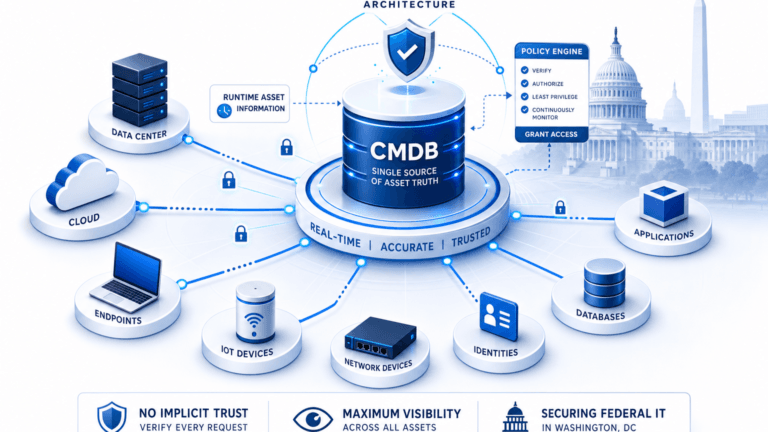
To establish full visibility without violating security protocols, agencies deploy multi-tiered discovery architecture for government agency infrastructure monitoring.
Deployment architecture for public sector networks
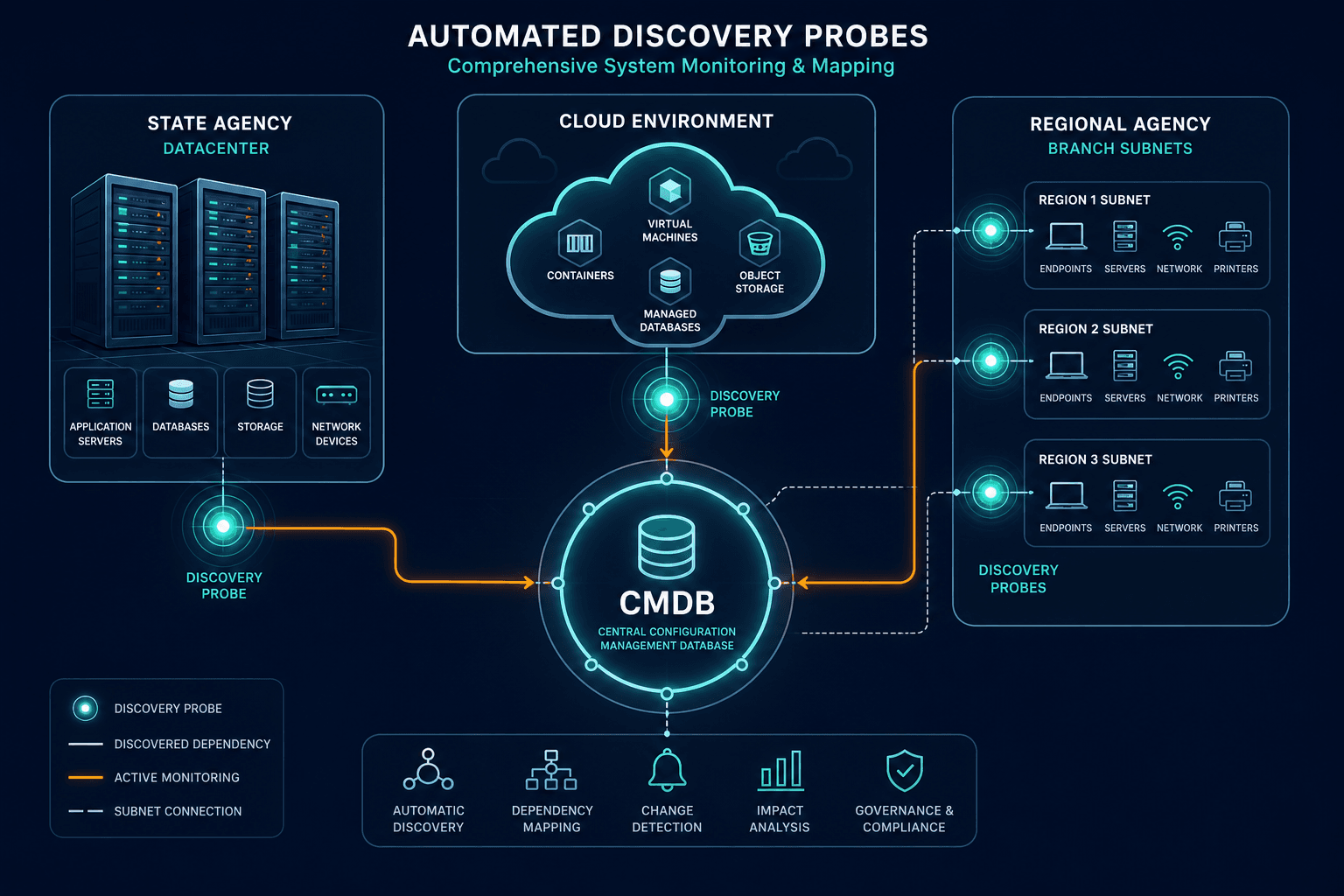
- Secure agentless probes: Deployed within secure datacenter zones and cloud environments, agentless probes use WMI, SSH, and SNMP protocols to query servers, hypervisors, and network devices without installing local software footprints.
- Segmented gateway discovery: Placed within isolated agency subnets (such as public safety or judicial networks), localized gateway probes collect configuration item (CI) data and securely relay metadata to the central CMDB over encrypted channels.
- Cloud instance integration: Native API integrations automatically track ephemeral workloads across AWS GovCloud and Microsoft Azure Government instances, capturing IP modifications and auto-scaling events as they occur.
By unifying these discovery sources into a single source of truth, public sector IT directors eliminate blind spots and ensure every asset is accounted for. That same blind-spot problem shows up in agencies that have never run a first discovery scan. To explore how automated discovery integrates with public sector service desks, visit the Virima integrations hub.
Citizen service uptime dependency mapping: connecting infrastructure assets to citizen impact
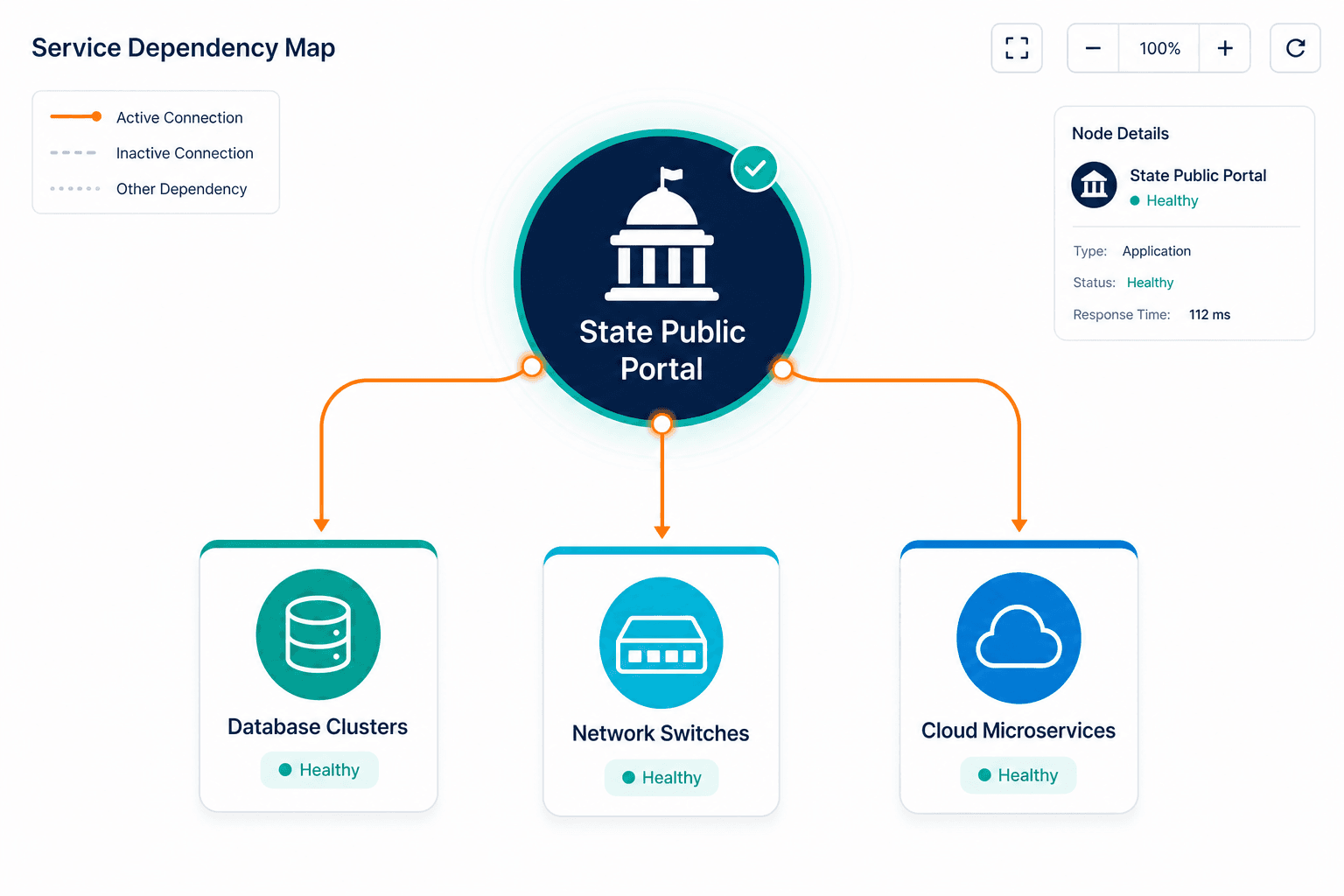
A static list of servers and IP addresses cannot explain why a citizen portal is failing. Public sector IT teams need service context to prioritize incidents and maintain operational resilience. Virima’s ViVID™ service maps build that context directly on top of discovery-sourced CMDB data, so the dependency tree updates as the environment changes instead of going stale between manual reviews — this is the government IT service mapping layer that turns raw inventory into an operational view.
Visualizing the service dependency tree
Dynamic service mapping transforms raw discovery data into actionable service maps. By analyzing running processes, network connections, and application configuration files, the mapping engine automatically identifies relationships between:
- Application layer: Public portal web interfaces, mobile application APIs, and public service forms.
- Middleware and database layer: Application servers, message queues, and relational database clusters containing citizen records.
- Infrastructure layer: Physical hypervisors, cloud instances, storage area networks (SANs), and core network switches.
When an alert triggers on a network switch, IT operators do not see an isolated IP address. They immediately see that the switch supports the primary web servers for the state emergency management agency, so they can escalate and resolve the incident before citizen services degrade.
Streamlining audits and federal compliance reporting
Public sector organizations face continuous audit cycles to verify compliance with federal security frameworks. Manual compliance reporting can require hundreds of hours of asset verification by hand.
An automated CMDB maintains a recorded history of asset configurations, patch levels, and change events, so agency managers can generate full inventory and dependency reports instantly during an audit — instead of reassembling that history by hand. Those reports show that security controls and configuration standards are enforced across every operational environment. One agency team walked through exactly how that shift played out in three decisions that changed once their discovery data could be trusted.
To see how organizations establish operational visibility and maintain service integrity, explore Trusted Runtime Truth.
Best practices for improving public sector service availability
Transforming public sector IT operations requires combining modern automation tools with structured operational governance. Government agency leaders achieve long-term uptime by adopting four strategic practices.
Start by mapping high-priority citizen services first — benefits portals, emergency dispatch, and tax payment systems — to establish quick operational wins before expanding to internal administrative systems. Next, automate pre-change impact analysis: require change advisory boards (CABs) to review automated blast-radius maps before approving infrastructure maintenance windows or software deployments, since a map that shows every downstream CI in seconds keeps the review from becoming the bottleneck that manual dependency tracing usually creates. From there, implement standardized CI governance by establishing clear data ownership rules across departments for CI naming conventions, criticality tiers, and technical owner assignments — a CI without an assigned owner is a CI nobody responds to when it drifts out of compliance. Finally, integrate ITSM and monitoring systems by connecting discovery-sourced CMDB data directly with incident management platforms such as ServiceNow, Jira Service Management, Ivanti, and Cherwell, equipping service desk technicians with instant service context during critical outages.
The cost of skipping this work is not hypothetical. A Microsoft Azure outage in late October 2025 disrupted online government services across several departments, with some restored only hours later (PublicTechnology). Agencies that had already mapped which cloud components supported their citizen services could tell citizens what was affected within minutes. The ones that had not spent those hours guessing.
What are the primary operational benefits of CMDB automation for public agencies?
CMDB automation eliminates manual inventory errors, speeds incident resolution during public outages, reduces compliance audit preparation from weeks to hours, and prevents service disruptions caused by unmapped infrastructure changes.
Building resilient public infrastructure for the digital era
As government entities expand digital service delivery, citizen expectations for government portal availability mirror those of commercial banking and e-commerce platforms. Operating critical public services on unmapped, fragmented infrastructure is no longer acceptable.
By combining continuous automated discovery, accurate configuration tracking, and dynamic service dependency mapping, public sector IT organizations achieve real operational resilience. They protect essential services, accelerate incident response, and fulfill their core mission of serving the public reliably.
Frequently Asked Questions
How does automated discovery maintain security compliance across air-gapped government subnets?
Automated discovery uses local proxy gateway probes installed within secured network segments. These probes conduct agentless scans locally and transmit encrypted configuration metadata to the central CMDB without opening inbound firewall ports or violating air-gap security protocols.
Can service dependency mapping integrate with existing public sector ITSM tools like ServiceNow and Jira?
Yes. Virima integrates directly with major ITSM platforms, including ServiceNow, Jira Service Management, Ivanti, and Cherwell, enriching existing service desk tickets with discovery-sourced asset dependency maps and configuration histories.
How does service mapping reduce MTTR during a public service outage?
Virima’s ViVID™ service maps link technical infrastructure assets directly to business services. When a failure occurs, technicians immediately identify the exact upstream database, network node, or server causing the issue, cutting diagnostic time and accelerating recovery.
How does Virima’s ViVID™ service mapping differ from a manually maintained dependency spreadsheet for government agencies?
A spreadsheet is a snapshot that goes stale the moment an agency adds a server, retires an application, or changes a network path. ViVID™ service maps update automatically from discovery-sourced CMDB data, so the dependency tree reflects what is actually running today rather than what someone recorded during the last manual review.