ITOM Governance with Automated Discovery Tools

Effective ITOM governance depends on data accuracy above all else. For IT operations teams managing hybrid infrastructure, outdated asset records directly undermine daily operations. Undocumented configuration relationships prevent teams from assessing risk accurately. As a result, incident response slows down and compliance audits stall.
This article explores how discovery-driven IT discovery tools and service mapping solve core data governance challenges. Furthermore, we examine how Virima’s IT discovery capabilities and ViVID™ service mapping deliver the operational foundation that governance frameworks require.
| What is ITOM governance? ITOM governance is the set of policies, processes, and controls that govern how an organization discovers, inventories, monitors, and manages its IT operations. It covers five disciplines: asset management, configuration management, compliance and auditing, risk management, and service delivery. Each discipline depends on accurate, discovery-sourced data to function as intended. |
Understanding the facets of ITOM governance
ITOM governance covers core activities that align service management ITSM with overall business goals. Consequently, organizations maintain compliance and hit performance objectives reliably. For broader context, Virima covers the fundamentals in our guide on what ITOM is and why it matters. Key facets include:
Asset management
Asset management requires maintaining an accurate inventory across all IT assets. Specifically, this inventory includes hardware, software, licenses, and cloud resources. Effective asset management gives leadership complete visibility into asset locations, ownership, and daily utilization.
Indeed, this visibility supports budgeting, capacity planning, compliance, and security. However, the Flexera 2025 State of ITAM Report tells a stark story. Complete asset visibility dropped to 43% of organizations, down from 47% year-over-year. Without this baseline, companies overspend on redundant assets, fail regulatory audits, and miss unpatched vulnerabilities.
Configuration management
Configuration management maintains strict control over asset configurations and their operational relationships. Teams actively track changes, ensure system consistency, and document critical dependencies. In practice, this also means expanding abbreviations so all documentation stays precise across the IT estate.
As a result, this discipline minimizes service disruptions from misconfigurations. When IT teams evaluate configuration relationships before deploying changes, risk drops significantly. A well-maintained CMDB serves as the operational system of record. For guidance, review our principles for successful CMDB implementation.
Compliance and auditing
Compliance management ensures IT operations adhere strictly to regulatory standards and internal policies. Operations teams document compliance activities, conduct internal audits, and produce verified audit evidence.
In fact, compliance failures trigger heavy legal penalties, expose sensitive data, and destroy customer trust. In addition, the Flexera 2025 State of ITAM Report reveals 45% of surveyed organizations spent over $1 million on software audits across three years. A further 23% spent over $5 million. Incomplete asset records directly drive this financial exposure.
Risk management
IT risk management identifies, assesses, and mitigates potential operational risks. Operations management ITOM teams analyze vulnerabilities, evaluate threat impact, and deploy targeted mitigation strategies.
Accurate dependency data determines whether a risk assessment succeeds. Without clear connection mapping, teams cannot evaluate blast radius accurately. Notably, the IBM Cost of a Data Breach Report 2024 places the average breach cost at $4.88 million. Incomplete asset records and unmanaged configuration relationships increase attack surface and make breaches harder to contain once they begin.
Service delivery
Modern service delivery ensures IT services operate reliably while advancing business operations ITOM goals. Teams monitor performance metrics, enforce SLAs, and refine service operation workflows.
Therefore, discovery-sourced configuration data provides the mandatory prerequisite for reliable service delivery. Stale data undermines service commitments and delays root-cause diagnosis.
How discovery-driven IT data strengthens ITOM governance
Discovery-driven data forms the foundation of modern IT operational governance. Traditional manual inventory methods waste time and introduce errors. Over time, these errors compound across the IT estate. Virima high-frequency discovery capabilities resolve these issues across the entire asset life cycle.
- Comprehensive asset inventory: High-frequency discovery provides an accurate view of all IT assets, including hardware, software, cloud resources, and non-IT assets. This eliminates data silos and establishes a single source of truth for downstream governance processes.
- Scheduled discovery cycles: Virima runs high-frequency discovery cycles to identify and track new assets as they are added to the network. This keeps the inventory aligned with the current state of the IT estate without requiring manual intervention each time the environment changes.
- Improved compliance and auditing: Accurate asset data is the prerequisite for demonstrating regulatory compliance. Discovery-built records simplify auditing by providing readily available, reliable information, which reduces audit preparation time and increases confidence in the evidence produced.
| How does high-frequency discovery improve ITOM governance? High-frequency IT discovery improves ITOM governance by generating accurate, discovery-built asset records without manual effort. When every hardware device, software installation, and cloud resource is cataloged through scheduled scans, compliance audits, risk assessments, and change impact analyses all start from verified data rather than estimates. This reduces audit preparation time and lowers the risk of compliance gaps. |
For IT leadership, Virima Trusted Runtime Truth framework shows how live discovery data transforms raw assets into governed operational intelligence.
| Ready to strengthen your ITOM governance? Explore the Trusted Runtime Truth framework |
Service mapping and ViVID™: visualizing dependencies for effective governance
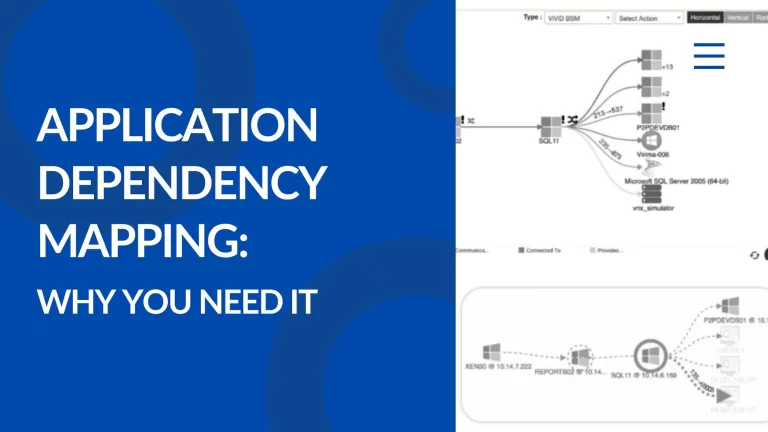
Service mapping extends governance beyond asset tracking by visualizing component dependencies. For details, explore Virima guide to ITOM service mapping. Specifically, Virima ViVID (Virima Visual Impact Display) enhances dependency maps with real-time operational overlays.
- Dynamic Dependency Mapping: Service mapping builds visual dependency maps across IT components. These maps clarify proposed change impacts before deployment.
- Data-Driven Insights: ViVID overlays ITSM data, vulnerability metrics, and change history onto dynamic maps. This context eliminates guesswork during root cause analysis.
- Proactive Risk Mitigation: Dependency visualization highlights single points of failure. Consequently, teams evaluate risk scope accurately and prioritize remediation.
- Configuration Management Support: Service maps deliver clear visibility across infrastructure configurations. Teams prevent unintended change consequences before execution.
| What does ViVID do in ITOM governance? ViVID (Virima Visual Impact Display) is Virima’s service dependency mapping capability. It overlays ITSM data, vulnerability information, and change history onto visual service maps built from discovery-driven CI relationships. In ITOM governance, ViVID supports change risk assessment by showing which services depend on a CI before a change is authorized, and supports incident resolution by mapping the path from symptom to root cause. |
Bridging the gap between ITOM governance and ITSM governance
ITSM governance depends directly on reliable operational telemetry from IT operations management. High-frequency discovery and service mapping bridge these two governance domains effectively. The critical ITSM-ITOM connection runs through the CMDB. When CMDB data remains accurate, both teams operate from verified facts.
- Improved incident management: Accurate asset and dependency data enables faster incident resolution. When responders can identify affected CIs and their relationships quickly, they spend less time reconstructing the environment. This minimizes downtime and improves service delivery.
- Enhanced change management: Visualizing dependencies before a change is approved reduces the risk of service disruptions. Change advisors gain the context needed to evaluate risk accurately rather than relying on the requestor’s knowledge of the environment.
- Data-driven service delivery: Accurate asset and configuration data supports service delivery decisions grounded in verified facts. IT services align to business needs more reliably when the underlying asset record reflects what is actually running.
| How does discovery connect ITOM and ITSM governance? Discovery-driven data connects ITOM and ITSM governance by providing a shared, accurate data foundation for both disciplines. Asset records built from scheduled discovery feed the CMDB that ITSM processes (incident management, change management, and problem management) depend on. When that data is discovery-driven, incident responders and change advisors work from verified CI relationships rather than assumptions |
The role of IT operations management in effective governance
IT operations management provides the operational foundation for a governance program to function. Virima’s IT operations management software delivers that foundation, giving governance teams a single platform for discovery, CMDB, and service mapping instead of stitching together point tools. A well-defined IT operations management framework aligns people, processes, and tools around shared operational goals. Discovery-driven data and dependency visualization give that framework a reliable data layer to build on. Virima’s ITOM platform capabilities are designed to support this foundation.
- Proactive monitoring: Discovery-built CI records make it possible to identify potential issues before they cause service disruptions. Teams that know exactly what exists in their environment can monitor the right assets and act on the right signals.
- Workflow-driven remediation: Remediation workflows built on accurate asset data can address issues quickly. When the CMDB reflects the current state of the environment, workflows act on verified records rather than stale ones.
- Data-driven decision-making: Discovery-driven data supports decisions about capacity, security, and change that reflect what the environment actually looks like, not what it looked like during the last manual inventory.
Importantly, governance urgency is accelerating. Gartner projects agentic AI will handle at least 15% of work decisions autonomously by 2028. That figure stands at 0% today. To that end, autonomous AI agents require a CMDB accurate enough to guide actions safely.
| What IT operations management tools support ITOM governance? IT operations management tools that support ITOM governance include high-frequency discovery platforms, CMDB solutions, and service mapping tools. Effective governance requires tools that can identify all assets without manual input, track configuration relationships across hybrid environments, and visualize service dependencies for change and incident management. Virima combines discovery, CMDB, and service mapping in a single platform to support all three requirements. |
How Virima makes ITOM governance work in practice
Effective ITOM governance demands foundational data accuracy and clear dependency visibility. High-frequency discovery and ViVID service mapping deliver both capabilities. By unifying ITOM and ITSM through a shared infrastructure data layer, organizations reduce governance failure risks.
Virima executes scheduled discovery cycles, constructs dynamic service maps, and maintains live accuracy across hybrid estates. Consequently, enterprises lower operational risk and simplify compliance readiness. To expand your knowledge, read our detailed analysis on IT operations management functions and how they feed into a governed IT operation.
| Ready to strengthen your ITOM governance? Schedule a demo with Virima! |
Frequently asked questions
What is the difference between ITOM governance and ITSM governance?
ITOM governance focuses on managing the IT infrastructure itself. Assets, configurations, capacity, and availability. By contrast, ITSM governance focuses on how IT services are designed, delivered, and improved. The two depend on each other. ITSM processes need the accurate asset and configuration data that ITOM governance provides.
Why is discovery-driven data important for ITOM governance?
Discovery-driven data removes the manual effort and error risk from asset inventory. Specifically, every downstream governance process. Compliance auditing, risk assessment, change impact analysis. Depends on knowing what exists and how it is configured. Asset records built from scheduled discovery are more accurate and more current than manually maintained ones. This makes every governance process that draws on them more reliable.
Supported integrations: ServiceNow, Jira Service Management, Ivanti, Halo, Xurrent, Hornbill.
How does service mapping support change governance?
Service mapping shows the dependency relationships between CIs before a change is implemented. When a change advisor can see which services depend on the CI being modified, they assess potential impact accurately. This reduces both change-related incidents and unnecessary change blocks due to missing context.
What is ViVID and how does it relate to ITOM governance?
ViVID (Virima Visual Impact Display) is Virima’s service dependency mapping tool. It builds visual maps of how IT components relate to one another, using CI data generated by high-frequency IT discovery. In ITOM governance, ViVID provides the dependency visibility that change management, incident resolution, and risk assessment each require.
How does a CMDB support ITOM governance?
A CMDB stores the configuration items and relationships that form the basis of IT operations management decisions. A discovery-maintained CMDB provides an accurate, auditable record of the IT environment. Scheduled discovery cycles keep that record current automatically. This supports compliance evidence, change risk assessment, and incident root cause analysis.