IT operations management functions: Mastering every aspect

Are you struggling to keep your organization’s workstations and assets running smoothly? Do you worry about fixing issues quickly, especially during major disruptions? Detecting IT problems early and resolving them fast can prevent bigger issues. IT operations management functions help with all these challenges.
This guide covers Virima’s approach to IT operations management (ITOM) and how ITOM processes drive IT success. We’ll also walk through practical implementation strategies using Virima’s IT operations management functions.
What are the key IT operations management functions?
IT operations management handles a company’s technology needs and infrastructure. It keeps IT services available, performing well, and meeting capacity demands. As a core part of IT service management (ITSM), ITOM processes manage the entire service lifecycle. To deliver these outcomes consistently, organizations need a structured IT operations management framework that ties each function together under a unified strategy.
Here are the key IT operations management functions:
- Asset management tracks IT assets throughout their lifecycle, improving usage and reducing costs.
- Configuration management maintains accurate records of IT components and their relationships, helping IT teams diagnose and resolve issues faster.
- Event management monitors IT systems continuously, detecting alerts and potential issues before they escalate.
- Incident management resolves IT issues quickly, minimizing downtime and protecting business continuity.
- Problem management identifies root causes of recurring incidents, preventing future disruptions and cutting long-term risk.
- Change management manages IT changes with minimal risk and impact.
- Service mapping visualizes dependencies between IT components and business services, helping IT teams see how disruptions affect operations.
- Performance monitoring tracks system performance so IT teams can detect and address bottlenecks before they reach users.
- Capacity management aligns IT resources with business demands. Proper capacity planning prevents resource shortages and slowdowns.
- Security and compliance management protect IT systems from threats while meeting regulatory requirements.
What is the difference between ITOM and ITSM?
ITOM and ITSM work together but serve different purposes. ITOM focuses on the health and performance of IT infrastructure: servers, networks, applications, and cloud resources. ITSM focuses on delivering IT services to end users through structured processes like incident, change, and request management.
Think of ITOM as keeping the engine running, while ITSM handles the customer-facing service experience. Most organizations need both. A strong ITOM practice feeds accurate infrastructure data into ITSM workflows, speeding up incident resolution and improving change planning.
Why do IT operations management functions matter?
IT operations management functions go beyond keeping systems online. They boost efficiency, security, and productivity while supporting long-term business goals.
- Improves IT efficiency. ITOM automates routine tasks, freeing IT teams to focus on strategic work.
- Reduces downtime. Proactive monitoring and incident management help resolve issues before they disrupt business operations.
- Strengthens security. ITOM processes enforce compliance with security policies, reducing exposure to cyber threats and vulnerabilities.
- Controls IT costs. Asset and capacity management prevent over-provisioning and underused resources.
- Protects business continuity. Reliable ITOM processes minimize disruptions and keep critical services running.
- Supports compliance. ITOM helps organizations meet industry regulations by tracking assets and enforcing security policies.
- Improves decision-making. Near real-time insights from IT operations management functions help leaders make informed decisions about IT investments.
Managing IT operations management functions without the right tools is complex and time-consuming. Virima simplifies ITOM processes with automation, near real-time visibility, and actionable insights so organizations can reduce risks, cut costs, and run IT operations more effectively.
What tools are needed for IT operations management?
Effective ITOM needs several core tools working together: an IT discovery platform to find and track assets, a CMDB to store configuration data and relationships, a service mapping tool to visualize dependencies, and an ITSM platform to manage incidents and changes. Organizations also need monitoring and alerting integrations to catch issues early.
Virima brings discovery, CMDB, service mapping, IT Asset Management, and ITSM into a single platform. It also integrates with ITSM tools like ServiceNow, Ivanti, Jira Service Management, HaloITSM, Cherwell, Xurrent, and Hornbill. Teams can build on their existing stack instead of ripping and replacing.
Virima’s approach to IT operations management functions
IT operations management helps you keep your systems running smoothly and securely. It supports your day-to-day work by managing operating systems and handling routine tasks. In addition, it improves service delivery and keeps processes consistent. You also rely on it for server and device management and strong network infrastructure management. As a result, your ITOM teams can manage incidents in real time and reduce downtime.
However, traditional ITOM solutions often create challenges. For example, you may face data silos and limited visibility across your information technology environment. Because of this, your operations teams struggle to manage data and respond quickly. It also becomes harder for your service desk to resolve issues on time. Over time, this slows down your ITOM and ITSM processes and affects daily operations.
Virima solves these problems with a simpler and more connected approach. It combines automated discovery with a unified CMDB to give you clear visibility. At the same time, it supports service management and improves event management for faster response. This helps you fix issues before they grow into bigger problems. As a result, you improve system stability and strengthen your disaster recovery plans.
Now, let’s see how Virima helps your team succeed across every part of IT operations management.
1. Gain complete IT asset visibility with Virima
IT Asset Management (ITAM) tracks assets throughout their lifecycle to improve usage, ensure compliance, and reduce costs. Without a centralized system, ITOM teams struggle to manage hardware, software, and cloud resources.
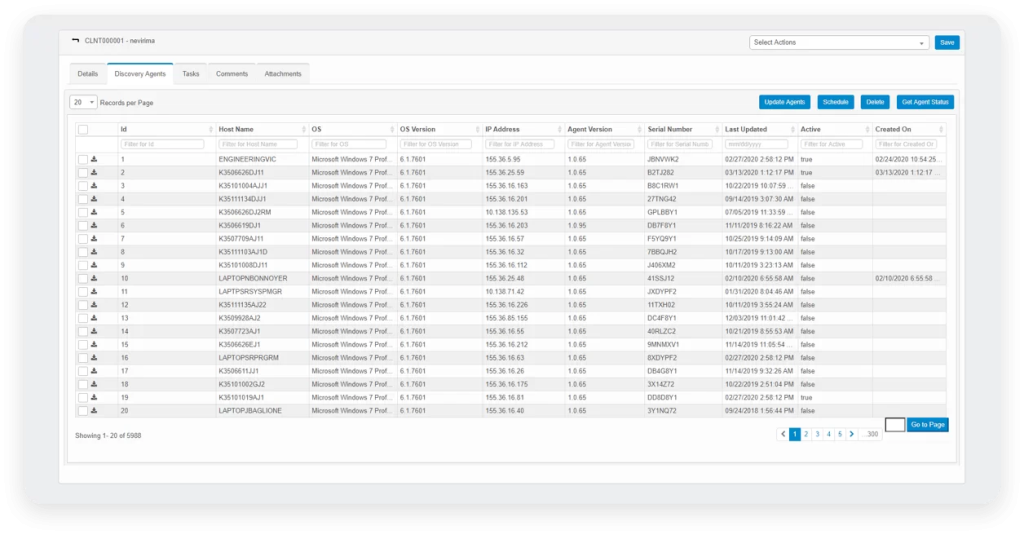
How Virima helps:
- Virima discovery automates asset identification across on-premises, AWS, and Azure environments using 100+ extendable probes. No more manual tracking.
- The IT asset repository stores asset details in one place, ensuring accurate reporting and easy access.
- Software license metering tracks usage, preventing over-licensing and ensuring compliance with vendor agreements.
Addressing IT asset visibility gaps with IT discovery
Limited visibility increases compliance risks, security threats, and wasted resources. IT teams often struggle to track assets, leading to shadow IT and unplanned costs.
Virima’s agent-based and agentless discovery scans networks to detect hardware, operating systems, and applications. Discovery agents enable persistent configuration monitoring and software usage tracking on Windows, Linux, and macOS devices, including those that roam off-network or connect remotely.
- Ensures near real-time inventory accuracy, improving infrastructure and device management.
- Identifies unauthorized assets, reducing security risks.
- Helps allocate resources more efficiently.
Optimizing asset lifecycle management with ITAM
Poor asset lifecycle management causes underused hardware, untracked software, and unnecessary expenses. Without a structured ITAM strategy, IT teams can’t optimize their assets.
Virima’s ITAM tracks assets from purchase to retirement, giving teams complete lifecycle visibility.
- Maintains accurate records of ownership, usage, and depreciation.
- Strengthens server and IT device management.
- Gives IT teams the data to plan ahead and avoid duplicate or unnecessary purchases.
2. Enhancing IT operations management functions with configuration management
Configuration management helps IT teams track and manage systems, applications, and dependencies. Accurate records reduce service disruptions and improve compliance. Outdated or incomplete records, on the other hand, increase risks and delay issue resolution.
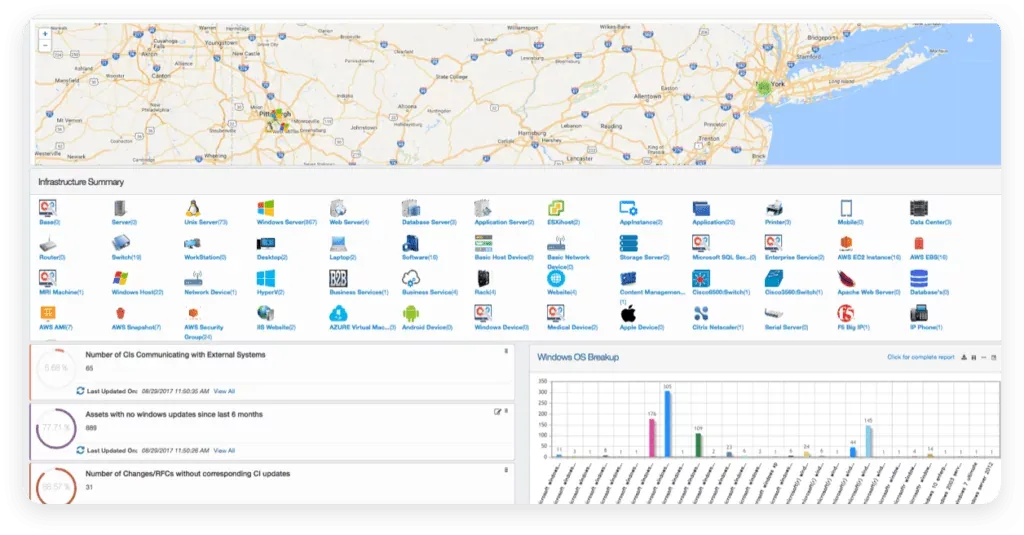
How Virima helps:
- Virima CMDB centralizes configuration data, giving IT teams a single source of truth.
- Automated dependency mapping discovers relationships between applications, servers, and networks, keeping records current.
- Data from multiple integrations feeds into one CMDB, enabling informed decision-making.
- Reporting and auditing capabilities support inventory management, software licensing, security, and GRC audits.
Ensuring reliable IT operations with CMDB
An incomplete CMDB slows incident resolution, weakens security, and complicates change management. IT teams need accurate data to make smart decisions.
Virima’s CMDB is PinkVERIFY ITIL 4 certified across six processes, including SACM, change management, incident, problem, request, and knowledge management. This simplifies asset and configuration management while reducing maintenance work through automation.
- Help desks resolve issues faster with near real-time configuration insights.
- Teams assess risks accurately and plan changes with confidence, enabling better change management.
- Accurate data helps meet security and regulatory requirements.
Maintaining configuration accuracy with discovery agents
IT systems change constantly. Without continuous tracking, misconfigurations and unauthorized changes go unnoticed, creating security gaps and performance issues.
Virima’s discovery agents persistently monitor configuration changes across Windows, Linux, and macOS systems. Combined with scheduled agentless scans, this ensures the CMDB stays current without manual updates.
- Accurate updates: IT teams get frequent, automated insights into configuration changes.
- Stronger security: Unauthorized changes trigger alerts, reducing compliance risks.
- Better performance: Up-to-date records help prevent downtime and speed up troubleshooting.
3. Unlocking IT service insights with service mapping
IT teams need to understand how applications and infrastructure components connect. Without proper service mapping, finding service issues and analyzing their impact takes longer.
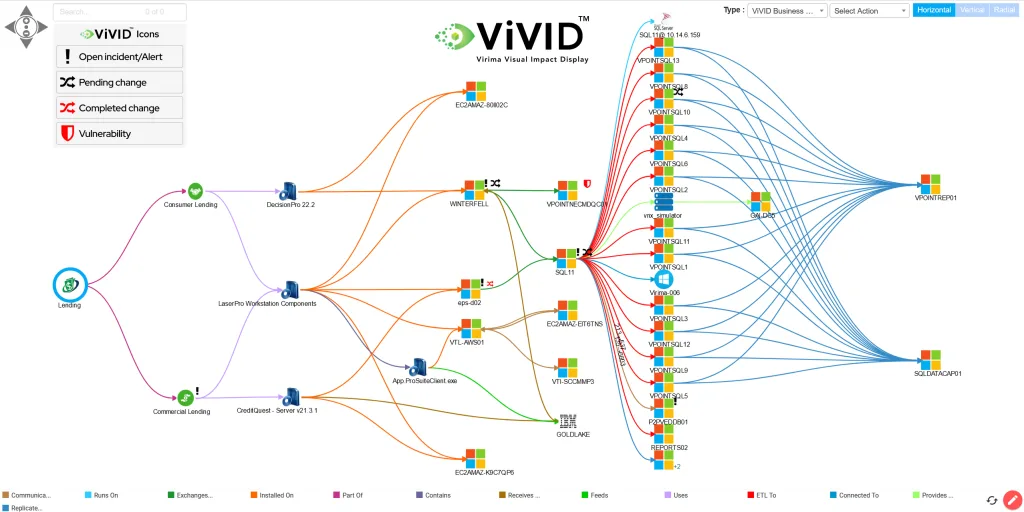
How Virima helps:
- ViVID™ (Virima Visual Impact Display) turns Virima’s automated service maps into an operational heads-up display, overlaying ITSM incidents, changes, alerts, and NVD vulnerabilities onto interactive dependency views.
- Near real-time updates keep service maps current, reducing troubleshooting and impact assessment time.
- Customizable views let IT teams see service dependencies based on their specific needs.
Mapping service dependencies for faster issue resolution
Without clear service maps, finding root causes takes longer and impacts spread before teams can act.
- Virima’s service mapping automates dependency discovery, creating detailed IT relationship maps powered by data from both agentless scans and agent-based monitoring.
- Autonomic Social Discovery™ complements these maps by gathering human intelligence like asset ownership, business criticality, and SLA assignments that automated scans can’t capture.
- Stronger infrastructure management helps teams identify critical components and their upstream and downstream dependencies.
4. Optimizing IT operations with proactive event monitoring
Proactive event monitoring helps IT teams detect and fix issues before they cause major disruptions. Virima’s ITOM integrates with event management platforms like SolarWinds, Nagios, and Logic Monitor, bringing alerts and monitoring data into ViVID™ service maps alongside ITSM records and vulnerability data.
How Virima helps:
- Integration with ITSM platforms like ServiceNow, Ivanti, and Jira Service Management connects incident tracking to infrastructure data for faster resolution.
- ViVID™ service maps give IT teams a visual overview of service dependencies, open incidents, recent changes, and known vulnerabilities in one place, helping teams act on issues before they escalate.
Improving incident response with ViVID™
Without clear infrastructure visibility, IT teams struggle to understand how incidents affect business services. Slow root-cause analysis extends downtime.
- ViVID™ overlays ITSM incidents, changes, alerts, and vulnerabilities onto interactive service dependency maps.
- Visualizing service health and potential risks accelerates incident resolution and helps prevent future disruptions.
- Help desk teams can pinpoint incident root causes quickly, reducing mean time to repair (MTTR) and improving service reliability.
How do you measure IT operations management functions success?
Tracking the right KPIs helps IT teams prove ITOM value and identify improvement areas. Here are some worth watching:
- Mean time to repair (MTTR): How quickly teams resolve incidents. Lower MTTR signals strong service mapping and incident workflows.
- CMDB accuracy rate: The percentage of configuration items that match their actual state. Automated discovery keeps this high.
- Change success rate: How often changes deploy without causing incidents. Accurate dependency maps from ViVID™ improve pre-change impact analysis.
- Asset utilization rate: Whether hardware and software are being used or sitting idle. ITAM tracking highlights underused resources.
- Unplanned downtime: Total minutes of unplanned service outages. Proactive monitoring and event integration reduce this over time.
5. Strengthening IT security through NIST compliance standards
Effective IT operations management requires a proactive approach to security risks. Vulnerability management is a critical piece: it keeps IT assets secure and compliant. The National Vulnerability Database (NVD) plays a key role by providing a centralized repository of known vulnerabilities.
The NVD assigns Common Vulnerabilities and Exposures (CVE) identifiers to publicly disclosed vulnerabilities. These identifiers help IT teams track and assess risks tied to specific software versions. Managing vulnerabilities manually can be overwhelming, especially in complex IT environments.
How Virima helps:
Virima integrates automated discovery and asset management with NVD vulnerability insights. NIST NVD integration is included at no additional cost. This helps organizations:
- Identify vulnerabilities across IT assets using automated CVE checks.
- Prioritize risks based on near real-time threat intelligence and asset criticality via ViVID™ service maps.
- Focus remediation on assets that matter most to business services.
Aligning with NIST standards for compliance
Aligning with NIST standards helps you stay secure and compliant. Security and compliance always go hand in hand, so you need both. With Virima, you can match discovered vulnerabilities to trusted NIST guidelines. This makes it easier for you to understand risks and take the right action. As a result, you stay on track with industry requirements.
At the same time, your IT team can fix threats faster and with more confidence. You do not need to guess what to do next. Instead, you follow clear standards that guide your response. In addition, Virima holds SOC 2 Type II certification, which builds trust with your stakeholders. This gives you stronger assurance that your systems and data stay protected.
Strengthen IT operations with Virima’s discovery-driven ITOM platform
Virima’s ITOM solutions help you manage complex IT environments with ease. You gain clear visibility into your systems and how they connect. At the same time, you can automate routine tasks and reduce manual work. This helps your team stay focused and work more efficiently. As a result, you improve both speed and accuracy.
Virima also covers key IT operations management functions you rely on every day. For example, you can manage assets, track configurations, and map services easily. In addition, you can respond to incidents faster and with better context. This reduces downtime and lowers security risks. Over time, you also cut costs and improve overall performance.
So, if you want to simplify your IT operations, Virima is a strong choice. It gives you the tools you need without adding extra complexity. You can take control of your environment and make better decisions faster. Go ahead and request a demo to see how it works in real time.