Jira IT Service Management and Virima: An Integrated Approach to Dynamic IT Operations

Virima enriches Jira by adding discovery-driven CI data to your Jira CMDB. When you connect Virima’s high-frequency discovery cycles and ViVID service maps to Jira, your team gets accurate configuration item (CI) data, clear dependency context, and faster incident resolution, all without ongoing manual effort. See how Jira CMDB and Virima ensure data trust for a practical walkthrough of what this looks like in your environment.
What Does Virima Discovery Do for Jira IT Service Management?
Virima Discovery keeps your Jira CMDB populated with current, accurate data. Rather than relying on manual updates, it runs high-frequency discovery cycles across your hybrid environment using agent-based, agentless, and API methods. For cloud environments, coverage extends to AWS and Azure via API-based discovery. See the full capability set on the Virima and Jira Service Management integration page.
When paired with ViVID service maps, the output of each discovery cycle becomes immediately actionable. Your team can see exactly how CIs relate to business services, spot potential impact before making a change, and reduce the guesswork that slows incident resolution. For a broader picture of what the Virima CMDB looks like with discovery feeding it, explore what a fully populated, multi-source CMDB delivers in practice.
ViVID Service Mapping for Jira IT Service Management
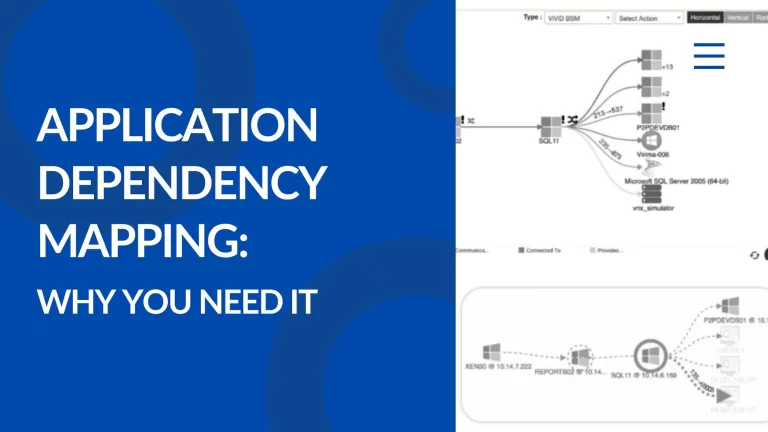
ViVID service maps give you a dynamic picture of how your IT components connect to the services your business depends on. When integrated with Jira IT service management, ViVID Visual Impact Display surfaces relationships and dependencies that would otherwise require hours of manual investigation. For a deeper look at what ViVID delivers, see what is ViVID service mapping.
Services are defined by your team, not auto detected. You provide the service definitions, manually, via spreadsheet import, or through integrations such as Lea nix, and Virima builds the dependency map from discovery data. The result reflects your actual environment. To understand why this matters operationally, see why CMDB business service mapping is critical.
Comprehensive Discovery and Dependency Mapping
Virima Discovery, connected to ViVID, gives your team the most complete asset picture across your IT environment. Combined, they turn raw CMDB data into a clear view of how infrastructure supports business services. A well-populated Jira CMDB supports confident change decisions and faster problem resolution. For the full discovery capability set including agent-based discovery across Windows, macOS, and Linux, Virima covers every node in your estate.
High-Frequency Discovery with Scheduled Probes
Manual service mapping is slow, error-prone, and difficult to maintain in complex environments. Scheduled discovery probes keep your Jira CMDB current without ongoing manual effort. The result is faster service delivery and a more reliable foundation for every ITSM decision. A CMDB without discovery is just a database — the scheduled probe cycle is what makes it a live, trusted resource.
Strengthened IT Service Delivery
Connecting service maps to Jira IT service management structures how your team handles incidents, problems, and changes. CMDB records stay current, SLAs become easier to meet, and your team spends less time hunting for context during active incidents. For a closer look at how ITIL-compliant ITSM software integrates with this discovery-backed CMDB, see how Virima’s ITSM module operates alongside Jira. Teams already using Jira can also explore maximizing ITSM efficiency with Atlassian Jira and Virima for scenario-level detail.
Lower Operational Costs
ViVID service maps speed up incident resolution, problem management, and change approval. Faster resolution means less downtime. Proactive problem management, built on discovery-driven insight, reduces recurring incidents over time. For a detailed look at how dependency context accelerates triage, see root cause analysis in IT incident management.
Improved Security and Compliance
ViVID provides detailed visibility into assets and their dependencies, helping your team identify hidden or untracked assets that may carry risk. NIST NVD lookups surface vulnerability data at the CI level. For organizations with broader security requirements, cybersecurity asset management extends this coverage across the full asset inventory. The role of CMDB compliance in IT security and risk management covers how discovery-sourced CI data supports compliance frameworks such as PCI-DSS, SOX, and ISO 27001.
Better-Informed Decision-Making
The complete picture provided by ViVID helps IT teams make sharper decisions about infrastructure upgrades, resource allocation, and service improvements. Knowing which CIs underpin which services makes planning more precise. ITIL change management and CMDB accuracy explains how this dependency visibility directly reduces change-related risk. For teams managing a broader IT operations portfolio, Virima’s ITOM platform connects discovery, CMDB, service maps, and ITSM into a unified operations view.
No-Code Integration with Jira
Virima’s no-code integration with Jira IT service management simplifies adoption. Custom development is not required. Reduced setup complexity means fewer integration errors and faster time to value. For a wider view of all available ITSM connections, see the full integrations list, which includes ServiceNow, Ivanti, Halo, Xurrent, and TeamDynamix alongside Jira.
Benefits of Using Virima with Jira IT Service Management
Combining Virima Discovery and ViVID service maps with your Jira platform delivers value across multiple dimensions. Here is what your team gains.
Faster Time to Value
Virima Discovery identifies elements of your IT environment and produces accurate records of business services, application dependencies, and infrastructure relationships. Paired with Jira IT service management, this gives your team a clear view from day one, cutting manual mapping effort and reducing CMDB errors that slow incident workflows. See the most impactful Jira service manager tool examples for a scenario-level breakdown. For the asset lifecycle dimension, IT asset management covers how Virima tracks hardware, software licenses, and contracts alongside CMDB data.
Thorough Data Maintenance
Virima’s scheduled discovery probes maintain a current, valid CMDB without requiring manual intervention. Each cycle removes stale records, adds newly detected assets, and updates changed configurations. For principles behind keeping CMDB data reliable at scale, CMDB best practices covers the structural decisions that prevent data drift over time.
Discovery-Driven Service Mapping
The integration of Jira with ViVID gives your team a complete picture of complex IT services. Your team can identify connections and dependencies accurately, supporting faster incident triage and more confident change decisions. Why Virima is the best CMDB integration for ITSM processes explains how this positions Virima across all major ITSM platforms. For the broader service mapping story, the key business benefits of IT service mapping cover the operational and financial case.
Cost Efficiency
By reducing manual CMDB maintenance, cutting incident resolution time, and preventing outages through dependency visibility, the Virima and Jira combination delivers a measurable return. Organizations commonly see faster time to value at a significantly lower total cost of ownership compared to maintaining equivalent visibility manually. For cloud-specific cost control, AWS discovery and service mapping and Azure discovery keep cloud CI data current without per-asset overhead.
Enhanced Security Posture
Virima Discovery and ViVID help your team manage risk effectively. Dynamic service maps, combined with NVD vulnerability data at the CI level, give your team the context to anticipate the impact of configuration changes before they cause problems. For hybrid cloud environments, hybrid cloud asset management covers what accurate discovery means for security posture across on-premises and cloud estates.
Improved Service Quality
Accurate, current CMDB data drives better service delivery. Discovery-driven records support proactive maintenance and faster root-cause analysis. When infrastructure changes are reflected promptly in service maps, your team responds to issues with current data. Connecting ITSM incident management to CMDB is a practical guide to how CI relationships and change history accelerate root cause identification inside Jira workflows.
Flexible Reporting
The Virima and Jira combination gives your team strong reporting capabilities. You can access and analyze data on IT assets and services, spot improvement opportunities, and align resource allocation with business priorities. The Jira Insight CMDB accuracy guide covers how accurate CI data translates into more reliable reporting within Jira’s native dashboards.
CMDB Accuracy at Scale
Virima Discovery improves CMDB data quality within Jira through network-based scans and API integrations. For cloud environments, API-based discovery covers AWS and Azure. Your Jira CMDB retains reliable information, giving your team a foundation for confident decisions. For teams evaluating their CMDB approach, CMDB vs ITAM — key differences explained clarifies which layer handles what, so you configure the integration correctly.
| See how Virima’s discovery-driven Trusted Runtime Truth strengthens Jira CMDB accuracy |
Getting Started with Virima and Jira IT Service Management
Virima and Jira together help you manage your IT assets, services, and dependencies with greater confidence. The combination removes the guesswork often linked with managing complex IT services, improving visibility, service quality, and team efficiency. For a structured approach to the implementation itself, successful CMDB implementation walks through the six steps that determine whether a CMDB stays accurate after go-live.
If you are looking to streamline IT management processes, reduce costs, and build a more reliable infrastructure, the Virima and Jira integration is a practical first step. With scheduled high-frequency discovery cycles, no-code connectivity, and dynamic dependency maps from ViVID, your Jira CMDB becomes a trusted resource rather than a maintenance burden. For the full scope of what Virima’s operations platform covers, see Virima IT Operations Management for the end-to-end picture. Teams that also use ITOM-level service mapping can explore ITOM service mapping best practices for guidance on governance and implementation scope.
Turn Your Jira CMDB Into a Trusted Source of IT Truth
Your Jira IT service management platform delivers the most value when it reflects what is actually running in your environment. Virima Discovery keeps your CMDB current without manual effort. ViVID service maps give your team the dependency context to resolve incidents faster, approve changes with confidence, and stay audit-ready. The combination plugs directly into the Jira CMDB you already have and starts improving data quality from day one.
| Schedule a demo to see Virima and Jira IT service management working together |
Frequently Asked Questions
Why does Jira CMDB data become inaccurate over time?
Jira’s CMDB relies on manual updates or periodic imports unless an external discovery layer feeds it. Every time a server is decommissioned, a cloud instance is spun up, or a software version changes, someone has to update the record manually. In large, fast-moving environments, that lag compounds quickly. The result is a CMDB that reflects last quarter’s infrastructure while your team makes decisions based on today’s. Connecting a scheduled discovery layer to Jira closes that gap by refreshing CI records automatically after each probe cycle.
How does service dependency mapping reduce incident resolution time?
When an incident fires, the first question is: what else depends on the affected component? Without a service map, answering that question means manually tracing relationships across documentation, tickets, and tribal knowledge. A dependency map built from current discovery data answers it in seconds. Your team sees which business services are at risk, who owns the affected CIs, and which related components to check first. That context cuts the time between alert and action, and reduces the chance of a fix in one area creating a new incident in another.
What is the difference between CMDB data and full IT asset management in Jira?
The Jira CMDB tracks configuration items (CIs) and their relationships — servers, applications, network devices, and how they connect to business services. IT asset management (ITAM) goes further: it tracks the full lifecycle of hardware and software, including procurement records, contracts, license entitlements, and disposal. CMDB data answers “what is running and how is it connected.” ITAM data answers “what do we own, what are we paying for, and when does it expire.” For organizations using Jira IT service management, adding a discovery layer improves CMDB accuracy; adding ITAM alongside it gives finance and procurement visibility into the same asset records.
How does Virima improve Jira IT service management without replacing it?
Virima connects to your existing Jira CMDB via a no-code integration and enriches it, rather than replacing it. Virima’s high-frequency discovery cycles populate the CMDB with current CI data. ViVID service maps layer dependency context on top of those records inside Jira. Your team continues working in Jira for incident management, change approval, and problem workflows. Virima supplies the accurate, discovery-driven data those workflows depend on. The setup requires no custom development, and the enriched CMDB becomes available to everyone already using Jira, without a platform migration.