ITOM for Infrastructure Directors: Fix Ownership When Platform Modules Stop at Scope

On June 12, 2025, a policy change landed in regional Spanner tables with blank fields. It replicated across Google Cloud within seconds, and a null pointer put Service Control binaries into a crash loop. The code had shipped on May 29, 2025 without a feature flag. A “red-button” rollout finished within about 40 minutes, according to the Google Cloud incident report. Service Control sits in the path of API authorization and quota checks for many customer workloads. After an event like that, ITOM for infrastructure directors stops being a dashboard problem.
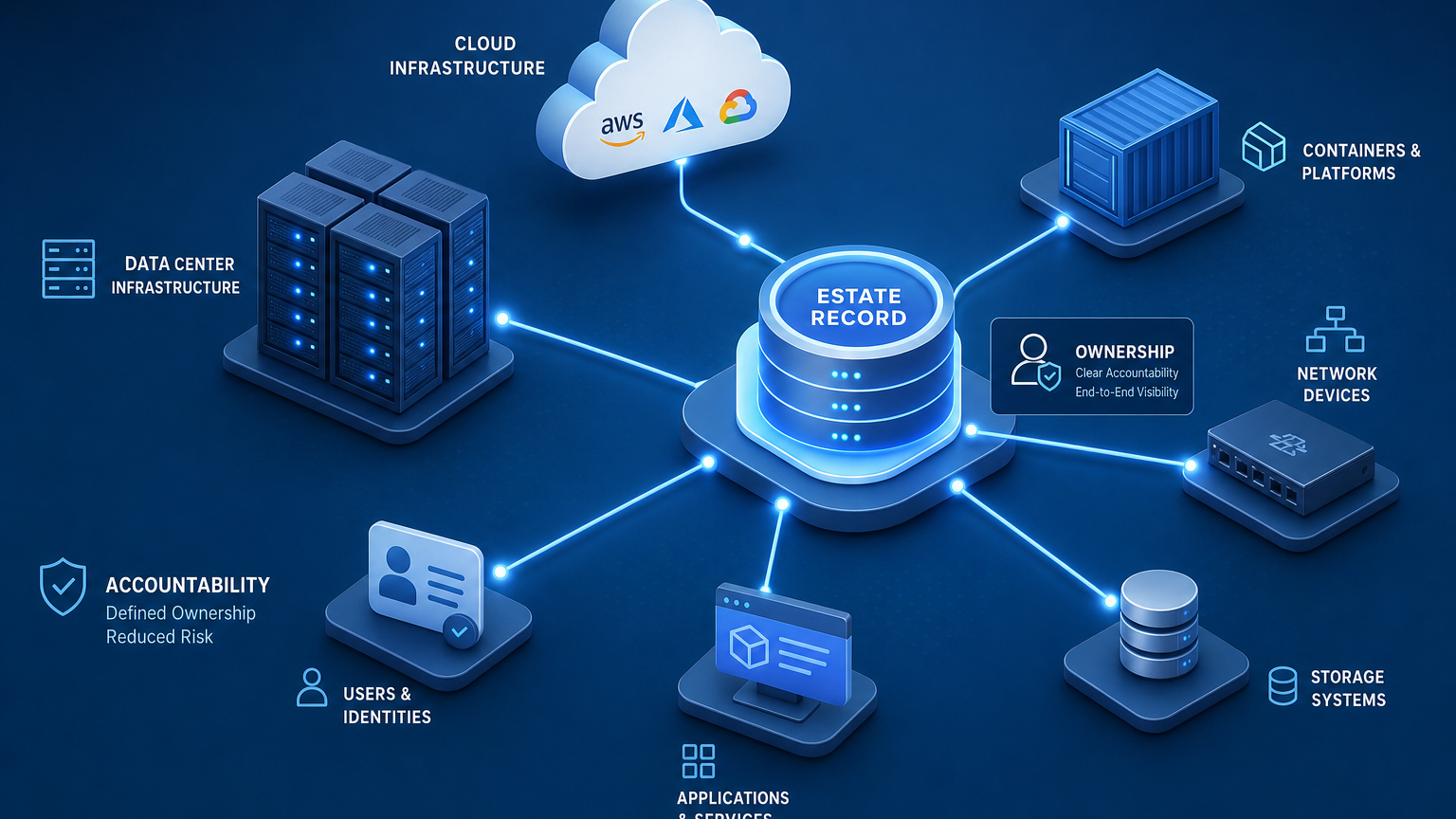
The question that matters is which of your services call a shared control plane, and who owns each one. That answer lives in a record someone has to maintain. Platforms often hold rich event detail for the same window. Ownership and dependency answers still come from spreadsheets and a few people who remember the last refresh plan.
What ITOM platform modules do well, and where their reach ends
ITOM covers how teams monitor, operate, and improve IT services day to day. ITIL 4 service configuration management and ISO/IEC 20000-1 treat configuration information and monitoring as practices that keep service records usable for change, incident, and audit work. Platform ITOM modules earn their keep here. They handle events, surface health views, and run discovery that works well inside the platform’s own data model and credential model.
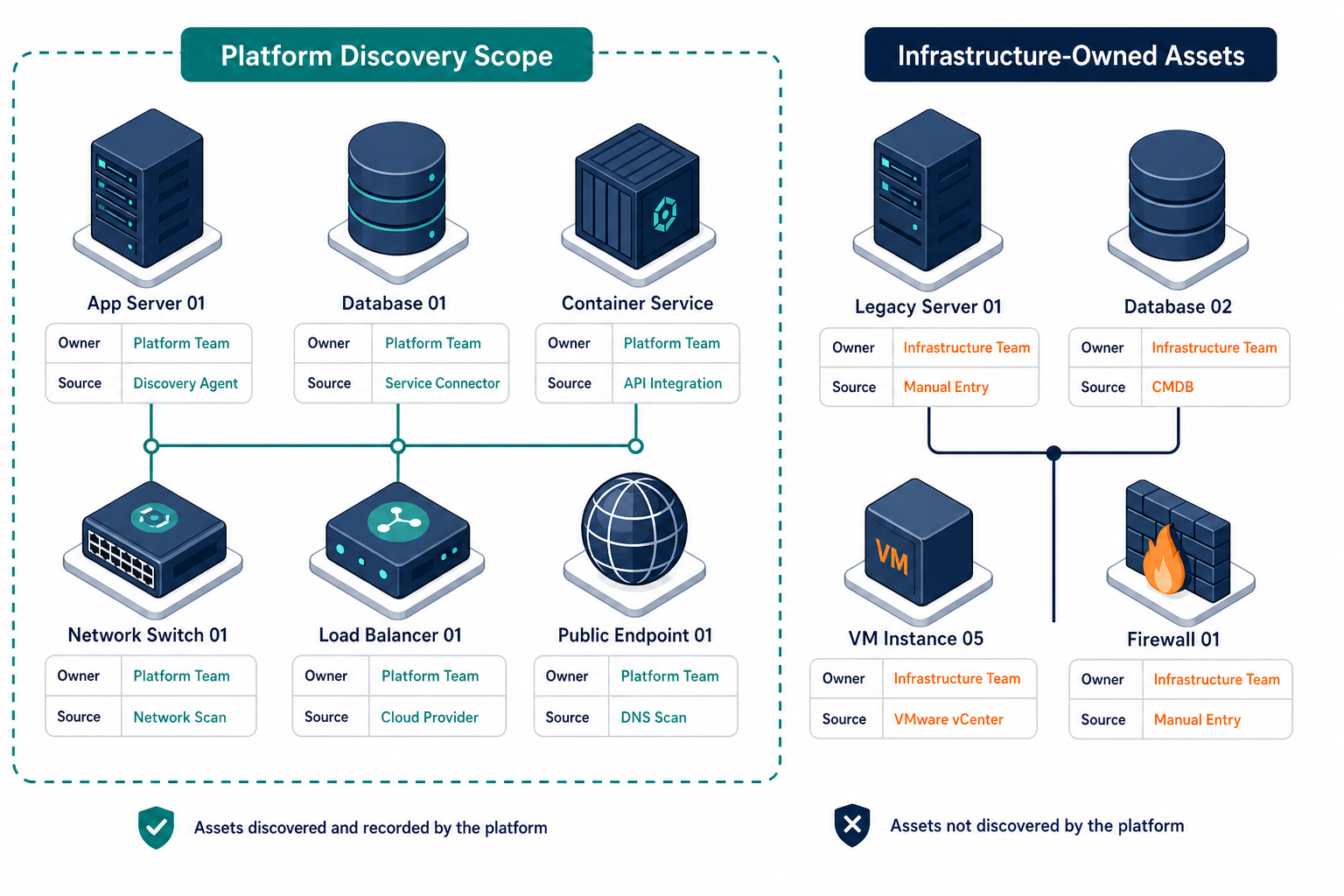
ServiceNow’s documentation on running discoveries in your network ties Discovery to IP ranges, schedules, credentials, and MID Server settings. The schedule’s range must fall entirely within the IP ranges one or more MID Servers are configured to support.
Any server, cloud account, or subnet outside that configured range does not appear in Discovery’s count. That design is sound for controlled estates; it also means those assets never enter the count the director uses for budget, retirement, and capacity decisions.
| Question | Module answer | Director’s follow-up |
|---|---|---|
| How many servers are in scope? | Count within configured ranges | How many exist outside those ranges? |
| Who owns this CI? | Whatever the field holds | Who answers when it breaks, and who approved the last change? |
| What depends on it? | Maps built for defined services | What about the services nobody has defined yet? |
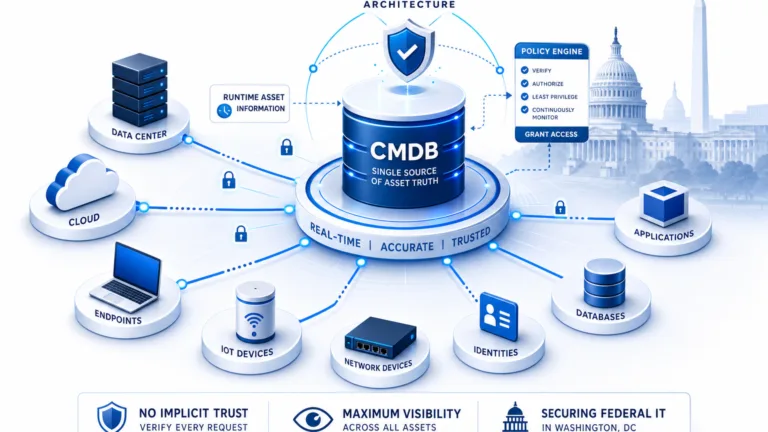
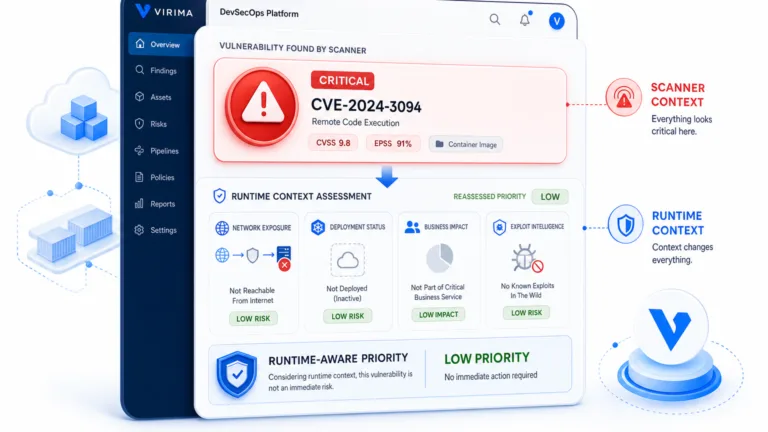
Virima ITOM sits on that same problem set: operational views only help when the underlying estate record matches what infrastructure actually runs. For how that record is framed as discovery-sourced runtime truth, see Trusted Runtime Truth.
Why infrastructure carries the bill for missing context
ITIC’s 2024 Hourly Cost of Downtime Report surveyed more than 1,000 firms from November 2023 through mid-March 2024. The average cost of a single hour of downtime exceeds $300,000 for over 90% of mid-size and large enterprises, and 41% of enterprises put hourly downtime between $1 million and over $5 million. Those figures exclude litigation and penalties. Infrastructure directors own the estate that failed and still answer for the outage. They rarely own the system of record that claimed to describe it.
Four ways platform-only ITOM strains an infrastructure team
- Staff time becomes the integration layer. Engineers reconcile platform counts against racks, cloud consoles, and hypervisor inventories. Result: hours each week go into maintaining the record instead of the estate.
- Ownership sits in two org charts. The platform team owns the CMDB records. Infrastructure owns the hardware and cloud accounts. Result: a CI can show an owner field nobody on the infrastructure side has reviewed, which is the same chase pattern covered in Virima’s work on RACI ownership for IT teams.
- Answers queue behind the platform backlog. A new subnet or cloud account stays outside discovery scope until someone works a platform ticket. Result: the director signs a plan using a count that predates the change.
- Context is stored in the platform’s model. Maps and relationship data live inside that product’s schema. Result: the next platform decision is also a data-rebuild decision for infrastructure.
None of this is a licensing argument. It is a labor and accountability ledger for the team that keeps the estate running.
What the gap costs, seat by seat
For the director. Budget submissions, refresh plans, and retirement decisions depend on counts and owners the director does not control. The director still signs the retirement. The record has to support that decision with a durable join key such as a serial number or cloud instance ID, not a hostname that recycled last quarter.
For the platform team. Every infrastructure expansion becomes a scope request: credentials, ranges, schedules, and exception lists. Capacity for product work shrinks as the estate grows.
For service owners. “What do I depend on?” turns into a ticket, not a lookup, until someone has defined the service and kept the relationships current.
For audit and regulated environments. Evidence requests for infrastructure scope land on the same contested record. Configuration management practices under ITIL 4 and ISO/IEC 20000-style service management assume that record can be produced and explained.
At market scale. When the estate record is thin, outage cost sits on infrastructure while the evidence trail sits elsewhere.
Three tests for deciding where the estate record should live
Run these on your own environment before you add another module license or another spreadsheet.
1. The coverage test
Can you list assets that exist but sit outside the platform’s configured scope? Virima Discovery runs high-frequency scheduled discovery — agentless, agent-based, and API-based IT asset discovery across on-prem, cloud, and remote segments, so infrastructure can see what the configured ranges never included. Product detail lives on the IT discovery feature page.
2. The ownership test
Does every CI carry a named owner and a recorded source? This is the core of CMDB ownership: Virima CMDB stores multi-source records people can confirm. Source attribution and confidence scoring belong in the same estate record, so ownership is visible rather than assumed under the Trusted Runtime Truth model.
3. The portability test
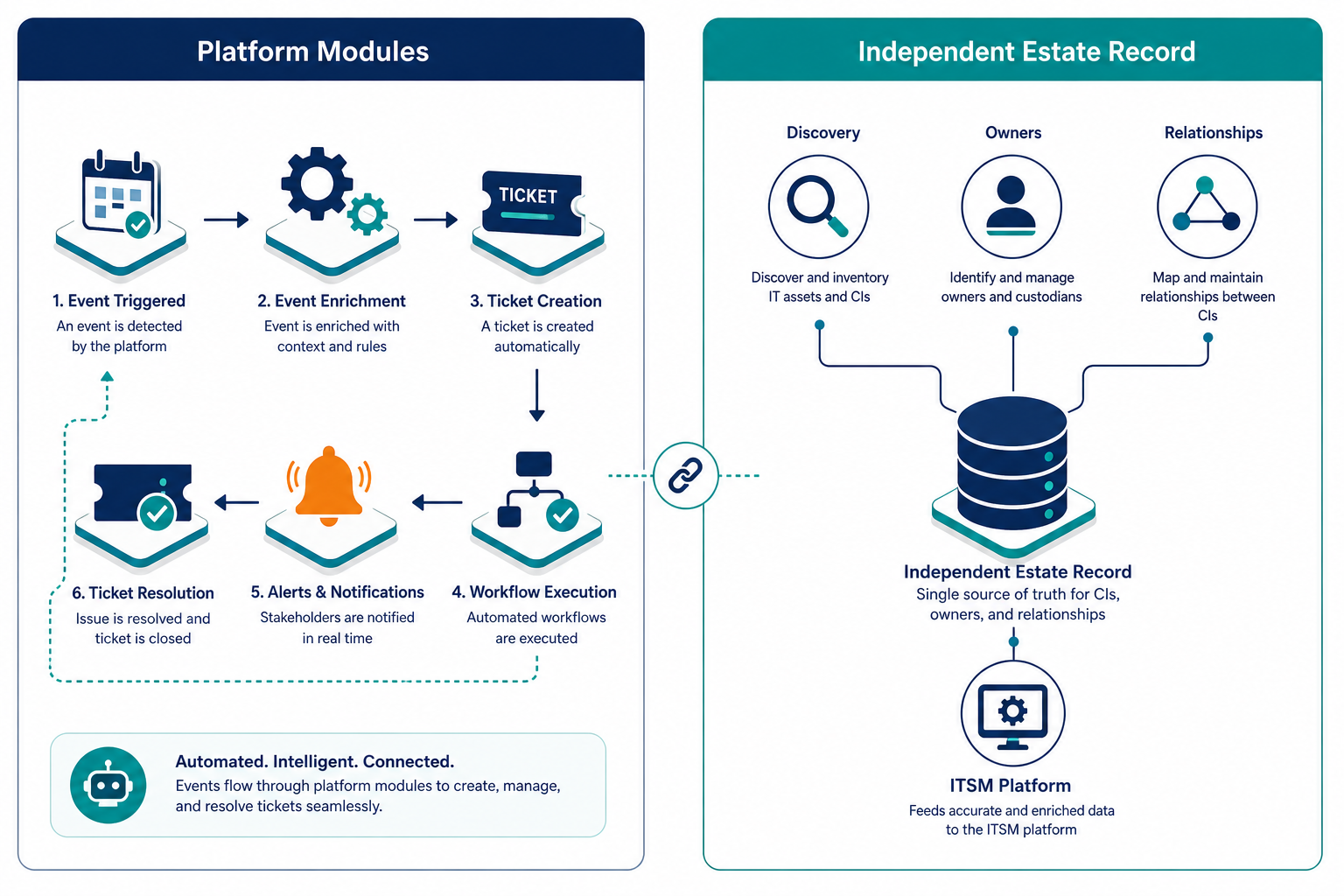
Does the record survive a change of ITSM platform? Virima keeps discovery, relationships, and ownership independent of any single ITSM product and feeds that record back to ServiceNow, Jira Service Management, and other ITSM tools listed on the integrations hub.
| Dimension | Platform modules alone | Platform plus an independent estate record |
|---|---|---|
| Scope definition | IP ranges, schedules, credentials inside the platform | Discovery can include segments the platform never scheduled |
| Ownership data | Fields maintained in the platform CMDB | Named owners and sources held with the estate record |
| Change of ITSM | Maps and history rebuild with the new platform | Estate record remains; integrations re-point |
| Who maintains it | Platform backlog plus infra reconciliation | Infrastructure owns the record; platform consumes it |
| What the platform still does | Events, workflow, tickets, module automation | Same operational and workflow role |
For a module-level feature comparison, see the vendor ITOM feature matrix whitepaper on virima.com. Treat it as a product document, not a third-party methodology study. Integration paths for feeding the ITSM sit on all integrations.
When modules alone are enough
A single-platform shop with a small hybrid footprint and a platform team that keeps scope current can run well on modules alone. That path is real for lean estates. Larger hybrid footprints need a clearer split between platform workflow and the estate record. The decision frame for discovery versus service mapping inside a ServiceNow-heavy stack is covered in ServiceNow Discovery vs Service Mapping.
Where platform-only ITOM strains in practice
These are illustrative scenarios, not case studies.
- The budget submission. Finance asks for a server count. Infrastructure, the platform CMDB, and a cloud bill each return a different number. The director still has to pick one figure for the plan.
- The new cloud account. Infrastructure stands up an account for a product team. Discovery credentials and ranges lag for weeks. The platform count stays calm while spend and risk move.
- The audit sample. An auditor asks for assets in one data center. The team exports, filters, and reconciles by hand before the sample can ship.
- The platform change. Leadership evaluates a new ITSM path. Rebuild cost for maps and ownership lands on infrastructure before anyone has moved a ticket workflow.
Virima gives infrastructure a record it doesn’t have to request
Virima supplies the discovery, relationship, and ownership layer infrastructure can maintain without waiting on platform scope tickets. It does not replace the ITSM platform, event management, or workflow. Modules still own incidents, changes, and operational automation. Virima owns the estate record those modules consume.
For the infrastructure team. Scheduled discovery and multi-source CMDB records put coverage and owners in infrastructure’s hands. People confirm ownership. The CMDB stores and shows what discovery found.
For the platform team. Integrations feed CIs and relationships into the ITSM instead of absorbing every subnet and account as a one-off scope request.
For the next platform decision. The estate record is portable. Maps built after service definitions are provided through service mapping (ViVID™) stay tied to infrastructure truth rather than a single vendor schema.
Platform modules answer what fired and which ticket moved. Virima answers what exists, how it connects, who owns it, and what changed on the last discovery cycle.
A five-step check you can run on one network segment
- Pick one segment or cloud account with a known owner.
- Pull the count from the platform, from the infrastructure team, and from one independent source.
- List the differences by owner.
- Trace who would have caught each gap, and how many hours that catch usually takes in a normal week.
- Decide where that record should live, and who maintains it on a schedule.
That exercise turns a vague accuracy debate into a single segment with names, deltas, and a maintenance owner.
Compare one segment with your infrastructure team in the room
If the platform count and the floor count already disagree on one network or cloud account, bring both views into a short working session. Walk the deltas, owners, and sources together. Request a demo when you want that side-by-side on your own segment with infrastructure and platform leads present.
Frequently Asked Questions
What is ITOM for an infrastructure director?
ITOM for an infrastructure director is the operating practice of knowing what the estate runs, who owns each piece, and how services depend on it, so monitoring and tickets sit on a record the director can defend.
Why does ITOM context matter to infrastructure teams?
Infrastructure teams answer for outages, capacity, and retirement decisions. Without shared ownership and coverage data, those decisions rest on exports and memory while the platform holds a narrower configured view.
Can ITOM platform modules alone cover a hybrid estate?
Modules cover events and discovery inside configured ranges and credentials — agentless, agent-based, or API-based, depending on the platform. Hybrid estates often grow outside those ranges, so modules alone leave infrastructure reconciling counts the platform never scheduled.
What are examples of ITOM context gaps in infrastructure operations?
Common gaps include cloud accounts missing from discovery scope, CI owner fields no infrastructure lead has confirmed, service dependencies never defined, and evidence packs that need a manual reconcile before audit.
Does Virima replace our ITOM platform modules?
Virima does not replace ITOM platform modules. It provides discovery, relationships, and ownership for the estate record and feeds ITSM platforms through integrations, while event management, tickets, and workflow stay with your modules.
Does Virima integrate with ServiceNow, Jira Service Management, or other ITSM platforms?
Virima integrates with ServiceNow, Jira Service Management, Ivanti, and other major ITSM platforms, feeding discovery-sourced CIs and relationships into the platform’s existing workflow rather than requiring a replacement.