How Much IT Integration Sprawl Can Your CMDB Survive?

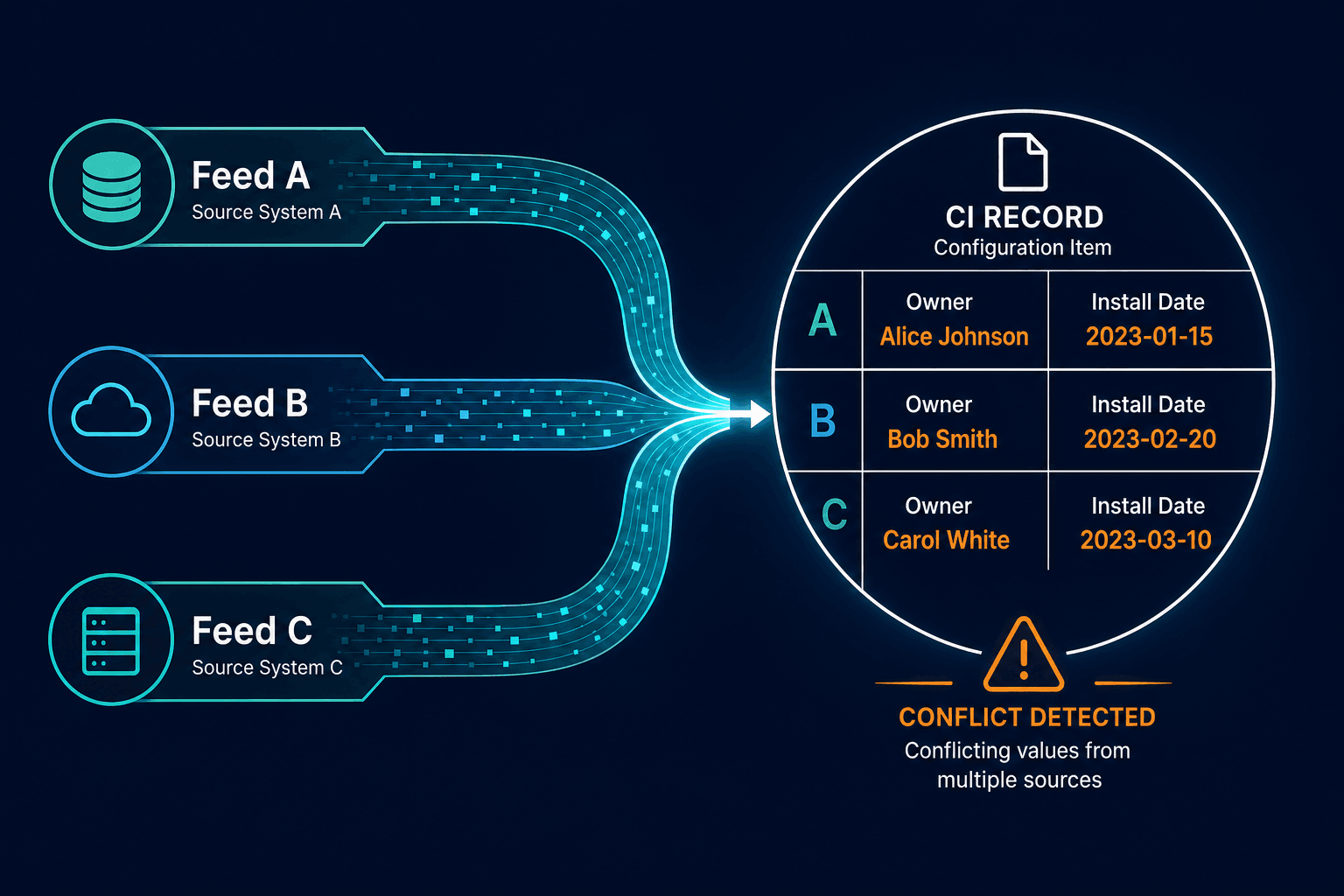
A mid-sized IT team runs an agentless network scanner for baseline coverage, a dedicated IT asset management (ITAM) platform for license tracking, and a cloud-native discovery add-on for Amazon Web Services (AWS). Each buy was reasonable on its own. None was designed with the other two in mind. Six months later, the same physical server appears as three assets with three owners, two install dates, and a software count that matches none of the tools’ own reports. Nobody added a fourth product to fix the mess. The first three never shared a rule for who owns which field.
This is an illustrative scenario, not a named public incident. Data conflicts from IT integration sprawl are usually chronic. They erode a configuration management database (CMDB) quietly rather than producing a single dated outage headline.
That pattern shows up in industry data as falling confidence in the stack. Flexera’s 2026 State of ITAM Report found complete technology-stack visibility declined to 36 percent, down from 43 percent the prior year, reflecting expanding scope and growing presence of SaaS and AI outside traditional governance models. More feeds did not automatically mean a clearer picture. Teams often respond by buying another scanner. Without authority rules, the fourth product mostly multiplies disagreement. Coverage and conflict are separate axes, and the rest of this piece treats them that way.
What “too many integrations” actually means
Peer-reviewed work treats multi-source inconsistency as a standing CMDB problem, not a one-off ops complaint. Aravind Barla’s 2025 review in the World Journal of Advanced Engineering Technology and Sciences frames data-standardization challenges across multiple discovery sources as an active research theme for accuracy and relationship mapping. The review supports the problem framing. It is not used here as a vendor scorecard or a single in-text percentage beyond that framing.
IT integration sprawl is not a count of discovery and asset tools. It is whether each feed has clear authority when sources disagree. A tool that sees something nothing else can see is a coverage win at any count. Two tools that disagree with no rule for who wins are a conflict, even if the stack has only two products. This is sometimes labeled discovery tool sprawl, but the label was never the variable that mattered; attribute-level authority is.
So “too many integrations” is the wrong phrase if it only means headcount of connectors. A better split:
- Coverage: Does this feed see assets or attributes nothing else can see?
- Conflict: When two feeds report different values for the same attribute, does anything decide who wins?
An integration that closes a blind spot is a win even if the stack is already busy. Conflict arises when outputs share attributes without an authority rule. Three sources with attribute-level rules can coexist. Two with no rule conflict on day one.
Teams that want a single named baseline for what exists, how it connects, and what changed are describing the same need Virima’s Trusted Runtime Truth puts on the page: discovery-sourced ground truth with explainable relationships, not another spreadsheet of tool logos.
The hidden problem
| Situation | What actually happens |
|---|---|
| A new integration closes a specific gap | The gap closes; nobody assigns authority over attributes the new feed also reports |
| Two integrations report different values for the same asset | Whichever wrote most recently is displayed, with little record that a disagreement existed |
| An integration lands faster than a rule is written | Coverage rises; so does the count of unresolved conflicts sitting in the CMDB |
Why this is a live conversation in 2026
Ian Cahall, Principal Architect at Ondaro, writing for ITSM Tools on 2026 ITAM trends, describes teams quietly struggling under the weight of their own success, juggling multiple discovery tools, separate license-optimization platforms, standalone contract repositories, and custom integrations holding the stack together. His outlook pairs focused AI with strong governance and an end to unmanaged tool sprawl. That is not a demand to rip every product out tomorrow. It is a demand to know which integration is authoritative for which attribute before the next connector goes live.
Platforms that publish many connectors without that discipline still leave CMDB owners reconciling by hand. A coherent integrations hub only helps when authority rules sit under the feeds, not when logos multiply on a slide.
Three ways this plays out
- A team adds cloud-native discovery for AWS coverage without revisiting who owns network-layer attributes, and the new feed, right about instances, starts overwriting fields it was never meant to own.
- License tracking and network discovery run on different schedules, so the more frequent scan dominates the record between the slower runs, regardless of which source is more accurate for that field.
- A merger brings a second full toolset online, and two previously independent sources of truth now disagree about the same estate on day one of combined operations.
None of these require bad intent from the tool vendors. Each product is doing the job it was bought for. The estate-level failure is missing authority design when feeds share attributes.
The real cost of getting this wrong
For operations and configuration managers. Each audit cycle burns hours re-arguing the same host that three tools still describe differently. Change and incident work inherit the wrong owner or stale software list. Mean time to trust the record exceeds mean time to open the ticket.
For ITAM managers. Duplicate or conflicting records inflate or deflate what the estate appears to own. That is exactly the exposure software and hardware audits are built to find. License position and lifecycle reports become arguments about which feed is real instead of decisions about renewals and reclaim. Virima’s guide to CMDB audit essentials covers what auditors actually check first when records disagree.
For leadership. The decision is rarely cut every integration. It is knowing what each feed is authoritative for. That is a governance cost. Procurement alone cannot buy it away by adding another scanner. Board questions about asset risk and AI readiness land poorly when three systems still disagree on basic ownership.
Evidence work gets harder when the baseline is contested. Virima’s reporting and auditing use case depends on a coherent asset and CI picture. Configuration management fails in the same way when siloed tools and fragmented processes feed the same CMDB without reconciliation rules.
See the framework in action: Trusted Runtime Truth shows how discovery-sourced ground truth assigns attribute authority so the next integration doesn’t get a blank check on every column.
What actually determines the IT integration sprawl threshold
How many discovery and asset tools can one estate absorb before data conflicts? There is no universal integer. The threshold is whether authority is assigned.
Two conditions matter more than headcount:
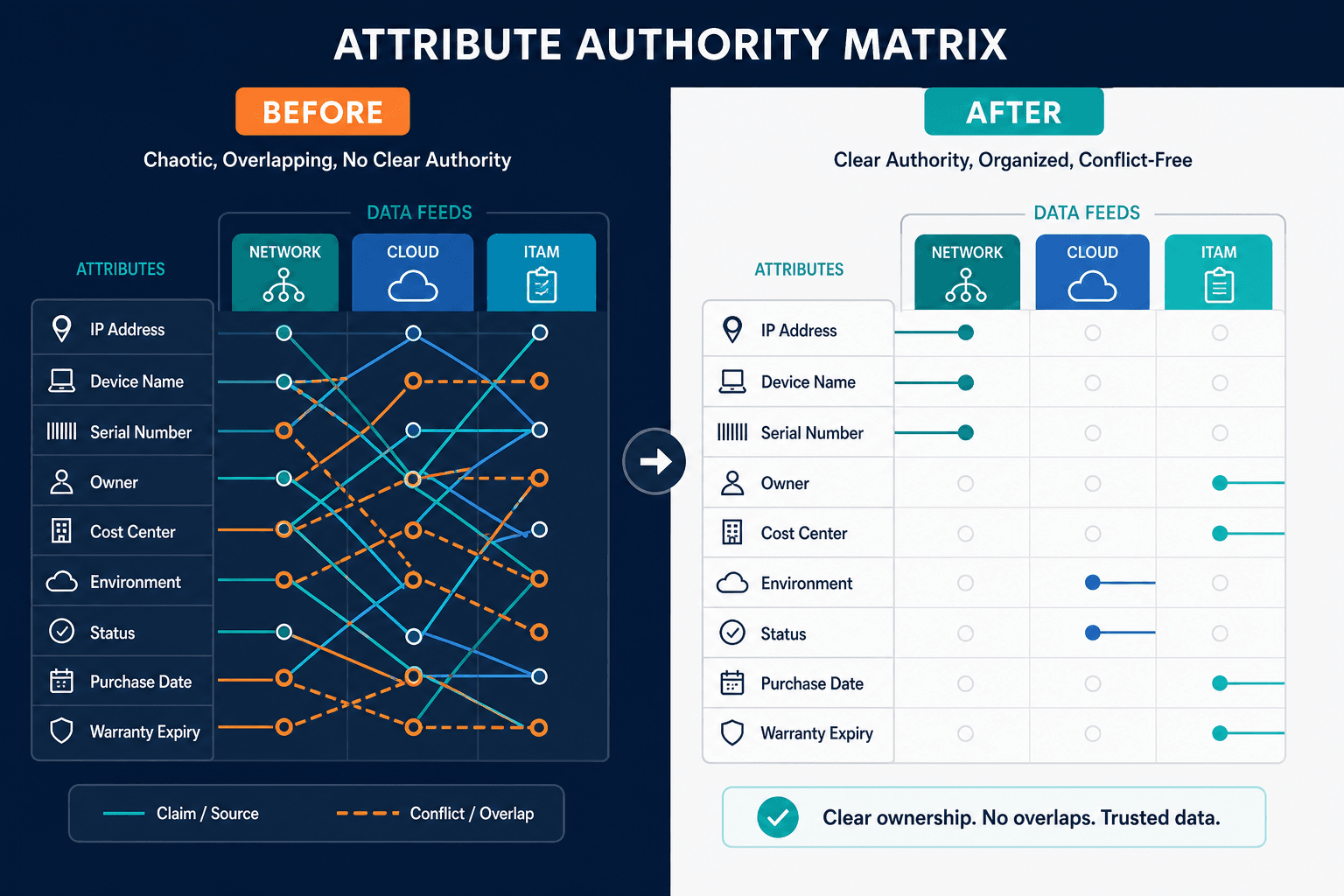
- Authority is assigned per attribute, not per integration. A cloud API can own region and instance type while an agent-based scan owns installed software. Neither needs to overwrite the other’s fields.
- Disagreements are surfaced, not silently overwritten. Last scan wins confuses recency with trust. Frequency is not authority.
This is not an argument that one platform must replace every scanner and ITAM product already in place. Virima’s own posture matches that honesty: multi-source feeds are expected; ungoverned last-write behavior is not. It is an argument that authority rules must exist before the next integration is turned on. Deep mechanics of attribute-level reconciliation, and why last-scan-wins fails, live in Virima’s guide to multi-source CMDB reconciliation. This article stays on the absorption decision: coverage versus conflict.
Multi-source inventory still starts with how IT discovery collects across agent, agentless, and cloud API methods on high-frequency scheduled cycles. The place those feeds become governed records is the CMDB, where relationship and attribute rules can be enforced instead of hoped for.
Coverage question versus conflict question
| Coverage question | Conflict question | |
|---|---|---|
| What it asks | Does this integration see something nothing else can? | Does anything decide who wins when integrations disagree? |
| Answer improves by | Adding more integrations where gaps remain | Assigning authority, not only adding integrations |
| Failure mode if ignored | Blind spots (undiscovered assets) | Silent overwrites (wrong truth) |
How many discovery and asset tools can one estate absorb before data conflicts?
There is no fixed tool count. An estate absorbs as many discovery and asset feeds as it has assigned clear per-attribute authority for. Coverage rises when a new feed sees assets others miss. Conflict rises when two feeds disagree and last-write or last-scan silently wins without a logged rule.
What this looks like in practice
Each new integration’s data lands against a CI that already knows which source should defer on which attribute, so operators stop treating every mismatch as a war-room event. Disagreements get logged and reviewed instead of vanishing into whichever scan finished last, and audit samples can show how a value was chosen. Technique choice still matters for coverage and the catalog of methods, from network sweeps through cloud and config automation, is covered in Virima’s CMDB discovery techniques guide. But sprawl control is what happens after those techniques all write into one CMDB. Lifecycle fields that ITAM owns still need a home on the same governed record, which is why the ITAM side of the stack belongs in the same authority design as discovery feeds.
The two patterns below are illustrative, not named customer cases.
Adding a fourth integration without breaking the first three
Without rules, the fourth feed repeats the original story: new coverage, new silent overwrites. With attribute authority already assigned, the new connector is scoped before go-live. Cloud-only fields stay under the cloud API. Installed software stays under the agent or deep inventory source. Network identity stays under the scanner that owns that layer. The fourth product extends coverage. It does not get a blank check on every column.
An M and A stack meeting its first joint audit
Two toolsets that were each fine in isolation now describe the same merged estate. Unreconciled, the first audit samples duplicate CI records, duplicate serials, conflicting owners, and software counts that cannot be defended. Reconciled, the audit still finds gaps, but the team can show which source is authoritative per attribute and which conflicts remain open. That is a manageable finding set, not an unowned pile of CIs.
Once records and relationships stabilize, dependency views become usable. Service maps only help after the underlying CI records stop fighting each other. Without a single authoritative host row, dependency graphs inherit the same three owners and the same unusable context.
How Virima fits in
Virima sits under the tools you already bought, not as a mandate to delete them. Network scanners, cloud APIs, and ITAM platforms keep collecting what they collect well. Virima’s job on a multi-feed estate is to ingest those signals on high-frequency scheduled cycles, reconcile competing attribute values into one CI record, and expose disagreements instead of hiding them behind last-write.
What teams keep: specialized collectors that close real coverage gaps (cloud regions one scanner never reaches, deep software inventory another feed never sees). What Virima owns in the middle: multi-source discovery orchestration, CMDB health and relationship structure, and the place attribute authority is enforced so the next connector does not get a blank check on every column.
What Virima does not pretend to be: a reason to throw out an existing license-optimization workflow or a peer ITSM system of record overnight. ServiceNow, Jira, Ivanti, HaloITSM, Xurrent, Hornbill, and TeamDynamix stay plain-text peers in the stack. When those systems need a cleaner asset and CI baseline, Virima is the runtime layer that feeds them after authority rules are set.
ViVID™ service maps sit one step later. Operators supply service definitions. Maps then consume reconciled infrastructure relationships. Fighting owners on the same host produce unusable dependency context no matter how pretty the graph looks.
The absorption question then becomes practical: can this estate add one more feed because Virima already knows which attributes that feed may write, and which it must defer? If the answer is no, the gap is governance design, not another logo on the integrations slide.
Moving from integration-by-integration chaos to assigned authority
| Old way | New way |
|---|---|
| Each new integration closes a gap with no plan for what it overwrites | Each integration’s authority is scoped to specific attributes before go-live |
| Disagreements vanish into whichever scanned last | Disagreements are logged, reviewed, and resolved by rule |
Getting started (five steps)
Adapted from the governance direction in Cahall’s ITAM outlook, not copied as a vendor playbook. None of this requires ITAM tool consolidation. Reducing the number of platforms is optional; assigning authority across the ones you keep is not:
- Map every discovery and asset integration feeding the CMDB today, and what each is actually good at.
- Identify where two or more integrations report on the same attribute.
- Assign one authoritative source per attribute, not one winner per product logo.
- Pilot the rule on the most audit-relevant asset class first.
- Expand once conflicts are visibly logged and resolved, not merely fewer tickets.
The same coherent baseline shortens firefights when production breaks. Incident teams inherit owners and dependencies instead of three contradictory host rows. Mean time to repair work only improves after the CMDB is worth opening, which is the operational payoff of assigned authority rather than another disconnected feed.
Absorb what you can govern
The honest answer to how much IT integration sprawl an estate can absorb and how many CMDB data conflicts it produces is that it is as many feeds as you have assigned authority for, with disagreements visible. Close coverage gaps on purpose. Do not confuse a new connector with a new source of truth until the attribute rules say so. Adjacent reading stays on mechanism pages for reconciliation engines and discovery technique catalogs. This page stays on the absorption decision your architecture and procurement reviews actually make.
Frequently Asked Questions
How much IT integration sprawl can an estate absorb before data conflicts start?
There is no fixed number. An estate can absorb as many discovery and asset feeds as it has assigned clear authority for. Two tools with no rule for who wins will conflict immediately. Five tools with clear per-attribute authority can coexist.
What is the difference between a coverage gap and a data conflict?
A coverage gap means no integration sees a given asset at all. A data conflict means two or more see it and disagree. Adding an integration fixes the first. It only fixes the second if authority is assigned for shared attributes.
Why does last-scan-wins cause problems even when every integration is accurate?
Recency and authority are different signals. An hourly scan is not automatically more correct than a daily one. It is only newer. Last-scan-wins treats frequency as trust and silently favors whichever feed runs most often.
Does Virima assign per-attribute authority automatically when it ingests ServiceNow, Jira, or other ITSM data alongside discovery feeds?
Virima ingests signals from ServiceNow, Jira, and other ITSM and discovery sources, then applies attribute-level authority rules so the platform knows which feed governs which field. It does not overwrite ITSM records; it reconciles what discovery and asset feeds report before that data reaches the CMDB.
How does Virima’s CMDB reconcile conflicting values from agentless, agent-based, and cloud API discovery without picking last-scan-wins?
Virima assigns one authoritative source per attribute rather than defaulting to whichever scan ran most recently. Disagreements between agentless, agent-based, and cloud API feeds are logged and surfaced for review instead of being silently overwritten.