ITAM in Telecommunications: Managing Hardware and Software Inventories Across Large Networks

Telecommunications companies have been managing inventories for decades.
They know where network equipment is installed. They track ports, circuits, logical resources, network capacity, and services. They maintain sophisticated operational support systems designed specifically to describe infrastructure at a level of detail most enterprises never require.
So why is inventory still such a persistent problem in telecommunications?
Because the network being inventoried has changed.
A modern telecom environment no longer consists only of physical network equipment installed at exchanges, towers, central offices, and data centers. Network functions can run as virtual machines or containers. Infrastructure extends into private and public clouds. Software releases can materially alter network behavior without any corresponding hardware replacement. Logical resources and customer services may be represented separately from the equipment supporting them.
The result is an unusual asset-management challenge.
Telecom operators do not necessarily lack inventory data. They can have several different versions of it.
As networks become more software-defined and automated, the important question is no longer simply whether an asset exists somewhere in an inventory.
It is whether the organization’s different representations of the network remain synchronized closely enough for operations, security, finance, and automation to trust them.
Telecom already has an inventory; in fact, it may have several
Telecommunications inventory is substantially more sophisticated than a conventional equipment list.
TM Forum maintains a standardized Resource Inventory Management API for querying and manipulating resource inventory, reflecting how fundamental structured inventory is to telecom operations.
That inventory may describe different layers of the same environment.
A physical device contains ports and interfaces. Those interfaces participate in logical network resources. Logical resources contribute to services. Other operational platforms describe configuration, capacity, software, and service state.
All of those views can be necessary.
They can also become fragmented.
BT provides a useful example.
As part of its OSS transformation, the operator worked to consolidate separate physical, logical, and virtual network inventory into a Single Resource Inventory Management System. BT tied inventory accuracy explicitly to network automation and reported multimillion-dollar CapEx and OpEx savings from the initiative, including savings related to network-asset reconciliation and software licensing.
A related BT transformation described its previous OSS inventory model as complex and distributed across multiple systems using their own terminology. BT and Tech Mahindra created a consolidated data model covering the physical, logical, and service layers; TM Forum reports that the broader automated planning initiative reduced network-preplanning time substantially and delivered a 70% reduction across planning tasks.
The obvious lesson is that fragmented systems create inefficiency.
But there is also a deeper one.
The same network legitimately exists in several representations. The harder problem is keeping those representations aligned.
What makes IT asset management in telecommunications different from other industries?
Telecommunications environments carry multiple simultaneous representations of the same infrastructure: physical, logical, virtual, and service layers, each maintained in different operational systems. Unlike most enterprises, the challenge is not building an inventory from scratch. It is keeping several existing, specialized inventories synchronized closely enough that operations, security, and automation can trust them.
The network no longer stops at the hardware
Traditional asset inventories have intuitive units.
A server. A router. A switch. A storage appliance.
Each can be purchased, deployed, maintained, depreciated, reassigned, and eventually retired.
Telco cloud complicates this model.
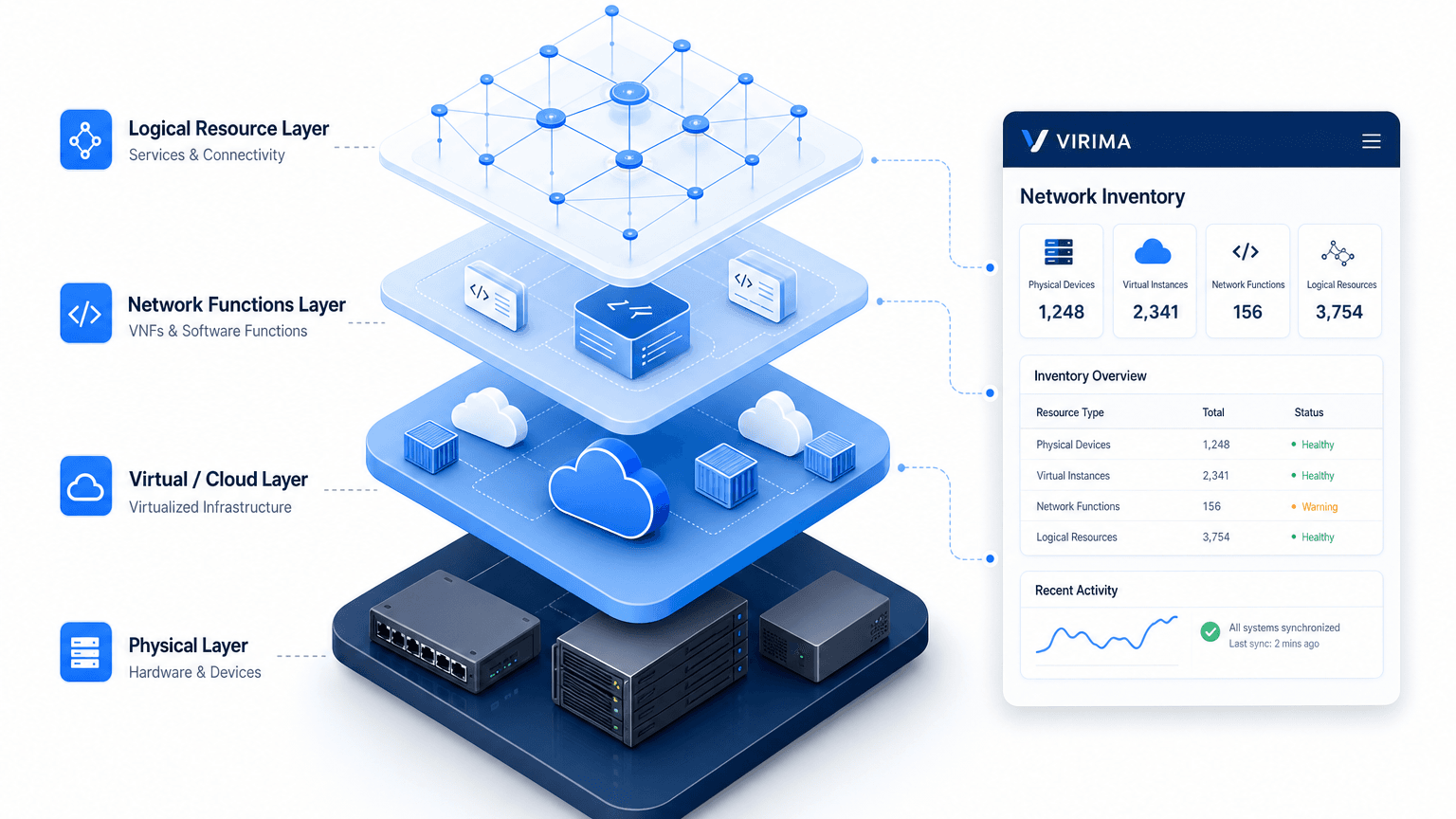
ETSI’s NFV group continuously evolves the Telco Cloud Architecture to include physical infrastructure, virtualized infrastructure, OS-container infrastructure, and additional infrastructure layers under cloud management. Network functions and applications then operate on top of those resources.
5G standalone moves further in this direction.
GSMA describes the 5G SA core as a cloud-native, service-based architecture, enabling operators to create and manage network services in ways increasingly reminiscent of cloud software environments.
A production service might therefore involve a hierarchy such as:
Physical infrastructure → virtual or container infrastructure → software-based network function → logical resource → network service → customer service
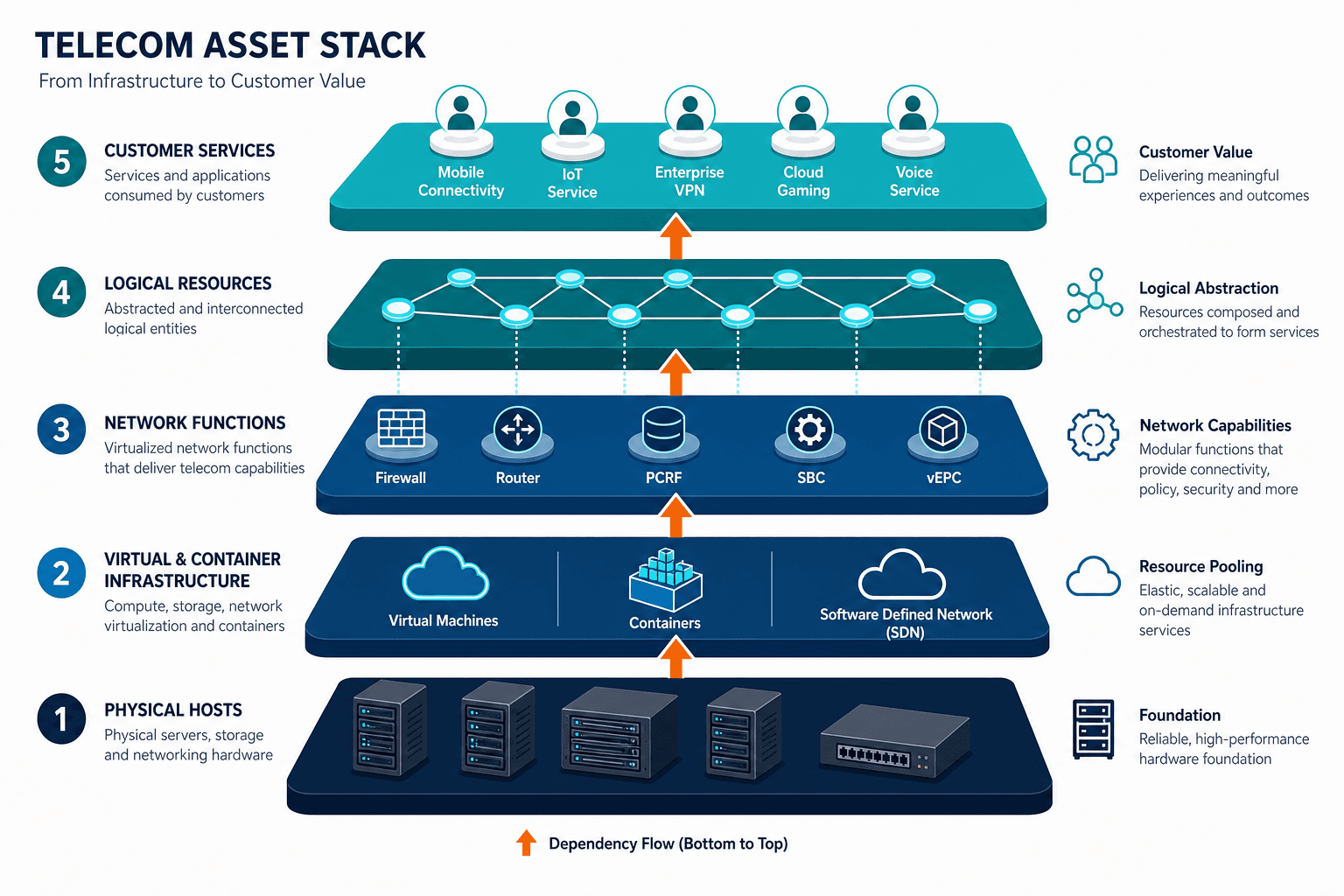
Now consider what inventory accuracy means across that stack.
The physical host may remain unchanged while workloads move.
A new software image may change a network function without replacing hardware.
A containerized function may scale up and down programmatically.
A service dependency can change even though the physical assets underneath it remain in place.
The assets have not disappeared.
But their operational meaning has changed.
Modern telecom inventory increasingly becomes a problem of state rather than existence.
Several systems can be correct while the overall picture is wrong
Imagine one server supporting part of a telecom environment.
Procurement can correctly say the company purchased it.
Discovery can correctly identify its current CPU, operating system, interfaces, and installed software.
The virtualization platform can correctly identify the workloads running on it.
An orchestrator can correctly describe the intended state of a network function.
A network inventory can correctly describe associated physical or logical resources.
A software-asset system can correctly describe a corresponding entitlement.
And a CMDB can contain relationships between some of those records.
Every system may be telling the truth about the part of the environment it understands.
Yet the organization can still have an inaccurate overall model if those records drift apart.
Contemporary telecom inventory systems increasingly emphasize reconciliation for exactly this reason.
Ericsson’s Adaptive Inventory spans physical, virtual, and logical resources, federates information from multiple data sources, and explicitly reconciles the planned view of the network against the live network.
Nokia similarly describes modern inventory around aggregation, normalization, observability, and discovery of physical, virtual, and containerized elements, along with relationships between those resources.
This suggests a better objective than simply declaring one application the “single source of truth.”
For large telecom environments, the practical objective is:
maintain a trustworthy operating model from systems that legitimately know different things.
Automation raises the cost of inventory drift
The distinction becomes crucial when machines begin acting on inventory data.
An engineer working manually can sometimes spot an obviously stale record.
Automation may simply execute against it.
Inventory accuracy becomes a hidden prerequisite for telecom automation.
BT’s planning transformation makes the dependency explicit. The operator’s previous data was scattered across applications, and the team concluded that automation could not be implemented reliably while the required information remained fragmented. TM Forum Inform, BT 70% Planning Time Reduction
Nokia makes essentially the same argument from a product-architecture perspective: precise, dynamic inventory provides the resource and relationship knowledge required by automation systems. Nokia, Autonomous Operations Inventory
Consider the decisions increasingly delegated to automated workflows:
- where new capacity should be provisioned,
- which network resource should be changed,
- which dependency might be affected,
- which instance should scale,
- whether available infrastructure can support a new service,
- which component requires remediation.
Every one of those decisions assumes that the automation system has a sufficiently accurate model of the environment on which it is acting.
That reverses the traditional relationship between operations and inventory.
Historically, an inventory could be treated primarily as documentation updated after a change.
In automated environments, trustworthy state increasingly needs to exist before the next change can safely be made.
Inventory becomes decision infrastructure.
Why does inventory accuracy matter for telecom network automation?
Automated workflows in telecom act on inventory data without human verification at each step. When inventory records are stale or fragmented, automation executes against an environment that no longer exists as the system describes it. Provisioning decisions, dependency checks, scaling triggers, and remediation workflows all assume the inventory is current, making inventory accuracy a prerequisite for safe automated action, not a documentation task after the fact.
See how Trusted Runtime Truth supports safe automation across large distributed networks
Cybersecurity has the same hidden prerequisite
Telecom cybersecurity reaches the same conclusion from another direction.
Following compromises affecting major telecommunications providers, CISA, NSA, FBI, and international partners published hardening guidance specifically for communications infrastructure.
One recommendation is deceptively straightforward: keep inventories of devices and firmware current so the environment can be effectively monitored.
The same guidance tells operators to track vendor end-of-life announcements for hardware, operating systems, and software and to maintain effective patch and change-management processes.
At telecom scale, that requires more than an equipment spreadsheet.
Security teams may need to determine:
- Which devices run a vulnerable firmware version?
- Where is affected software installed?
- Which operating systems are approaching end of support?
- Who owns remediation?
- What services depend on the affected infrastructure?
- Did the configuration change after the last inventory update?
- Is an asset present in the live network that never entered the expected inventory?
These questions combine asset-management data with technical discovery and configuration relationships.
A hardware record alone cannot answer them.
The useful unit is the asset in its current operational context.
In telecommunications, software inventory is becoming network inventory
As network functions move to software running on general-purpose infrastructure, inventory and licensing questions follow them there.
ETSI’s NFV lifecycle requirements make this concrete. They require the integrity of network-service instance data such as descriptors, software images, and associated records to be protected as part of lifecycle management.
Software inventory therefore intersects directly with network operations.
Telecom teams may need to connect:
What physical infrastructure exists? → What software is running on it? → Which version? → What license or support agreement covers it? → Which network or business service depends on it?
Software Asset Management and hardware ITAM no longer sit outside the network-management story.
They describe parts of the network itself.
Hardware and software still have different lifecycles
That does not mean telecom operators should collapse every type of resource into one generic asset model.
Hardware and software behave differently.
Physical equipment may spend years moving through procurement, installation, maintenance, refresh, and disposal.
Software may move through entitlement, deployment, upgrade, usage, renewal, and retirement.
Virtual and cloud resources may appear and disappear in minutes.
Network functions may have another lifecycle altogether.
The useful objective is therefore not to impose one lifecycle on all of them.
It is to connect their lifecycles through common context.
For a meaningful asset record, an operator should be able to reconstruct:
| Question | Required context |
|---|---|
| What is it? | Hardware, software, VM, container, network device, cloud resource |
| Where is it? | Data center, exchange, edge, remote site, cloud, or logical domain |
| Who owns it? | Technical, operational, and financial ownership |
| What runs on it? | OS, firmware, installed software, applications |
| Which version? | Current software, firmware, and configuration state |
| What covers it? | Warranty, support contract, license, entitlement |
| What depends on it? | Related CIs, applications, services |
| What changed? | Difference between recorded and observed state |
| Where is it in lifecycle? | Ordered, deployed, active, retired, disposed |
That is considerably more valuable than knowing there are 50,000 devices in the estate.
Discovery should be able to contradict the inventory
An inventory cannot remain trustworthy if it is allowed to prove itself correct.
The live environment must be able to contradict it. That requires a reconciliation model with clear rules:
- Which source is authoritative for which attribute?
- How recently was the attribute verified?
- What happens when observed state disagrees with planned or recorded state?
- Which changes should be accepted automatically?
- Which discrepancies require review?
The Ericsson distinction between the planned network and the live network is significant for exactly this reason. Ericsson Adaptive Inventory
The operational goal is not a static single source of truth.
It is a source of truth that is continuously tested against reality.
Relationships become as important as the assets themselves
A router without context is an asset.
A router known to support particular systems, network paths, or services becomes operational intelligence.
This difference matters enormously in telecom.
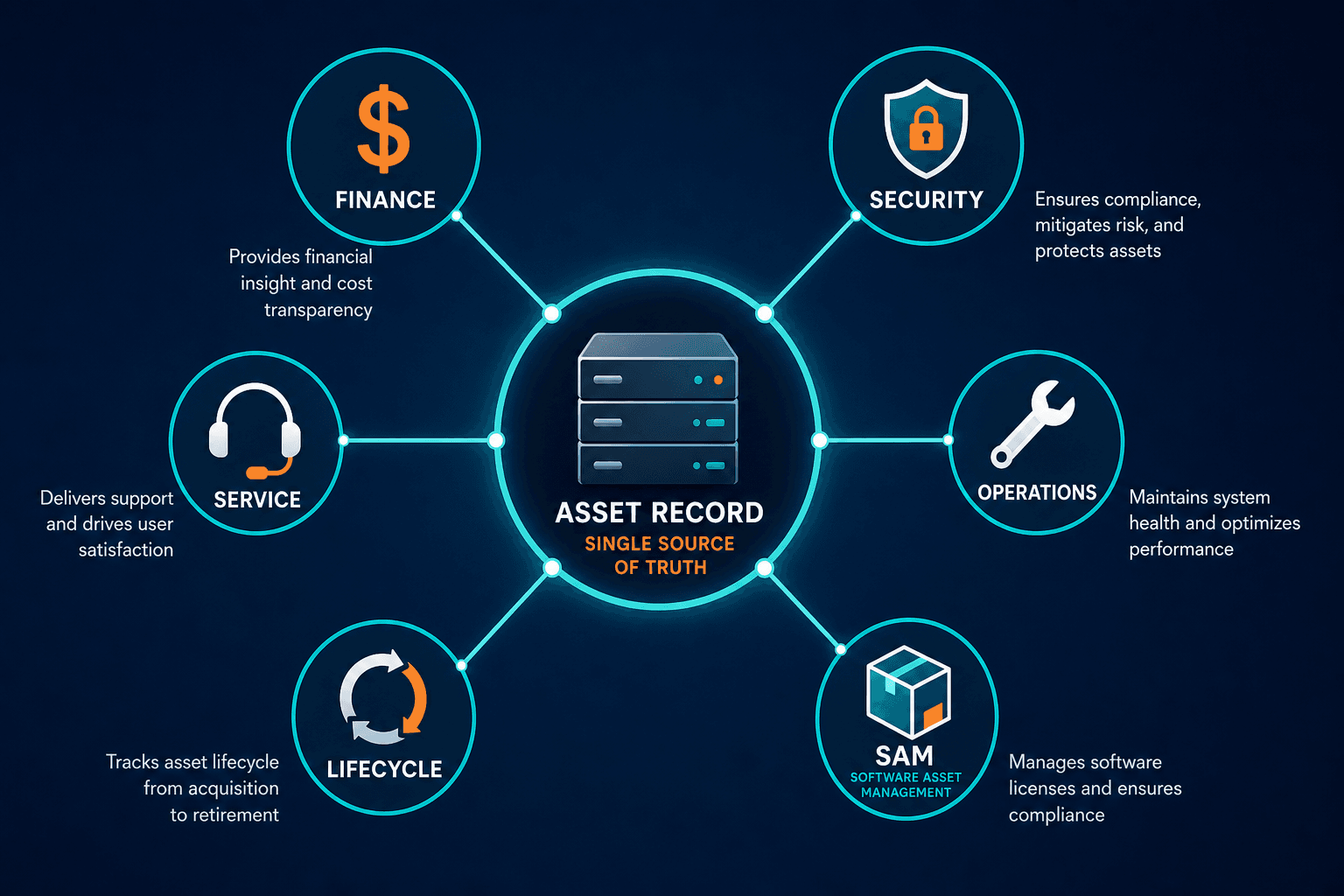
When asset records connect ownership, lifecycle, software, licensing, and dependency context, different teams can interrogate the same estate from different directions.
Finance can ask: What are we paying for?
Security can ask: What is vulnerable and what does it affect?
Operations can ask: What changed?
Software asset management can ask: What are we entitled to run versus what is actually installed?
Lifecycle teams can ask: What needs replacement or retirement?
Service teams can ask: Which operational services depend on this asset?
Those are not separate inventories.
They are different questions about overlapping infrastructure.
Telecom’s inventory challenge is increasingly synchronization, not counting
When representations of the same infrastructure drift across systems, financial, security, lifecycle, and automated operational decisions may execute against an environment that no longer exists as its records describe.
That is where IT asset management becomes strategically relevant.
Not as a replacement for telecom OSS, resource inventory, network controllers, or orchestration. Those systems have specialized jobs.
ITAM provides another necessary layer: What assets does the organization own or govern? What is actually present? What software is running? Who owns it? What does it cost? What covers it? Where is it in its lifecycle? And does the recorded asset still match the observed asset?
Where Virima fits in telecom IT asset management
A telecommunications provider should not expect an ITAM platform to replace its specialized network orchestration, service inventory, or OSS platforms.
Virima’s role is different.
It provides a discovery-driven ITAM and CMDB foundation for keeping hardware, software, network, cloud, and supporting infrastructure records current and governed across a large distributed estate.
Virima Discovery uses agent-based, agentless, and API-based methods across physical, virtual, cloud, container, edge, and network environments. It can discover network equipment including routers, switches, firewalls, and load balancers; servers and workstations; VMs and containers; cloud resources; installed software; software versions; and configuration attributes. Each discovered attribute carries source and freshness information.
That matters in telecom because collection alone does not solve state divergence.
When multiple discovery sources disagree about a CI attribute, Virima’s CMDB applies configured authority rules to reconcile the conflict and retains reconciliation history for audit. Discovered CIs enter the CMDB with their source, freshness timestamp, and relationship data attached.
The CMDB therefore answers the technical-state side of the problem: What is currently there, which source established it, what changed, and how is it related to other infrastructure?
Virima ITAM adds the governance and lifecycle side. Its platform combines discovery-enriched asset records with ownership, procurement context, lifecycle status, hardware and software inventory, and software licensing information.
For software specifically, Virima connects license records to detected installations and the hardware CIs on which software is installed, enabling teams to compare what the organization is entitled to run with what discovery says it is actually running.
This separation of responsibilities is particularly useful for telecom environments.
Your OSS can continue answering: How should this network resource operate?
The orchestrator can continue answering: What network function or service should be instantiated?
And Virima can help IT operations, asset management, software management, security, and governance teams answer:
What underlying assets actually exist? What is installed on them? Who owns them? What changed? What licenses or contracts cover them? Where are they in their lifecycle? And how much confidence should we place in the current record?
Modern telecom operators do not necessarily need another inventory simply because their networks are large.
They need an asset-management layer capable of continually reconciling the organization’s records with an infrastructure estate that changes across physical, virtual, cloud, container, network, and software domains.
Because once network operations become automated, inventory accuracy stops being documentation hygiene.
It becomes a prerequisite for safe action.
Request a demo of Virima IT Asset Management for telecommunications
Frequently Asked Questions
Why do telecommunications companies still have inventory problems despite running sophisticated OSS platforms?
Telecom OSS platforms are designed to manage specific layers of the network, physical resources, logical resources, or service layers, not to maintain a unified, reconciled view across all of them. As networks have expanded into virtual, container, and cloud infrastructure, the gap between what different systems know about the same asset has grown. The inventory problem in telecom is not a data shortage. It is a synchronization problem: multiple systems that are each locally correct can produce a collectively inaccurate overall picture when their records drift apart.
How does network functions virtualization change the scope of hardware and software inventory in telecommunications?
NFV means a network function that previously required dedicated hardware can now run as software on general-purpose infrastructure. A new software image can change production network behavior without any hardware replacement. A containerized function can scale programmatically, creating and removing instances without a corresponding purchase order. This makes software version, license entitlement, and deployment state as operationally significant as physical asset location, and it means hardware and software inventories can no longer be managed as separate concerns.
What is the difference between a network inventory system and IT asset management in a telecom context?
Network inventory systems describe how the network is built and how resources relate to services. They answer operational questions: what resources exist, how they are connected, and how services are provisioned. IT asset management adds the governance and financial layer: what the organization owns, what software is licensed, who owns each asset, what it costs, and where it sits in its lifecycle. In modern telecom, both layers are necessary because the infrastructure underneath the network is also IT infrastructure subject to procurement, licensing, security, and compliance requirements.
How does Virima support IT asset management for telecommunications infrastructure?
Virima provides a discovery-driven ITAM and CMDB foundation that operates alongside, not instead of, specialized telecom OSS and orchestration platforms. Virima Discovery identifies hardware, software, VMs, containers, cloud resources, and network equipment across the estate using agent-based, agentless, and API-based methods. That data feeds a CMDB that reconciles information from multiple sources using configured authority rules. Virima ITAM then adds ownership, procurement, lifecycle, and licensing context to those records, giving IT operations, asset management, and security teams a governed view of the infrastructure underneath the network.
How does Virima’s CMDB reconciliation address inventory drift across physical, virtual, and cloud resources?
When multiple discovery sources report different values for the same CI attribute, Virima’s CMDB applies configured authority rules to determine which source is authoritative for that attribute and resolves the conflict. Each discovered CI carries a source identifier and freshness timestamp, so the age of every data point is visible. Reconciliation history is retained for audit. This makes the CMDB continuously testable against the live environment rather than a static record that ages silently between manual updates.