Configuration Item lifecycle: From discovery to decommission in a modern CMDB

The problem with treating CIs as static records
Most CMDB projects start with momentum. Teams run a discovery sweep, populate records, map relationships, and call it done. Six months later, the data is already unreliable. A year in, engineers have stopped trusting it entirely.
The reason is simple: configuration items are not static. Servers get patched. Applications get updated. Virtual machines spin up and disappear. Network paths shift. Ownership changes hands. And yet most CMDBs capture the birth of a CI and then leave that record to age in place, untouched.
The gap between what the CMDB says and what is actually running in your environment is called CMDB drift. It is not a data quality problem you can fix with a cleanup sprint. It is a process problem — and it starts with how you think about the configuration item lifecycle.
What is a CI lifecycle?
A CI lifecycle is the complete journey of a configuration item from the moment it is first detected in your environment to the moment it is formally retired and removed from active records.
That journey covers initial discovery, classification, normalization, relationship mapping, ongoing change tracking, periodic review, and eventual decommission. Every stage matters. Skip one and the record becomes unreliable. Let the process run without automation and the CMDB becomes a liability rather than an asset.
Managing the CI lifecycle well means your CMDB reflects what is actually running, who owns it, what it depends on, and what changed last. That is the foundation of trusted runtime truth — live, explainable, policy-aware operational context that lets IT teams move faster and AI agents act safely.
The 5 stages of the CI lifecycle
Stage 1: Discovery
What happens: A CI enters the CMDB when it is first detected — through agent-based scanning, agentless network discovery, API integration with cloud providers, or manual entry. The record is created with basic attributes: hostname, IP, OS, hardware class, location.
What goes wrong without automation: Manual discovery is a snapshot. By the time a spreadsheet is imported, the environment has already moved on. Cloud instances appear and disappear faster than any manual process can track. On-premises hardware gets reconfigured between scans. Shadow IT never gets captured at all.
What good looks like: Discovery runs on a recurring scheduled basis across every protocol and environment. New CIs are detected and added to the CMDB automatically during each scan cycle, so nothing enters production without a corresponding record. See how Virima’s IT discovery capabilities handle this across hybrid environments using agentless and agent-based methods spanning on-prem, AWS, and Azure infrastructure.
Stage 2: Classification and normalization
What happens: Raw discovery data gets structured. CIs are assigned to the correct class — server, application, network device, virtual machine, container. Attributes are normalized so that “Windows Server 2022” is not stored as five different strings across five different discovery sources. Relationships to other CIs are identified and recorded.
What goes wrong without automation: Classification becomes a manual mapping exercise. Different teams use different naming conventions. Hardware models are entered free-form. Software versions carry inconsistent formatting. The CMDB accumulates multiple records for the same physical or virtual asset because nobody caught the duplicate.
What good looks like: Discovery data gets normalized at ingestion. CI classes are assigned based on detected attributes, not human judgment. Duplicate detection runs automatically against existing records. Relationships — application-to-server, server-to-network, service-to-infrastructure — are mapped based on observed traffic and configuration, not self-reported documentation.
Normalization is where attribute authority starts to matter. The deeper and more precise your discovery methods, the more authoritative the CI data becomes. Shallow discovery that only captures hostnames and IP addresses produces low-authority records. Discovery that captures installed software, running processes, open ports, configuration files, and dependencies between CIs produces high-authority records that downstream processes can actually trust.
Stage 3: Active management
What happens: The CI is in production and its record needs to stay current. Every change — patched OS, updated application version, new network path, ownership transfer, relocated hardware — must be reflected in the CMDB. This is the longest phase of the CI lifecycle management process and the one where most CMDBs lose accuracy.
What goes wrong without automation: Changes happen to CIs every day. Without recurring discovery scans detecting those changes and writing them back to the CMDB, the record starts drifting from reality immediately after initial population. A server gets patched, but the CMDB still shows the old OS version. An application team adds a new dependency, but the relationship record does not exist.
What good looks like: Recurring scheduled discovery scans detect attribute changes and relationship shifts automatically. Change records are cross-referenced against discovery findings — if a change was made that discovery did not detect (or vice versa), that discrepancy is flagged for investigation. CI ownership stays current because discovery data is supplemented by organizational feeds.
This is also the stage where Autonomic Social Discovery adds value. Some CI attributes — business context, application owner, compliance classification — cannot be discovered through network scans. They require human intelligence. ASD automates the process of gathering those non-discoverable attributes from the people who know them, keeping the CMDB complete across both technical and organizational dimensions.
Stage 4: Review and recertification
What happens: Periodically — quarterly, semi-annually, or triggered by a specific event — CIs undergo formal review. The goal is to confirm that the record is still accurate, the CI is still needed, and its classification and relationships are still correct.
What goes wrong without automation: Review becomes a bureaucratic checkbox exercise. CI owners receive a list and rubber-stamp it. Nobody actually compares the CMDB record against the live environment because doing so manually takes too long. The review declares everything accurate when it is not.
What good looks like: Review is driven by data, not forms. Before the review cycle begins, a comparison runs between the current CMDB record and the latest discovery data. Any discrepancies are surfaced automatically. Reviewers do not confirm what the CMDB says — they investigate what does not match. CIs that have shown no activity across multiple discovery cycles get flagged as candidates for decommission.
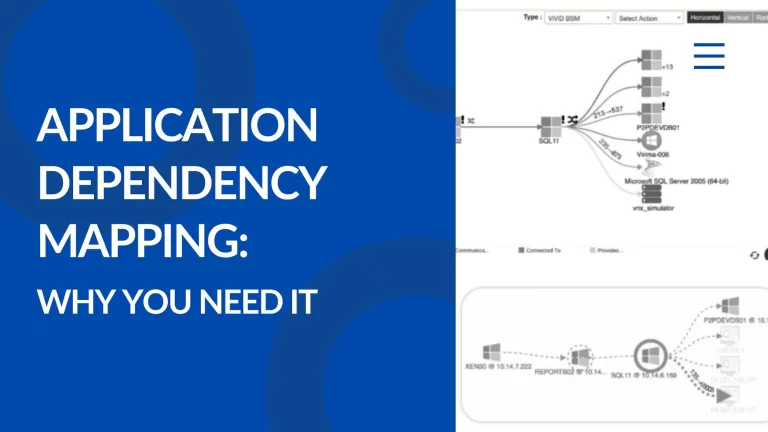
This is also the stage where ViVID™ helps teams see the big picture. Rather than reviewing CIs one record at a time, teams can examine a visual topology that shows how each CI fits within its service context. A CI that looks fine in isolation might be clearly redundant or misclassified when viewed alongside its dependencies and consumers.
Stage 5: Decommission and retirement
What happens: The CI is no longer needed. It is taken offline, and its CMDB record is transitioned from active to retired status. Its relationships are dissolved. Its history is preserved for audit and compliance purposes, but it no longer appears in operational views, impact assessments, or change planning.
What goes wrong without automation: Decommission is the most neglected stage. Hardware gets physically removed, but the CMDB record stays active. Virtual machines get terminated, but the CI record lingers. Over time, the CMDB accumulates ghost CIs — records that describe assets that no longer exist. Ghost CIs pollute impact assessments, inflate licensing counts, and erode trust in the CMDB.
What good looks like: Discovery detects when a previously active CI stops responding. After a defined period of consecutive non-detection, the record is flagged for decommission review. If the CI owner confirms retirement, the record transitions to inactive status with a decommission timestamp. Relationships are cleaned up automatically. The ghost CI problem is addressed at its root: detection, not periodic spreadsheet audits.
The CMDB drift problem
CMDB drift is not a bug. It is the natural outcome of running a CMDB without continuous feedback from the live environment.
Research consistently shows that manually maintained CMDBs reach 30–40% data inaccuracy within six months of initial population. That is not because the teams maintaining them are careless. It is because the rate of change in a modern IT environment — patches, deployments, scaling events, configuration updates, infrastructure moves — outpaces any manual update process.
Drift affects every downstream process that relies on CMDB data. Change management makes approval decisions based on stale dependency maps. Incident response teams trace root causes through relationships that no longer exist. IT asset management reports on inventory that is months out of date.
The CI lifecycle model is the structural answer to drift. Each stage includes a mechanism for keeping the record aligned with reality. But those mechanisms only work if they are automated. Manual processes at any stage of the lifecycle reintroduce the drift they are supposed to prevent.
How discovery-driven automation changes each stage
When IT discovery runs on recurring scheduled scans rather than one-time sweeps, it transforms every stage of the CI lifecycle:
Discovery (Stage 1): New CIs are detected and added to the CMDB as they appear in the environment, not weeks later when someone notices them.
Classification (Stage 2): Discovery data provides the attributes needed for automatic classification. CI classes, normalization rules, and duplicate detection run against fresh data, not imported spreadsheets.
Active management (Stage 3): Attribute changes and relationship shifts are detected during each scan cycle. The CMDB stays current without requiring manual updates after every change.
Review (Stage 4): Reviews are data-driven. Discovery findings are compared against CMDB records before the review begins, surfacing discrepancies that need investigation instead of asking reviewers to confirm accuracy on faith.
Decommission (Stage 5): CIs that stop appearing in discovery scans are flagged automatically. Ghost CI accumulation is caught at the detection layer, not during an annual audit.
The common thread is that automation removes the gap between what is happening in the environment and what the CMDB records. The shorter that gap, the more trustworthy the CMDB becomes — and the more useful every process built on top of it.
CI lifecycle and change management
The CI lifecycle and change management are deeply interdependent. Every change modifies at least one CI. Every CI modification should generate or reference a change record. When these two processes run independently — when changes happen without updating CI records, or CI records change without a corresponding change ticket — both processes lose integrity.
During the active management stage (Stage 3), the CI lifecycle depends on change management to log modifications. During change risk assessment, the change management process depends on the CI lifecycle to provide accurate, current records and relationships. If the CI lifecycle is not functioning well, change managers cannot trust their blast radius assessments. If change management is not logging modifications, the CI lifecycle cannot track what changed and when.
This interdependence is why organizations that invest in one process but neglect the other consistently see poor results from both.
Why CI decommission is the most neglected stage
Decommission gets neglected because it is the only lifecycle stage with no immediate operational pressure. A CI that is not discovered creates a visible gap. A CI that is not classified cannot be managed. A CI that drifts during active management causes incidents. But a ghost CI — a record that should have been retired but was not — causes no immediate pain.
The costs accumulate silently. Ghost CIs inflate software license counts, leading to overpayment during vendor audits. They pollute impact assessments, making blast radius analysis less accurate. They slow down discovery cycles because scans attempt to reach assets that no longer exist. They erode trust in the CMDB overall, because engineers learn that some records describe things that are not there.
The fix is structural, not behavioral. If decommission depends on someone remembering to retire the record, it will not happen consistently. If discovery scans detect the absence of a CI and flag it automatically, the ghost CI problem gets caught at its source. Pair that with automated workflows that notify CI owners and transition records after confirmed non-detection, and decommission becomes a managed process rather than an afterthought.
What good CI lifecycle management actually looks like
Good CI lifecycle management is not visible. It is the absence of problems that every IT team recognizes: the CMDB record that contradicts what the engineer sees on the server, the impact assessment that missed a critical dependency, the ghost CI that inflated a license audit by thousands of dollars.
When the lifecycle works, every CI record in your CMDB matches the live environment within the margin of your most recent discovery cycle. Relationships are current. Ownership is accurate. CIs that leave the environment leave the CMDB. And every downstream process — change management, incident response, asset management, compliance reporting — runs on data that teams actually trust.
That level of trust is what trusted runtime truth delivers — a CMDB that reflects what is actually running, kept accurate by recurring discovery that feeds it on a scheduled basis, a classification process that normalizes data at ingestion, and a decommission process that retires records based on detection, not memory.
See how Virima delivers trusted runtime truth for your CI lifecycle at virima.com.
Schedule a demo with Virima. Move faster. Act safely.
FAQs
What is a ghost CI?
A ghost CI is a CMDB record that describes an asset, application, or infrastructure component that no longer exists in the live environment. Ghost CIs accumulate when the decommission stage is neglected. They distort reporting, inflate costs, and reduce trust in the CMDB.
How many lifecycle stages does a CI have?
The five formal stages are: Discovery, Classification and Normalization, Active Management, Review and Recertification, and Decommission and Retirement. Some frameworks combine stages or add sub-stages, but these five cover the full journey from first detection to formal retirement.
What causes CMDB drift?
CMDB drift occurs when the rate of change in your IT environment exceeds the rate at which the CMDB is updated. Patches, deployments, scaling events, configuration changes, and infrastructure moves all modify CIs. If those modifications are not captured — either through automated discovery or disciplined change management — the CMDB record diverges from reality.
How does CI lifecycle management relate to ITAM?
IT Asset Management tracks the financial and contractual aspects of IT assets — procurement, licensing, depreciation, disposal. The CI lifecycle tracks the operational aspects — configuration state, relationships, service context. These overlap significantly, and organizations that manage both through the same CMDB get consistent data across financial and operational views.
How do you prevent ghost CIs from accumulating?
Automated discovery is the most reliable prevention. When discovery scans run on a recurring schedule, CIs that stop appearing are flagged after a defined number of consecutive non-detections. Paired with an automated review workflow, this catches ghost CIs at the detection layer rather than waiting for a manual audit.