IT Asset Management for Nashville Hospital Operators

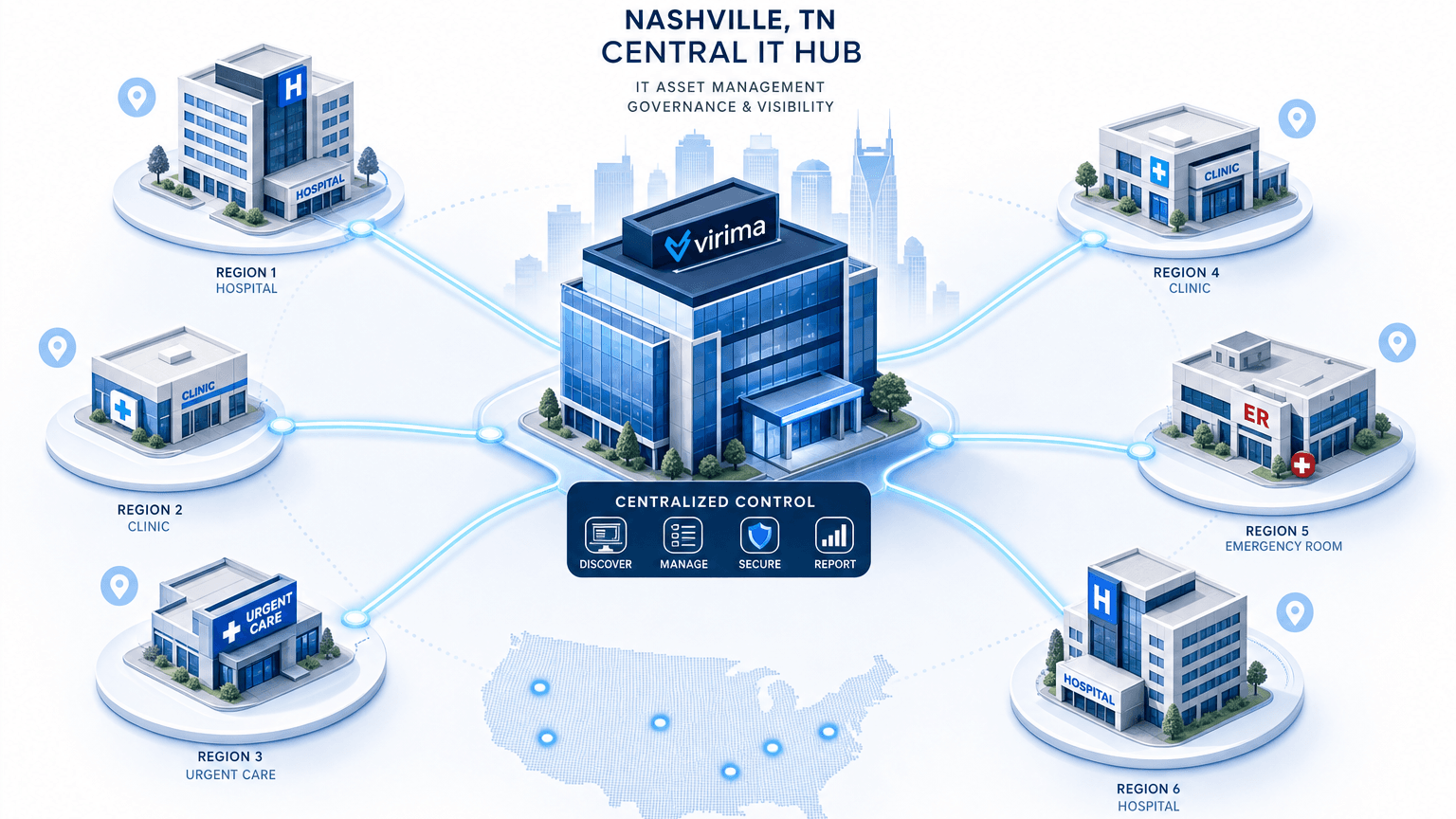
You don’t run a few regional hospitals from Nashville. You run hospitals, clinics, and physician practices scattered from Florida to Virginia, while your IT team stays in one building. Nashville-area companies manage more than half of U.S. for-profit hospital beds, with more than 900 healthcare companies and 17 publicly traded healthcare businesses headquartered in the region (Nashville Area Chamber). The IT asset management Nashville healthcare operators need looks less like a spreadsheet and more like enterprise governance — accurate records for equipment your team will never see in person.
HCA Healthcare operated 190 hospitals and approximately 2,500 ambulatory sites as of December 31, 2025, according to its fourth-quarter 2025 earnings release. The IT teams responsible for those assets aren’t spread across 2,500 locations — they sit in Nashville.
In October 2025, Bloomberg Law reported that HCA’s settlement of litigation arising from a 2023 data breach received final approval, affecting approximately 11 million patients. HIPAA Journal reported that the compromised data came from an external storage location used to automate email formatting — a database of 27.7 million records was stolen. HCA denied wrongdoing and settled without admitting liability.
That distinction matters: the technology involved was supporting infrastructure, not an EHR or a bedside device. If you manage IT for a Nashville-based operator running hundreds of facilities, that raises the question at the center of IT asset management — what enterprise technology exists across every site, and how does your team account for it?
Nashville is a healthcare headquarters market, not only a hospital market
Most cities contain hospitals. Nashville runs them at national scale from one address — and if you work in IT here, that’s the job you inherited.
Locally significant employers include Vanderbilt University Medical Center, HCA Healthcare, Ascension Saint Thomas, Community Health Systems, and Lifepoint Health, headquartered in nearby Brentwood. When you define an endpoint standard from Nashville, that policy may govern workstations in Texas, Florida, Virginia, and across much of the continental United States — an enterprise operating problem, not an inventory problem belonging to one hospital.
Nashville’s healthcare estates aren’t static, either. Lifepoint completed the acquisition of eight acute care hospitals from ScionHealth in June 2026, per Lifepoint Health’s newsroom, and Vanderbilt Health continues expanding across Middle Tennessee. This market grows by affiliation and acquisition, not only by construction.
What makes Nashville a healthcare headquarters market?
Nashville-area organizations manage more than half of U.S. for-profit hospital beds, with HCA Healthcare, Community Health Systems, Lifepoint, Ascension Saint Thomas, and Vanderbilt among locally headquartered operators. ITAM decisions for facilities across dozens of states are frequently made from Nashville offices.
One healthcare operator can contain several kinds of IT estate
TriStar Health, HCA’s Greater Nashville division, shows what distributed means locally. Its network includes more than 90 locations: 10 hospitals, seven freestanding emergency rooms, 18 urgent-care centers, and 111 physician clinics. Ascension Saint Thomas reports 18 hospitals and more than 350 sites across Middle Tennessee. This is hospital IT asset management Nashville-style: one operator, several kinds of estate — a hospital carries different infrastructure than a freestanding ER, and a surgery center has different software needs than a billing office.
Your corporate asset model needs visibility into employee endpoints, servers, network infrastructure, virtual machines, software, cloud resources, printers, storage, remote devices, and supporting business systems at every setting.
This is enterprise IT, not clinical hardware. The question you need answered is how you maintain central accountability across technology running at dozens or hundreds of locations. A separate category of content addresses clinical device management — see Complete guide to enterprise IT asset management. The two categories shouldn’t be merged.
Central standards do not automatically create central visibility
You can define an endpoint standard, a software policy, and a retirement procedure from Nashville. Defining those policies and knowing whether every site conforms to them are different problems.
Asset evidence likely comes from endpoint consoles, purchasing records, local IT staff, Active Directory, cloud consoles, virtualization platforms, security tooling, and facility-level spreadsheets — and one physical asset can appear differently across each, with a different name, lifecycle state, and owner.
That’s the core of multi-site hospital IT management: your policy is centralized, but your evidence is fragmented. The fix isn’t making every site administer technology identically — it’s building enterprise-wide visibility despite local differences.
Why can’t central IT policy alone create consistent IT asset visibility across distributed healthcare sites?
Each site typically maintains separate purchasing records, endpoint consoles, and local Active Directory. An asset can appear differently in each system without a reconciliation layer that consolidates records into one authoritative inventory.
What the HCA breach reveals about your supporting systems
The lesson here is bounded: the 2023 incident doesn’t establish that deficient asset management caused the breach. What it does establish is scope — a healthcare estate this size generates infrastructure far beyond the clinical applications you’d instinctively monitor.
If you run IT for a large healthcare operator, you can’t limit accountability to obviously clinical technology. Supporting systems — the kind involved in HCA’s breach — can also process sensitive operational information.
Know what enterprise technology operates across your distributed healthcare estate Virima’s Trusted Runtime Truth gives you a discovery-sourced view of assets, ownership, and configuration across every facility in your portfolio. |
IT asset management in Nashville begins with discovering what is actually present
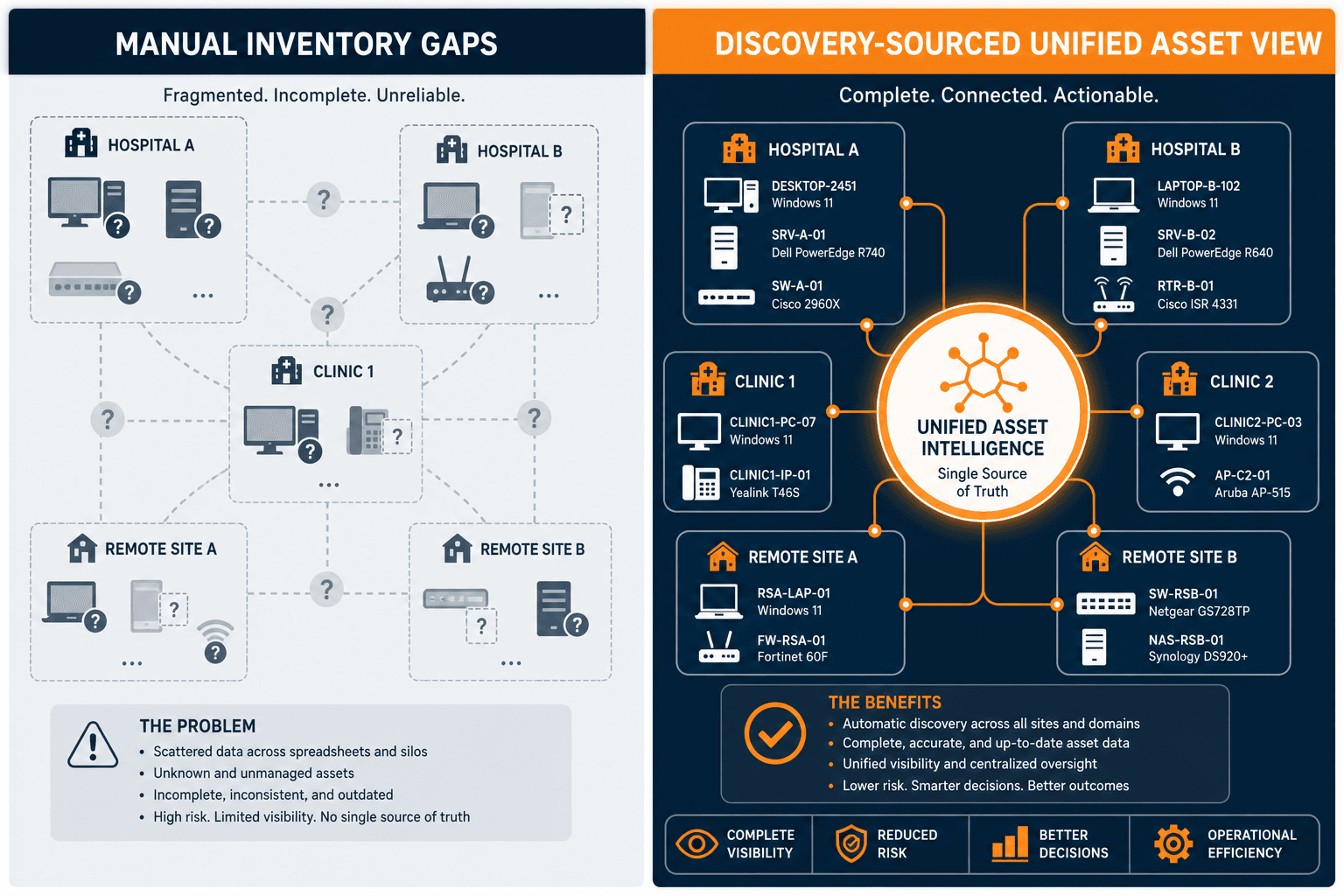
Manual inventories get fragile fast when assets are spread across Nashville hospitals, remote offices, and cloud environments. Your spreadsheets won’t self-update when a device moves, a cloud resource gets provisioned, or an endpoint goes offline.
Discovery gives you technical observations manual tracking can’t maintain at this scale: hardware identity, OS and version, installed software, IP address, configuration state, virtualization status, and network equipment.
The enterprise IT discovery approach for healthcare environments supports agent-based collection for managed endpoints, agentless collection for network infrastructure and servers, and API-based discovery for cloud environments. That’s the healthcare ITAM Nashville teams need — a discovery-sourced foundation with source context retained, so you can trace every observation back to where it came from. Discovery tells you a device exists; it doesn’t tell you who owns it or whether it’s still needed — that’s the governance layer the next two sections cover.
What types of IT assets does discovery identify in a distributed healthcare environment?
Discovery typically surfaces hardware identity, OS and version, installed software, IP address, virtualization state, and network equipment — the technical layer that feeds a governed asset record.
Site should become an explicit asset-management dimension
Location should do more than sit on an asset record as a mailing address. A practical model builds it into the asset hierarchy: Health system → region → facility → department → owner → asset — for example, HCA → Middle Tennessee → Nashville hospital → imaging administration → infrastructure team → server, or Health system → Rutherford County → outpatient clinic → front office → local user → workstation.
This isn’t rigid taxonomy — it’s what lets you distinguish assets you govern centrally from assets assigned to a specific facility, department, or user. Before You Run AI Agents on ServiceNow, Answer These 5 Questions About Your CMDB covers this approach in more depth.
Acquisitions and expansion make asset reconciliation continuous
When you acquire a hospital, IT doesn’t get a clean, blank environment — you inherit devices, software, naming practices, and lifecycle histories built under someone else’s governance model. Lifepoint’s eight-hospital ScionHealth acquisition and Vanderbilt’s continuing expansion are recent examples, each adding asset histories you have to reconcile into enterprise governance.
Discovery against an acquired environment produces the first observation of what exists. Reconciliation against your existing CMDB — the configuration database that should be your single system of record — identifies what’s net-new, what conflicts with your estate model, and what needs an owner before it becomes untracked. That cycle doesn’t end after the first pass; expansion makes it continuous.
What headquarters needs to know about every distributed asset
The question you should answer for any asset is the same regardless of site: who owns it, what lifecycle stage it’s in, and is it still needed?
| Question | Asset context required |
|---|---|
| What is it? | Hardware or software identity |
| Where is it? | Hospital, clinic, office, cloud, remote |
| Which region? | Nashville / Middle Tennessee / other market |
| Who owns it? | Corporate, facility, department, user |
| Who supports it? | Enterprise IT, local IT, vendor |
| Is it active? | Current discovery status |
| What runs on it? | OS and installed software |
| What lifecycle stage? | Deployed, refresh, stored, retired |
| What source reported it? | Discovery, endpoint management, purchasing |
| When was it verified? | Last-observed timestamp |
| What else relates to it? | Services or systems where relevant |
The workflow: Discover → Reconcile → Contextualize → Govern → Verify — from first observation, through conflict resolution and ownership context, to enterprise standards and recurring verification against stale records.
What questions should headquarters IT be able to answer about every distributed asset?
What it is, where it operates, who owns and supports it, whether discovery has recently observed it, and what lifecycle stage applies — the minimum data model for multi-site ITAM.
Where Virima fits
Virima gives your healthcare IT team a discovery-sourced enterprise asset layer around the technology operating across your distributed environment.
Virima Discovery collects data via agent-based, agentless, and API-based methods across on-premises, cloud, hybrid, and remote environments, feeding a CMDB with source tracking retained per observation. Reconciliation rules resolve conflicts when multiple systems observe the same asset differently, without last-scan-wins overwriting your authoritative records.
Virima ITAM adds ownership, lifecycle state, and asset history, with facility hierarchy built in so location becomes a governance layer, not just a mailing address. ViVID™ service maps surface how services and infrastructure depend on each other. The model scales to acquisitions: discovery against a newly acquired hospital produces an initial observation, and reconciliation against your CMDB identifies what’s net-new before ITAM applies your lifecycle model.
Nashville built a healthcare capital by learning to operate at scale
Nashville became a healthcare capital by learning to run healthcare across geographies too large for informal coordination — governance centralized, technology presence distributed across the country.
ITAM closes that distance by keeping asset records tied to what’s actually operating at each location. Nashville healthcare IT asset management succeeds when your central visibility matches your central policy; without it, policies exist on paper while the facts stay local.
Frequently Asked Questions
Why is multi-site healthcare particularly difficult to manage from a central IT asset perspective?
Ownership is centralized while presence is distributed: a Nashville team sets policy, and assets implement it across facilities in multiple states. Without discovery-sourced visibility at each site, central IT can’t confirm conformance — ITAM reconciles fragmented sources into one record.
What did the HCA Healthcare breach reveal about enterprise IT asset scope in large healthcare organizations?
HIPAA Journal reported the compromised data came from an external storage location used to automate email formatting, holding 27.7 million records — supporting infrastructure, not a clinical application. The settlement reached final approval in October 2025 without an admission of liability. Accountability can’t focus exclusively on obviously clinical systems.
Does Virima support IT asset management across acquired or newly affiliated hospital sites?
Yes. Virima Discovery runs against a newly acquired environment to produce an initial observation of what exists. Reconciliation against your CMDB identifies what’s net-new, what conflicts with your estate model, and what needs an owner. ITAM then applies your lifecycle and ownership model — whether it’s your first acquisition or your fifth.
How does Virima support IT asset management for multi-site healthcare operators?
Virima Discovery collects data via agent-based, agentless, and API-based methods across on-premises, cloud, hybrid, and remote environments, with source tracking retained per record. Virima ITAM adds ownership, lifecycle state, and asset history, and facility hierarchy makes location a governance dimension. ViVID™ service maps surface dependency context across distributed assets.
What is the difference between IT asset discovery and IT asset management in a healthcare context?
Discovery identifies that an asset exists: hardware type, OS, installed software, and network presence. IT asset management adds the governance layer: who owns it, who supports it, its lifecycle stage, and whether it’s still required. Discovery provides observation manual tracking can’t sustain at scale; ITAM converts it into a governed asset.