IT Asset Visibility for Chicago Manufacturing IT/OT Boundary

A ransomware crew does not need to reach a single programmable logic controller to shut down a production line. Dragos tracked 1,140 ransomware incidents against industrial organizations in the second quarter of 2026 alone, and manufacturing accounted for 747 of them, 65 percent of the total. In the clear majority of these cases, the intrusion stayed inside information technology (IT), the servers running order management, scheduling, and shipping. That was enough. IT sits close enough to the shop floor that taking it offline stops the line as effectively as an attack on the machinery itself.
Chicago carries this exposure at real scale. The metro area anchors one of the country’s densest concentrations of discrete manufacturing: machinery, fabricated metals, food and beverage processing, plastics. Those plants run IT environments built the same way every other corporate network is built — flat, convenient, and connected straight through to the plant floor. IT asset visibility at that boundary is a current, owned inventory of every system that can interrupt production if it fails, plus the dependencies that connect those systems. For a Chicago manufacturer’s IT team, the real test is whether anyone can say, right now, which of those systems would take production down if it went dark.
The Chicago manufacturing base and its operating rhythm
The Chicago metro is not a single vertical. It is a stacked set of discrete manufacturing clusters that share one operating pattern: fabricated metal shops feeding machinery builders, food and beverage processors running continuous lines on tight shipping windows, plastics and packaging plants one hop from national distribution, and contract manufacturers holding customer drawings, toolpaths, and quality records on the same networks that schedule presses and mixers.
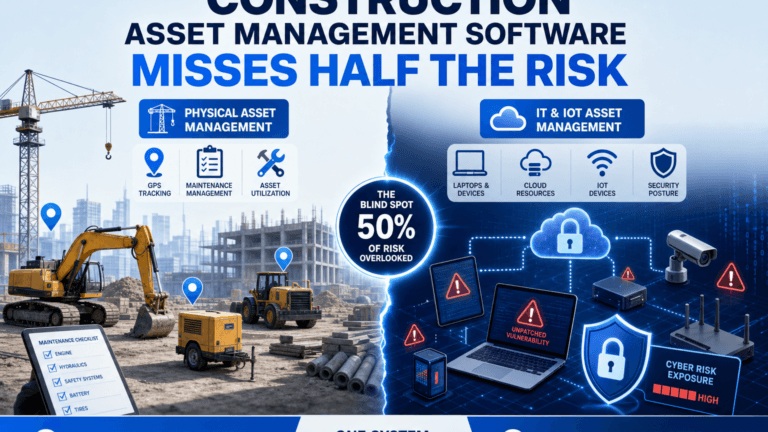
What those plants share is a thin IT layer pressed against a dense operational technology (OT) floor, run by lean teams. Many shops sit in the small and mid-sized band where one IT manager covers identity, backup, plant Wi-Fi, and the ERP vendor relationship. Enterprise resource planning (ERP), manufacturing execution systems (MES), warehouse systems, and quality databases sit on corporate Active Directory and authenticate users the same way finance does. They talk to file shares, print servers, and remote desktop jump hosts — intermediary servers that let plant engineers reach human-machine interface (HMI) stations and historians without a direct line into the plant network. The business treats that path as normal convenience. An attacker treats it as a production kill switch that never required a PLC exploit. This IT/OT overlap is not a Chicago-only pattern; see how manufacturing IT asset management plays out across the sector broadly, but the density of shops running that same design is what sharpens the risk locally.
Contract manufacturing adds a second pressure: customer intellectual property (IP), process recipes, and quality evidence live on the same hosts that schedule production, so a ransomware event is a production event and a customer-trust event in one ticket. Multi-tenant plants running jobs for several OEMs cannot afford a week of silence while someone rebuilds which share held which customer’s toolpaths. Legacy equipment compounds the problem — a 15-year-old press line may still depend on an aging Windows engineering station, a serial-to-Ethernet bridge, and a file share that has never been tagged as a production configuration item. Without scheduled discovery that reaches both layers and service definitions that name the production cell, the plant’s source of truth is tribal knowledge on the night shift.
No Chicago-specific breach is required to establish the stakes. Density plus lean staffing plus shared IT/OT paths is enough. When one mid-size plant loses scheduling and shipping systems for 48 hours, customer lines downstream feel it the same week. When several plants in the same supply web share the same unmanaged pattern, the metro becomes a correlated risk surface, not a set of isolated shops.
Why does Chicago manufacturing face outsized IT/OT ransomware risk?
Chicago packs dense discrete manufacturing next to thin IT staffs and shared paths from ERP and MES into plant systems. Ransomware that only hits IT can still stop lines because order, schedule, and shipping systems sit on the same operational path as the floor.
What asset visibility means at the IT/OT boundary
IT asset visibility at the boundary is not a static spreadsheet of servers, and it is not an OT vendor list kept only by controls engineers — it is one map that covers both sides of the plant. For the cybersecurity fundamentals behind that inventory, see IT asset visibility for cybersecurity.
On the OT side, the familiar names are programmable logic controllers (PLCs), supervisory control and data acquisition (SCADA) servers, HMI panels, historians, industrial switches, and engineering workstations. On the IT side sit domain controllers, ERP application servers, MES databases, file shares holding recipes and CNC programs, jump hosts, remote access gateways, backup targets, and the virtualization hosts underneath them. The boundary is the set of shared dependencies between those layers: authentication, name resolution, file transfer, historian SQL links, vendor remote access, and the Windows jump boxes plant techs still use every shift.
Teams that only inventory OT devices miss the IT hop that ransomware prefers. Teams that only inventory IT servers miss which of those servers is the single path to a line. IT asset management typically stays IT-owned and IT-scoped; OT asset inventory typically stays engineering-owned and device-scoped — and visibility fails exactly where those two ownership boundaries meet, when neither team can answer which configuration item would halt Line 3 if it went offline at 2 a.m. That is why IT discovery has to reach the plant-adjacent estate, not only the data center rack list.

Where it breaks, with evidence
Manufacturing has held the top rank on IBM X-Force’s most-targeted industry list for years — the IBM 2026 X-Force Threat Index newsroom release confirmed it again in 2026. The structural insight from Dragos’s Q2 2026 industrial ransomware analysis matters more than the ranking: most industrial ransomware cases never needed a successful PLC compromise. IT-only impact on order systems, scheduling, shipping, and related enterprise services was enough to stop production. Attackers chase plants because downtime converts quickly into payment pressure, and IT paths into production remain easier than deep OT exploits. That is the gap a Chicago IT leader has to close in inventory terms — not only whether PLCs are segmented, but which IT systems are production-critical because the floor cannot run without them.
When those systems are missing from the configuration management database, change tickets ship without impact review. When backup and recovery plans omit them, restore priorities favor generic file servers over the MES database that restarts the line. When security tools alert without business-service context, triage burns hours before anyone names the production consequence. A CMDB foundation only helps if plant-adjacent systems are present as owned configuration items with relationships, not as tribal names on a whiteboard.
Chicago plants lose hours when production-critical IT paths are missing from inventory. Download the checklist to map ERP, MES, jump hosts, and plant-adjacent systems before the next encryption event or defense contract review.
What breaks first when there is no visibility
The first break is rarely a melted PLC. It is a halted schedule. Shipping labels stop printing. Quality holds cannot clear. Maintenance cannot pull the work order system. Operators stand at HMIs that still show green while the business systems that authorize the next batch are encrypted or offline.
That halt moves into the supply chain within hours: Tier-1 and Tier-2 customers lose inbound parts, just-in-time lines elsewhere idle, and the plant’s commercial team fields status calls without a defensible list of restored systems because nobody had a current map of production dependencies.
Industry parallels outside Chicago already show the pattern. Jaguar Land Rover’s widely reported 2025 ransomware disruption rippled through supplier networks far beyond a single site, and Fairlife’s publicly reported production stoppages tied to cyber impact likewise showed how food and beverage lines depend on IT systems that sit next to, not inside, the control layer. Those cases are cautionary parallels, not local claims — but they illustrate the same structural failure: production stopped while the control system itself was never the only, or even the first, target.
Without visibility, recovery order is guessed. With visibility, restore sequences follow production criticality, ownership, and dependency paths instead of whoever shouts loudest in the war room — recovery priority follows production-service criticality, not system type. Change impact analysis only works when the same dependency map is current before the change and during the outage.

What fails first in manufacturing ransomware when IT is hit but OT is not?
Scheduling, shipping, quality, and MES systems fail first. Lines stop because those IT services authorize and sequence production, even when PLCs and SCADA remain reachable. Recovery then stalls until teams rebuild which IT assets were production-critical.
The regulatory backdrop for Chicago defense and dual-use plants
Cybersecurity Maturity Model Certification (CMMC) 2.0 Phase 1 took effect on November 10, 2025 under the Defense Federal Acquisition Regulation Supplement rule published in the Federal Register. Chicago-area manufacturers that bid on Department of Defense work, or that sit in the defense supply chain as subcontractors, now face contractual paths that expect controlled unclassified information (CUI) protections and verifiable practices, including knowing which systems process, store, or transmit that information.
You cannot certify visibility into systems nobody can currently enumerate. Asset inventory and system categorization are upstream of access control evidence, logging scope, and incident response playbooks — a plant that still separates IT assets in the CMDB from OT stuff on a spreadsheet will fail the practical test long before an assessor argues control language. Dual-use shops that run commercial and defense jobs on shared infrastructure feel this first: the inventory boundary is the compliance boundary.
Phase timelines continue to evolve at the program level, including later-phase adjustments announced by the Department, but Phase 1’s effective date and the need for an accurate system inventory do not wait on perfect clarity about later phases. If the contract path requires CMMC alignment, the enumeration work starts from the live environment, not from last year’s architecture diagram. Pair that work with disciplined IT asset inventory hygiene so CUI-bearing hosts are not missing from the same source of truth security and operations use daily.
What accurate visibility actually looks like
Accurate visibility treats IT and OT as one operational map maintained on a shared cadence, not two lists owned by two teams that meet once a quarter. Here is how to build a CMDB across IT and OT in practice:
- Discovery coverage that reaches corporate servers, virtualization, cloud instances where MES or quality apps run, network devices, and the engineering and jump hosts that touch the plant, on scheduled discovery cycles rather than ad hoc audits.
- Normalization and ownership so each configuration item (CI) has a named owner, environment, and criticality, including plant-floor adjacent Windows hosts that security tools often ignore.
- Service definitions for production cells, packaging lines, and shipping flows provided by operations, then service mapping built from those definitions so impact paths are visible before change and during incident response.
- Relationship truth showing which ERP module, database, file share, and remote access path sit under each named production service.
- Change and restore use of that map so CAB reviews and ransomware recovery both pull the same production-critical list.
Separate OT scanners and separate IT CMDBs can each look complete on their own terms and still leave the boundary dark. The test is simple: can the IT manager and the controls lead open one view and agree which ten systems take Line 4 down? CMDB best practices start with that shared ownership model, not with a prettier CI form.

Where a platform fits
Service dependency mapping in manufacturing means visualizing which ERP modules, databases, and remote paths a named production service — a line, a cell, a packaging run — actually depends on, so blast radius is visible before a change or incident, not discovered during one.
Platforms that combine multi-source discovery, a governed CMDB, and service mapping after service definitions are supplied close the gap faster than spreadsheets and tribal walkdowns. Virima discovers and reconciles IT assets across on-prem and cloud, maintains CI relationships, and builds ViVID™ service maps once production services are defined, so blast-radius and dependency views reflect the path from ERP and MES into the systems the floor depends on. Integrations with ITSM platforms such as ServiceNow, Jira Service Management, Ivanti, HaloITSM, Xurrent, and Hornbill keep that inventory inside the tools teams already use for change and incident work, through a single integrations hub rather than one-off silos. ITAM and ITOM views then pull from the same discovery-sourced records, so lifecycle and operations teams are not maintaining parallel lists of plant-adjacent hosts.
The point of the platform is not a longer asset list. It is a production-aware runtime picture IT and operations can both trust when the next encryption event, change window, or CMMC evidence request arrives.
Knowing what would take the line down
Dragos’s Q2 2026 numbers made the structural point plain: industrial ransomware often never needs the PLC. IT systems close to the shop floor are enough. Chicago’s manufacturing density multiplies that pattern across machinery, metals, food, and plastics plants that still run the same networks between the front office and the floor.
The operational question is narrower than whether malware was detected. It is whether your team can name, right now, the systems between order entry and the last station on the line that would halt production if they went dark, who owns them, and what depends on them. That is IT asset visibility at the IT/OT boundary. Without it, segmentation projects, backup investments, and compliance binders all float above an incomplete map. With it, recovery order, change impact, and contract evidence start from the same production truth.
Frequently Asked Questions
Can ransomware stop a manufacturing line without compromising PLCs or SCADA?
Yes. Dragos’s Q2 2026 industrial ransomware analysis found that a large share of industrial cases stayed in IT systems such as scheduling, shipping, and order management. Those systems sit close enough to production that encrypting or disabling them halts the line without a successful control-system exploit.
What counts as the IT/OT boundary for asset inventory purposes?
The boundary is the shared dependency set between enterprise IT and plant systems: domain authentication, jump hosts, file shares with recipes or CNC programs, historian databases, remote access gateways, and the servers running ERP and MES. Inventory work has to cover those hops, not only PLC and HMI device lists.
Why do Chicago manufacturers struggle more with this inventory gap?
Many Chicago-area discrete manufacturers run lean IT and security staffs, dense contract-manufacturing IP on shared networks, and legacy shop-floor hosts beside modern ERP. OT and IT ownership often stay split, so production-critical IT systems never enter the same discovery and CMDB cycle as corporate servers.
How does CMMC change asset visibility expectations for defense-supply manufacturers?
CMMC 2.0 Phase 1 became effective November 10, 2025. Contractors and subcontractors in scope need to know which systems handle controlled information and support required practices. That starts with an accurate, current system inventory. You cannot evidence controls on assets the organization still cannot enumerate.
How does Virima help manufacturing IT teams at the IT/OT edge?
Virima runs scheduled discovery across IT environments, reconciles configuration items into a governed CMDB, and builds ViVID™ service maps after teams define production services. That gives IT and operations a shared view of which enterprise systems sit on the path to the line, for change impact, recovery priority, and audit evidence.
Does Virima’s discovery reach OT-adjacent IT systems like historians and jump hosts, or only corporate servers?
Virima’s discovery reaches OT-adjacent IT systems — historians, jump hosts, engineering workstations, and the Windows hosts that sit between corporate IT and the plant floor — not only data-center servers. Those systems get reconciled into the CMDB alongside ERP and MES so they carry ownership and criticality like any other configuration item.