IT Asset Management in Higher Education: Tracking Devices and Software Licenses Across Departments

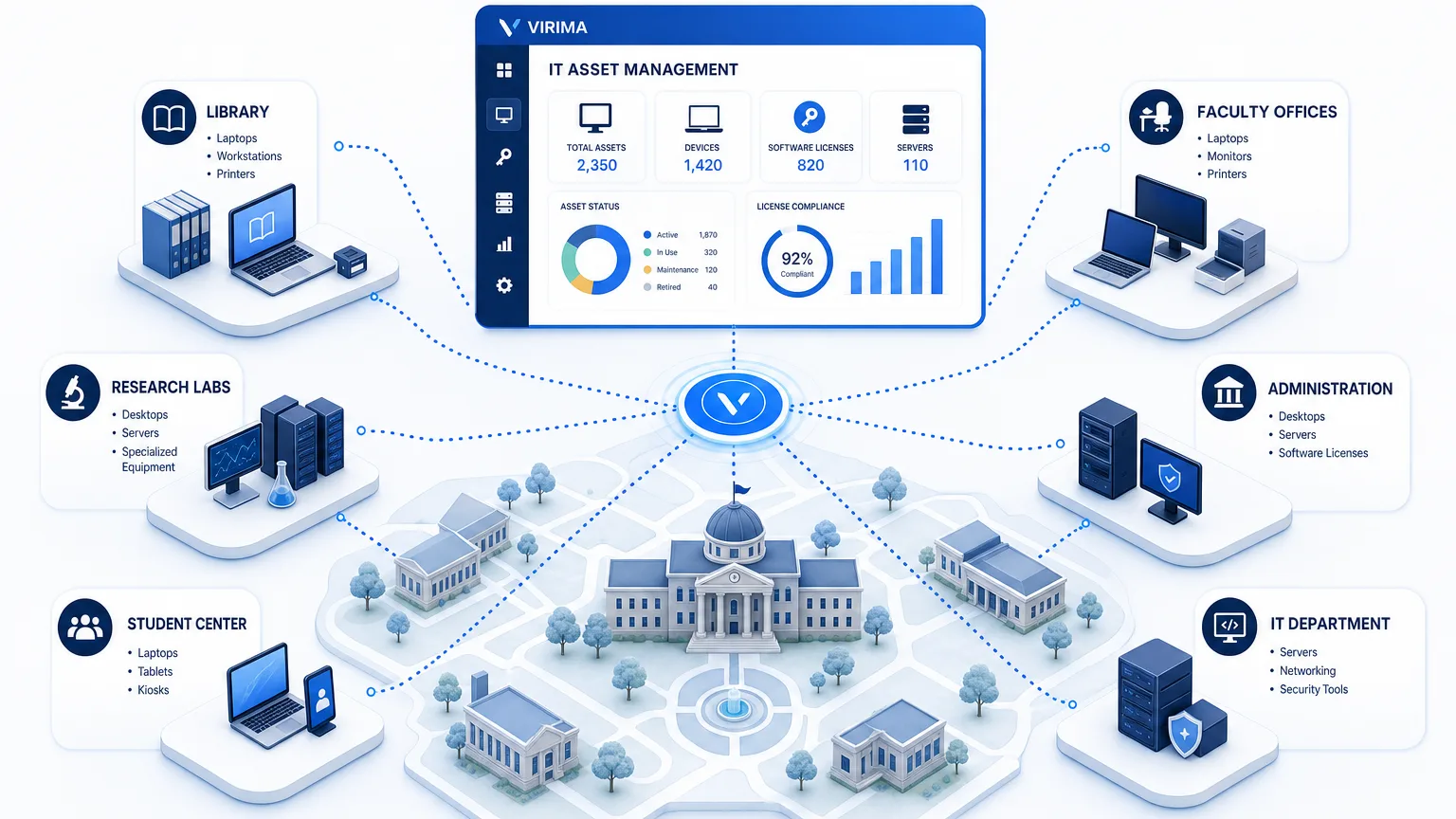
A university operates under one name and one security program. Underneath that umbrella, technology sprawls across colleges, research labs, libraries, satellite locations, and central IT — each making its own purchasing decisions. That distribution isn’t inherently a problem, until the institution needs to answer one simple question: what technology do we actually have? Answering that means finding devices bought by different departments, tracing who owns them, matching installed software to the right licenses, and placing every asset in its lifecycle. That is the real work of IT asset management in higher education: not centralizing every technology decision, but building institution-wide visibility across distributed ownership.
What is IT asset management in higher education?
IT asset management in higher education is the practice of maintaining institution-wide visibility over hardware devices, software licenses, and their ownership across decentralized departments, colleges, and research units, connecting procurement, deployment, and lifecycle data into one reliable record regardless of which unit made the original purchasing decision.
Decentralized IT isn’t necessarily the problem
Higher education institutions have good reasons for distributing some technology decisions.
Academic departments have specialized teaching requirements. Research teams may purchase systems with grant funding. Administrative units need applications specific to their functions. Individual colleges can have technology environments that look substantially different from those of other colleges within the same university.
Institutional policies often reflect this reality.
For example, the University of Michigan’s software procurement policy applies across university departments and units while still allowing certain software purchases to take place under delegated authority within defined institutional requirements. University of Michigan, Software Procurement Policy
Cornell University takes a similarly selective approach to software licensing. Its central licensing organization considers whether centrally managing a product makes sense based partly on demand across multiple colleges, departments, or administrative units. Cornell University, Criteria for Software Licensing
The lesson is important:
Centralization and governance are not the same thing.
A university does not necessarily need to route every laptop, research application, or departmental software subscription through one team to establish effective IT governance.
It does, however, need enough shared information to understand the technology for which the institution is ultimately responsible.
The real challenge is decentralized visibility
Consider what happens after those individual technology decisions accumulate.
One school acquires laptops for faculty. Another maintains specialized workstations. A research team acquires software for a funded project. Central IT manages institution-wide applications. Individual departments maintain additional software licenses.
Each decision may make sense independently.
The institution-wide picture can be much harder to reconstruct. That difficulty shows up in the numbers: only 36% of enterprises report having complete visibility into their technology estate, down from 43% the year before, per Flexera’s 2026 State of ITAM Report. Higher education’s decentralized purchasing makes that gap easier to fall into, not harder.
The University of Minnesota provided a useful example of the software side of this problem in an EDUCAUSE case study. Its software acquisition environment had historically been decentralized and siloed, making it difficult to answer basic questions such as whether somebody had already purchased a particular product or whether an existing solution could meet the need. The university responded by creating a technology portfolio that brought information about software, approved uses, contracts, and other decision-making context together. EDUCAUSE, University of Minnesota Technology Decision-Making Case
This points to the underlying IT asset management challenge:
Technology ownership can be distributed while institutional accountability remains shared.
Washington University in St. Louis makes that distinction particularly clear. Its IT asset management policy applies university-wide and extends requirements to organizations that manage their own budgets. It also requires applicable asset information to be maintained in the CMDB and associated with an individual or organizational area. Washington University, IT Asset Management Policy
A department may therefore have operational responsibility for an asset while the university still needs an institutional record of it.
That shared visibility matters throughout the asset lifecycle.
See how discovery-driven IT asset management works for higher education
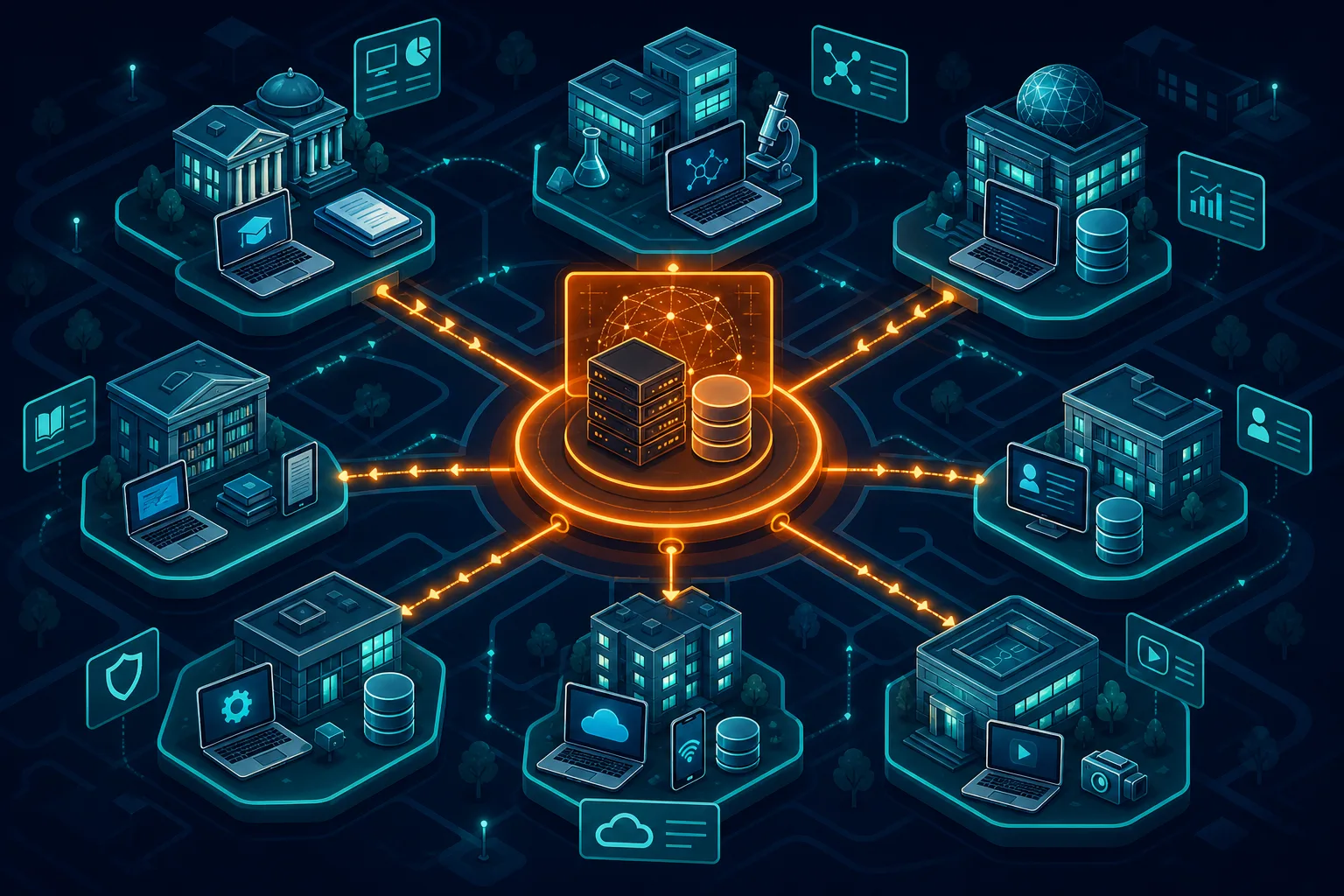
One device can exist in several different systems
Universities rarely suffer from a complete absence of asset data.
More often, pieces of the truth exist in different places.
A laptop, for example, could appear in:
- a procurement or financial system,
- an endpoint management platform,
- Active Directory or another identity source,
- a network discovery tool,
- a department-maintained inventory,
- an IT service management platform,
- and a configuration management database.
Each system may describe a different aspect of the same device.
Procurement knows what was purchased and how much it cost. Endpoint management knows configuration details. Identity systems may help identify the user. Network tools know where the device is appearing. ITSM records may show incidents or requests associated with it.
The problem is not solved by creating one more spreadsheet and asking departments to copy everything into it.
Higher-ed IT needs to reconcile those signals into a trustworthy asset record.
Texas A&M University illustrates the approach through its IT Asset Management System, which aggregates asset information from multiple technology sources and consolidates that data for security and operational visibility. Texas A&M University, IT Asset Management
That changes the objective from:
“Put every piece of data into one system manually.”
to:
“Create one reliable view from the systems that already know different things about the asset.”
That distinction becomes increasingly important as a university’s IT environment grows.
Software licensing makes visibility even harder
Hardware is only part of the picture.
Software introduces another layer because knowing that an application exists does not automatically tell IT whether its use is covered by the correct license.
A higher education institution may simultaneously have:
- university-wide agreements,
- departmental software purchases,
- device-based licenses,
- named-user licenses,
- subscriptions,
- specialized research applications,
- cloud services,
- and software attached to particular projects or funding sources.
Boston University, for example, provides centrally managed licensing for some software while also maintaining departmental purchasing processes for other software. Boston University, Departmental Software Purchasing
Cornell likewise centrally manages selected software agreements rather than treating every software product as part of one universal licensing model.
That complexity has a price tag: the same Flexera report found 44% of organizations spent more than $1 million on software audits over the past three years, a cost that grows when license types multiply across departments that don’t share purchasing records.
That means a useful software inventory needs to answer more than:
What applications are installed?
It should help IT investigate:
Where is the software installed?
Who or which department uses it?
What entitlement covers the installation?
How many licenses were purchased?
When does the agreement renew?
Is the software still being used?
Can a license be reassigned when an asset or user leaves?
Without connecting deployment data to licensing and ownership context, institutions can have a software inventory without having effective software asset management.
How do universities manage software licenses across multiple departments?
Universities that manage software licenses effectively connect deployment data to entitlements by tracking where each application is installed, which license type covers it, how many seats were purchased, and when agreements renew. Without linking these four data points, institutions risk compliance gaps, paying for unused licenses or running software outside the terms of their agreements.
Why incomplete asset visibility affects more than inventory
Asset tracking can sound administrative until another IT process depends on the answer.
Then data quality becomes operational.
Security depends on knowing what exists
IT teams cannot manage devices they do not know about.
An asset inventory helps establish which hardware and software belong to the environment and provides context for identifying unsupported operating systems, unexpected software, aging assets, or systems requiring security attention.
Washington University’s IT asset management policy connects asset management with information security, risk management, business continuity, maintenance, and compliance across the asset lifecycle.
Visibility supports a more fundamental security question:
Which assets are we responsible for protecting?
Financial planning depends on lifecycle context
Knowing that a university owns 4,000 laptops is useful.
Knowing which of those devices are approaching replacement is considerably more useful.
Washington University’s broader IT Asset Management Program connects centralized hardware and software inventory with technology refresh planning and budgeting. Washington University, IT Asset Management Program
Asset information can help institutions move from reactive replacement toward more predictable lifecycle planning.
Software decisions depend on knowing what is already available
Before purchasing another application, procurement and IT should ideally be able to determine whether:
- the university already owns the product,
- another department has an agreement for it,
- an institution-wide license exists,
- an approved alternative already meets the need,
- or an existing entitlement can accommodate additional users.
The University of Minnesota’s software portfolio was developed in response to precisely this type of information problem.
Better visibility does not make every procurement decision automatic.
It makes better questions possible before money is committed.
Start by discovering what actually exists
A reliable higher education ITAM program cannot depend exclusively on somebody remembering to update an inventory after every change.
Devices move.
Software gets installed and removed.
Virtual machines are created.
Configurations change.
Remote endpoints may spend little time connected to a traditional campus network.
Automated IT discovery becomes an important foundation for asset management.
The University of Tennessee’s IT asset management policy, for example, includes active discovery of network-connected assets as part of maintaining a campus IT asset inventory, with additional discovery practices included at more advanced implementation levels. University of Tennessee, IT Asset Management Policy
Discovery can identify technical information such as:
- hardware assets,
- operating systems,
- installed applications,
- software versions,
- configuration attributes,
- virtual resources,
- cloud resources,
- network devices,
- and relationships between systems.
But discovery should not be confused with complete IT asset management: a CMDB built without discovery reduces to a database of whatever someone remembered to type in.
A scanner may identify a laptop and its installed applications. It may not inherently know the funding source, procurement record, contractual entitlement, lifecycle policy, or business purpose associated with that device.
The stronger model combines discovered technical truth with institutional context.
Reconcile discovery with ownership, procurement, and lifecycle data
University asset discovery is only part of the picture. IT asset management in higher education depends on connecting that technical data to institutional context — for each significant technology asset, a useful higher education ITAM program should ultimately help answer several layers of questions.
| Question | What IT needs to understand |
|---|---|
| What is it? | Hardware or software identity and configuration |
| Where is it? | Campus, location, network, or environment |
| Who uses it? | Assigned user |
| Who owns it? | Department, school, or organizational unit |
| How was it acquired? | Procurement and financial information |
| What covers it? | License, agreement, warranty, or contract |
| What state is it in? | Requested, deployed, stored, reassigned, retired |
| Is it still needed? | Activity or software usage where measurable |
| What depends on it? | Services, systems, and related configuration items |
The ownership dimension is particularly important in decentralized environments.
A university may need institution-wide reporting without taking day-to-day control away from the team responsible for a particular system.
That leads to a more useful model for higher education:
Centralize visibility, not necessarily ownership.
For higher education, the strongest operating model is federated rather than purely centralized: departments retain operational responsibility for technology decisions that require local expertise, while central IT holds the common visibility and governance layer. Federated IT asset management lets departments keep purchasing and operational authority over their own devices and software while contributing records to one institution-wide inventory. Washington University’s policy applies this model university-wide, requiring even self-budgeted units to maintain CMDB records — proof that shared visibility and local autonomy aren’t mutually exclusive.
The practical question is how to structure that split. The six-stage workflow below is one answer.
A federated IT asset management workflow for higher education
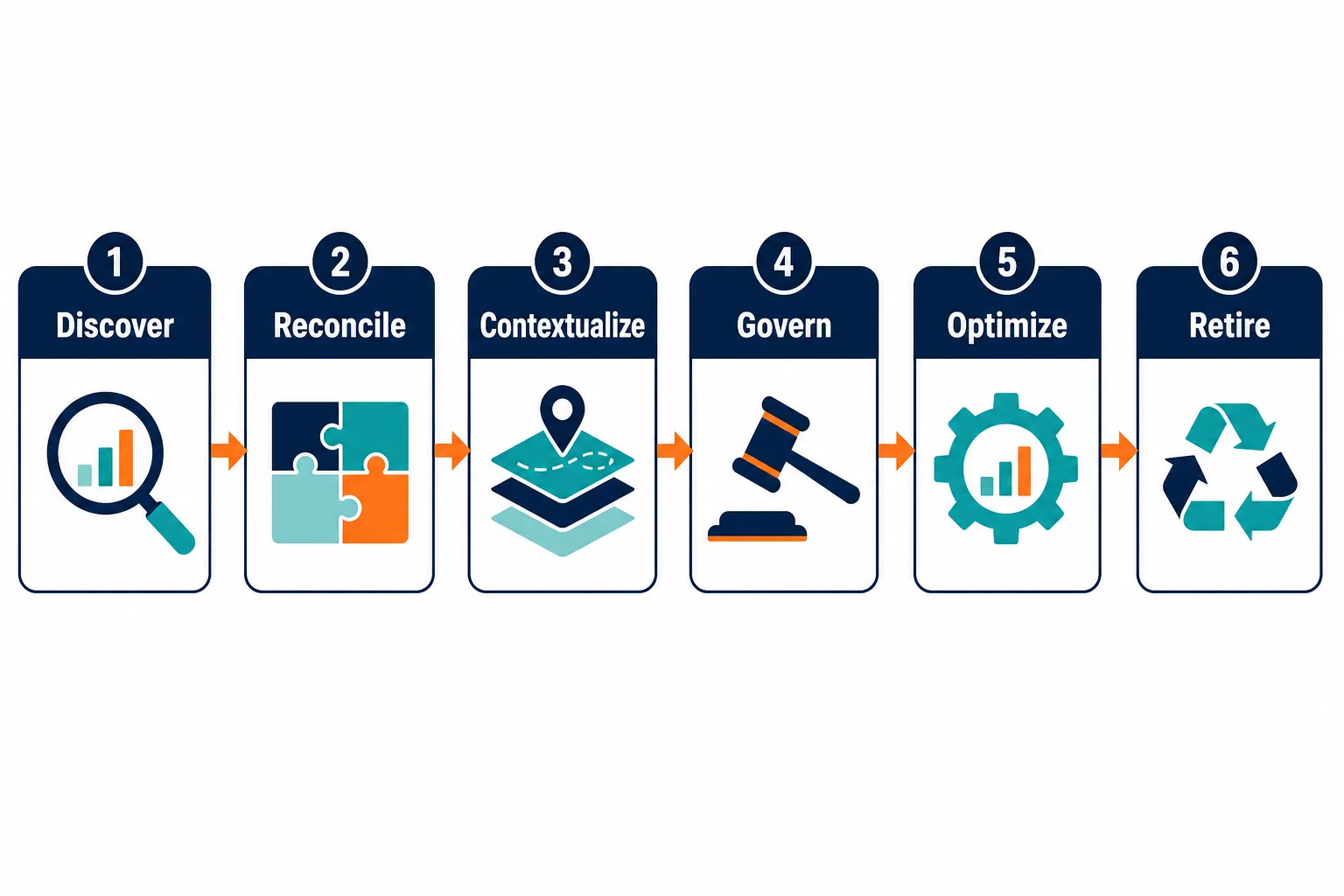
Putting these ideas together produces a six-stage model. A practical higher-ed ITAM workflow runs in six stages: Discover (identify assets across environments), Reconcile (merge conflicting records), Contextualize (attach ownership and licensing), Govern (apply shared policy), Optimize (surface waste and renewals), and Retire (close the lifecycle). Each stage depends on the discovery data from stage one staying current.
| Stage | What happens | Illustrative example |
|---|---|---|
| 1. Discover | Continuously identify hardware, software, virtual, cloud, and other discoverable assets | A network scan surfaces an unmanaged lab workstation |
| 2. Reconcile | Compare data from multiple sources and resolve duplicate or conflicting records | A procurement record and an endpoint agent both describe the same laptop |
| 3. Contextualize | Connect technical records with ownership, department, location, and licensing information | A discovered server is tagged to the college and grant that funded it |
| 4. Govern | Apply shared lifecycle, security, and reporting requirements while allowing departmental responsibility | A security policy flags an unsupported OS version for remediation |
| 5. Optimize | Investigate inactive devices, underused software, redundant purchases, and expiring contracts | A license renewal is right-sized before the vendor invoice arrives |
| 6. Retire | Update lifecycle records, recover reusable licenses, and remove retired equipment from active inventory | A decommissioned lab machine’s license is reassigned to a new device |
1. Discover
Continuously identify hardware, software, virtual, cloud, and other discoverable assets across the environments within scope.
2. Reconcile
Compare data from multiple sources and resolve duplicate or conflicting records so IT is not managing several competing versions of the same asset.
3. Contextualize
Connect technical records with ownership, department, location, procurement, contract, and licensing information.
4. Govern
Apply common lifecycle, security, data-quality, and reporting requirements while allowing appropriate departmental responsibility.
5. Optimize
Use the resulting information to investigate inactive devices, underused software, redundant purchases, expiring contracts, upcoming refreshes, and licensing requirements.
6. Retire
When assets reach end of life, update lifecycle records, recover reusable licenses where allowed, preserve required history, and ensure retired equipment no longer appears as an active institutional asset.
This is where IT asset management becomes more than inventory.
It becomes an operational system for understanding technology from acquisition through retirement.
Track software from entitlement to actual usage
Software asset management has its own stage sequence within the broader ITAM lifecycle, and each stage depends on discovery to stay current. Software asset management works when each installed application is linked to the license that covers it: discovery records the install, a license-key CI records the entitlement, and reconciliation recalculates the gap automatically whenever either side changes. That link — not the inventory alone — is what lets IT catch under- or over-licensing before a vendor audit does.
Discover → Record → Entitle → Reconcile → Assess → Act
Automated discovery runs on a defined schedule and inventories installed software across endpoints without manual input. Each detected installation creates or updates a software CI in the CMDB, linked to the hardware CI where it was found. When an installation is removed, discovery updates the CI accordingly.
Entitlement records are held as license key CIs. Each captures the license type, seat count, vendor details, start and expiry dates, and current compliance status. A component-of relationship connects the license key CI to the software CI it authorizes, so the chain runs in both directions: from license down to the device, or from a device up to the license covering it.
Reconciliation runs automatically. When discovery detects a new installation or removal, it triggers a recalculation of the compliance position, seats deployed against seats licensed. The gap is visible without a manual audit pass.
Assessment goes further for business-critical applications. Heightened tracking can flag whether installations appear on authorized devices and whether the installed version matches the approved baseline.
The Act stage produces two paths. Where entitlements exceed active installations, reclamation candidates surface before the next renewal. Where installations exceed entitlements, the gap is visible in time to remediate rather than after a vendor audit letter arrives.
There is an important qualification: software licensing is contractual. Different vendors, products, and agreements define usage and compliance differently. Discovery-sourced data provides the accurate position; the contractual terms still determine what constitutes compliant use.
Bringing IT asset management in higher education together with Virima
Higher education institutions do not need another isolated inventory.
They need a way to combine what is actually present in the environment with who owns it, how it is licensed, where it sits in its lifecycle, and how it relates to the rest of IT.
That is the problem Virima is designed to address.
Virima brings together IT Discovery, IT Asset Management, and CMDB capabilities on a shared data foundation.
Virima Discovery supports automated collection across physical, virtual, cloud, and hybrid environments. That helps IT teams identify hardware, software, configurations, and relationships without relying only on manually maintained asset records.
That discovery data feeds Virima’s CMDB. There, information from multiple sources is reconciled, so IT teams get one reliable configuration record instead of several conflicting versions of the same asset. Virima’s CMDB capabilities include reconciliation and source-aware data management designed for environments where multiple systems contribute information about the same configuration item.
For higher-ed teams dealing with distributed asset ownership, that distinction matters.
For universities that also want to see how a reconciled asset record translates into operational risk, Virima’s ViVID™ service maps extend that same configuration data into service-level dependencies — showing which systems and services would be affected if a given device, application, or license changed status.
Records already exist across procurement, endpoint management, and department spreadsheets. The task is turning those into information IT teams can trust.
Virima IT Asset Management extends that foundation across the asset lifecycle, bringing hardware and software asset information together with ownership, lifecycle, license, contract, inventory, and usage context.
For software asset management specifically, Virima provides capabilities for connecting software inventory with license and asset information, helping teams assess deployments, entitlements, usage, and licensing context. Virima, Software License Tracking and Compliance Guide
This makes Virima particularly relevant to higher education institutions that want stronger centralized visibility without rebuilding every departmental IT process around a single operational tool.
A university can continue operating a distributed technology environment while creating a shared layer of asset intelligence across it.
With Virima, higher education IT teams can move toward a more complete answer to the questions that matter:
What assets do we have?
What software is running on them?
Who owns and uses them?
How are they changing?
Where are they in their lifecycle?
What licenses and contracts are associated with them?
And can we trust the information we are using to make those decisions?
Effective IT asset management in higher education doesn’t centralize every technology decision — it makes those decisions, and the assets they create, visible as one connected IT environment.
Frequently Asked Questions
How can universities track devices purchased by different departments without centralizing all procurement?
Universities can maintain institution-wide asset visibility without centralizing procurement by combining automated discovery with a shared CMDB. Automated discovery identifies devices across campus networks regardless of how they were purchased. Ownership attributes, department tags, and procurement context are then added to each discovered record, giving central IT a complete picture while departments retain operational responsibility for their assets.
What is the difference between centralized IT governance and centralized IT ownership in higher education?
Centralized IT governance means establishing shared policies, classification standards, reporting requirements, and visibility across the institution. Centralized IT ownership means routing all technology purchasing and operational decisions through one team. Universities commonly pursue the first without the second. Departments can retain purchasing authority and day-to-day operational control while still contributing asset records to an institution-wide inventory that supports security, compliance, and financial planning.
How do higher education institutions avoid overspending on software licenses they already own?
Overspending on duplicate or redundant software licenses is most often a visibility problem. When procurement teams cannot quickly determine whether a product is already licensed, they purchase again. Institutions that address this connect their software inventory to a searchable record of existing agreements, approved uses, and entitlement counts. Before any purchase is approved, the relevant teams can check whether an existing agreement covers the need or whether an existing entitlement has unused capacity.
How does Virima help higher education IT teams manage assets across decentralized departments?
Virima combines automated discovery, IT asset management, and CMDB capabilities on a shared data foundation. Discovery runs scheduled scans across physical, virtual, cloud, and hybrid environments, identifying devices and software without relying on manual updates. Those discovery records are reconciled with procurement, ownership, licensing, and lifecycle context in the CMDB, giving central IT a reliable institution-wide view while departments retain operational responsibility for their assets.
Can Virima connect software deployment data to license entitlements for university software agreements?
Virima provides capabilities for connecting software inventory with license and asset information, helping IT teams assess where software is deployed relative to what the institution has purchased. This supports investigations into entitlement coverage, usage patterns, and license reclamation opportunities before agreements renew. The underlying contractual terms of each vendor agreement still determine what constitutes compliant use, but Virima supplies the deployment and inventory data needed to have those conversations accurately.