Cloud Environment Management: How Real-Time Discovery Keeps AWS and Azure CIs Accurate

Every infrastructure change in AWS or Azure creates a transaction with a cloud provider. The provider’s ledger is mathematically certain: instance created at 14:37:22 UTC, tags assigned, security groups attached, volume mounted. The transaction is atomic, verified, logged, certain.
But somewhere between that certainty and your own internal records, the trail breaks. By next week, nobody remembers who provisioned it or why. By next month, it’s orphaned in a spreadsheet nobody updates. By next quarter, it doesn’t exist in your CMDB at all, even though it’s running in production, consuming budget, and supporting something your business depends on.
This isn’t a technology problem, but a speed problem. Cloud infrastructure moves faster than documentation. Automation moves faster than reconciliation. The gap isn’t a bug; it’s the inevitable consequence of how modern IT actually works.
IT teams spend recurring hours every month rediscovering infrastructure that the cloud provider knows exists, their billing system knows exists, but their own organization doesn’t. They do this not because they’re disorganized, but because the manual effort required to keep a CMDB accurate in a dynamic cloud environment is, mathematically, unsustainable.
This gap compounds, and over eighteen months, it becomes a problem. Over three years, it becomes a liability. When auditors arrive and query both the CMDB and the cloud provider’s API in the same afternoon, the discrepancy is unavoidable.
What Is Cloud Environment Management?
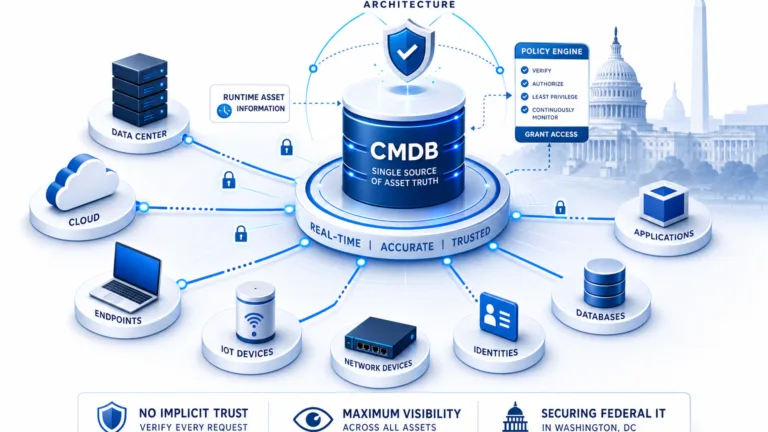
Cloud environment management refers to the practice of maintaining accurate, current, complete visibility of all computing resources. It includes instances, containers, databases, APIs, load balancers, and serverless functions across on-premises, multi-cloud, and hybrid infrastructure, and reconciling that intelligence with authoritative records in the CMDB.
NIST Special Publication 800-128 (“Guide for Security-Focused Configuration Management of Information Systems”) defines configuration management requirements for information systems. According to NIST, an authoritative CMDB requires:
- Complete visibility across all IT assets and their relationships
- Continuous synchronization between discovery findings and CMDB records
- Change-driven updates that capture infrastructure modifications as they occur
- Authorized change processes that prevent unauthorized configuration drift
The gap between NIST’s definition and most organizations’ operational reality is where risk accumulates.
The Hidden Problem
| Situation | What Happens |
|---|---|
| Manual discovery cycles (monthly or quarterly) | CMDB accuracy degrades between scans as cloud resources are provisioned and decommissioned outside of documented processes. |
| Cloud resource provisioning outside CMDB workflow | New instances, databases, and API endpoints exist in AWS/Azure but never enter the CMDB. Shadow resources accumulate silently. |
| Container and serverless workloads not discovered | Kubernetes pods, Lambda functions, and managed services lack stable persistent identifiers in traditional CMDB discovery tools. Coverage gaps widen as workloads modernize. |
| Multi-region deployments with region-specific naming | Same application deployed across multiple AWS/Azure regions creates reconciliation overhead; many teams abandon regional tracking entirely. |
| CI relationship mapping done manually or stale | Dependency chains are documented at deployment, then decay as the environment changes. Changes to security groups, network routes, or database connections are not reflected in the CMDB. |
Why Is Cloud Environment Management Important?
According to IBM’s 2026 Cost of a Data Breach Report, the global average cost of a data breach is $4.99 million. More significantly, AI-enabled breaches, which now account for one in four malicious breaches, cost an average of $6 million, representing a $1 million premium over the average breach. Organizations that deployed AI and automation in security operations cut breach costs by an average of nearly $2 million. Faster detection and containment depend fundamentally on complete asset visibility.
For IT Leaders and CIOs
The cost of inaccurate CMDB data accumulates across unplanned downtime, audit remediation, and delayed transformation initiatives. When auditors discover CMDB gaps, the finding escalates to IT leadership and the board. Beyond that immediate crisis, cloud transformation velocity depends on IT data accuracy. CIOs launching digital transformation initiatives cannot confidently architect cloud migrations or plan infrastructure consolidation without a trustworthy baseline.
Loss-aversion trigger: Every quarter of delayed visibility is another quarter where your cloud foundation becomes more fragmented, requiring exponentially more effort to consolidate later.
For IT Operations and CMDB Owners
The operational tax of maintaining an inaccurate CMDB in a cloud environment is relentless: manual reconciliation, discovery tool data normalization, CI deduplication, relationship mapping updates. This effort produces no strategic value; it is the cost of maintaining a broken process. The CMDB Owner is personally accountable when the gap is discovered during an audit.
Loss-aversion trigger: Manual reconciliation means your CMDB is already stale before you finish updating it. The gap only widens with time.
For Security and Compliance Teams
Mandiant’s 2026 M-Trends report documents that global median attacker dwell time reached 14 days in 2025, up from 11 days in 2024, with cyber espionage and insider threat campaigns reaching 122 days of undetected presence. When organizations lack complete asset visibility, attackers have longer windows to move laterally, escalate privileges, and exfiltrate data before detection. IBM’s 2026 research shows that organizations deploying AI and automation in security operations reduced breach detection and containment timelines significantly, cutting costs by an average of nearly $2 million. Organizations with asset inventory gaps cannot achieve this performance level.
For regulated organizations, the compliance cost is direct. Audit findings related to “incomplete asset inventory” or “unexplained configuration drift” are exceptions that must be remediated.
Loss-aversion trigger: Every unmanaged endpoint in your estate is a potential dwell location for a threat actor. The longer your discovery gap, the higher your exposure.
For Finance and Procurement
Software asset management programs cannot function on inaccurate infrastructure data. When IT operations does not know what instances are running in AWS or Azure, IT operations also cannot track what software licenses are deployed on those instances. Software compliance settlements for large IBM deployments average $620,000 to $2.4 million when audits uncover unlicensed software. Additionally, cloud cost optimization is not possible without baseline asset data, and organizations cannot challenge cloud bills or identify unused resources without authoritative infrastructure inventory.
Loss-aversion trigger: License over-provisioning and under-utilization are costing organizations 25–35% of their software budget annually. Without optimization data, you’re renewing bloated contracts every year.
The Real Cost of Getting Cloud Environment Management Wrong
The financial impact of inaccurate cloud environment data is measurable and escalating. Organizations without complete asset visibility face costs across four dimensions:
Unplanned Downtime from Change Assessment Failures
According to ITIC’s 2025 Hourly Cost of Downtime Survey, the median cost of downtime is $9,000 per minute ($540,000/hour) for enterprises with 1,000+ employees, with mid-market companies (200-1,000 employees) averaging $2,400 per minute. 35% of enterprises reported outages exceeding $1 million, and 8% exceeded $5 million. When change advisory boards cannot accurately assess blast radius due to incomplete CMDB data, changes that should be rejected proceed, directly causing these downtime events.
Cloud Migration Delays and Cost Overruns
According to McKinsey’s research on cloud migration, companies incur 14% more in migration spend than planned each year due to inefficiencies in coordinating migrations. Additionally, 38% of companies have seen their migrations delayed by more than one quarter. For a $1.2 million enterprise cloud migration project (the average for large organizations migrating 50+ applications), a 14% cost overrun represents an additional $168,000 in unplanned spend, with delays cascading into opportunity cost.
Audit Activity and Remediation Costs
According to Flexera’s 2026 State of ITAM Report, nearly half (48%) of organizations were audited in the last year, and 44% report spending over $1 million on software audits over the past three years. For SOC 2 compliance, remediation work: implementing new security controls, creating documentation, and developing policies- can range from $5,000 for small companies with robust security practices to $250,000+ for larger organizations with significant gaps. Incomplete asset inventory creates audit findings that push remediation costs to the high end of this range.
Executive Risk and Compliance Certification Delays
Audit findings related to incomplete asset inventory are not advisory; they are exceptions that must be remediated before compliance certifications (SOC 2, ISO 27001, FedRAMP) can be issued. In regulated industries, delayed certification directly blocks customer contracts and revenue recognition. According to Secureframe’s 2026 Cybersecurity and Compliance Benchmark Report, nearly half of respondents (47%) said a lack of compliance certification has delayed sales cycles, and 38% reported losing a deal or competitive bid because they could not provide the level of assurance buyers expect. Additionally, 61% said compliance certification was necessary to win new contracts or renew existing agreements. Incomplete asset visibility directly translates to lost revenue and stalled transformation initiatives.
How Real-Time Discovery Fixes This
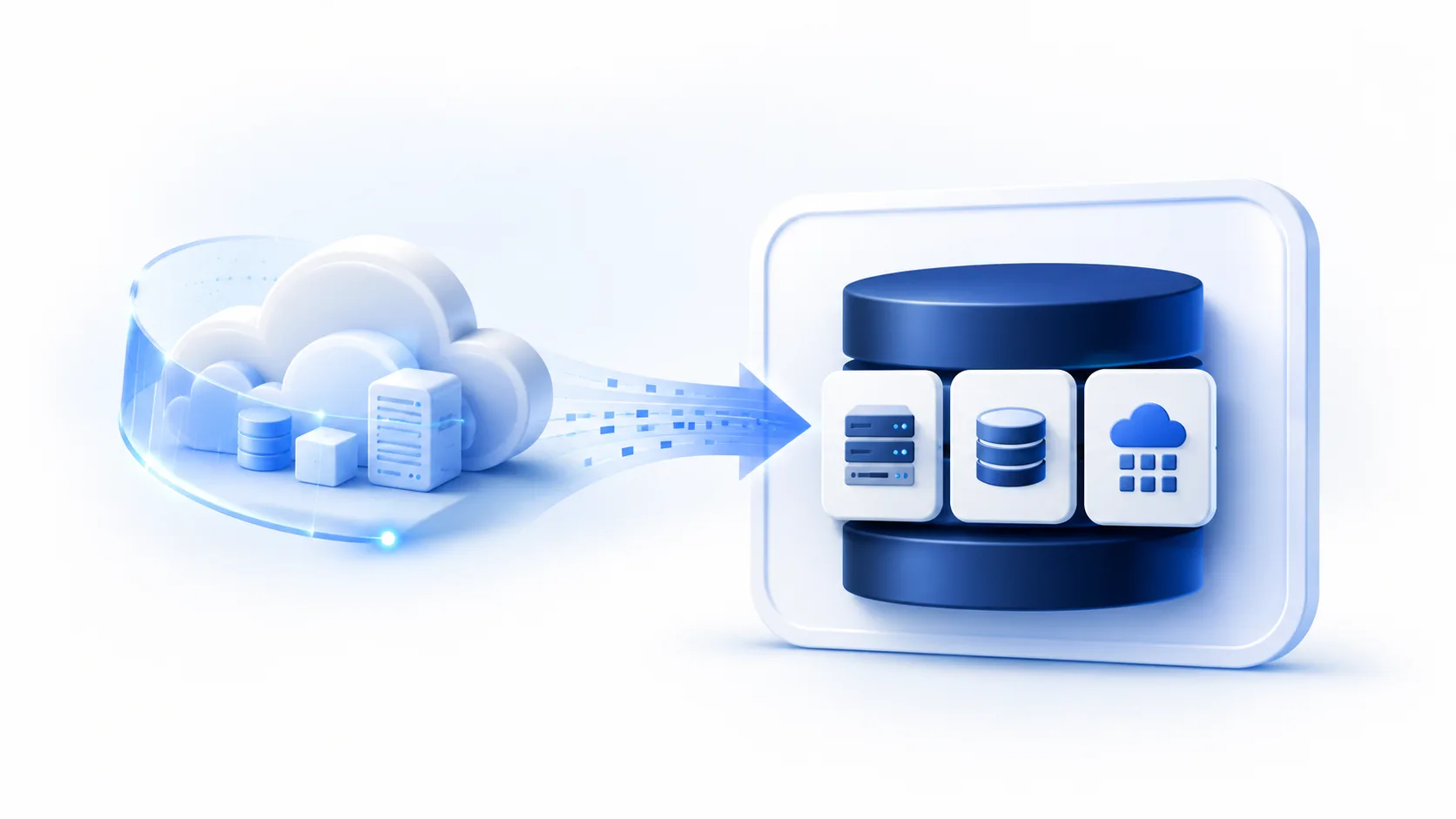
Real-time discovery, the continuous, automated identification and mapping of all cloud resources and their relationships, breaks the cycle of manual reconciliation and data staleness. The capability operates through three mechanisms that compress time-to-value:
Mechanism 1: Agentless Cloud API Discovery
Real-time discovery integrates directly with AWS and Azure APIs to query the authoritative state of all resources. Rather than waiting for a quarterly discovery scan, the platform queries cloud APIs continuously. This approach is agentless and comprehensive because cloud provider APIs have authoritative visibility into every resource they host. The CMDB is synchronized to the cloud provider’s live state, not to a snapshot from last month.
Business impact: Organizations eliminate the discovery blind spot. According to Flexera’s 2026 State of ITAM Report, 57% of IT teams do not have complete visibility across their technology stack, a gap that real-time API-sourced discovery closes.
Mechanism 2: Automated CI Normalization and Deduplication
Cloud discovery generates raw data: IP addresses, hostnames, region tags, owner metadata, security group associations. This must be normalized into CI records with standardized attributes, reconciled against existing CIs to prevent duplicates, and mapped into the correct CI class hierarchy. Automated normalization using rules engines and machine learning ensures consistency. Deduplication logic prevents the accumulation of orphaned duplicate records.
Business impact: Organizations stop losing time to manual reconciliation. The result is a single source of truth for infrastructure, free from duplicate or stale records.
Mechanism 3: Real-Time CI Relationship Mapping
Cloud resources form dependency relationships through security groups, subnets, load balancer attachments, database connections, and API integrations. Rather than relying on teams to manually document these relationships, real-time discovery queries the cloud provider’s network topology data to infer relationships automatically. When an EC2 instance connects to an RDS database through a security group rule, the platform discovers and records that relationship. The result is a dynamic CI relationship map that updates every time the infrastructure changes.
Business impact: Change risk assessment becomes data-driven. According to IT Toolkit’s 2026 guide on ITIL implementation, organizations with effective CMDB utilization report 35% MTTR reductions for critical incidents and 25% higher first-call resolution rates through faster dependency visibility and impact analysis.
Manual vs. Automated Cloud Environment Management
| Capability | Manual (Spreadsheet/Quarterly Scan) | Automated (Real-Time Discovery) |
|---|---|---|
| Discovery cadence | Monthly or quarterly | Continuous (4–6 hour polling) |
| Time from cloud resource creation to CMDB appearance | 30–90 days | 4–6 hours |
| CI normalization rule maintenance | Manual; rules documented in email chains | Automated; rules maintained in platform |
| Duplicate CI detection and remediation | Manual audit; weeks of effort | Automated; prevents duplicates at creation |
| CI relationship mapping | Manual; documented at deployment; decays with time | Automated; queries cloud provider topology; updates continuously |
| Data staleness between discovery runs | 30–90 days | 4–6 hours maximum |
| Audit readiness | Requires weeks of preparation | Report generated on-demand; always current |
| Change risk assessment accuracy | Limited to relationships documented 6+ months prior | Current relationship map reduces unknown risks |
How Virima Powers Cloud Environment Management
Virima’s approach to cloud environment management centers on three outcomes: immediate accuracy gains visible in the first 30 days, long-term data integrity that removes manual reconciliation, and seamless integration with existing IT workflows.
Immediate Operational Impact
In the first 30 days of real-time cloud discovery deployment, discovery typically identifies 15–35% more CIs than the organization’s existing CMDB contained. For a 5,000-CI estate, that’s 750–1,750 previously unknown assets. Most of these discoveries represent resources provisioned outside of IT governance workflows or that had drifted from documented state.
Organizations also see immediate remediation of data quality issues: duplicate CI records are identified and consolidated, orphaned CIs are flagged and marked for retirement, and CMDB accuracy metrics typically improve from the pre-implementation 60–70% range to 90%+ within 45 days.
Key metrics for internal presentation:
- Days to first value: 4 hours (live discovery results)
- CMDB accuracy improvement: 20–30 percentage points in first month
- Operational time recovered: 15–20 hours/week per CMDB administrator
Long-Term Accuracy and Drift Prevention
Once real-time discovery begins polling cloud APIs continuously, the problem of data staleness is solved. CMDB records reflect cloud provider state within a 4–6 hour window. The platform also detects and flags configuration drift: instances that have been modified outside of approved change processes are automatically detected, the CMDB is updated, and audit events are flagged.
IT leaders gain visibility into unauthorized changes; change management improves; compliance posture strengthens.
Integration with Existing Workflows
Real-time discovery integrated with ServiceNow ITSM workflows means that CMDB data freshness improves without requiring teams to change how they work. The platform updates the CMDB and ServiceNow synchronously. Change advisory boards access current, accurate CI relationships when reviewing proposed changes. Incident responders have current asset context when investigating events.
Similarly, integration with security tools (SIEM, vulnerability scanners, SOAR platforms) through AWS and Azure discovery integration means that security teams benefit from accurate asset inventory without managing a separate system. Every alert in the SIEM includes current asset context. Vulnerability scanners assess every asset in the cloud environment because the asset inventory is complete and current.
Moving from Static, Delayed Discovery to Real-Time Cloud Environment Intelligence
The transition from manual, periodic discovery to automated, continuous discovery requires a process change, not just a tool change. The shift has two elements: how infrastructure data flows into the CMDB, and how the organization thinks about what “current” data means.
Two-Change Framework
| Old Approach | New Approach |
|---|---|
| Discovery Process: Scheduled tool runs on a fixed cadence; significant time lag between resource creation and discovery; manual reconciliation effort. | Discovery Process: Continuous API polling; resources discovered within 4–6 hours; automatic reconciliation and duplicate prevention; manual effort shifts from reconciliation to validation. |
| Relationship Mapping: Documented at deployment; manually maintained; degrades as environment changes; significant effort required to maintain. | Relationship Mapping: Queried from cloud provider topology; updated continuously; reflects current state automatically; teams validate inferred relationships rather than maintain them manually. |
Benefits Cascade: Three Implementation Phases
- Phase 1: Data Foundation (Weeks 1–4)
The platform queries AWS and Azure APIs, discovers all resources, normalizes them into CI records, and reconciles them against the existing CMDB. The result is a complete, deduplicated baseline with immediate visibility into previously unknown assets and cleanup of duplicate and orphaned record accumulation.
IT leadership gains visibility into the true size and scope of the cloud estate. Finance can project cloud costs against a complete asset baseline. Security teams can design vulnerability scanning strategies that cover every known asset, not a guess at what exists.
- Phase 2: Process Integration (Weeks 5–8)
Real-time discovery is integrated with change management workflows, incident management workflows, and compliance reporting. CABs now access current CI relationship data. Incident response teams now have current asset context at the point of triage. Compliance reports include real-time infrastructure inventory.
The operational result is measurable: change-related incidents decline as risk assessments become more accurate. MTTD improves as incident triage benefits from current asset context. Audit cycles accelerate because compliance evidence is generated on-demand rather than compiled over weeks.
- Phase 3: Governance Evolution (Weeks 9–12)
With continuous real-time discovery in place, the organization can implement more sophisticated governance: automated detection of configuration drift, change risk scoring that factors in discovered relationships, shadow IT alerting that flags unmanaged resources within hours of provisioning.
The strategic result is IT governance that is proactive, data-driven, and responsive to the speed of cloud infrastructure change, rather than reactive and perpetually behind.
Getting Started: Five Steps
- Step 1: Cloud Credential Provisioning. Provide the real-time discovery platform with read-only access to AWS and Azure APIs. The platform requires permissions to list EC2 instances, RDS databases, Lambda functions, AppService apps, AKS clusters, and related resources. No agent installation required; API-based discovery only.
- Step 2: Discovery Baseline Run. Execute the first discovery query against your entire AWS and Azure estate. The platform queries all regions and generates a baseline inventory report. Typical baseline discovery takes 1–4 hours for mid-market organizations.
- Step 3: Reconciliation and Deduplication. The platform compares discovered resources against the existing CMDB, identifies duplicates and orphaned CIs, and flags high-confidence matches for automatic reconciliation. Review the recommendations and approve high-confidence matches.
- Step 4: ServiceNow Synchronization. Confirm the ServiceNow CMDB integration. The platform maintains bi-directional synchronization: discoveries update the CMDB; manual CMDB updates are reflected in the discovery platform.
- Step 5: Enable Continuous Polling. Configure the real-time discovery polling interval. The platform will query AWS and Azure APIs automatically on that schedule and keep the CMDB current.
Path Forward
Real-time discovery transforms cloud environment management from a perpetual struggle against data decay into an operational capability that strengthens with time. When CMDB accuracy and completeness move from “problems to solve” to “facts of operational life,” IT leaders, operations teams, security teams, and finance teams all move from reactive data firefighting to proactive, data-driven decision-making.
Every IT organization knows that accurate cloud environment data matters. The question is how long you’re willing to tolerate the cost of maintaining that accuracy manually.
Want to explore how real-time discovery works in your environment? We offer a cloud environment assessment that identifies accuracy gaps in your current CMDB and cloud infrastructure baseline, showing you the infrastructure that exists in AWS and Azure but isn’t reflected in your CMDB today. Request a demo.
FAQ
Will real-time discovery overwrite our existing CMDB data?
No. Reconciliation is conservative: the platform matches discovered resources against existing CIs using deterministic matching rules. High-confidence matches are automatically reconciled; low-confidence cases are flagged for manual review. Your existing CMDB data is preserved and enriched, not overwritten.
How does real-time discovery handle security groups and network topology?
Real-time discovery queries AWS and Azure network topology APIs to infer relationships. If an EC2 instance connects to an RDS database through a security group rule, the platform discovers and records that association. Network topology data is queried and updated continuously, so the relationship map reflects current infrastructure state.
Can real-time discovery track Kubernetes-hosted workloads?
Yes. The platform integrates with AWS EKS and Azure AKS APIs to discover Kubernetes clusters, namespaces, deployments, pods, and services. Each Kubernetes entity is modeled as a CI with appropriate relationships to parent resources and child workloads.
What permissions does the platform need for AWS and Azure access?
Read-only API permissions. No agent software is required on instances. The platform queries AWS and Azure APIs to retrieve authoritative resource state.
How quickly does the platform discover newly created resources?
On the default polling interval (4–6 hours), new resources are discovered within the next scheduled poll. Faster discovery is available with more frequent polling intervals.