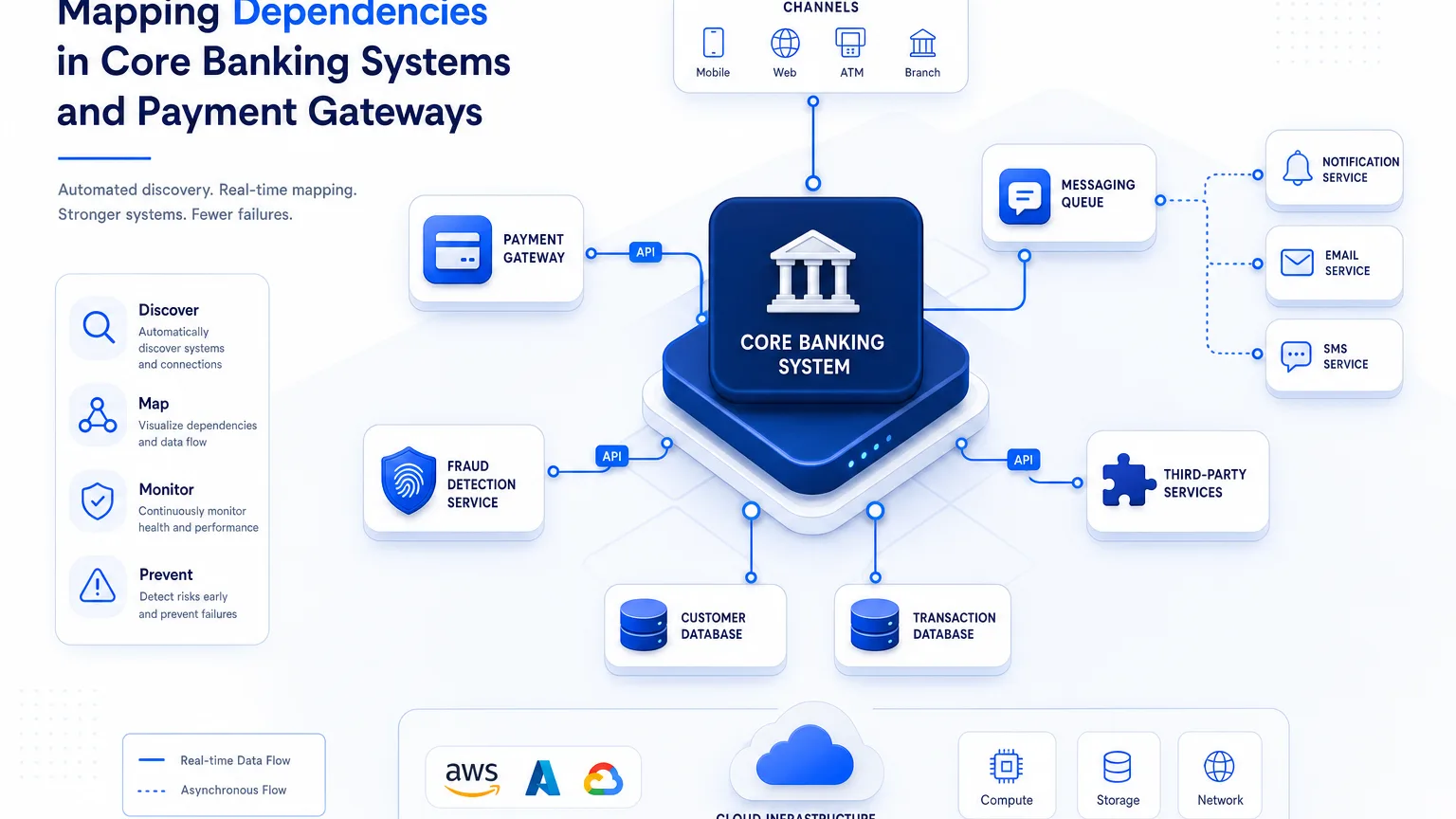
Banking and Financial Services: Mapping Core Banking Systems and Payment Gateway Dependencies

At 4:30 PM on a Friday, real-time wire transfers and mobile payment authorizations begin timing out across a major retail banking network. Merchant terminals report declined transactions, while customer support queues flood with calls regarding failed direct deposits.
Initial incident response centers on the primary payment gateway, which shows normal CPU and memory utilization on core monitoring dashboards. What the monitoring tools miss is an unmapped dependency three hops downstream: a thread starvation on an internal messaging queue running on a secondary middleware server. That queue passes real-time ledger verification requests between the payment gateway, the fraud detection engine, and the core banking system of record.
When financial IT directors and CMDB owners rely on static architecture diagrams or manual configuration lists, hidden dependencies trigger severe outages during high-volume settlement windows. Mapping dependencies across core banking platforms and payment gateways requires automated discovery, application-aware relationship tracking, and a CMDB built on actual runtime truth.
Why is dependency mapping critical for core banking systems and payment gateways?
Core banking platforms and payment gateways connect web frontend applications to backend ledgers, fraud engines, and interbank messaging networks. Mapping these relationships reveals single points of failure, evaluates change risks, and prevents transaction processing downtime that triggers financial penalties and customer churn.
The Interconnected Web Behind Modern Core Banking and Payment Gateways
Modern financial services operate on hybrid architectures that combine legacy mainframe ledgers with cloud-native payment microservices. Processing a single credit card payment or account transfer involves dozens of automated handoffs in fractions of a second.
Regulatory guidance from the FFIEC emphasizes that financial institutions must maintain complete IT asset inventories and business continuity maps across all transaction processing paths. Achieving that level of visibility requires understanding how distinct software layers interact under heavy load.
1. Payment Gateway Pipelines and Distributed API Services
Payment gateways serve as the primary entry point for merchant transactions, mobile app transfers, and automated clearing house (ACH) requests. Incoming traffic flows through load balancers, tokenization vaults, and API gateways before reaching core transaction processing nodes.
Behind the entry layer, microservices query customer account databases, run real-time sanction screening, and calculate available credit limits. A minor configuration drift on a container orchestrator or an expired API token on an external credit bureau interface can disrupt payment processing across every channel.
2. Core Banking Integration and Messaging Bus Bottlenecks
Core banking systems manage general ledger balances, deposit accounts, loan processing, and interest calculations. While modern digital channels update continuously, core ledgers often communicate through enterprise service buses, queueing managers, and ISO 20022 message translators.
Because these integration paths exist inside application logic and messaging middleware, standard IP network scanners cannot see which payment gateway endpoints depend on which messaging queues. When infrastructure teams update host operating systems or reconfigure storage volumes without mapping these connections, critical financial transactions fail silently.
How do unmapped dependencies cause transaction processing failures in banking IT?
Unmapped dependencies obscure secondary connections, such as tokenization services, fraud check API endpoints, and database connection pools. When IT teams perform maintenance without seeing these hidden links, unexpected outages occur, blocking real-time payments and delaying ledger reconciliation schedules.
The High Cost of Unmapped Dependencies in Financial Infrastructure
When an IT outage strikes a financial institution, the impact extends far beyond internal operational inconvenience. Unmapped infrastructure dependencies expose banks to direct financial loss, regulatory fines, and lasting reputational damage.
1. Extended War Rooms and Delayed Incident Resolution
During a major payment disruption, IT operations teams assemble war rooms with specialists from network, database, application, and cloud teams. Without a clear map of service dependencies, engineers spend hours isolating individual components rather than pinpointing the root cause.
When engineers must manually analyze network traces and application logs while payment queues backlog, mean time to resolution stretches from minutes to hours. Clear dependency maps show the exact path from consumer payment channels down to virtual hosts, database instances, and network switches.
2. Failed Changes During Weekend Maintenance Windows
Financial IT teams perform software patches, database upgrades, and network reconfigurations during scheduled weekend maintenance windows. Updating a server or reallocating storage pools appears routine when viewed as an isolated asset record.
If that server hosts an unmapped message broker that feeds batch settlement files to external clearinghouses, restarting the host delays Monday morning account balancing. CMDB owners who lack automated service mapping cannot assess the true blast radius of scheduled infrastructure changes.
To de-risk core banking modifications and eliminate unmapped payment dependencies, financial IT leaders deploy discovery-sourced Trusted Runtime Truth.
Architecting Service Mapping for Hybrid Banking Environments
Financial institutions operate under strict security policies and high transaction volumes. Automated discovery and service mapping tools must inventory complex environments without degrading transaction performance or introducing security vulnerabilities.
1. Agentless Multi-Protocol Discovery Across Banking Networks
Banking environments combine mainframe systems, Unix servers, Windows clusters, cloud microservices, and specialized hardware security modules (HSMs). Deploying software agents across every endpoint creates administrative overhead and vendor compliance challenges.
Agentless discovery uses standard administrative protocols (WMI, SSH, SNMP, and cloud APIs) to inspect system configurations safely. By scanning network subnets on defined schedules, discovery tools capture installed software packages, active network listeners, running processes, and established TCP connections.
2. Context-Aware Dynamic Service Visualization
Capturing raw asset inventories is only the baseline. IT teams need to group assets into operational business services, such as “Real-Time Merchant Authorizations,” “Core Ledger Reconciliation,” or “Mobile Banking Payments.”
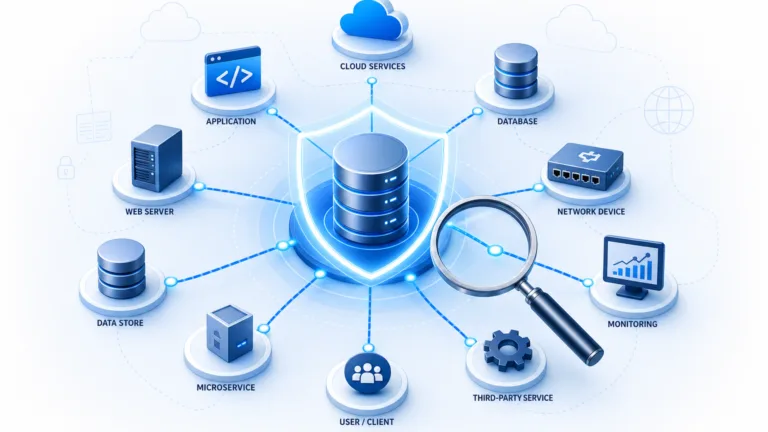
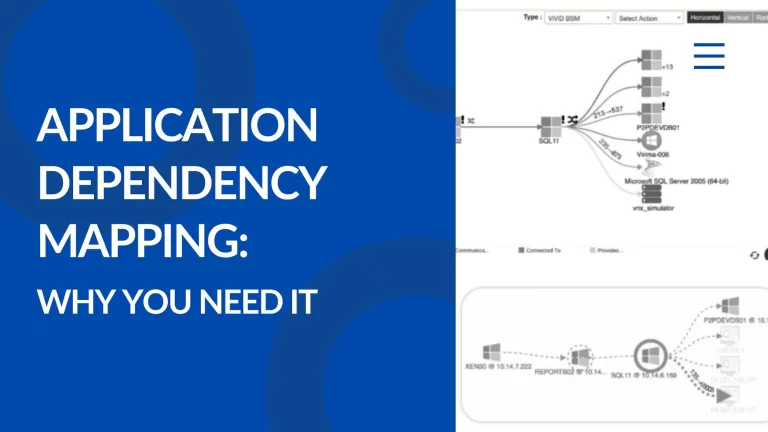
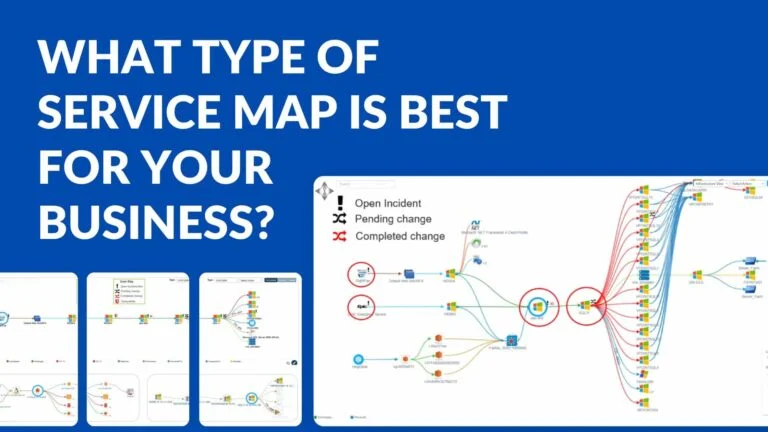
Dynamic service mapping processes connection data to generate visual dependency trees automatically. These visual maps display physical, virtual, and cloud relationships alongside application-to-application communication paths. When an alert fires on a storage array, engineers instantly identify every financial service dependent on that array.
To explore how automated discovery integrates with enterprise ITSM platforms, visit the Virima integrations hub.
How does agentless discovery safely map core banking infrastructure without affecting transaction speed?
Agentless discovery uses read-only administrative queries and passive connection inspection during low-volume maintenance windows. By querying system metadata without installing endpoint agents or sending intrusive traffic, IT teams map dependencies without impacting live transaction latency or core ledger performance.
Navigating FFIEC, PCI DSS, and Operational Resilience Compliance
Financial regulators globally have shifted focus from static asset reporting to operational resilience. Frameworks enforced by bank examiners require institutions to map critical business services to their underlying technology assets and prove they can withstand severe operational disruptions.
1. Documenting Payment Data Paths for PCI DSS and FFIEC Reviews
Payment Card Industry Data Security Standard (PCI DSS) compliance requires institutions to maintain precise documentation of the cardholder data environment (CDE). Manual network diagrams fail audit tests because cloud instances scale dynamically and microservices update frequently.
Automated service mapping traces exact data paths between payment gateways, tokenization servers, and backend database stores. Compliance officers generate verifiable reports proving that cardholder data processing systems remain segregated behind required firewalls and security controls.
2. Supporting Vulnerability Management and Blast Radius Analysis
When security advisories disclose critical vulnerabilities in web servers or database engines, security teams must act immediately. Identifying a vulnerable software package is useful, but knowing that server supports the primary payment authorization pipeline changes remediation urgency.
Discovery-sourced CMDBs combine software vulnerability data with service mapping context. Security engineers prioritize patching based on asset criticality and potential transaction impact, ensuring emergency security updates do not inadvertently trigger core banking downtime.
Best Practices for Mapping Banking Dependencies at Enterprise Scale
Financial IT organizations that maintain reliable, audit-ready CMDBs follow a structured operational approach that combines automated technology with clear governance.
- Prioritize High-Value Payment Pathways: Focus discovery and service mapping efforts first on mission-critical transaction paths, including core banking ledgers, payment gateways, and wire transfer systems, before expanding to back-office workflows.
- Schedule Automated Off-Peak Discovery Scans: Run agentless discovery scans during off-peak windows to capture configuration drift, container updates, and cloud infrastructure changes before data becomes obsolete.
- Validate Middleware and Message Broker Connections: Work with application architects to verify message routing paths and ensure internal queues are properly linked to core banking hosts.
- Integrate Service Maps into Change Approval Protocols: Require change advisory boards to analyze dynamic service maps and blast radius reports before approving maintenance on financial infrastructure.
- Connect CMDB Data to Operational Workflows: Feed discovery-sourced CIs directly into incident, change, and asset management workflows within your enterprise service management platform.
Financial institutions evaluating dependency mapping can see how automated discovery protects transaction availability by requesting a Virima product demo.
Securing Banking Continuity with Discovery-Sourced Dependency Maps
As financial services expand digital banking platforms, real-time payment rails, and open banking APIs, the line between technology infrastructure and business revenue disappears. A single database connection timeout or unmapped server reboot is not merely an IT issue; it is a disrupted merchant, a delayed payroll run, or a regulatory violation.
Static asset lists and manual diagrams cannot keep pace with dynamic financial environments. By implementing automated agentless discovery and dynamic service mapping, banking IT teams gain a clear, defensible view of every system supporting financial operations. They eliminate blind spots, resolve incidents faster, and maintain compliance with confidence.
Frequently Asked Questions
How does automated discovery map core banking dependencies without impacting live transaction processing?
Automated discovery uses read-only administrative queries (such as WMI and SSH) and passive network connection tracking during off-peak hours. It captures running process details and established port connections without injecting intrusive network packets or degrading transaction processing latency.
Why are static CMDBs inadequate for modern payment gateway architectures?
Payment gateways rely on cloud microservices, load balancers, and external API integrations that change continuously. Static CMDBs require manual updates, causing data to age rapidly and hiding critical secondary dependencies that cause unexpected downtime during routine software maintenance.
How does Virima support FFIEC audit compliance and operational resilience reviews?
Virima generates discovery-sourced service maps that visualize all hardware, virtual hosts, middleware, and network paths supporting financial operations. Compliance officers use these maps to prove data isolation, analyze change blast radius, and satisfy bank examiners during operational resilience audits.