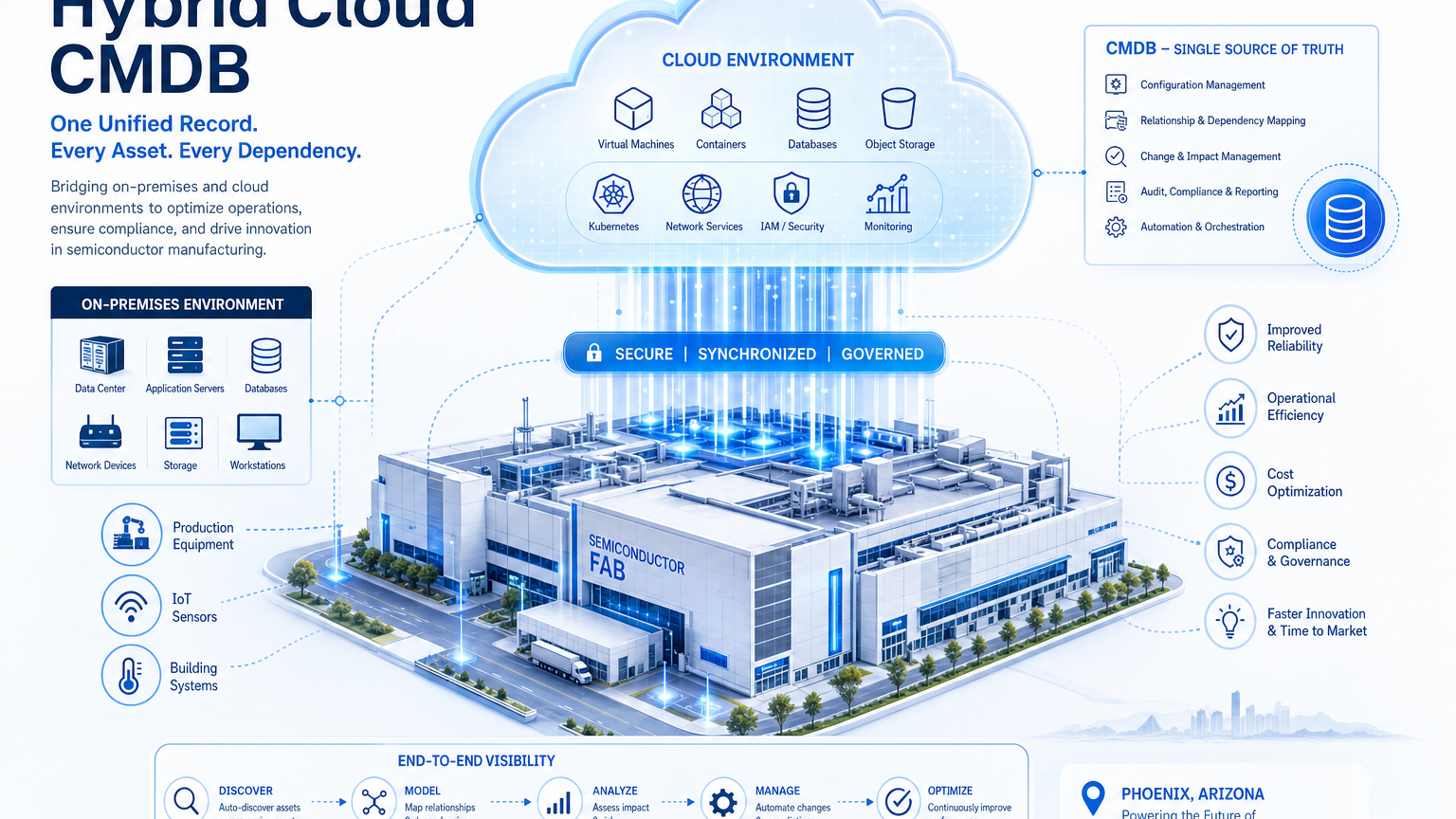
Can Hybrid Cloud CMDB for Semiconductor Manufacturing Enterprises in Phoenix Keep Pace?

Phoenix semiconductor campuses keep adding fabs, packaging sites, suppliers, and cloud accounts while the record of what exists lags behind that growth. The question behind hybrid cloud CMDB for semiconductor manufacturing enterprises in Phoenix is whether one owned record covers on-premises and cloud together, and who confirms it.
Per ENR reporting on the TSMC Arizona expansion, TSMC announced four additional fabs for its Phoenix campus in July 2026. That would bring the long-term plan to 10 fabs plus packaging and research space across more than 1,100 acres, with no firm completion dates given. If a campus keeps adding sites and suppliers over several years, what happens to the list of systems that feed every change window?
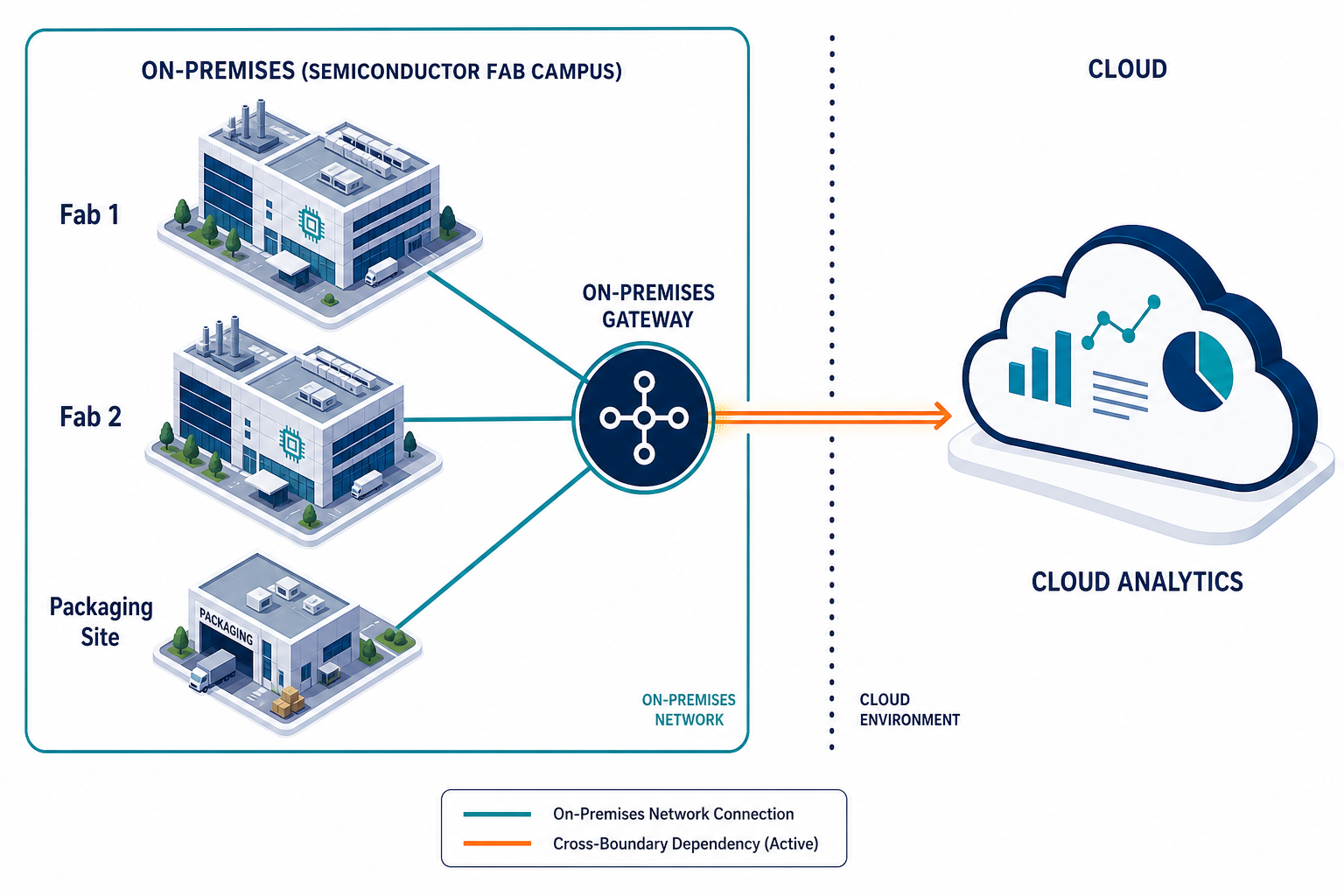
Consider a labeled composite, not a customer account. A Phoenix semiconductor firm moves yield analytics to a cloud account while collection stays on site. During a change window on the on-premises gateway that feeds that analytics workload, nobody can list every system that depends on that gateway. Three engineers compare memory, spreadsheets, and a cloud console, and each source tells a different story.
Why a fab cluster produces a hybrid record problem
A CMDB records IT infrastructure and relationships across environments. It does not control fab tools, hold process recipes, or store design data.
That boundary matters because a fab cluster creates three record problems that often appear together across manufacturers.
First, analytics and engineering workloads often move to AWS or Azure while data collection, file shares, and gateway infrastructure stay on site. The dependency between a cloud analytics account and an on-premises collector runs across two environments.
Result: the dependency runs across two environments, and no single record shows it.
This cloud-burst pattern is familiar from fabless design environments, where elastic compute expands faster than records, as described in the San Diego hybrid cloud CMDB analysis. Phoenix adds the campus dimension, because the on-premises side itself keeps growing while cloud accounts multiply.
Second, tools that run for decades often sit beside new campus builds with modern network designs. The SEMI blog on cyber-resilient approaches for legacy systems notes that many legacy tools remain in service for decades and cannot be patched because of operating system limits or downtime risk. Older controllers, consoles, and support workstations often lack current agents, current credentials, or reachable network paths.
Result: the oldest systems are the ones least likely to be on any list.
Third, suppliers, contractors, and equipment vendors often connect systems, sensors, or remote access paths to fab networks during builds, qualifications, and maintenance. Those connections arrive through projects, not through IT intake. Ownership stays with whoever opened the ticket, and the record never receives a named owner.
Result: when something changes, nobody can say whose it is.
General manufacturers face a similar half-record problem when plants modernize in pieces, as described in the Minneapolis hybrid cloud CMDB analysis. Semiconductor campuses intensify it because cleanroom-adjacent systems, long-lived tools, and supplier connections combine in one estate.
What the numbers say
No verified Phoenix semiconductor visibility benchmark was found, so every figure below is global, cross-industry, or company-reported.
Flexera surveyed 753 respondents for its 2026 State of the Cloud work, summarized on the Flexera State of the Cloud report page. Among respondents, 73% run hybrid cloud, and 54% name understanding dependencies among services as a top challenge. The dependency problem is therefore common, even outside semiconductors.
Flexera surveyed 512 respondents for its 2026 State of ITAM work, summarized in the Flexera State of ITAM 2026 overview. Only 36% report complete visibility into their IT assets, down from 43% in the prior year, while 78% name building an accurate inventory as a top priority. Visibility is declining while priority is rising, which matches what fab growth creates.
An older company-reported incident shows how a new tool can reach the network ahead of any record. As reported by EE Times Asia on the TSMC virus incident, a WannaCry variant spread in August 2018 after a new tool was installed and connected before isolation and inspection were complete. TSMC expected an impact of no more than 2% of third-quarter revenue and about one point of gross margin. This example is used only to show timing pressure when equipment joins a network, not to claim that a CMDB would have prevented the spread. It was not described as a hack.
Breach cost pressure remains relevant for any estate that joins IT and cloud. IBM’s most recent Cost of a Data Breach report puts the global average breach cost at $4.99 million, up 12% year over year. That figure is cross-industry, and no verified semiconductor-specific figure was used here.
What hybrid cloud CMDB means here, and where it stops
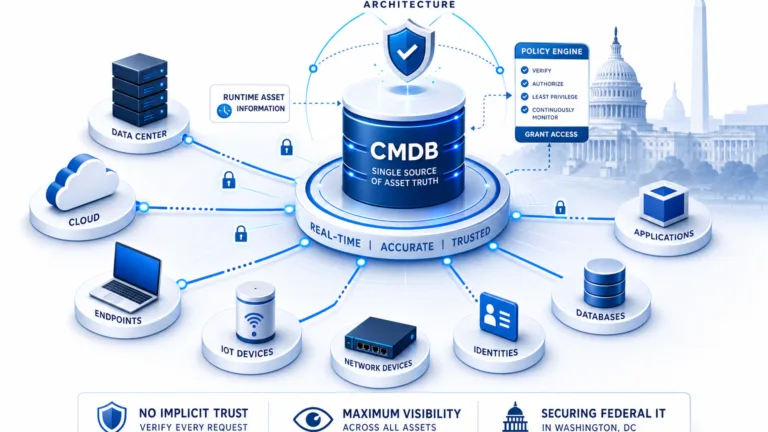
A hybrid cloud CMDB, as used in this article, means one record that holds on-premises items, AWS and Azure items, and the relationships between them. That record is kept current by scheduled discovery and confirmed by named owners — not by event streaming, so short-lived cloud resources can fall between scheduled cycles.
That coverage depends on network reach and protocol compatibility. Devices that resist discovery are registered manually with an owner and a verification date. Fab tools and plant control systems are covered only when they are reachable on the network with a compatible protocol, and only when plant owners have agreed that discovery may touch them. Anything outside that agreement stays in plant systems.
The record covers servers, network equipment, workstations and endpoints, cloud accounts, and the relationships between them. It does not hold data content, design files, process recipes, or intellectual property. AWS and Azure are the supported cloud imports, configured in the Virima interface with customer credentials. Google Cloud and private cloud coverage are not claimed here.
SEMI calls for complete OT asset inventories owned by plant teams. That inventory remains the plant owner’s responsibility. The CMDB holds the IT side and links to plant records where an agreed reference exists, without claiming to replace the OT inventory. Broader context on cloud and hybrid scope is available in the guide on whether a CMDB is needed in cloud environments.
Hybrid cloud CMDB for semiconductor manufacturing enterprises in Phoenix: one record across both sides
This section describes four mechanisms for building a hybrid cloud CMDB for semiconductor manufacturing — one owned record that works as a true CMDB for fab campus IT estates, covering both the on-premises and cloud sides of a Phoenix campus.
Discover both sides into one record
Scheduled probes and installed agents cover on-site servers, network gear, and endpoints, while AWS and Azure imports cover cloud accounts. Reconciliation merges results from multiple sources into one authoritative item record. Limits from the prior section still apply, including reach, protocol compatibility, manual registration, and agreed plant boundaries. Fragile fab-adjacent systems are touched only under an explicit plant agreement, because no documented safe-scanning method was verified for this article.
Service dependency mapping for Phoenix fab campuses
ViVID™ service maps build dependency maps from service definitions that people provide, then show communication flows by port and protocol between infrastructure items. Teams define services such as yield analytics or tool data collection, with owners attached to each definition. The map then shows which collectors, gateways, databases, and cloud workloads support each service. Service definitions can arrive manually, through spreadsheet import, or through enterprise architecture inputs, and the map refreshes as infrastructure changes. The service mapping overview describes how maps are built once definitions exist.
Put an owner on every record
People supply ownership and criticality for each item, and each record carries its source and last-verified timestamp. That discipline matters most for new sites and supplier connections, because those items otherwise enter the estate without accountability. Ownership confirmation belongs to named people, while the CMDB stores, shows, and tracks the assignment over time.
Connect change activity to the record
Integrations with ITSM platforms carry build, move, and retirement activity toward the CMDB so records prompt review when environments change. Virima supports ServiceNow alongside other ITSM platforms through listed integrations. A change window on a gateway or cloud workload then starts from a record with owners and verification dates, not from memory.
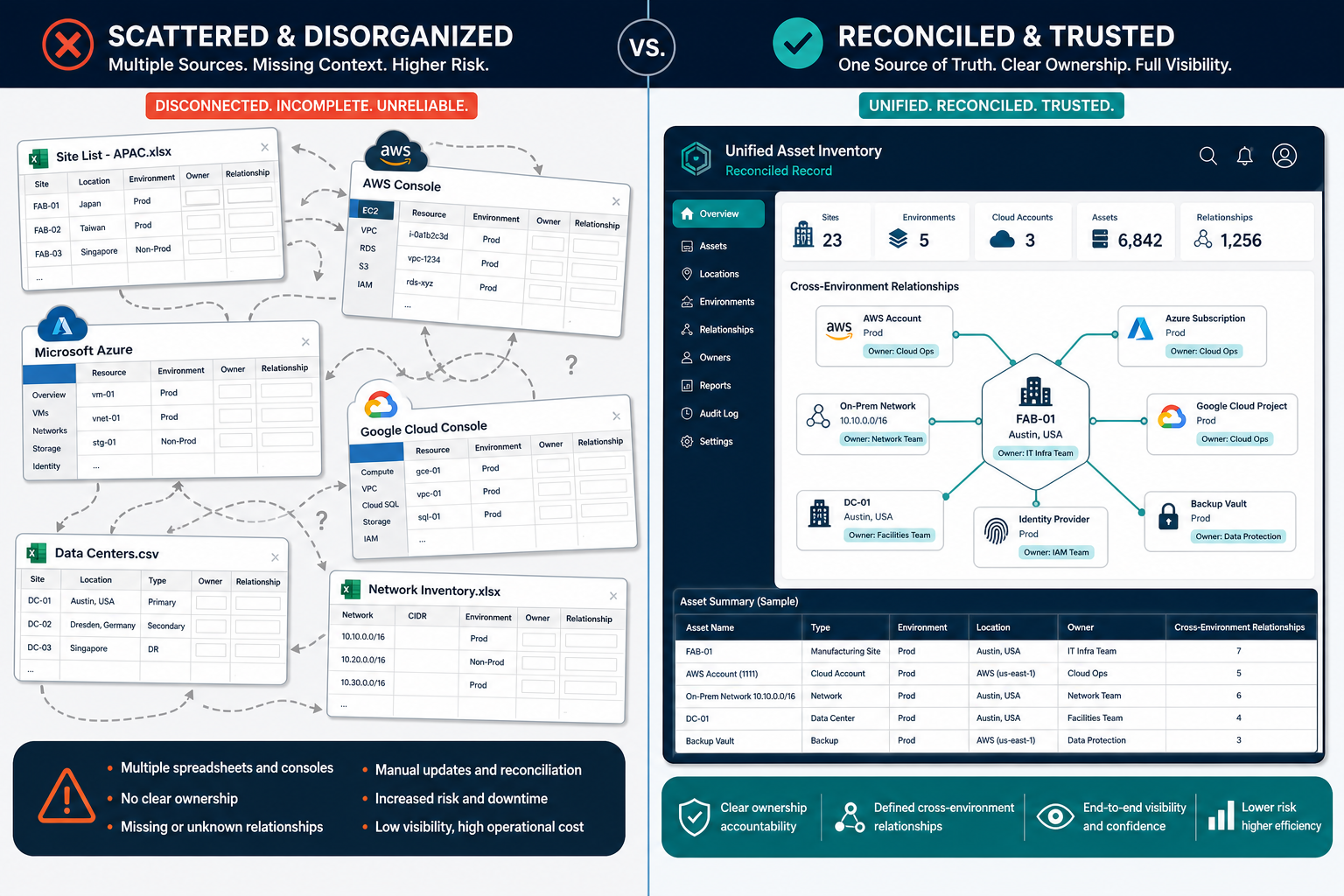
The table below compares the common starting point with a discovery-fed approach.
| Area | Separate spreadsheets and cloud consoles | One discovery-fed CMDB |
|---|---|---|
| Where on-premises and cloud items are listed | Site lists plus separate AWS and Azure consoles | One reconciled record across site and cloud accounts |
| Owner field | Often blank or held by whoever created the sheet | Named owner plus source and last-verified date |
| Relationships across the boundary | Described from memory during the window | Port and protocol flows tied to defined services |
| Evidence of currency | File dates and console exports | Scheduled discovery runs with reconciliation history |
| Effort before a change window | Hours assembling affected-system lists | Review of affected systems and owners from the record |
| What still needs people | Almost everything, every time | Service definitions, ownership confirmation, retirement decisions, and plant boundary agreements |
Discovery runs on a high-frequency scheduled cadence that the customer sets. That wording is deliberate, because short-lived resources can appear and disappear between cycles. Core discovery methods are described on the IT discovery overview, and the record model is described on the CMDB overview. Teams planning change review can pair this record with the change impact analysis approach.
What the CMDB settles, and what stays elsewhere
This section scopes the claim so architects and executives set the right expectations.
The CMDB answers four infrastructure questions: what IT infrastructure exists on site and in AWS or Azure, what each item connects to, who owns it, and when it was last verified. Those answers support planning, change review, onboarding, audits, and incident scoping.
The table below separates CMDB answers from decisions owned elsewhere.
| Question | Answered by the CMDB | Owned elsewhere |
|---|---|---|
| Which servers, network devices, and cloud accounts support yield analytics | Yes, with relationships and owners | Plant process decisions stay with engineering |
| Who owns an item and when was it verified | Yes, with source and timestamp | Staffing and budget decisions stay with leadership |
| How fab tools are controlled and which recipes they run | No | Equipment engineering and plant operations |
| What OT inventory exists for segmented control networks | No, except agreed references | Plant and automation owners |
| What design data or process IP means | No, infrastructure classification only | Design and process owners |
| Whether a system should be patched or virtually patched | No | Security and plant owners with maintenance windows |
| Whether export-control or customer security terms are met | No | Compliance, legal, and security owners |
| How to respond to an active security event | Informs scoping only | Security response owners |
The record is upstream infrastructure truth that informs tool, data, security, and compliance decisions without making those decisions.
Where the efficiency and savings come from
This section stays conservative by design: no invented savings figures, and no vendor outcome claim reused as proof. Each measure below is something a team can track locally, not a number this article assigns to Phoenix.
- Change window prep: fewer unknown dependencies means fewer late discoveries. Track hours spent listing affected systems before and after a bounded scope carries owners and verification dates.
- Cloud/on-site reconciliation: count items present in one environment and missing in the other each quarter. Flexera’s 54%-dependency-challenge stat gives context, but the measured result must come from each firm’s own counts.
- New site and supplier onboarding: measure days from connection to an owned record for each new scope — a process-discipline measure as much as a tooling one.
- Unowned and retired equipment: count records with no named owner each quarter and track retirement decisions through to discovery rerun, turning cleanup into a defensible backlog instead of a vague goal.
- License reviews: compare installed versus entitled positions before and after each review cycle. Flexera cross-industry ITAM data reports audit and spend pressure, but savings at any firm must be calculated from its own license positions. License tracking itself is described on the ITAM overview.
- Incident scoping: measure minutes from alert to a named system list during drills. IBM’s breach-cost data shows why faster scoping matters financially, but drill performance at any firm must be measured locally.
Starting with one scope: the first 90 days
A Phoenix semiconductor team can start with one bounded scope instead of attempting a campus-wide record at once.
- Name an owner for the CMDB and for each environment, covering on-site infrastructure and each cloud account in scope. Name who confirms records, who defines services, and who decides retirements. That roster should include plant and OT contacts wherever discovery approaches fab-adjacent networks.
- Pick one bounded scope, such as one cloud account and the on-premises gateway it depends on. Agree with plant and OT owners what discovery may touch before any run. Write that agreement down, including excluded ranges, approved windows, and escalation contacts.
- Run discovery on that scope at a cadence the team can sustain. Reconcile results against the cloud console and existing lists. Record each gap with an owner and a decision, whether that means correcting the record, registering an item manually, or excluding it with a reason.
- Define the services that matter for that scope, such as analytics or tool data collection, with owners attached. Review the communication flows between infrastructure items and confirm that the map matches operational understanding. Correct service definitions first, because maps inherit definition errors.
- Add a change check before windows open. No window proceeds until affected systems carry owners and last-verified dates. That single control prevents the composite scenario at the top of this article from repeating.
- Close out retired items deliberately. A named owner decides each retirement, the record is updated, and discovery is rerun to confirm removal. Then add the next scope, such as another cloud account, another gateway, or another supplier connection set.
See what one owned scope would show
Run a discovery pass on one cloud account and the gateway it depends on, then compare the owned record against current lists. The IT discovery overview describes the methods that would feed that comparison.
Frequently Asked Questions
What is a hybrid cloud CMDB?
It is one record of on-premises and cloud infrastructure and the relationships between them, kept current by scheduled discovery and confirmed by named owners.
Does IT discovery for semiconductor fabs cover OT equipment?
It covers only items reachable on the network with a compatible protocol under a plant agreement. Remaining equipment is registered manually or tracked in plant systems.
Does a CMDB hold design data or IP?
No, it classifies infrastructure and relationships, not data content. Design files, recipes, and process data stay with their owners.
Which clouds does Virima import?
Virima imports AWS and Azure when configured in the interface with customer credentials. Each import runs on a scheduled cadence the team controls.
Does Virima connect to ServiceNow or Jira Service Management?
Yes, Virima connects to ServiceNow, Jira Service Management, and other ITSM platforms through listed integrations. Changes then prompt review of affected records.