What Does IT Asset Management Software Cost in 2026?

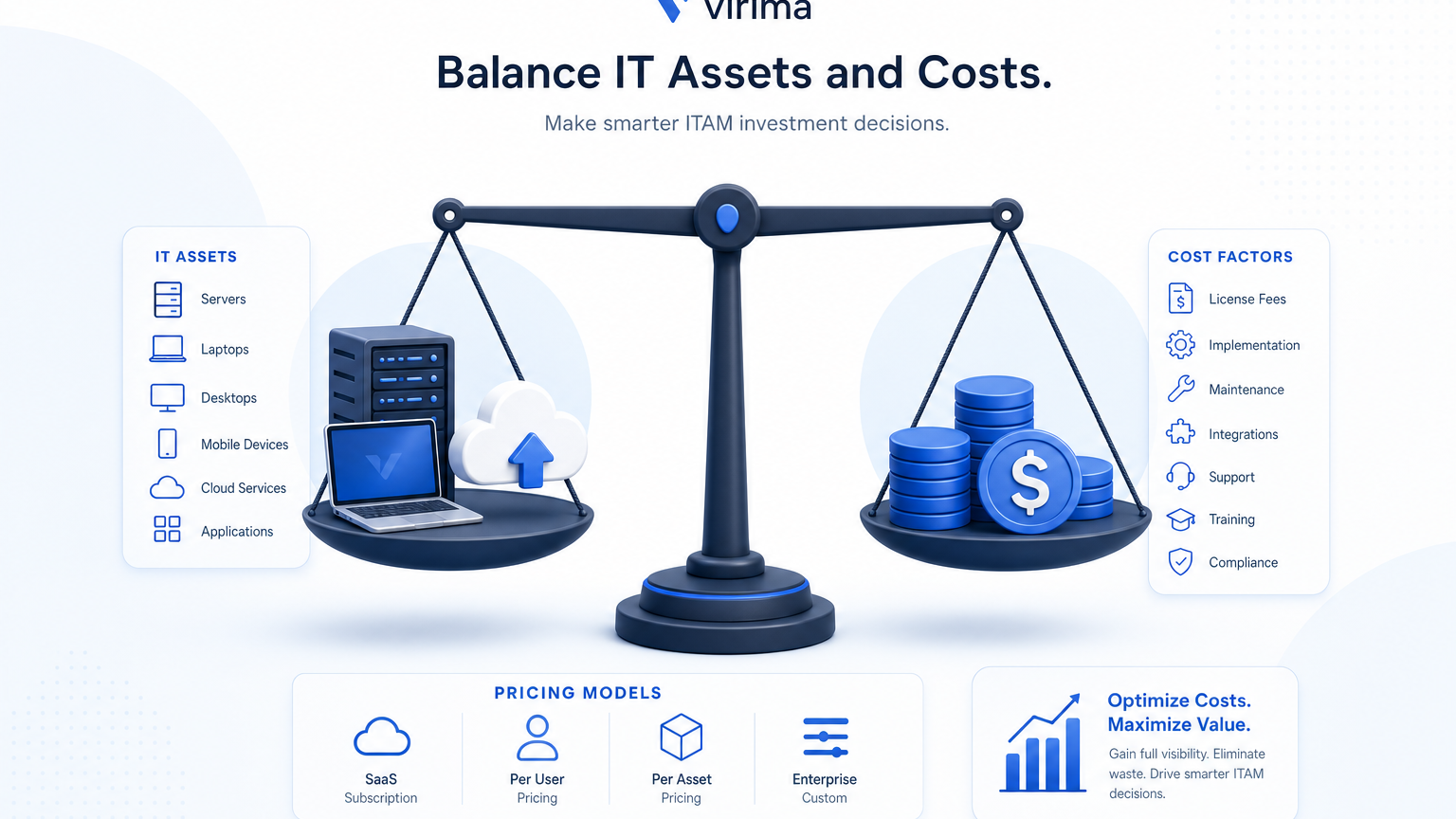
IT asset management software costs between $2 to $15 per managed asset per year for mid-market platforms, or $50 to $150 per technician seat monthly. Enterprise deployments with agentless discovery and CMDB synchronization typically range from $15,000 to over $100,000 annually depending on asset scale and required integrations. Buyer-reported ranges in 2026 cluster at $2 to $15 per managed asset per year, $50 to $150 per technician seat monthly, or a tiered annual bundle — with enterprise deployments running $15,000 to over $100,000 depending on scale and integrations.
Unexpected costs surface when discovery engines, connector licenses, and API access are sold as separate line items. A quote that looks affordable on page one becomes expensive once implementation, data cleanup, and renewal uplifts are included. This guide breaks down the real models so you can compare quotes on total cost of ownership.
Procurement teams often anchor on the license line and miss the labor line. Manual reconciliation, audit preparation, and true-up penalties usually cost more over three years than the platform subscription itself. See how enterprise CIOs establish trusted runtime truth to de-risk digital transformation.
The 3 primary ITAM pricing models in 2026
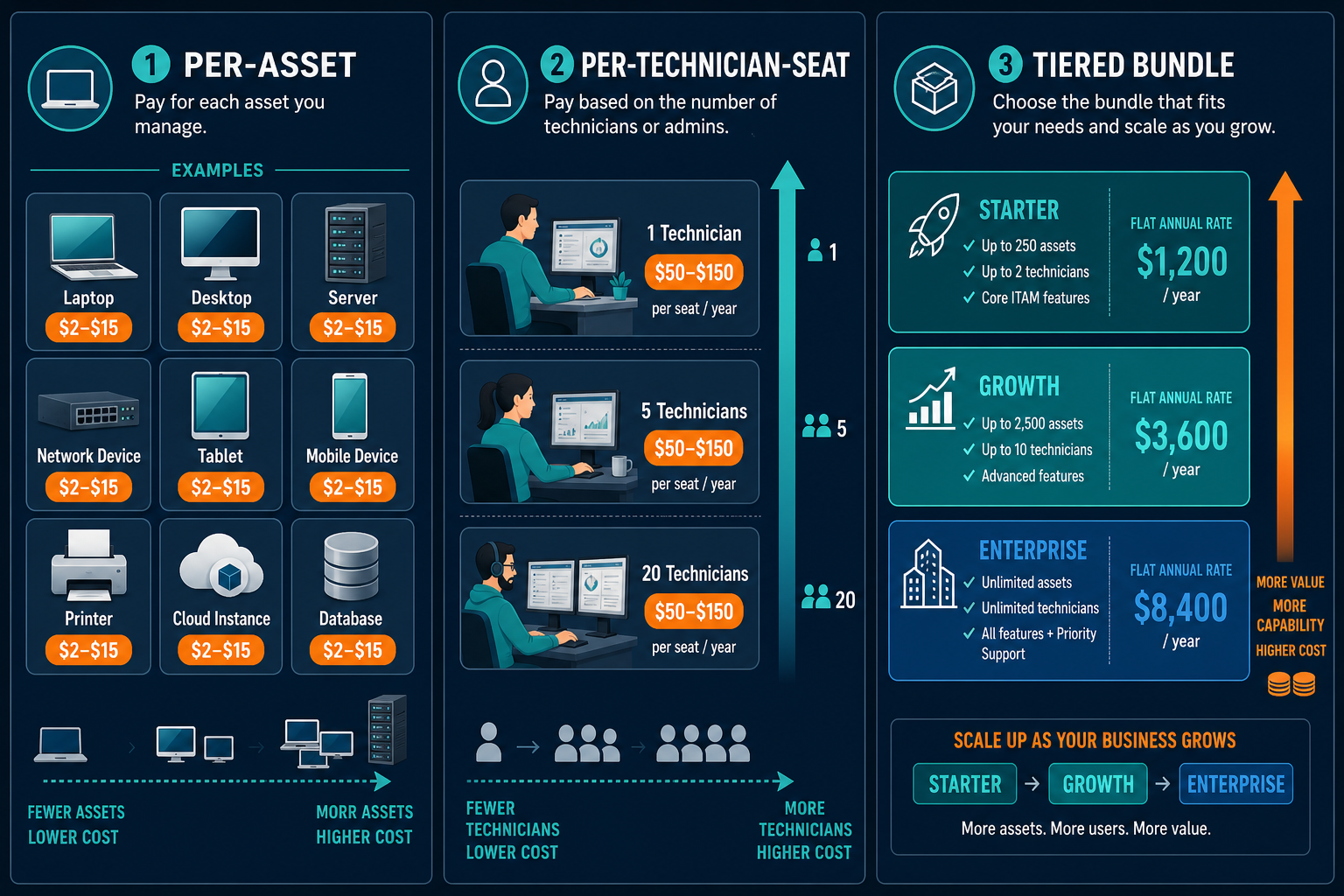
Most vendors package ITAM pricing in one of three ways. The model shapes how costs scale as your estate grows, so match the model to your growth pattern before you compare numbers.
- Per managed asset or per node. You pay for every discovered laptop, server, VM, network device, or cloud instance under management. Buyer-reported ranges in 2026 cluster around $2 to $15 per asset per year for mid-market suites. Agent-based tools sometimes price per agent install instead, which penalizes teams with high device churn. This model favors stable estates with predictable device counts. It becomes expensive when unmanaged cloud workloads and short-lived containers inflate the count.
- Per technician, admin, or operator seat. You pay for each IT staff member who logs into the console, often a buyer-reported $50 to $150 per technician per month. Unlimited assets or end users are included. This model favors organizations with large fleets and lean admin teams. A university with 8,000 devices and four admins pays far less under per-seat pricing than under per-asset pricing. It becomes expensive when many stakeholders need read access for approvals and reporting.
- Tiered platform bundles. You pay a flat annual subscription for an asset band with a defined feature set. Starter tiers cover inventory and lifecycle tracking. Growth tiers add software license tracking and procurement workflows. Enterprise tiers add agentless discovery, service dependency mapping, and governance controls. This model gives finance predictable budgeting. Watch for overage fees when you exceed the band and for feature gates that force an upgrade to access discovery or API connectors.
How is IT asset management software typically priced?
ITAM software is priced per managed asset, per technician seat, or as a tiered platform bundle. Per-asset plans scale with estate size. Per-seat plans scale with admin count. Tiered bundles offer predictable annual pricing for defined asset bands and feature sets.
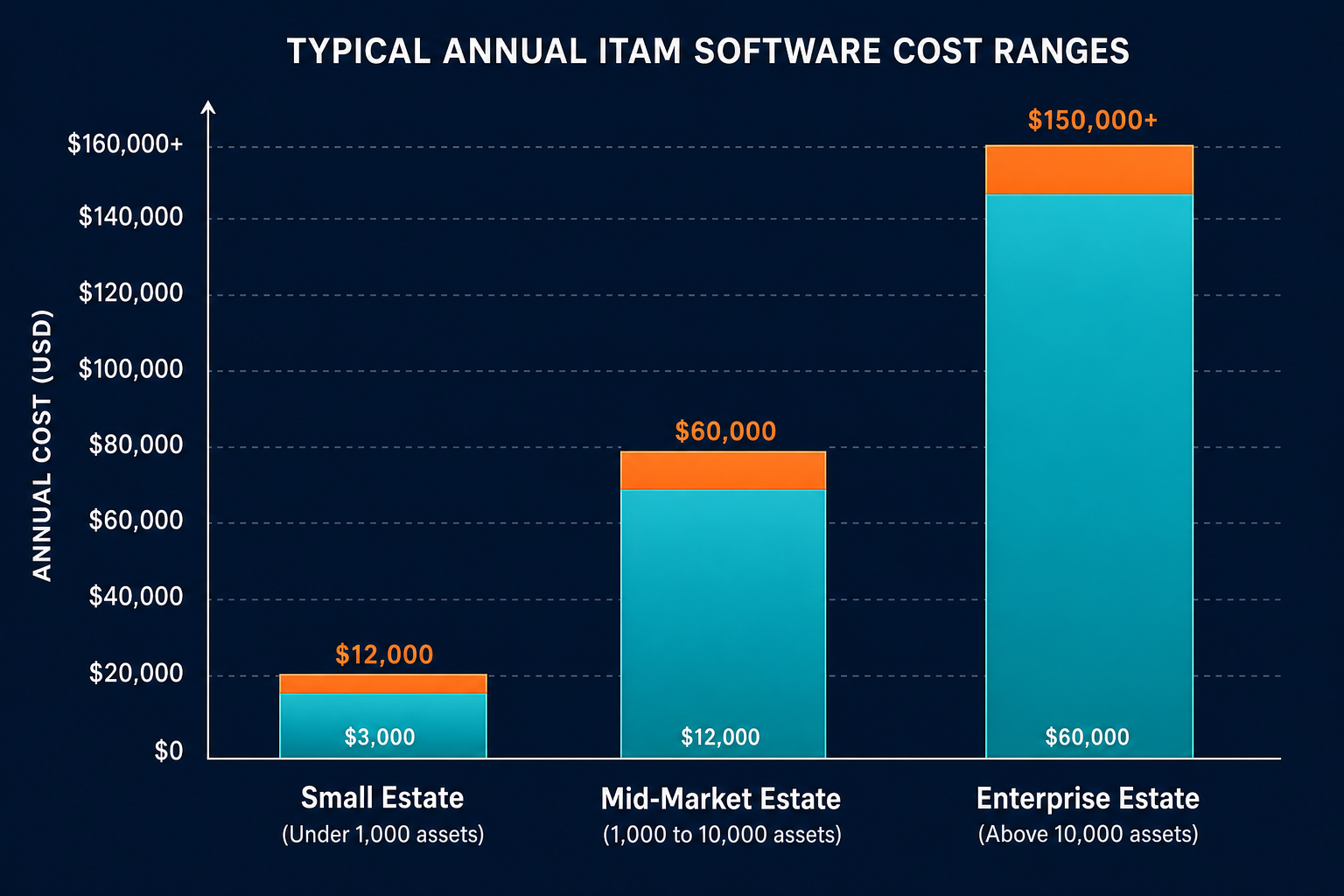
Typical 2026 cost ranges by estate size
List prices vary by vendor, but buyer-reported ranges fall into consistent bands. Use these bands to sanity-check quotes and to set budget expectations with finance.
Small teams managing under 1,000 assets generally see quotes from $3,000 to $12,000 per year for commercial SaaS ITAM. Open-source inventory tools lower license spend to near zero but shift cost into hosting, upgrades, and manual data entry. Teams that outgrow spreadsheets usually land here first, so compare options sized for smaller IT teams before committing to an enterprise tier.
Mid-market organizations managing 1,000 to 10,000 assets generally see quotes from $12,000 to $60,000 per year. This band usually includes software license tracking, procurement, contract management, and standard ITSM connectors. Quotes at the upper end include scheduled discovery and CMDB synchronization. For a broader view of which platforms compete in this band, review this overview of top asset management tools.
Enterprise estates above 10,000 assets or with multi-cloud sprawl generally see quotes from $60,000 to well above $150,000 per year. These deployments include multi-source discovery, reconciliation rules, granular entitlements, audit evidence packs, and dedicated support. Implementation services often add 20 to 40 percent in year one. Multi-year commits usually reduce the effective annual rate. See this breakdown by company size for the full picture.
Schedule a pricing consultation to scope your estate before you sign a quote.
Hidden costs that inflate your ITAM bill
The subscription line rarely tells the full story. Four add-on categories drive most budget overruns after purchase.
First, discovery collectors sold separately. Some vendors sell inventory as the base product and charge extra for network probes, cloud connectors, or agent licenses. Each remote site or cloud account can trigger another fee. Platforms that include scheduled discovery as a foundation avoid this collector tax and keep asset counts trustworthy from day one.
Second, connector and API metering. ITSM sync, SSO, and directory integrations are sometimes gated behind integration packs. API call caps can throttle reconciliation right when you need freshness before an audit. Confirm that ServiceNow, Jira, and directory integrations are included and that API access is not metered by volume. Then check the supported integrations list.
Third, implementation and data cleanup. Migrating from spreadsheets or a legacy register requires deduplication, ownership assignment, and normalization of purchase records. Vendors quote 4 to 12 weeks of services for mid-market estates. If your current register has duplicate serials and missing owners, budget for that cleanup either as vendor services or internal labor.
Fourth, renewal uplifts and true-ups. Contracts often include 5 to 10 percent annual uplifts plus true-up charges for assets added mid-term. Cloud elasticity makes this painful because short-lived instances inflate peak counts. Negotiate how burst assets are metered and whether decommissioned assets drop off the bill automatically.
Are discovery and CMDB sync included in base ITAM pricing?
Sometimes they are bundled and sometimes they are sold as add-ons. Many vendors charge separately for network discovery probes, cloud connectors, and CMDB synchronization. Confirm inclusion in writing before signing, since unbundled discovery is a common source of renewal uplifts.
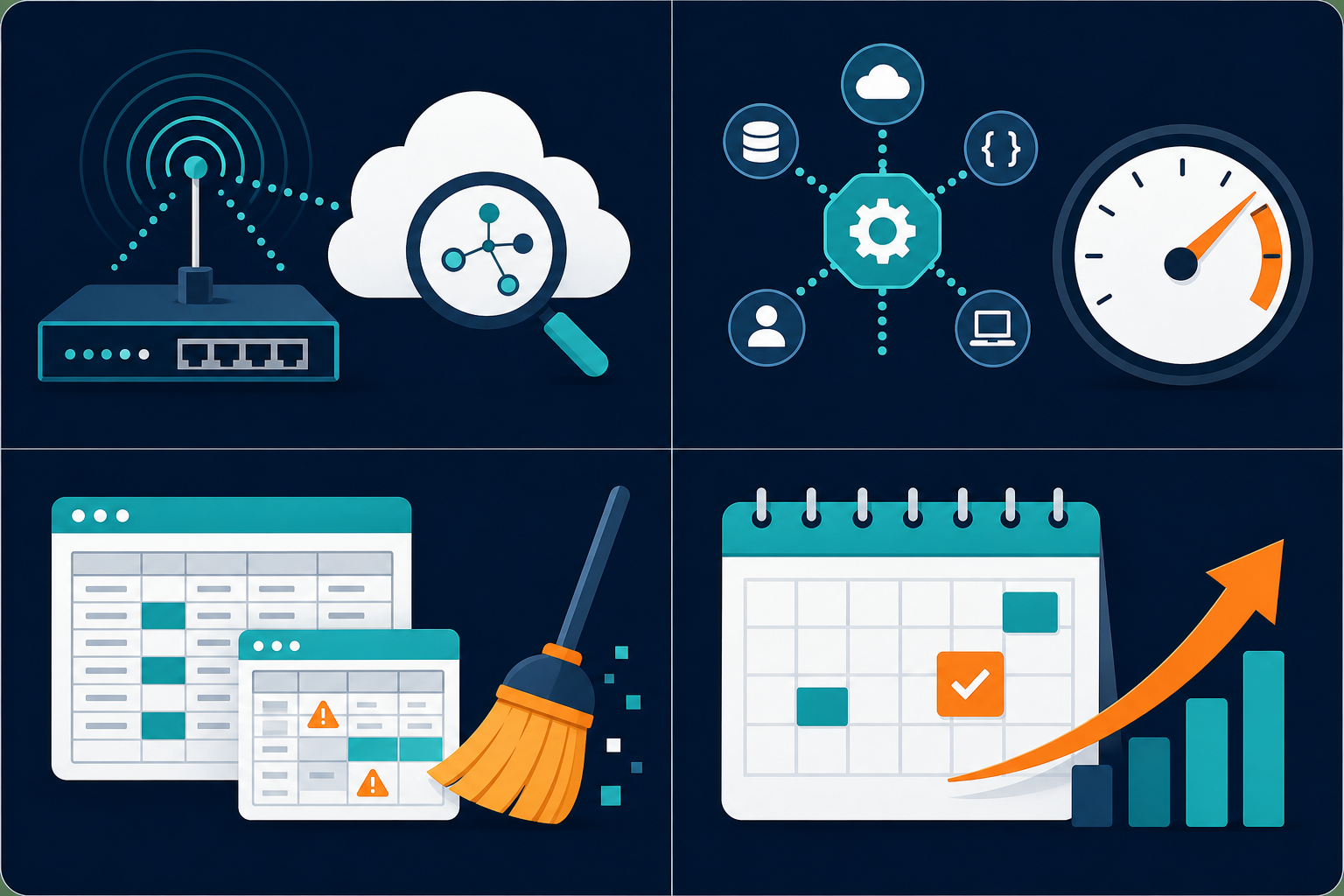
If your quotes separate inventory from discovery, compare total cost with discovery included. Virima combines discovery, ITAM, and service context in one platform so finance sees predictable scope.
Free and open-source vs. commercial ITAM total cost
Free tools win on license cost and lose on labor cost. That tradeoff decides whether open source is actually cheaper over three years.
Open-source inventory registers work well for small fleets with stable hardware and one administrator. You control hosting and customization. You also own upgrades, backups, agent maintenance, and every CSV import. Most open-source tools lack native service dependency mapping, offer limited automated reconciliation against live asset discovery, and provide minimal audit evidence generation for software compliance.
Commercial platforms charge a subscription to absorb that labor. Scheduled discovery verifies what exists, flags shadow assets, joins purchase and warranty records, and keeps the effective license position current. License compliance workflows track installations against entitlements so audit letters do not trigger emergency true-ups.
Flexera reports that IT teams continue to lose visibility as cost pressures mount, raising audit and overspend exposure when inventory relies on manual updates (Flexera 2025 State of ITAM Report). A Block 64 survey found 46 percent of IT leaders waste roughly a quarter of their software budget on underused licenses.
The break point usually appears between 500 and 1,500 assets. Below that line, a disciplined admin can keep a free register accurate. Above that line, manual verification hours exceed the subscription cost of a commercial platform. Factor fully loaded admin hours, audit preparation weeks, and unused license spend into the comparison.
What actually drives price up or down
Five variables explain most of the variance between two quotes for the same asset count.
Discovery depth matters most. Basic agent inventory costs less than multi-source discovery that covers agentless network ranges, cloud APIs, and certificates. Deeper discovery costs more upfront and reduces audit penalty exposure later. Shallow inventory looks cheaper until an auditor finds uncounted installations.
Software license governance adds cost and removes risk. Tracking Microsoft, Oracle, Adobe, and SaaS entitlements requires normalization libraries and use-rights rules. Vendors charge for that content. Organizations with complex publisher estates recover the fee by reclaiming unused licenses and avoiding penalties.
CMDB and service context changes the category. Asset registers list devices. Discovery-led platforms also maintain configuration relationships and service dependency context used for change and incident work. Native IT asset management with discovery-sourced accuracy typically carries a premium over a standalone asset register, offset by the reconciliation labor a register-only tool never eliminates.
Deployment and data residency requirements affect services cost. SaaS multi-tenant deployment is fastest and least expensive. Private hosting, region pinning, and hardened access controls add implementation scope. Regulated buyers should confirm these options during scoping rather than after contracting.
Support tier and onboarding assistance round out the quote. Standard support covers break-fix and documentation. Premium tiers add named experts, health checks, and expanded onboarding. Lean teams often benefit from stronger onboarding because it shortens time to trusted data.
What is the difference between per-asset and per-seat ITAM pricing?
Per-asset pricing scales with the number of devices, VMs, and cloud instances under management. Per-seat pricing scales with the number of technicians who administer the system. Large fleets with few admins usually save with per-seat pricing.
Where Virima fits on cost and value
Virima competes as a discovery-led ITAM platform rather than a manual register. Scheduled discovery establishes what exists across on-prem, cloud, and network-attached assets. That verified inventory feeds lifecycle tracking, software governance, and service dependency context without separate collector licenses.
Discovery-led platforms in this category combine inventory and lifecycle tracking in a single subscription, which avoids separate discovery licensing and reduces reconciliation labor compared to register-only tools. Virima Business Pro packages this as a right-sized tier for growing estates; larger organizations add CMDB synchronization, vulnerability context, and governance workflows through the full platform.
Bundled discovery eliminates the per-probe and per-connector licensing common in modular platforms, which compounds into real savings over a multi-year contract term. Service context adds a second layer of savings: teams see which business services depend on an asset before it is patched, moved, or retired, cutting change-related outage cost that a standalone asset register can’t touch.
How to compare quotes without getting burned
Ask every vendor the same seven questions and score answers side by side.
- What counts as a billable asset, and how are short-lived cloud instances metered?
- Are scheduled discovery, cloud connectors, and CMDB sync included or sold as add-ons?
- Which ITSM, directory, and procurement integrations are included, and is API use capped?
- What does implementation cover, and how is dirty data cleanup handled?
- How are renewals, uplifts, and true-ups calculated?
- How do decommissioned assets drop off the bill?
- What audit evidence does the platform produce for software entitlements?
Run a 60-day pilot on a representative slice of your estate. Include one cloud account, one network range with unmanaged devices, and one publisher with complex entitlements. Measure coverage delta between what you thought you owned and what discovery verified. That delta, multiplied by license and risk cost, usually justifies the platform decision more clearly than feature checklists.
Closing: budget for trusted data, not just licenses
ITAM budgets fail when they fund licenses but not accuracy. A low subscription paired with stale inventory leaves audit penalties, unused licenses, and outage risk untouched. Nearly a third of organizations now carry audit liabilities above $1 million, triple the share from two years ago (2025 Software Compliance survey). A discovery-led platform costs more upfront and less over three years because the data stays trustworthy.
Bring your current asset count, admin count, and top three publisher entitlements to the scoping call. That scope produces a precise quote and a clear payback based on reclaimed licenses and avoided penalties. Schedule a pricing consultation to calculate your IT estate’s total cost of ownership.
Frequently Asked Questions
How is IT asset management software typically priced?
Most vendors use per-asset, per-technician, or tiered bundle pricing. Per-asset plans charge for each managed device or instance. Per-technician plans charge for each admin. Tiered bundles charge a flat annual fee for an asset band and feature set.
What is the difference between per-asset and per-user pricing in ITAM?
Per-asset pricing grows with estate size and suits stable device counts. Per-user or per-technician pricing grows with admin count and suits large fleets managed by small teams. Check whether read-only stakeholders require paid seats.
Are auto-discovery and CMDB included in base ITAM pricing?
It depends on the vendor. Some include scheduled discovery and CMDB sync in the base platform. Others sell network probes, cloud connectors, or sync packs as add-ons. Confirm inclusion in the order form before comparing quotes.
Can small IT teams implement commercial ITAM affordably?
Yes, when the scope matches the estate. Right-sized packages bundle discovery-backed inventory and lifecycle tracking without enterprise service overhead. Pilots focused on one cloud account and one network range keep onboarding fast and measurable.
What’s included in Virima’s pricing for lean IT teams?
Virima Business Pro packages discovery-backed inventory, lifecycle tracking, and service context into one subscription sized for growing estates, without the enterprise service overhead of the full platform. It’s built for IT teams that need discovery-verified data without a large admin team to run it.