The Hybrid Cloud CMDB Gap Minneapolis-St. Paul Manufacturers Keep Inheriting

Consider a Minneapolis-St. Paul manufacturing plant that runs MES and SCADA on the plant side and grows analytics and remote monitoring in AWS or Azure. A change window opens on the IT ticket. The CAB reads a CMDB that still looks like launch day for corporate compute. Nobody sees that the job path still touches a production-adjacent historian or jump host in the DMZ. The approval is clean on paper. The dependency picture is not.
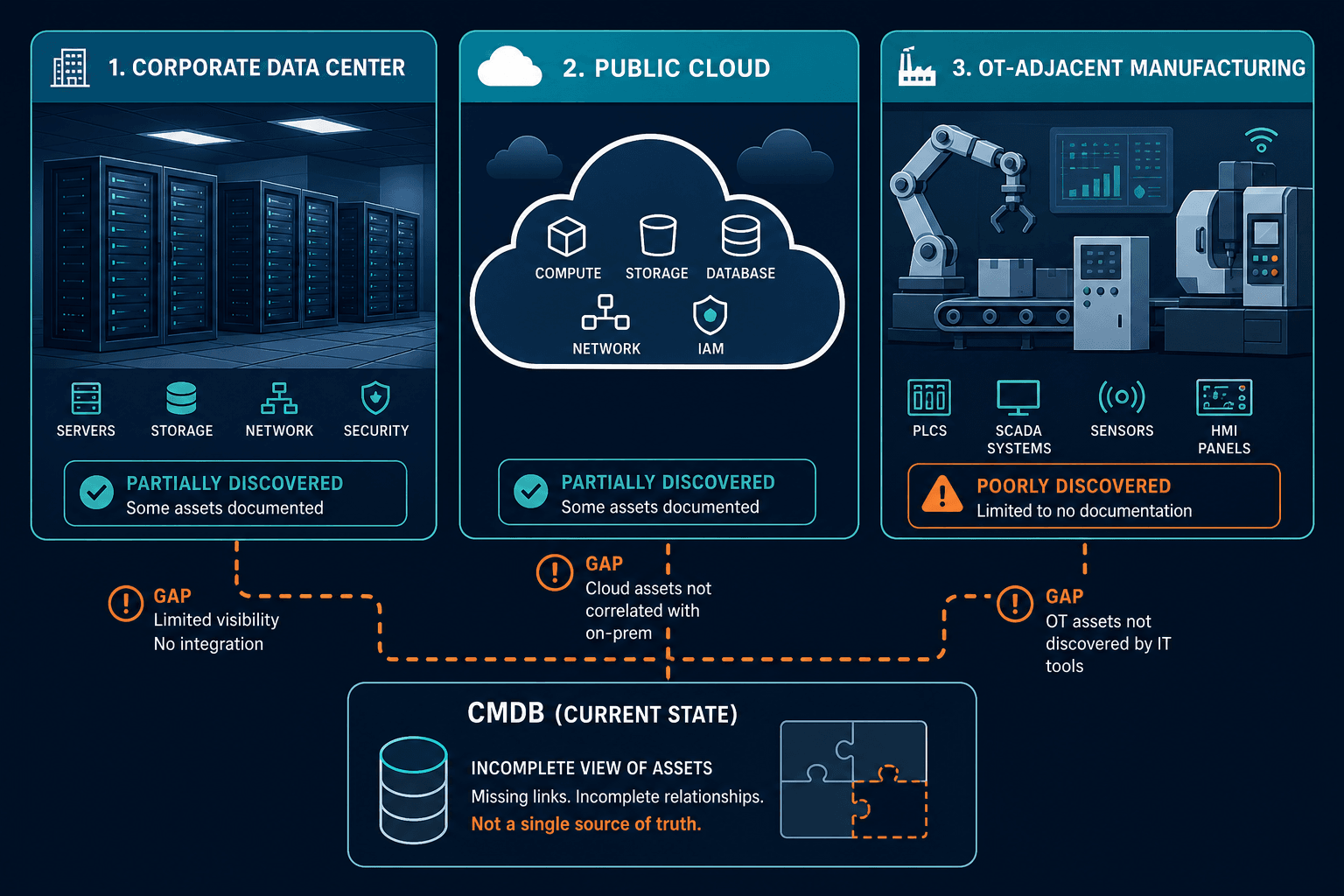
For Minneapolis-St. Paul manufacturing IT teams, plants often modernize in pieces. Cloud arrives for ERP extensions, quality analytics, or vendor portals. The configuration management database still often reflects the data-center half of the estate. The shop-floor and cloud halves stay partially documented. Teams inherit that coverage gap when discovery never expanded with the hybrid footprint.
The agentic IT era runs on runtime truth. Not ticket history, not manual CMDB maintenance. See Virima Trusted Runtime Truth →
What is a hybrid cloud CMDB for manufacturing?
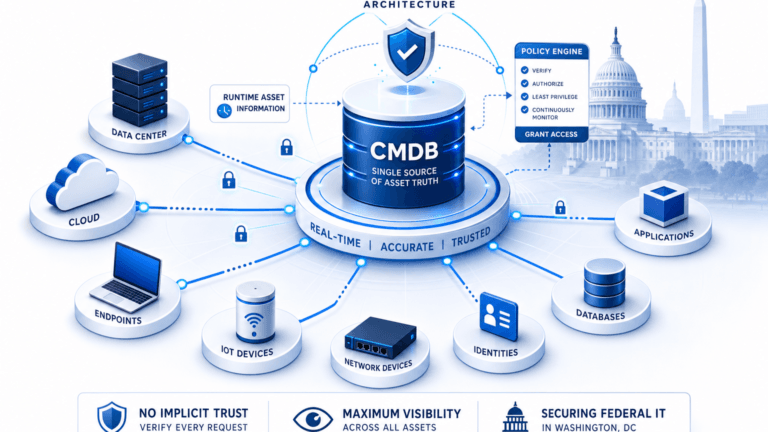
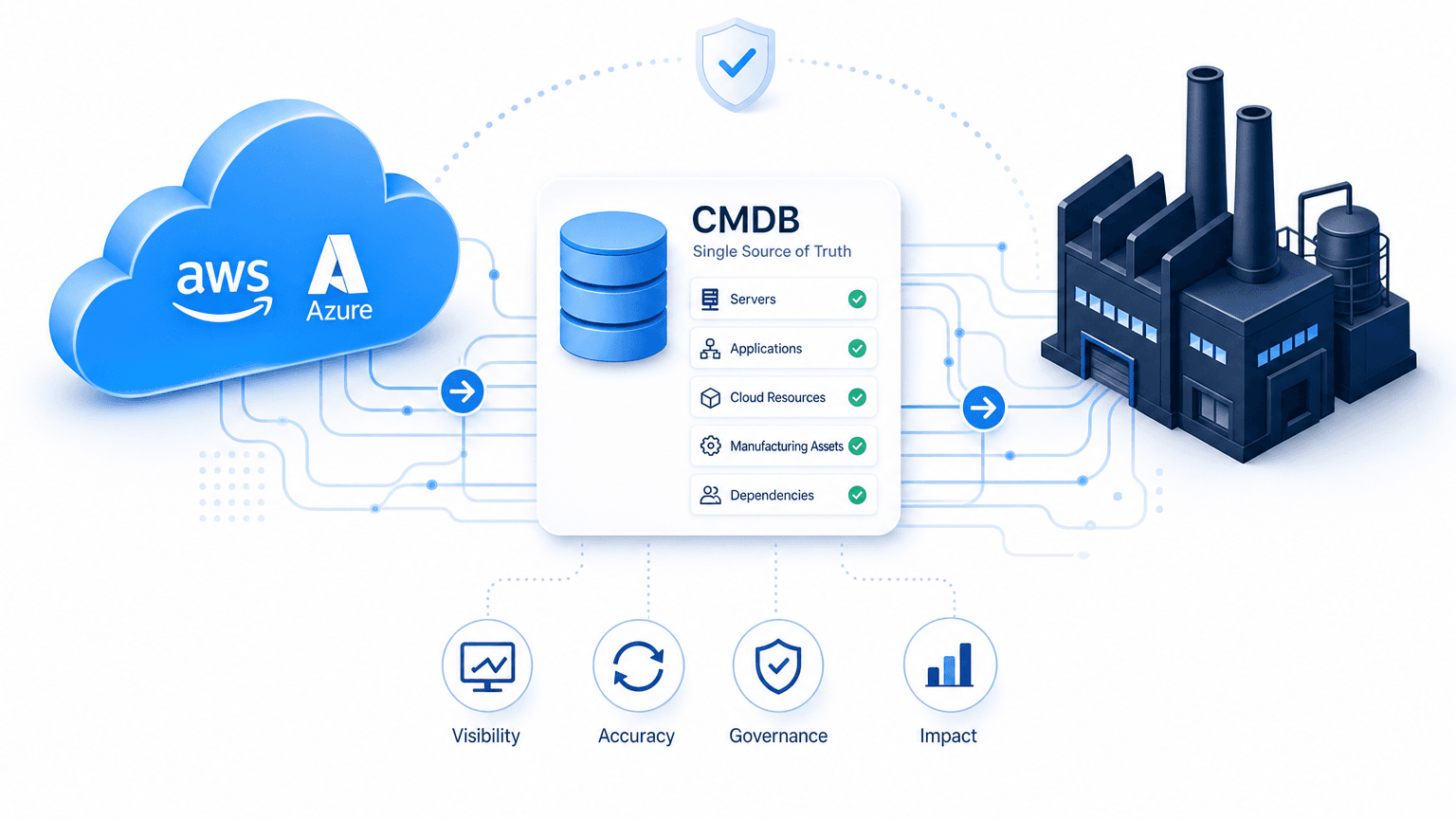
Under ITIL 4, configuration management maintains controlled information about services and the infrastructure that supports them. A hybrid cloud CMDB extends that practice across three realities manufacturing IT already lives in: on-prem and OT-adjacent systems near the line, private data-center assets, and public cloud resources in AWS or Azure. Each environment produces configuration items. Those items still need one reconciled CI record, relationship data, and change history the ITSM team can trust.
Core requirements stay practical:
- Accurate CI records across on-prem, OT-adjacent, and cloud scopes
- Relationship and dependency data a change board can read before a window
- Integration into the ITSM tools the team already uses
- Audit-ready history of what changed and when the record last matched discovery
The coverage gap
| Situation | What happens |
|---|---|
| CMDB populated once during ServiceNow or ITSM rollout | Cloud and OT-adjacent assets added after go-live never enter discovery; the CMDB still mirrors launch day |
| Discovery covers corporate IT only | Historian servers, jump servers, and DMZ bridges between IT and OT stay outside the CI set |
| Manual updates for cloud resources | Ephemeral instances appear and disappear faster than spreadsheet owners can log them |
IT/OT convergence makes the same gap more expensive. For a fuller treatment of plant-floor and enterprise IT joining at the asset layer, see a fuller look at IT/OT convergence. This article stays on hybrid cloud CMDB architecture and the Twin Cities operating reality around it.
When does a manufacturing hybrid cloud CMDB become incomplete after go-live?
Incompleteness usually starts after the first ITSM cutover, when cloud accounts and OT-adjacent hosts keep changing while discovery still targets corporate LAN ranges only. Ephemeral cloud roles and DMZ jump paths appear in runbooks long before they appear as configuration items (CIs), so the next change window inherits yesterday’s map.
What’s at stake when the CMDB only sees half the plant
Converged IT and OT means a cloud-side change can carry a shop-floor consequence, and a plant-side dependency can sit outside the map CAB members review. Hybrid cloud on the manufacturing side is no longer a side project. A 2025 Deloitte survey of 600 manufacturing executives, cited in Deloitte’s 2026 Manufacturing Industry Outlook, found 80% plan to invest 20% or more of improvement budgets in smart manufacturing, including cloud computing.
Visibility stakes are not abstract either. CISA industrial control systems guidance treats Critical Manufacturing as a national-risk sector where incomplete asset inventory weakens defense and response. You cannot prioritize, segment, or evidence what your CMDB does not hold as a current CI.
Where hybrid cloud CMDB approaches break down
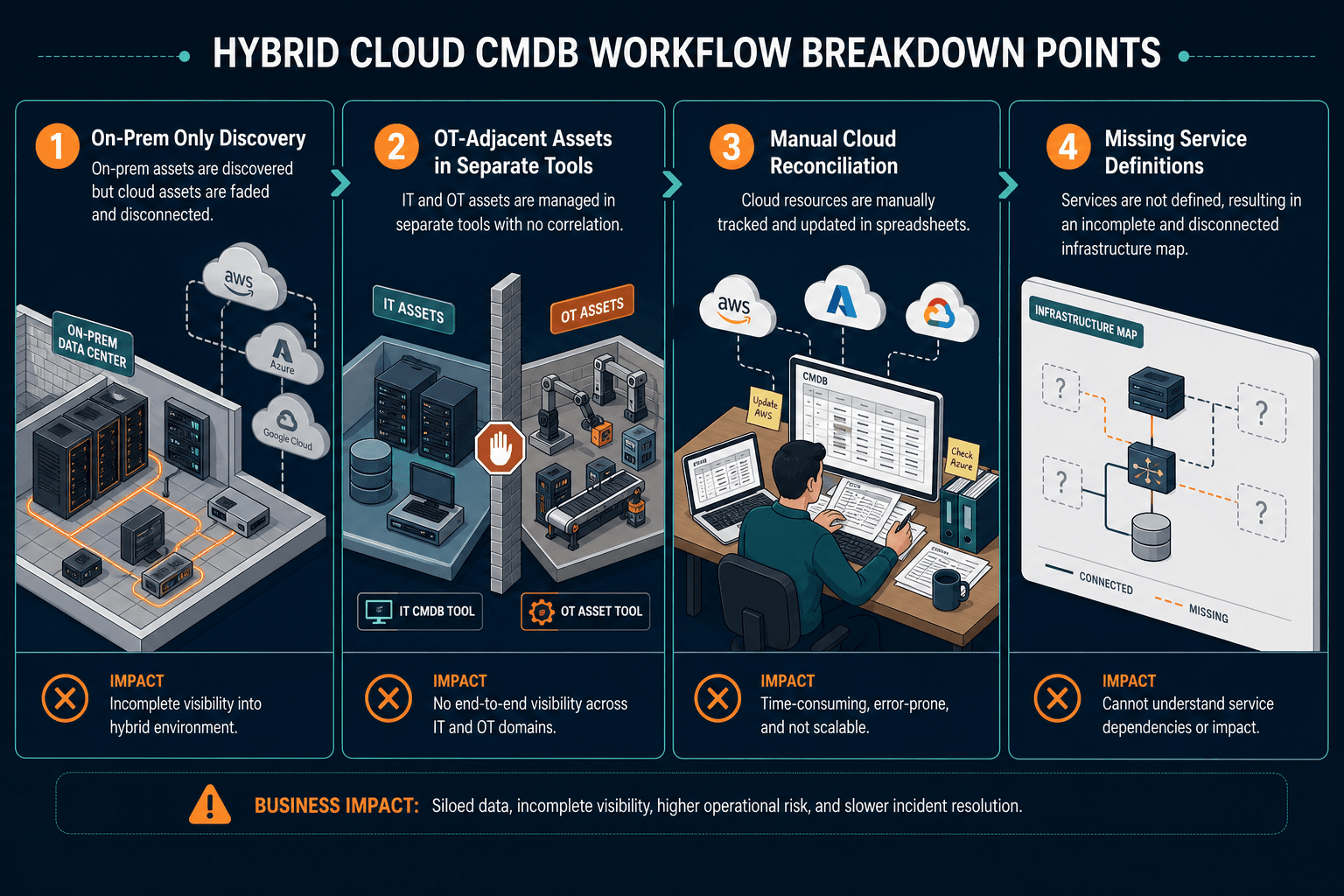
- Discovery covers on-prem corporate IT only, so cloud CIs never populate the CMDB. Result: change advisory boards approve work blind to cloud-side dependencies.
- OT-adjacent assets live in a separate engineering spreadsheet or tool. Result: the dependency map stops where the IT/OT boundary starts.
- Operators reconcile cloud consoles to the CMDB by hand. Result: records reflect last quarter’s estate, not today’s running set.
- Service definitions never reach the mapping layer, so infrastructure graphs stay IT-centric. Result: blast-radius questions stall in meetings instead of resolving from the map.
Language matters here. High-frequency scheduled discovery is the honest operating model. Claims of passive continuous or event-stream “real-time” CMDB sync overstate what most manufacturing stacks can defend today.
Why do smart-factory cloud projects raise CMDB risk for manufacturers?
Smart manufacturing spend moves analytics, remote monitoring, and ERP extensions into AWS or Azure while MES and SCADA stay plant-side. Each new cloud path multiplies change dependencies the configuration management database (CMDB) never saw at go-live. Teams that fund the cloud program without expanding discovery scope fund outage risk in parallel.
Who ends up paying for the coverage gap
For CMDB owners and configuration managers
You spend hours each week reconciling cloud consoles, OT engineering lists, and the CMDB. Every stale CI becomes a credibility problem in the CAB. When an outage trace stops at an undocumented jump host, you become the person answering for a record you did not have authority or tooling to keep current.
For IT directors and CTO-adjacent owners of hybrid infrastructure
Bolt-on scanners that never spoke industrial-adjacent paths create architecture debt. Teams approve network and cloud designs without a full dependency view. Technical skepticism is rational: a CMDB that only mirrors the data center trains leaders to ignore it when the plant is on the critical path.
For compliance-driven manufacturers
Food and beverage, pharma, automotive, and defense-adjacent plants face frameworks such as IEC 62443 and NIST SP 800-82, plus sector rules like FDA 21 CFR Part 11 or IATF 16949. The CMDB does not “do compliance.” It maps the infrastructure that supports documentation, zoning evidence, and inventory requests those programs demand. When the inventory cannot produce a complete, current picture on demand, audit prep turns into a reconstruction project. CISA keeps Critical Manufacturing in the national risk conversation for the same visibility reasons.
Twin Cities market-scale challenge
Minnesota manufacturers already operate under tight margin and climate pressure, as reflected in Enterprise Minnesota’s State of Manufacturing work and BusinessNorth’s coverage of manufacturer concerns. An incomplete hybrid cloud CMDB adds operational and audit risk on top of conditions that are already strained. It is not a hypothetical lab problem.
Who feels a half-plant CMDB first inside a manufacturing IT organization?
Configuration managers feel it first as hours of console-to-spreadsheet reconciliation before every CAB. Directors feel it next when architecture reviews cannot prove cloud-to-line blast radius. Compliance owners feel it last, when an auditor asks for a same-day inventory of every host touching a controlled process and the team needs a reconstruction project instead of a report.
How manufacturing IT teams close it
Three mechanisms matter, and each must match how plants actually run.
1. Discovery that reaches on-prem, cloud, and OT-adjacent assets
Combine agentless, agent-based, and API-based methods so AWS and Azure resources land in the same CI model as plant-adjacent servers. IT discovery has to feed one authoritative record set, not three disconnected inventories.
2. Dependency mapping that shows blast radius before a change ships
Once service definitions exist (manual entry, spreadsheet import, or an EA feed), ViVID™ service mapping builds the infrastructure dependency view. CAB members can see cloud-to-plant paths instead of guessing from tribal knowledge.
3. ITSM integration that puts context where work already happens
Bidirectional sync with platforms such as ServiceNow, Jira Service Management, and Ivanti puts discovery-sourced CI context into queues people already open. Partner names stay operational labels here. For how Virima connects across that stack, use the single integrations hub: all integrations.
| Manual / siloed | Discovery-driven hybrid cloud CMDB | |
|---|---|---|
| Cloud CI updates | Logged when someone remembers | Populated on scheduled, high-frequency discovery cycles |
| OT-adjacent visibility | Tracked separately, if at all | Reconciled into the same CI record set |
| Change impact review | Based on assumption | Based on dependency data across IT and cloud |
| Audit prep | Manual reconstruction | Reporting against current discovery-backed records |
Map hybrid cloud CMDB coverage against your plant estate →
Three ways this plays out on the floor
- A discrete manufacturer moving MES analytics to Azure learns mid-migration that the CMDB never recorded which on-prem controllers feed the new dashboards until dependency mapping surfaces them.
- A food and beverage plant preparing for an IATF- or FDA-adjacent audit needs a same-day inventory of every cloud and on-prem asset touching a production system, not a two-week reconciliation project.
- A CMDB owner inheriting a partially documented hybrid environment uses scheduled discovery to close the gap between what the CMDB stores and what is running, without a rip-and-replace of the ITSM platform.
For foundations on scope and CI types, revisit what a CMDB actually tracks.
Where Virima fits
Virima is a discovery and CMDB foundation that sits beside the ITSM platform you already run. It does not require you to discard ServiceNow, Jira Service Management, or Ivanti to get trustworthy CI data.
What changes in week one
High-frequency discovery starts closing cloud and OT-adjacent blind spots without a multi-month manual reconciliation program. Teams see net-new CIs and stale records in the first scheduled cycles.
What stays accurate six months in
Scheduled discovery cycles keep refreshing CI records as cloud footprint and plant connectivity change. The CMDB stops being a launch-day snapshot.
Where it shows up in ServiceNow, Jira, or Ivanti
Integrations deliver asset and CI context into the workflows operators already use. IT asset management views sit on the same discovery-backed truth for lifecycle questions the CMDB alone never answered cleanly.
Product boundaries stay clear. Virima maps infrastructure and relationships. It does not classify business data content the way a DLP tool does. When a CI leaves service, the IT team decommissions the record after confirming no active dependencies remain.
What should manufacturing teams expect from discovery-backed CMDB work in the first six months?
Week one should surface missing cloud and OT-adjacent configuration items (CIs) without a full ITSM rip-and-replace. Six months in, scheduled discovery cycles should keep those records current as plant connectivity and cloud accounts change. Service maps stay useful only after teams supply service definitions, then keep maps current as infrastructure shifts.
What changes once the coverage gap closes
| From | To |
|---|---|
| Periodic manual audits of cloud and plant lists | Scheduled discovery cycles with review cadence |
| IT-only CMDB scope | CI records that span cloud and OT-adjacent assets |
Faster change approval. CAB packets cite dependency data instead of heroics.
Cleaner audit prep. Inventory requests become a report against current records.
Fewer stale-record incidents. Undocumented jump hosts and forgotten cloud roles stop surprising responders.
Getting started
- Inventory current discovery coverage by environment.
- List OT-adjacent and cloud CI blind spots with owners.
- Pilot discovery on one cloud account or one production line.
- Connect discovery output to the existing ITSM platform.
- Set a review cadence for scan frequency and exception handling.
If your CMDB still assumes a single data center, read why a data-center CMDB doesn’t automatically cover cloud.
Frequently Asked Questions
What is a hybrid cloud CMDB?
A hybrid cloud CMDB holds configuration items and relationships across on-prem, OT-adjacent, and public cloud environments such as AWS or Azure, so change and audit work share one reconciled record set instead of separate inventories.
How does IT/OT convergence affect manufacturing CMDB accuracy?
Convergence puts production-adjacent systems on the same risk path as enterprise IT. If discovery never reaches historians, jump hosts, or DMZ bridges, the CMDB stores an incomplete estate and change impact stays guesswork.
What discovery methods work across on-prem and cloud manufacturing environments?
Teams combine agentless network methods, agents where deep inventory is required, and cloud APIs for AWS and Azure. Scheduled high-frequency cycles then reconcile those sources into shared CI records.
How does a hybrid cloud CMDB support manufacturing compliance audits?
The CMDB maps infrastructure that backs frameworks such as IEC 62443 and NIST SP 800-82. It supplies current inventory and relationship evidence. It does not replace the control frameworks or GRC tooling themselves.
What’s the first step for a manufacturing IT team with an incomplete hybrid cloud CMDB?
Document coverage gaps by environment, then pilot scheduled discovery on one cloud account or one line. Connect results into the ITSM platform you already run before expanding scope plant-wide.