Hybrid Cloud CMDB for Nashville’s Multi-Facility Healthcare IT Estates

A Nashville health system schedules a failover test for its clinical platform on a Saturday morning. The central hospital runs on its primary data center. Two satellite clinics route through a cloud-hosted gateway added during last year’s expansion. The test plan names the data center and the primary EHR cluster. It misses the cloud gateway entirely. The test passes on paper while the clinic path stays unverified.
Hybrid cloud CMDB for Nashville multi-facility healthcare IT estates fails exactly here, where the estate spans more facilities than the record covers.
Multi-facility growth creates this exposure. Hospitals, clinics, imaging centers, and administrative offices each hold local infrastructure. Cloud estates carry the shared clinical platforms between them.
HHS has proposed strengthening the HIPAA Security Rule with an explicit technology asset inventory and network map requirement — reviewed at least every 12 months under the draft rule, and covering how ePHI enters, moves through, and exits a facility’s systems — as published in the HIPAA Security Rule proposed rulemaking. The American Hospital Association tracks cyber risk across hospitals as a sector-wide priority through its cybersecurity resource center.
This article shows how multi-facility teams build one discovery-sourced CMDB across hospitals, clinics, and cloud. See how enterprise teams establish Trusted Runtime Truth as the shared evidence layer under clinical operations.
Why multi-facility estates drift from the record
Each facility keeps its own rhythm. The central hospital runs scheduled maintenance windows with formal change control, while satellite clinics add imaging devices, pharmacy systems, and network closets between projects. But cloud teams expand shared platforms without visiting every site, so each local record stays accurate for its own scope — the joint estate just never gets one.
Three gaps open as facilities multiply:
- Site-level inventories miss shared cloud dependencies behind clinical services.
- Cloud inventories miss facility devices that consume those services.
- Ownership splits across biomedical, network, and application teams with no joint view during incidents.
A failover test then verifies only the facilities named in the plan.
These blind spots carry a real cost. IBM’s 2025 Cost of a Data Breach Report puts the average healthcare breach at $7.42 million, the highest average of any industry for the 14th consecutive year. The same report found healthcare breaches took 279 days on average to identify and contain, well past the global average (HIPAA Journal, 2025). Long detection times track with exactly the kind of coverage gap described above: a device or cloud path that no one’s inventory names.
A hospital network’s own shadow IT discovery work turned up far more CMDB gaps than facility teams expected. Most sat in cloud and procurement paths that fell outside the formal inventory process (Virima: Shadow IT Discovery on a Healthcare Network).
Why do multi-facility health systems need one CMDB?
Each facility holds accurate local records while shared cloud platforms sit outside every site list. One CMDB joins hospital, clinic, and cloud assets with owners and verification dates, so failover plans and incident response cover the full estate instead of one building.
What hybrid cloud CMDB visibility must prove for multi-facility healthcare
A defensible healthcare hybrid cloud asset inventory rests on three proofs:
- Prove the inventory covers every facility plus the cloud estates behind shared services.
- Prove each clinical service links to its full asset set across sites.
- Prove the record stays current through scheduled verification at every location.
These three proofs map directly onto the audit case for a CMDB under HIPAA. The HHS Office for Civil Rights’ HIPAA Security Rule guidance sets the baseline risk-analysis requirement this evidence has to satisfy; see Virima: HIPAA Compliance via CMDB for how the ePHI asset gap connects to that requirement.
Prove completeness across facilities and cloud
Discovery must reach every layer of the estate:
- Hospital data centers, clinic network closets, imaging networks, and administrative offices
- Cloud accounts, containers, and integration gateways behind shared clinical platforms
Shared platforms need one record per asset with a stated owner. Devices without owners need named remediation, since an unowned infusion pump gateway or clinic switch blocks audit evidence.
Prove service linkage for clinical continuity
Each EHR workflow, imaging pipeline, and pharmacy service needs its facility-by-facility asset set named behind it. Service composition comes from user input through manual entry, spreadsheet import, or architecture input, and the dependency map builds from those definitions. Failover plans then cite the service and its full cross-site assets together.
Prove freshness on a facility schedule
Virima reconciles multi-source discovery into one authoritative CI record with source tags and last-verified dates. Scheduled cycles refresh each facility and cloud account. Manual entries stay fenced behind review. Freshness becomes a timetable, not a claim.
Join facility systems, cloud platforms, and clinical IT in one map
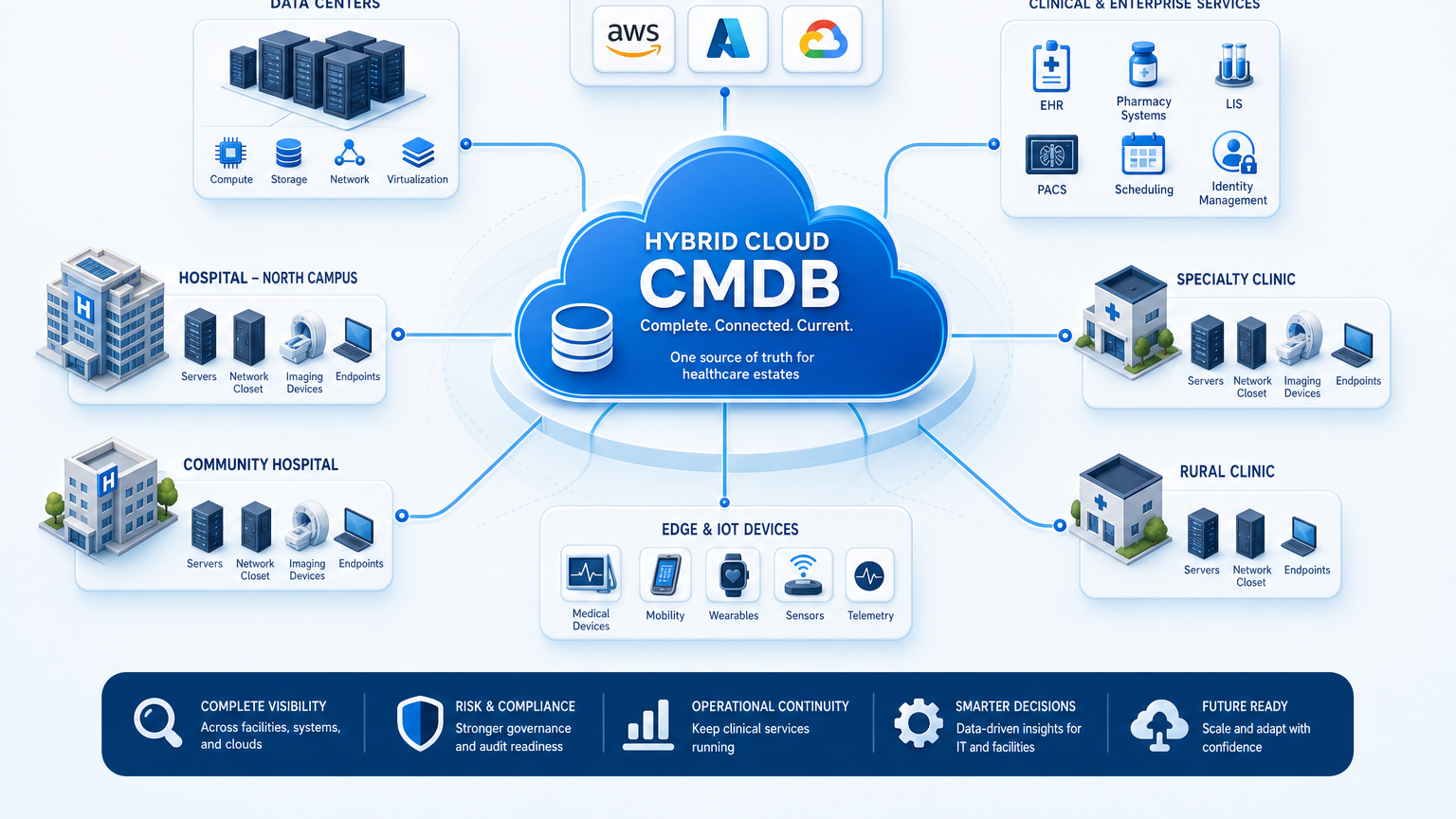
The fix is not a larger spreadsheet per site. It is one ViVID™ service map with three node types, each fed by scheduled discovery and each tied to named clinical services.
What each node contributes
Facility nodes contribute servers, network closets, imaging modalities, pharmacy systems, and endpoints across hospitals and clinics. Platform nodes contribute cloud accounts, container clusters, databases, and integration engines behind shared clinical services. Enterprise IT nodes contribute identity, patch, backup, and monitoring systems that span every site. Discovery finds the infrastructure. Service definitions name which pieces form one clinical service.
How the map supports continuity and response
When a cloud gateway degrades, the responder opens the service map and traces the failing CI to affected clinics and clinical workflows. Ownership shows on the same screen. Facilities and platform teams brief from one record. That path from failing CI to affected service is the core behavior to demand from any CMDB platform, and it’s what shortens mean time to resolution. The alternative is paging facilities, platform, and application teams separately and reconciling three partial views on a bridge call. One team can instead open the ViVID™ map, confirm the blast radius, and brief leadership from a single source. The responder isn’t flying blind between buildings and cloud accounts during the incident that matters most.
Which assets belong in the first healthcare service map?
Start with one clinical service across two facilities: the shared platform nodes plus the facility devices that consume them. Add imaging, pharmacy, and administrative services once the first map holds. Narrow scope proves completeness faster than estate-wide collection.
Feed clinical IT context into the ITSM you already run
Hybrid visibility earns trust when it shows up inside daily ITSM work. Incident tickets link to the affected CI and its clinical service. Change requests check the dependency map before approval across facilities. Problem records reference the same service definition that audit evidence cites.
Virima supports this pattern by syncing discovered CIs and relationships into existing ITSM workflows. Platform names stay as plain references here: ServiceNow, Jira Service Management, Ivanti, HaloITSM, Xurrent, and Hornbill teams each keep their desk while reading the same CI truth. One integration reference covers the path: the integrations hub lists the supported ITSM sync options.
Keep the data flow one-directional at first. Discovery sources the CMDB, the CMDB feeds the desk, and manual edits stay fenced behind review. That order keeps audit evidence anchored to observed data.
When clinical services span hospitals, clinics, and cloud across Nashville, walk through your service chain with the Virima team — scoped to one clinical service across two of your facilities, mapped from your discovery data rather than a slide deck — and see which assets and owners a hybrid cloud CMDB evidence map should hold.
How should healthcare asset data reach the service desk?
Sync discovered CIs and relationships into incident and change workflows so agents and approvers read the same record. Keep discovery as the source and fence manual edits behind review. One-directional flow keeps evidence anchored to observed data.
Where to start: one service across two facilities, then expand
Start with one clinical service across two facilities. Pick one shared platform, discover its full component set at both sites, define the service explicitly, and run incident and change work from that map for one full cycle.
Measure three outcomes before expanding:
- Incident tickets link to the right CI on first touch.
- Change reviews name cross-facility impact without extra calls.
- The service map matches both sites at cycle end.
Expand facility by facility only when all three hold.
Teams that need a scoped walkthrough of that first service can start a conversation through the demo request path with their facilities and platforms listed. Other health systems have run a similar discovery-first scoping pass; see Virima: IT Asset Discovery for Research Hospitals in Boston for how one hospital network approached its own first service.
Build the joint record before the next test finds the gap
Failover tests and audit requests arrive on their own timetable. Health systems that map one service across two facilities before that hour will verify faster and restore with more care. Teams that assemble evidence site by site won’t. Build the joint layer now, prove it on one service, and expand while verification dates stay fresh.
Frequently Asked Questions
What is a hybrid cloud CMDB for healthcare?
A hybrid cloud CMDB for healthcare — sometimes called a healthcare hybrid cloud asset inventory — joins facility infrastructure and cloud platform assets into one record with owners and verification dates. It’s the foundation of a true multi-facility hospital CMDB that also accounts for the cloud assets between sites, so clinical services link to their full cross-site asset set for continuity and audit work.
How does this support HIPAA asset inventory and network map expectations?
Discovery-sourced inventories with network maps show which assets exist and how they connect across facilities and cloud. Verification dates and ownership keep the record auditable through scheduled cycles.
Do ViVID™ service maps update when facilities change?
Maps stay current as discovered infrastructure changes, once service definitions are provided. Definitions come from manual entry, spreadsheet import, or architecture input, and map building runs automatically.
Does Virima work alongside ServiceNow, Jira Service Management, or other ITSM platforms already in use across hospital networks?
Yes. Discovered CIs and relationships sync into incident and change workflows so every facility reads the same record. Keep discovery as the source during rollout.
How does Virima support multi-facility healthcare estates?
Virima reconciles multi-source discovery into authoritative CI records, builds service dependency maps from provided definitions, and syncs that context into ITSM workflows for incident and change decisions — the operational core of any hybrid cloud CMDB for multi-facility healthcare IT estates.