NIS2 IT Asset Visibility for Stockholm’s Telecom and Tech Enterprises

A Stockholm carrier detects degraded signaling on a core link at 07:15. The enterprise tech tenant on the same fabric sees latency on its platform API. The carrier opens its network inventory. The tenant opens its cloud inventory. Neither shows the shared path between them.
NIS2 IT asset visibility for Stockholm telecom and tech enterprises fails exactly here, in the gap between two accurate lists.
Each side holds strong local records. The shared dependency between carrier transport and tech platform has no joint owner. This article shows how to build NIS2-ready visibility from discovery-sourced data, so both sides prove what they hold and how it connects. See how enterprise teams establish Trusted Runtime Truth as the shared evidence layer under telecom and tech operations.
Why NIS2 treats telecom and digital infrastructure as one problem
NIS2 names digital infrastructure and ICT service management as covered sectors with risk management and incident duties. The European Commission confirms the directive covers digital infrastructure providers alongside energy, transport, and other essential sectors in its NIS2 directive overview. Member states had until 17 October 2024 to transpose it into national law.
Sweden transposed NIS2 through a new Cybersecurity Act. The government adopted the Cybersecurity Act (2025:1506) in December 2025, as analyzed in the Bird and Bird guide to NIS2 in Sweden. Sweden’s Cybersecurity Act extends NIS2’s critical infrastructure duties to Stockholm’s telecom and tech cluster, where carrier cores sit inside the same facilities as cloud and enterprise platforms. Stockholm concentrates the exposure. The official Sweden portal describes a major ICT cluster in Kista and Stockholm built around telecom and 5G work in its innovation overview. Carrier cores, cloud regions, and tech campuses share power, fiber, and facilities across the capital.
When each side proves only its own inventory, three gaps open. Carrier transport nodes carry one owner. Cloud and platform estates carry another. The enterprise IT joining them often carries a third. That incident then needs three evidence packs — but the regulator reads one event.
Why do telecom and tech need shared NIS2 asset visibility?
Tech platforms depend on carrier transport for connectivity, signaling, and restoration. Carrier sites depend on enterprise IT for management, identity, and monitoring. Shared visibility maps each dependency once, so incident evidence names the full chain instead of two disconnected halves.
What NIS2 asset visibility must prove in Stockholm
NIS2 evidence rests on three proofs. Prove the inventory is complete. Prove each asset links to its service and owner. Prove the record stays current through scheduled verification.
Prove completeness across network, cloud, and IT
Telecom operators must join core routers, aggregation nodes, transmission gear, and management platforms with supporting IT. Tech enterprises must join cloud accounts, Kubernetes estates, databases, and API gateways with on-prem infrastructure. Shared facilities need one record per asset with a stated owner. Unowned assets need a named remediation owner, not a blank field.
A shared facility in Kista that hosts both a carrier point of presence and a tenant’s edge compute rack is the clearest test case. If either side’s inventory stops at the rack door, the dependency between them stays invisible until an incident forces a manual walkthrough to find it.
Prove service linkage for incident reporting
Risk management starts from identified assets and their users and dependencies. Apply that frame to Stockholm operations. Each signaling path, platform service, and restoration workflow needs a named asset set behind it. Incident reports then cite the service and its assets together. That same named-asset discipline is what lets a documented risk register tie directly to change records instead of living as a separate compliance exercise. Service composition comes from user input through manual entry, spreadsheet import, or architecture input, and Virima builds the dependency map from those definitions.
Prove freshness on a schedule
Evidence holds value only when verification dates stay recent. Virima reconciles multi-source discovery into one authoritative CI (configuration item — any tracked IT asset or component) record with source tags and last-verified dates. Scheduled cycles refresh the record. Manual entries stay fenced behind review. Freshness becomes a timetable, not a claim, the same discipline covered in how automated discovery supports IT audit readiness.
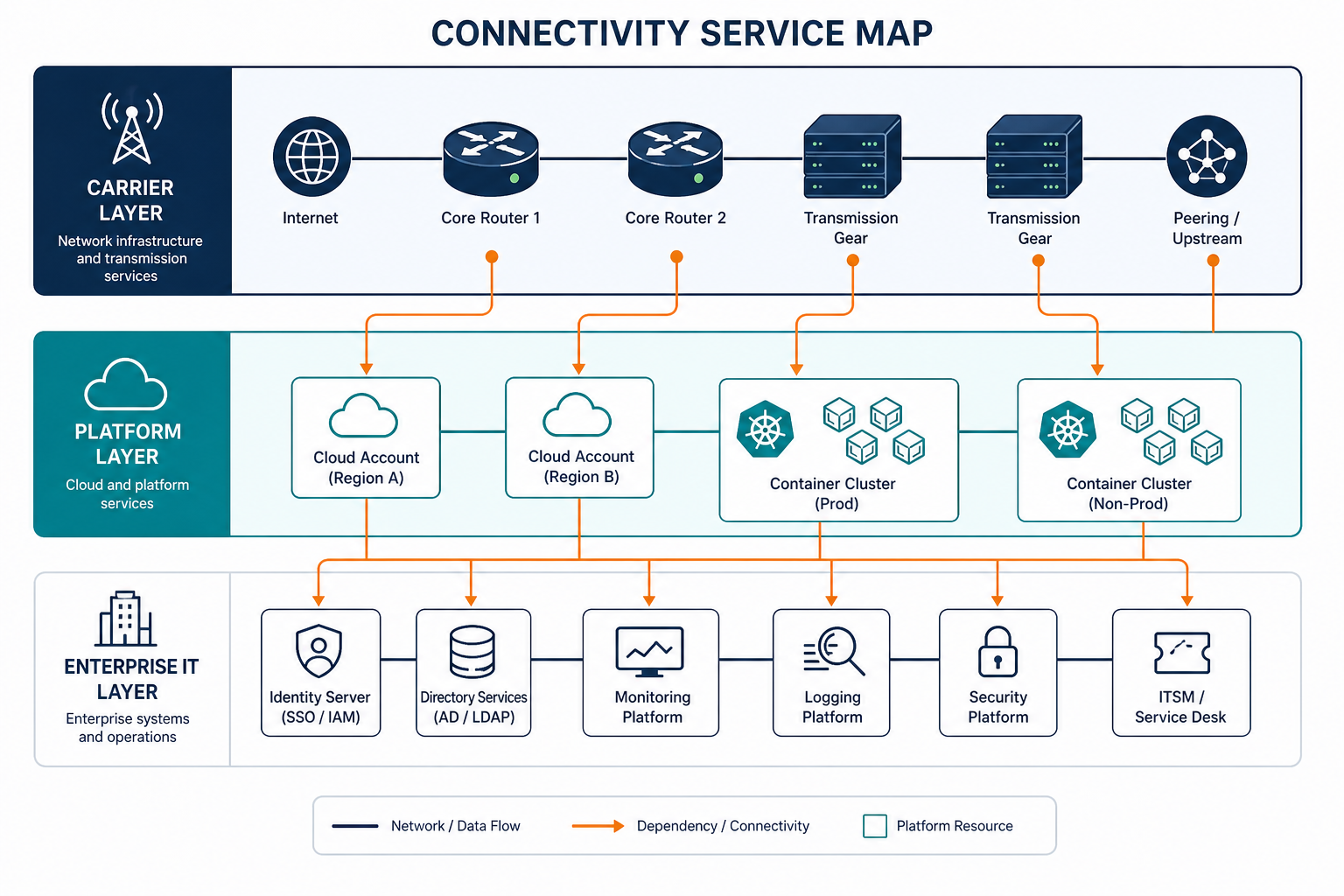
Carrier systems, platform systems, and enterprise IT belong in one map
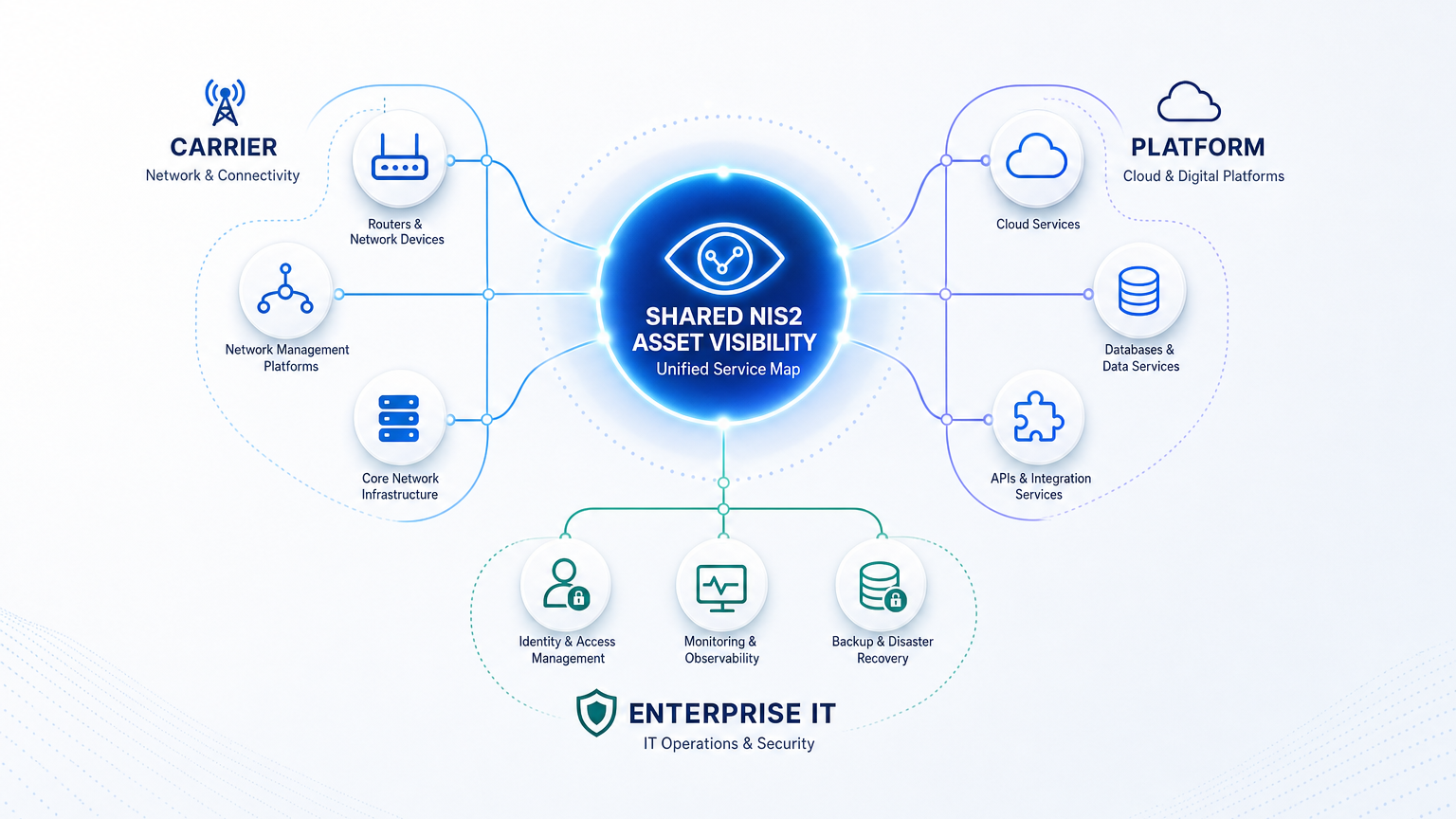
The fix is not a larger spreadsheet. It is one service map with three node types, each fed by scheduled discovery and each tied to a named essential service.
What each node contributes
| Node type | Contributes |
|---|---|
| Carrier | Core and aggregation routers, transmission gear, signaling systems, network management platforms |
| Platform | Cloud accounts, container clusters, databases, integration gateways |
| Enterprise IT | Identity servers, patch systems, backup targets, monitoring platforms |
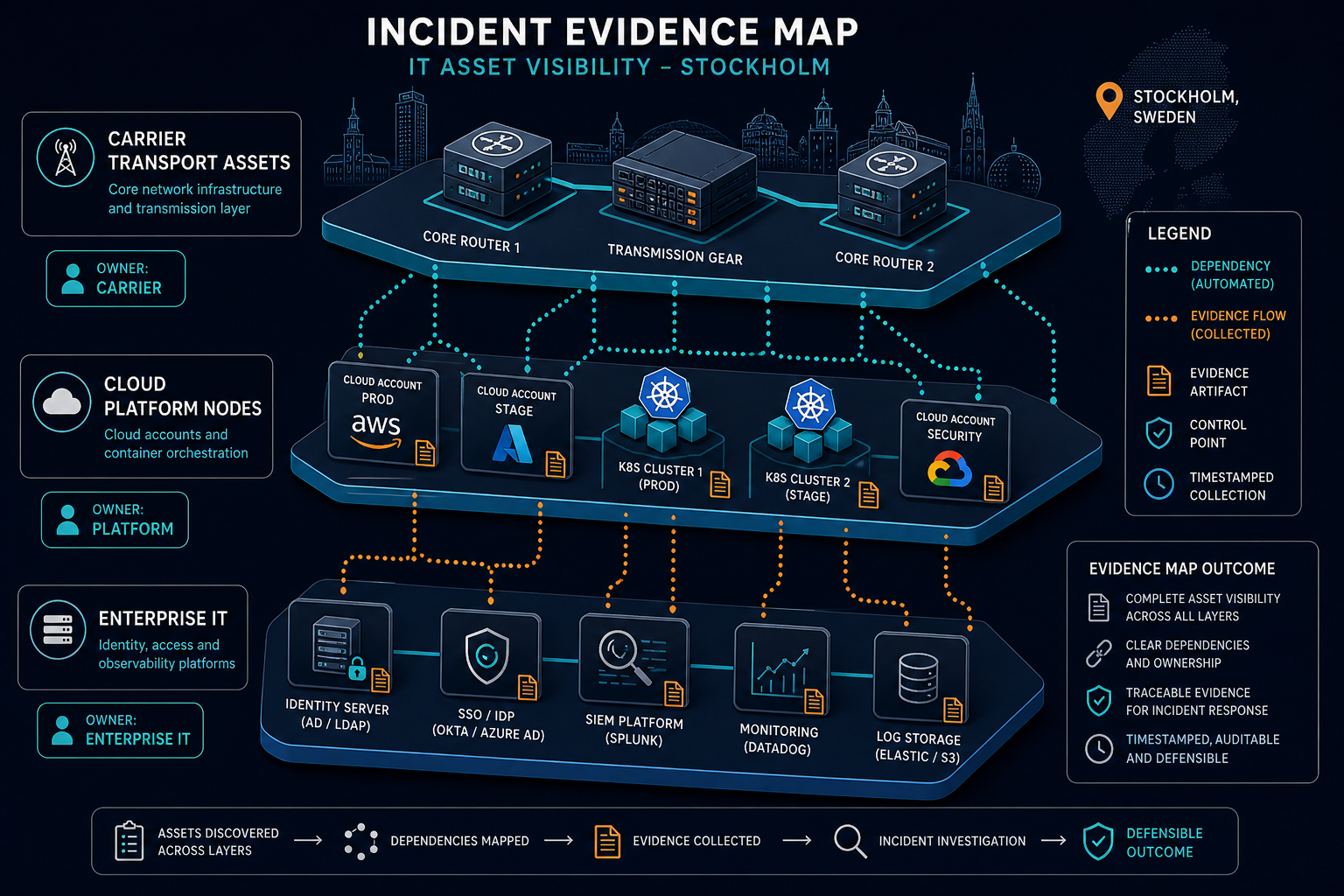
Discovery finds the infrastructure. Service definitions name which pieces form one essential service. Each row reconciles from multi-source discovery into one CI record with source tags and a last-verified date — the same freshness proof described above, and one that matters more in a cluster as dense as Kista’s, where carrier, cloud, and enterprise nodes often share the same rack or facility.
How the map supports joint response
When a signaling path degrades, the responder opens the service map and traces the failing CI to affected platform services and enterprise consumers. Ownership shows on the same screen. Both sides brief from one record. That tracing is also what cuts MTTR during incident response when root cause spans more than one team’s inventory. Return to the 07:15 signaling incident from the opening. With one map, the carrier’s on-call engineer sees the tenant’s affected platform API in the same session — no cross-company bridge call needed just to confirm the link exists. That path from failing CI to affected service is the core behavior to demand from any CMDB platform.
Which assets belong in the first NIS2 visibility map?
Start with one connectivity path: carrier transport nodes, platform gateways, and enterprise identity and monitoring behind them. Add signaling and restoration services once the first path holds. Narrow scope proves completeness faster than estate-wide collection.
Feed NIS2 evidence into the ITSM you already run
NIS2 visibility earns trust when it shows up inside daily ITSM work. Incident tickets link to the affected CI and its service. Change requests check the dependency map before approval. Problem records reference the same service definition that evidence packs cite.
Virima supports this pattern by syncing discovered CIs and relationships into existing ITSM workflows. Platform names stay as plain references here: ServiceNow, Jira Service Management, Ivanti, HaloITSM, Xurrent, and Hornbill teams each keep their desk while reading the same CI truth. One integration reference covers the path: the integrations hub lists the supported ITSM sync options.
Keep the data flow one-directional at first. Discovery sources the CMDB, the CMDB feeds the desk, and manual edits stay fenced behind review. That order keeps audit evidence anchored to observed data.
When platform uptime depends on carrier paths across Stockholm, walk through your connectivity chain with the Virima team and see which assets and owners the evidence map should hold.
How should NIS2 asset data reach the service desk?
Sync discovered CIs and relationships into incident and change workflows so agents and approvers read the same record. Keep discovery as the source and fence manual edits behind review. One-directional flow keeps evidence anchored to observed data.
Where to start: one connectivity path, then expand
Start with one path. Pick one carrier segment, one platform service, and the enterprise services behind both. Discover the full chain, define the service, map the dependencies, and run incident and change work from that map for one full cycle.
Measure three outcomes before expanding:
- Incident tickets link to the right CI on first touch.
- Change reviews name cross-side impact without extra calls.
- The service map matches the estate at cycle end.
Expand path by path only when all three hold.
Teams that need a scoped walkthrough of that first path can start a conversation through the demo request path with their telecom and tech nodes listed.
Build the evidence map before the next incident tests it
Incident clocks do not wait for inventory projects. Reporting windows, restoration pressure, and regulator questions arrive on their own timetable. The operators that read one shared visibility map before that hour will have the context at hand that teams assembling evidence by phone must discover through calls. Stockholm’s shared carrier-and-tech footprint makes this harder to defer than in a single-sector market, since the next outage is as likely to start on someone else’s side of the fence as your own. Build the joint layer now, prove it on one path, and expand while verification dates stay fresh.
Frequently Asked Questions
How is NIS2 asset visibility different from a standard inventory?
A standard inventory lists owned assets. NIS2 visibility adds service linkage, ownership, and verification dates, so each asset supports incident evidence and risk management duties.
Does Virima support asset discovery across both telecom network and enterprise IT environments?
Yes. Virima discovers carrier transport, platform, and enterprise IT assets and reconciles them into one CI record so shared facilities and connectivity paths are mapped under one joint scope.
Do service maps update when infrastructure changes?
Maps stay current as discovered infrastructure changes, once service definitions are provided. Definitions come from manual entry, spreadsheet import, or architecture input, and map building runs automatically.
Can NIS2 evidence feed our existing ITSM?
Yes. Discovered CIs and relationships sync into incident and change workflows so agents and approvers read the same record. Keep discovery as the source during rollout.
How does Virima support NIS2 asset visibility work?
Virima reconciles multi-source discovery into authoritative CI records, builds service dependency maps from provided definitions, and syncs that context into ITSM workflows for incident and change decisions.