Hybrid Cloud CMDB for Munich Automotive and Industrial IT Estates

Munich plant shutdowns rarely trace back to a failed machine. In practice, they trace back to a change that looked safe because a dependency wasn’t recorded — a server moved in Azure, a database patched on premises, or a supplier link changed without review. Hybrid cloud CMDB for Munich automotive and industrial IT estates means keeping configuration records accurate across plant-adjacent IT, offices, and AWS/Azure accounts on the same discovery cycle, so change review and incident response start from current dependencies instead of memory. For background on the category, see Trusted Runtime Truth.
Munich estates join factory systems with enterprise IT and public cloud. Press lines, test benches, and logistics platforms depend on shared identity, network, and data services. Cloud migration adds short lived workloads that sheets miss. A discovery-sourced CMDB holds these layers together on scheduled cycles.
Why Munich automotive estates need hybrid cloud configuration accuracy
Automotive IT in Munich spans design systems, manufacturing execution, supply chain portals, and connected vehicle back ends. Industrial groups add plant historians, SCADA adjacent servers, and logistics platforms across multiple sites. Each layer changes on its own schedule, and shared services carry the blast radius between them. A hybrid cloud CMDB for automotive manufacturing has to hold all of these layers together on one cycle, not just the enterprise IT ones.
The Flexera 2026 State of the Cloud Report found 73 percent of organizations now run hybrid estates across on premises, SaaS, and multi-cloud infrastructure. Munich automotive groups sit firmly in that pattern. Design and ERP systems stay on premises while analytics and supplier portals scale in cloud. The same drift shows up in other manufacturing hubs. Virima’s Minneapolis-St. Paul manufacturing CMDB guide frames the same gap for U.S. plants running MES and SCADA alongside cloud analytics.
Where stale records cause failures
Stale records create familiar failures. Change review approves a firewall update without seeing the plant link, then incident response pages application owners while the network path stays dark, and audit teams sample configuration items that no longer match production. Each gap can extend downtime on lines where every minute of stoppage carries a direct cost to the program.
Discovery closes the gap when scope covers every segment — agentless scanning finds network reachable assets across plants and offices, optional agents cover engineering workstations and remote endpoints, and cloud connectors cover AWS and Azure accounts used by group IT. Reconciliation then merges duplicates by serial number or cloud instance ID rather than hostname.
This article differs from Virima’s guide to ITIL change management best practices. That article covers BSIG plant inventory and BSI evidence for security duties. This article covers hybrid cloud CMDB accuracy for change, incident, and production stability across automotive and industrial IT estates in Munich. One proves asset coverage for the regulator. The other keeps daily operations safe.
How plant systems and cloud services share one dependency map
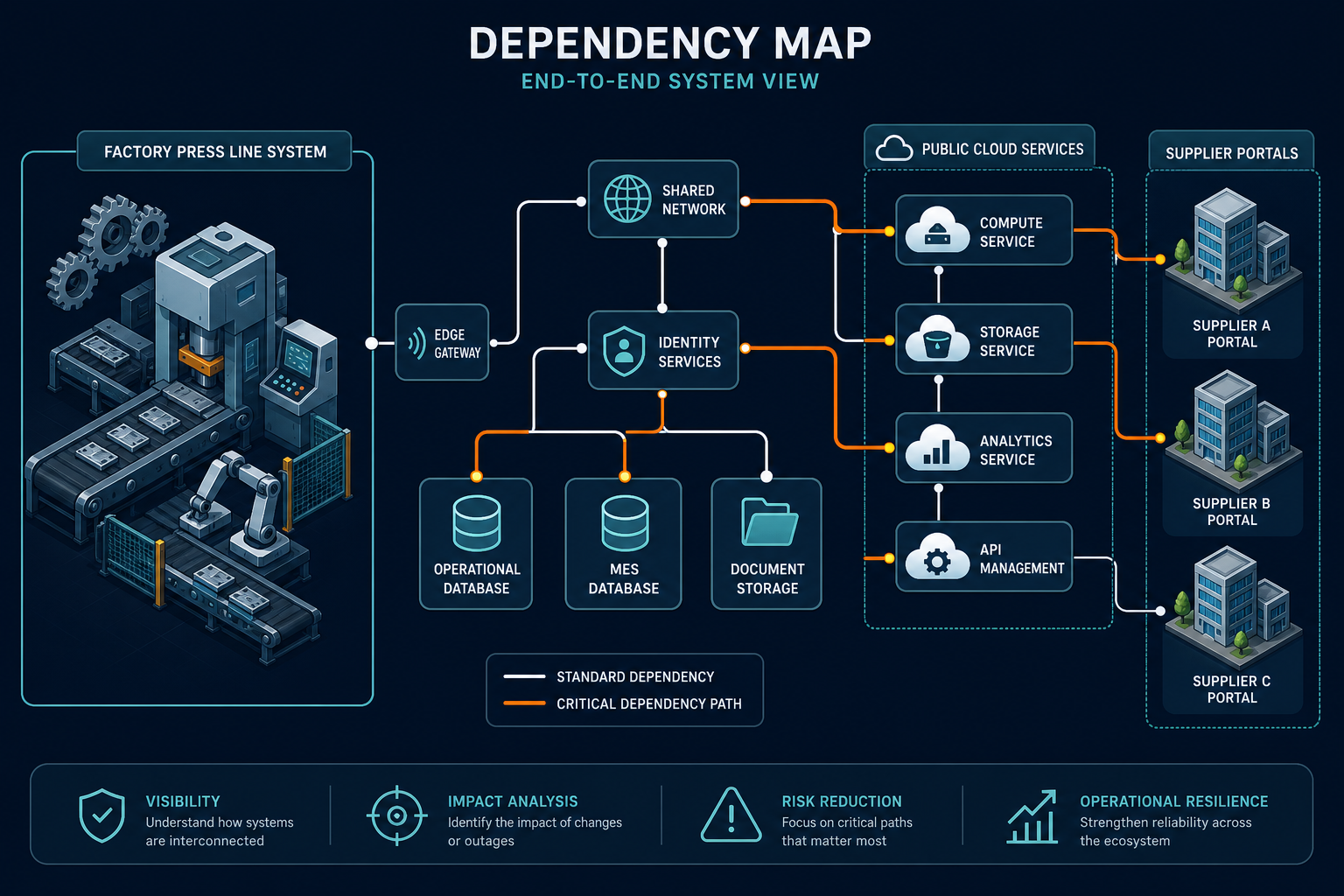
Plant systems and cloud services fail together more often than teams expect. A single identity outage can stop both shop floor logins and cloud analytics. A single database change can break both production reporting and supplier visibility. The map must show these shared links before change approval.
Start with service definitions for production critical services. Name each vehicle program platform, plant execution service, and logistics chain in operational language. Link each service to supporting configuration items with typed dependencies. Runs on, connects to, and processed by each tell a different recovery story.
Service dependency mapping for plant and cloud systems holds these links in one place. Definitions come from operations and engineering rather than inference. Discovery builds the map from those definitions on each cycle, so the result reads the same for plant IT, enterprise IT, and cloud teams.
| Approach | How it stays current | Blast-radius visibility |
|---|---|---|
| Manual spreadsheet | Updated by hand after each change, if at all | Depends on whoever remembers to update it |
| Discovery-sourced service map | Rebuilt from scheduled discovery cycles | Shows plant-to-cloud dependencies automatically |
The ENISA Threat Landscape 2024 places manufacturing among the sectors facing sustained pressure from ransomware and supply chain disruption. Shared dependencies explain why one compromised credential can halt both office and plant services. Accurate maps shorten containment because teams see the full path at once.
Owners attest on a standing cadence. Plant engineers confirm production links after line changes. Cloud teams confirm account scope after migrations. Business owners confirm service priority each quarter. Discovery confirms existence between attestations so the map reflects production rather than memory.
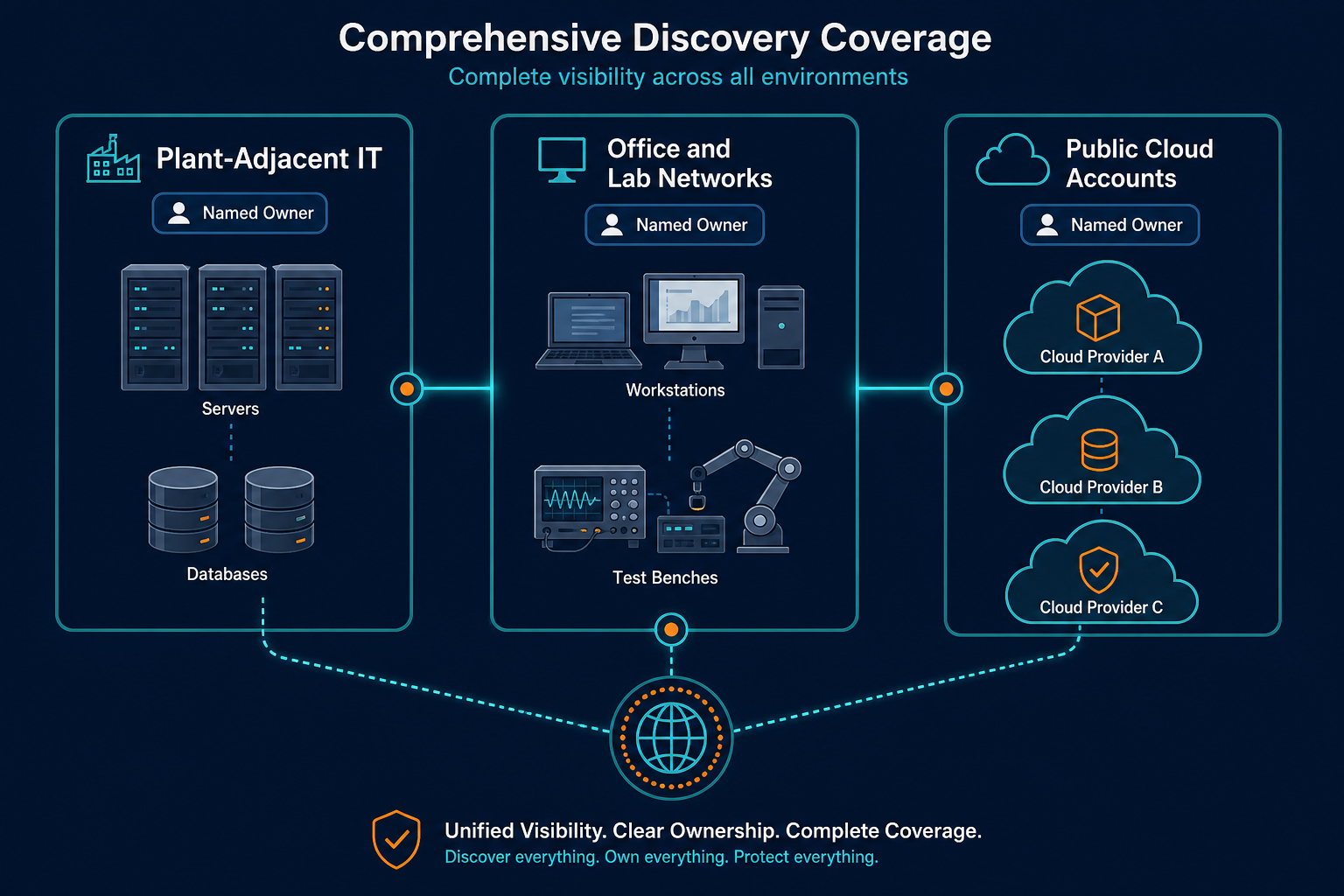
What discovery scope must cover across factories, offices, and cloud
Incomplete scope is the most common CMDB failure in industrial estates. Plant networks stay excluded for safety reasons. Engineering labs stay excluded as temporary. Cloud accounts stay excluded because another team owns them. Each exclusion becomes a blind path during incidents.
Cover plant adjacent IT without touching control networks directly. Discover servers, historians, file shares, and authentication paths that support production from the IT side, and coordinate scan windows with plant operations. Record excluded control segments explicitly with dates and owners rather than leaving silent gaps. This record also supports automotive-specific compliance regimes such as IATF 16949 and IEC 62443, both of which depend on accurate evidence of what runs on the plant-adjacent network.
Cover offices, test facilities, and logistics sites on the same schedule. Engineering workstations carry design tools and credentials that reach both plant and cloud. Test benches carry short lived systems that later enter production. Logistics platforms carry supplier data that auditors trace end to end.
Cover cloud accounts on AWS and Azure with named owners. Tag each account to a program, plant, or shared service. Remove orphaned accounts on schedule. Federal guidance such as CISA Binding Operational Directive 23-01 treats complete asset visibility as the prerequisite for vulnerability and operations programs. Munich groups apply the same discipline across their own hybrid scope.
Feed the ITSM system of engagement through bi-directional sync without creating a second source of record. Integration names stay plain text here, and the single hub reference is integrations hub. Incidents, changes, and problems then start from current configuration data. Plant and cloud teams work from one record during joint bridges.
How accurate configuration data improves change and incident work
Change review improves first. Reviewers see affected production services before approval rather than after failure, so high risk changes get narrower windows, fuller backups, and clearer rollback steps while low risk changes move faster because the blast radius is known. Plant managers trust the process because production links are visible.
Incident response improves next. Responders start from the affected service rather than a bare host alert, then page the correct owner across plant and cloud teams and isolate the failed segment without stopping unaffected lines. They record fixes against configuration items so the next review learns from the event.
Vulnerability work belongs on the same map for Windows Server configuration items through NVD lookups. Teams prioritize patches by production impact rather than raw score. A critical score on an isolated lab waits. A medium score on a shared authentication path moves first. Security and operations agree because the map shows the same service impact.
Germany’s BSI IT-Grundschutz framework sets out documented asset coverage and tested recovery paths as baseline requirements for critical operations. Munich industrial groups meet that expectation when discovery scope, service definitions, and drill evidence stay current. Auditors review dated records rather than slide decks.
Explore Virima’s ViVID™ service maps when change review still misses plant to cloud links. The capability builds maps from defined services rather than inferred guesses. Teams see what breaks before approval and who owns each downstream service. For the broader fundamentals of keeping a CMDB current across every environment, see Hybrid Cloud CMDB: Full IT Asset Visibility Across Every Environment.
Where Munich teams start without stopping production
Most teams phase this rollout in five steps, without pausing production changes:
- Confirm the production critical service list with plant and enterprise owners together. Keep the list short enough for joint review and detailed enough for recovery use — close vacant owner fields before tooling debates, since unknown owners cause more downtime than unknown servers.
- Extend discovery to excluded segments one site at a time, starting with plant-adjacent IT and one cloud account per program.
- Reconcile duplicates on durable keys, such as serial number or cloud instance ID, rather than hostname.
- Link each service to supporting items with typed dependencies — runs on, connects to, processed by.
- Schedule change review pilots on low-risk windows first, then expand once the map holds up in practice.
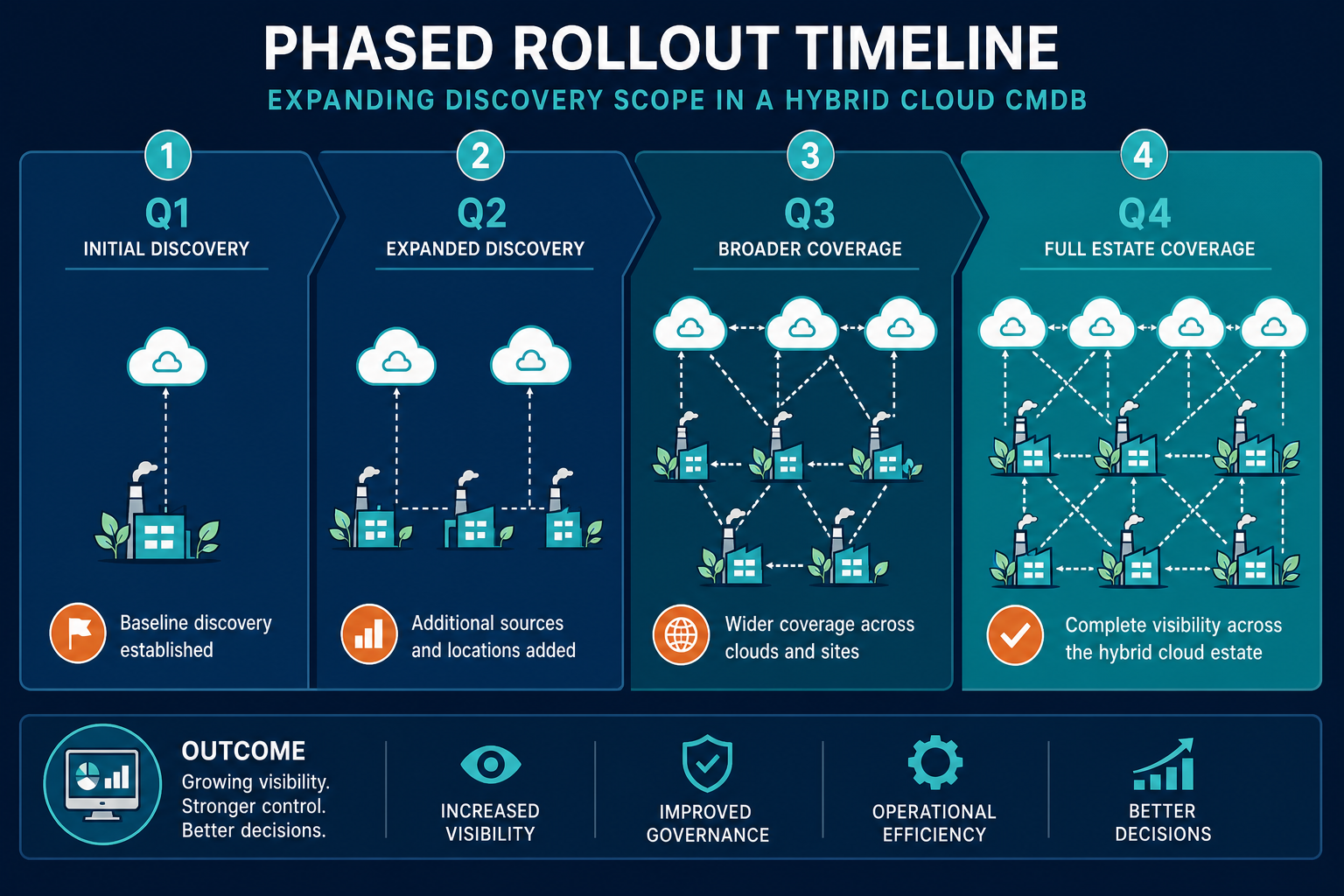
Run one joint drill per quarter across plant and cloud teams — take one shared service through failure and recovery in staging, time owner paging and failover execution, and record gaps against the configuration record. Feed corrections into discovery scope before the next production change window.
Teams that want a starting point can download the Munich hybrid CMDB discovery-scope checklist — a one-page template for the production critical service list above, with fields for owner, tolerance for disruption, and supporting plant and cloud items. How to Build an AI-Ready CMDB Checklist for 2026
Keep production moving while cloud scales
Hybrid cloud CMDB discipline rewards teams that map shared dependencies before changing them. One service list, linked configuration items, named owners, and dated drills carry more weight than separate plant and cloud records.
Frequently Asked Questions
How is this different from NIS2 manufacturer readiness work in Munich?
Which services should Munich automotive teams map first?
How does Virima discover plant-adjacent assets without touching control networks?
How often should hybrid configuration data refresh?
Does Virima’s CMDB replace ServiceNow or Jira Service Management?
Munich automotive and industrial estates do not have to choose between plant stability and cloud scale once the CMDB reflects both. Virima’s discovery-sourced CMDB and ViVID™ service maps give plant and cloud owners one dependency view before the next change window, so change review and incident response start from current data instead of memory. See a working ViVID™ service map for a hybrid plant-and-cloud service.