The Hybrid Cloud Asset Visibility Gap Behind Dublin’s Data Center Boom

An operations lead managing hybrid cloud asset visibility for Dublin data centers already runs production racks across more than one colocation campus. Equinix and Digital Realty footprints are common starting points. Iron Mountain capacity sits in the mix for some estates. Grid connection policy then forces a second move. New load that cannot land cleanly in the Dublin area gets planned for Cork or Limerick, while teams still need short-term burst capacity in AWS or Azure. The physical expansion is rational for capacity, yet the configuration record often is not.
Each vendor exports its own inventory, and each cloud account holds its own instance list. The CMDB still shows last quarter’s Dublin-only picture until someone updates it by hand. Change tickets reference hosts that moved, while audit packs ask where personal data systems live and the answer takes three spreadsheets plus a week of chase. Hybrid cloud asset visibility is the missing layer between that expansion story and a trustworthy estate map.
This guide treats that gap as an operations and configuration problem. It does not claim to solve power, land, or grid capacity, which belong to utilities, planners, and facility operators. The software problem is narrower and still expensive: keep one accurate record of what exists, where it runs, and how it connects as Dublin’s footprint multiplies.
What Is Hybrid Cloud Asset Visibility for Dublin Data Centers?
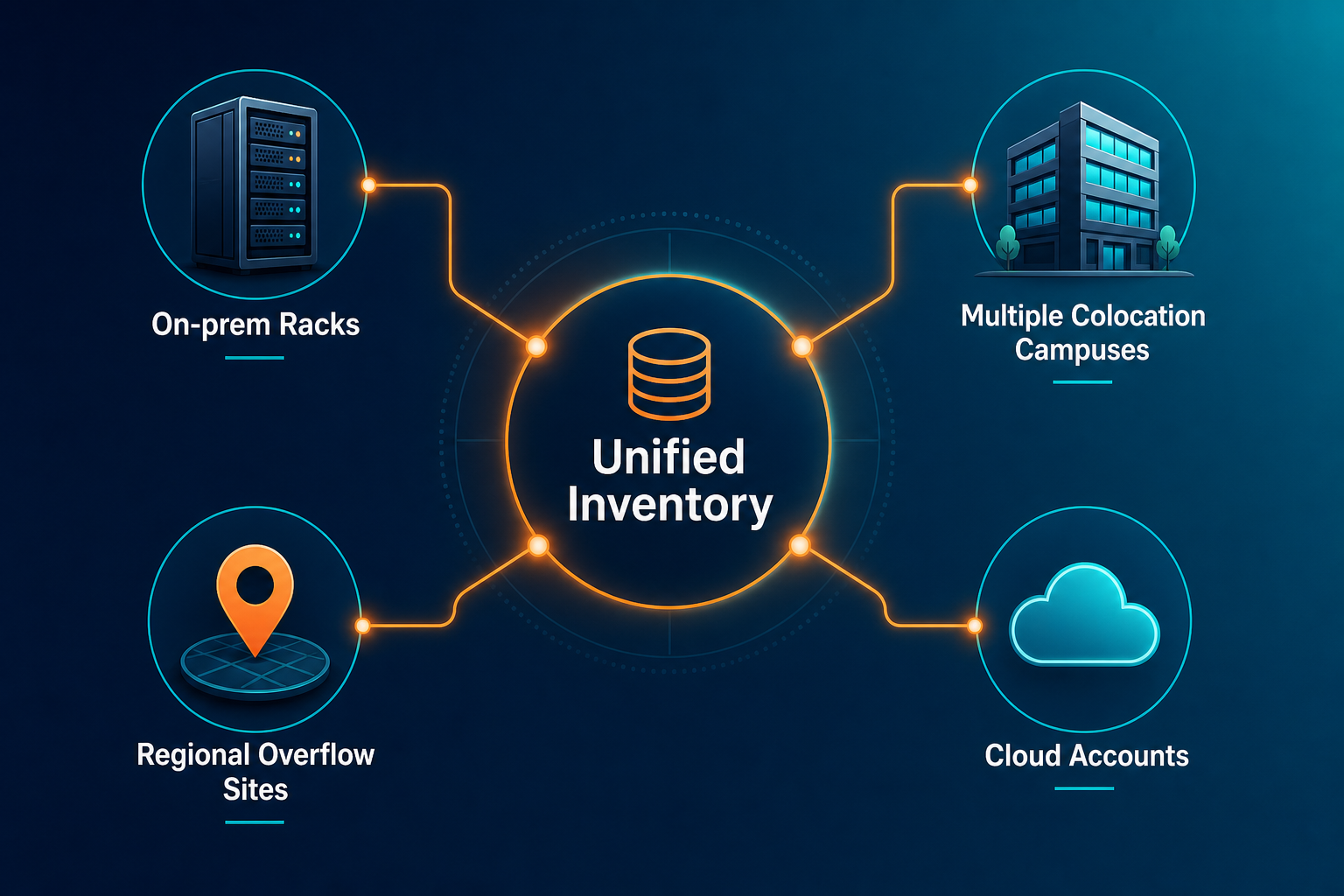
Hybrid cloud asset visibility for Dublin data centers means one authoritative inventory of configuration items across on-prem racks, multi-vendor colocation, regional overflow sites, and public cloud accounts that the same organization operates. The record covers hardware, software, network devices, virtual machines, cloud instances, owners, and the relationships that tie them to services. Visibility fails when any of those layers updates without the others.
ITIL 4 service configuration management frames the practice around accurate configuration information for service delivery and change. ISO/IEC 19770 defines process and data expectations for IT asset management systems. Neither standard assumes a single data hall in one city. Both assume the inventory stays current as the estate changes.
For Dublin operators, the estate change is structural. Grid policy and capacity planning have already pushed growth outside a single metro campus model. Public reporting from the Irish Examiner notes that data centres already account for about 20% of electricity consumption, with EirGrid expecting that share to exceed 30% by 2030. Every overflow site that policy creates adds a configuration source that must reconcile into the same CMDB or it goes untracked, and when placement multiplies sites and vendors, the CMDB becomes the place where operational truth either consolidates or fractures.
What Grid-Driven Expansion Does to Your CMDB
| Situation | What happens in the record |
|---|---|
| Workload moves from a Dublin campus to a Cork overflow site | The new site stays absent until someone adds it manually |
| The team spins up AWS burst capacity around local limits | Cloud configuration items sit outside the CMDB until the next reconciliation |
| Assets sit across Equinix, Digital Realty, and Iron Mountain facilities | Each vendor exports separately, and nothing reconciles by default |
Cloud configuration items create a second class of drift. Instance inventories in the provider console look complete inside that account, yet they do not automatically become CMDB rows with owners, change windows, and service links. Teams that want a durable join between cloud and on-prem still need a deliberate model, which is why many operators revisit whether a CMDB still belongs in cloud environments once burst capacity becomes routine, a question addressed further in Virima’s guide to building a CMDB with AWS and Azure discovery.
Why Is Hybrid Cloud Asset Visibility Important?
Visibility matters because outages, audits, and change windows all inherit whatever the CMDB currently stores. When that store lags the estate, the failure shows up as delayed impact analysis, incomplete evidence packs, and ticket queues that start on the wrong host. Uptime Institute’s Annual Outage Analysis 2026 reports that in the 2025 annual survey, 57% of respondents said their most recent major outage cost more than $100,000. One in five reported costs above $1 million for the second consecutive year. Failures to follow established procedures remain a leading driver of human-error outages, and procedures that depend on stale configuration data inherit that outage risk directly. More campuses, more vendors, and more cloud accounts mean more places for the same business service to hide from the map.
Failure Modes That Show Up After Expansion
- Multi-vendor colocation visibility gaps fragment configuration item records by vendor export. Result: reconciliation gaps surface during audits, not before change windows.
- Cork and Limerick overflow expansion outpaces manual CMDB updates. Result: new sites run without a complete monitored record for weeks after go-live.
- Cloud burst capacity spun up around grid and campus constraints creates shadow configuration items. Result: configuration drift stays undetected between scan cycles and ticket reviews.
- GDPR evidence-of-location requests hit incomplete infrastructure maps. Result: audit preparation becomes a manual, multi-vendor scramble instead of a pull from controlled history.
Data residency questions sit next to topology questions. Teams that already struggle to describe hybrid paths across campus and cloud will struggle harder when a regulator or customer asks which systems process personal data and where those systems currently run. The hybrid and multi-cloud network topology problem and the inventory problem reinforce each other when either one goes stale.
Who Pays as Dublin’s Footprint Multiplies
The bill for weak hybrid cloud asset visibility does not land on one role. Leaders carry contract and audit exposure, operators carry hours of reconciliation, and regulated programs carry evidence risk when location claims cannot be backed by infrastructure records.
For Leaders
CIOs and CTOs already approve multi-year colocation and cloud spend across Ireland. Vendor sprawl is a governance surface as much as a procurement line. When each campus and each cloud account holds a partial truth, board questions about concentration risk, third-party dependency, and recovery readiness get answered with caveats. Personal accountability on audit findings rises when the organization cannot show a single controlled inventory of systems in scope. Leaders need an estate map that still matches reality after the latest Cork build and the latest Azure subscription expansion.
For Ops Teams
CMDB owners and ITAM managers feel the hours first. Monday starts with three vendor CSVs, two cloud exports, and a service desk queue that still points at decommissioned hostnames. Reconciliation is a weekly tax that grows with every overflow site and every short-lived burst fleet. Hardware lifecycle fields drift from software install truth, and warranty records detach from the live device list. IT asset management for the Dublin data center region only stays useful when discovery keeps feeding the same system of record the team already uses for audits and refresh planning.
For Regulated Environments
GDPR does not turn a CMDB into a compliance product. Controllers still need lawful bases, policies, and process controls elsewhere. What the CMDB can supply is infrastructure evidence: which systems exist, which environments they occupy, which relationships connect them, and how those records changed over time. Article 30 of the GDPR requires controllers to maintain records of processing activities under their responsibility. When those records name systems and locations, incomplete estate maps force manual reconstruction. Security and risk programs that treat CMDB accuracy as an input to control evidence still need discovery currency underneath the policy layer. The same inventory discipline appears in CISA Binding Operational Directive 23-01, which requires automated asset discovery on a recurring schedule for in-scope federal networks. The directive is not Irish law, yet it signals that modern security programs treat fresh asset visibility as a prerequisite.
Market-Scale Challenge
Ireland’s data centre footprint keeps expanding even while connection policy tightens the rules of growth. Equinix, Digital Realty, and other colocation operators continue to shape campus choice for enterprise and hyperscale tenants. Operators that support those tenants inherit multi-site reality whether or not they own the building, and every new hall multiplies sources that must reconcile into one operational picture.
Teams already weighing the hours lost to weekly reconciliation can start with ITAM to see how automated discovery fits into existing asset lifecycle tracking.
How Hybrid Cloud CMDB Fixes This
A hybrid cloud CMDB closes the hybrid cloud asset visibility gap for Dublin operators when discovery, relationship mapping, and ITSM handoff work as one loop. It stores configuration items and relationships after authoritative sources refresh them on a schedule the organization controls.
1. High-Frequency Scheduled Discovery Across On-Prem, Colocation, and Cloud
Agent-based, agentless, and API discovery methods cover different layers of the estate. On-prem and colocation devices need network and credentialed collection, while cloud accounts need API inventory of instances and related objects. The cadence is high-frequency and scheduled, not continuous event streaming. Teams set the scan interval to match how fast their Dublin footprint actually changes, then let IT discovery repopulate configuration items before the next audit pack or CAB review.
2. Service Mapping Across Sites and Cloud Tiers
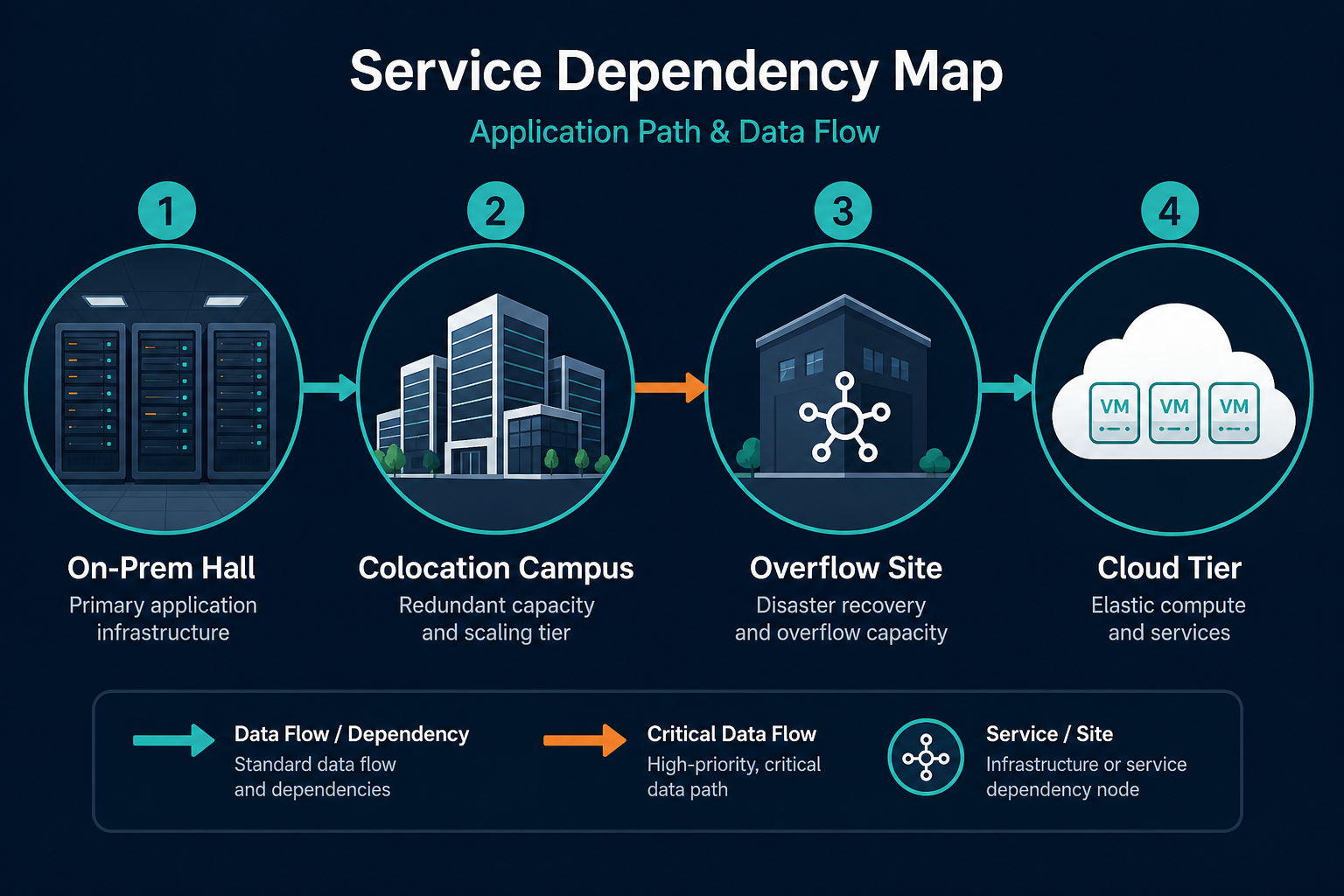
Inventory without relationships still leaves blast radius guessing. Once service definitions are provided, dependency maps can show how an application path crosses a Dublin hall, a Cork overflow host, and a cloud tier. ViVID™ service mapping builds those maps from defined services and discovered infrastructure so tickets and change records can reuse the links. The service mapping layer turns a multi-campus asset list into an impact path a human can defend in a war room. Operators still supply service composition; the automation applies to map building after those definitions exist.
3. Bi-Directional ITSM Sync Without Stack Replacement
Most Dublin operators already run ServiceNow, Jira Service Management, Ivanti, or another ITSM platform for tickets and change. A discovery-sourced CMDB should feed those workflows rather than ask the team to abandon them. Bi-directional sync keeps configuration item fields and relationships current inside the tools people already open on Monday morning. The point is handoff quality, not another console for the same ticket queue.
Manual Tracking Versus Discovery-Sourced CMDB
| Workload | Manual approach | Automated discovery-sourced CMDB |
|---|---|---|
| Multi-vendor reconciliation | Spreadsheet exports per colocation vendor | One CMDB fed by scheduled discovery |
| New site onboarding | Manual add after go-live | Registered at the next scan cycle |
| Audit evidence | Assembled on request from vendor packs | Pulled from existing configuration item history |
Hybrid Cloud Asset Visibility Examples in Practice
- Multi-campus reconciliation. Equinix and Digital Realty exports stop living as parallel truths. Scheduled discovery normalizes devices into shared configuration item classes with owners and relationships, so campus labels become attributes instead of separate systems of record.
- Cork and Limerick onboarding. Overflow capacity appears in the CMDB after the next discovery cycle rather than after a project manager remembers to open a ticket.
- Cloud burst reconciliation. Temporary AWS capacity used around campus limits becomes configuration items with account, region, and relationship context. Teams that formalize this path often start from the same discipline used to build How to build an AWS configuration management database and then extend it to Azure and on-prem peers.
- Audit evidence pulls. Location and ownership questions pull from configuration history instead of vendor-by-vendor attestation chains, which shortens the infrastructure half of the pack without replacing legal review.
How Virima Powers Hybrid Cloud Asset Visibility
Virima approaches the Dublin multi-site problem as discovery-sourced configuration truth under the tools operators already run. It does not sell grid capacity, DCIM power models, or a replacement ITSM suite. The product job is to discover what exists across hybrid estates, store it in a CMDB with relationships, map services once definitions are provided, and sync that truth into existing workflows.
Immediate operational impact shows up after the first scheduled scan cycle across a new or expanded site. Devices and cloud objects that were only visible in vendor portals appear as configuration items the team can assign, relate, and ticket against.
Long-term accuracy depends on recurrence, because estates that add vendors and regions every quarter decay without a refresh loop. Teams that already care about hybrid structure can pair this with guidance from blog post on why a strong CMDB schema matters for hybrid IT. ServiceNow, Jira, Ivanti, and other platforms remain the engagement layer for many desks, while Virima supplies the discovery and mapping feed when native inventory falls behind a multi-campus Ireland footprint. AWS and Azure discovery cover the public cloud side of the same record. Supported platform handoffs are listed on the integrations hub. The result is Trusted Runtime Truth for the people who approve changes and answer auditors: what exists, how it connects, what changed, and who owns it.
Moving from Vendor-Siloed Tracking to Map-Driven Visibility
The operating model shift is concrete. Old practice treats each colocation vendor and each cloud account as a separate inventory owner. New practice treats those sources as inputs to one configuration authority with a named governance owner and a fixed scan cadence.
| Dimension | Old way | New way |
|---|---|---|
| Source of truth | Vendor portals and local spreadsheets | Discovery-sourced CMDB with ITSM sync |
| New site handling | Manual entry after go-live | Baseline scan, then recurring discovery |
| Service impact | Tribal knowledge and partial diagrams | Maps built from defined services and live CIs |
| Audit prep | Multi-vendor chase under deadline | Pull from controlled configuration history |
Benefits land in the order operators feel them. Reconciliation hours drop when exports stop being the weekly system of record. Change failures tied to missing dependencies fall when maps stay current enough for CAB packets. Audit cycles shorten when evidence already lives in configuration history. None of that requires claiming continuous streaming discovery; it requires a cadence the team can staff and trust.
Getting Started
Start by inventorying the current footprint across Dublin campuses, overflow regions, and cloud accounts, noting which vendor owns each hall. Run a baseline discovery scan across on-prem, colocation-reachable devices, and in-scope cloud APIs, then reconcile what discovery finds against existing ITSM records and retire duplicates with an owner decision, not a silent overwrite. Connect the ITSM integration so tickets and changes reference the refreshed configuration set, and set a scan cadence with a named governance owner responsible for exceptions and decommission decisions.
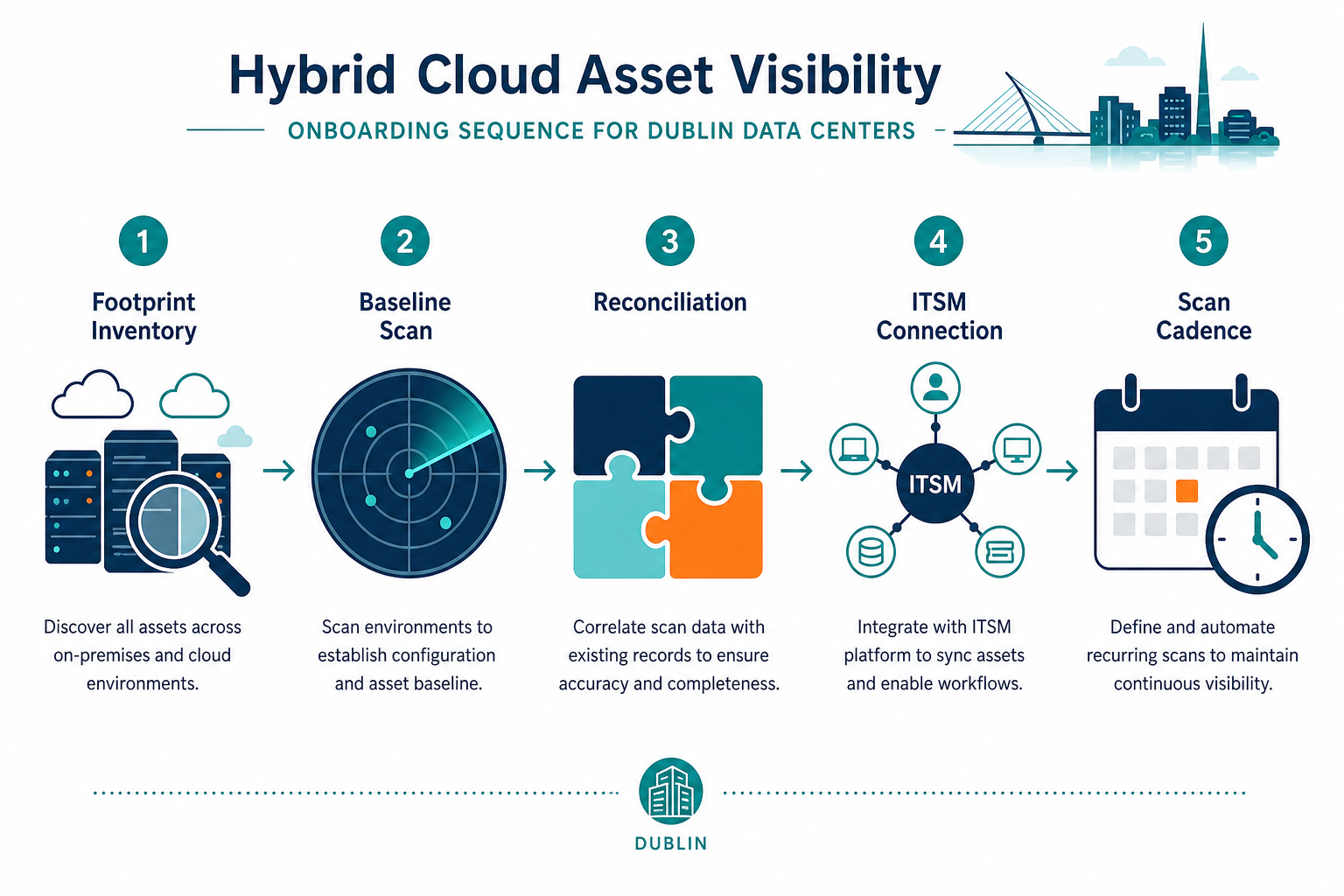
This sequence is also available as a standalone Dublin Hybrid Cloud CMDB Readiness Checklist teams can run against their own inventory. Download the Dublin Hybrid Cloud CMDB Readiness Checklist
Keep Dublin’s Expanding Estate on One Map
Dublin’s data center boom is real, and so is the sprawl that follows grid constraints, multi-vendor colocation, and cloud burst capacity. Hybrid cloud asset visibility for Dublin data centers is the discipline that keeps that sprawl from becoming a permanent blind spot in the CMDB. Discovery on a high-frequency schedule, service maps built from defined services, and ITSM sync give operators a single place to answer what exists and what a change will touch.
The operators who win this shift are not the ones with the largest spreadsheet library. They are the ones who can prove, after the latest Cork hall and the latest cloud burst, that change packets and audit packs still read from the same estate map. Those teams make a process and tooling choice without waiting for the next grid policy cycle.
Teams mapping infrastructure across Dublin colocation campuses and cloud accounts can explore ITOM to see how estate visibility supports the operational decisions those teams make every week.
Frequently Asked Questions
What is hybrid cloud asset visibility?
Hybrid cloud asset visibility is a single authoritative inventory of devices, software, cloud objects, owners, and relationships across on-prem, colocation, and public cloud accounts the same organization runs. It stays useful only when discovery refreshes the record on a controlled schedule.
Why is asset visibility important for Dublin’s hyperscale operators?
Dublin estates often span multiple colocation vendors, overflow regions such as Cork or Limerick, and cloud burst accounts. Without shared visibility, change impact, outage triage, and audit evidence each start from incomplete vendor-specific lists instead of one configuration base.
What are examples of visibility challenges in multi-vendor colocation environments?
Common failures include separate CSV exports per campus, hostnames that change ownership without CMDB updates, cloud instances that never join the same record as hall devices, and audit packs assembled under deadline from three portals instead of configuration history.
How does Virima’s CMDB support hybrid cloud asset visibility across Dublin sites?
A CMDB stores configuration items and relationships after discovery and integrations refresh them, giving change, incident, and audit workflows one place to read current estate data. Virima adds ViVID™ service maps and bi-directional ITSM sync on top of that record. It does not replace DCIM power models, legal GDPR controls, or the ITSM ticket platform itself.
How often does Virima scan a multi-vendor Dublin colocation and cloud footprint?
Use high-frequency scheduled discovery matched to how fast sites and cloud accounts change, then tighten intervals where overflow builds and burst fleets appear weekly. Virima’s scan intervals are configurable per site or account, so teams can run colocation scans weekly and cloud scans daily without waiting on a fixed global schedule. Continuous event streaming is a different architecture than scheduled discovery cycles.